Iliotibial band syndrome
Also called ITBS, IT band syndrome, iliotibial band friction syndrome, iliotibial band impingement syndrome
A common cause of pain on the outer side of the knee in runners and cyclists. How reviews define it, who it affects, and what studies of its course, of exercise, injections and surgery found.
- Region
- Knee
- Updated
- September 30, 2026
- Reviewed
- September 30, 2026 · how entries are checked
What it is
How reviews define it
A 2020 systematic review describes iliotibial band syndrome as a common cause of lateral (outer side) knee pain1. It is seen especially in runners, cyclists and other athletes whose sports repeatedly bend and straighten the knee1. Another 2020 review calls it an overuse disorder of the outer knee, identified from a person’s history and an examination4.
A 2007 systematic review, using the older name iliotibial band friction syndrome, calls it a common outer knee injury in runners, cyclists and endurance sports5.
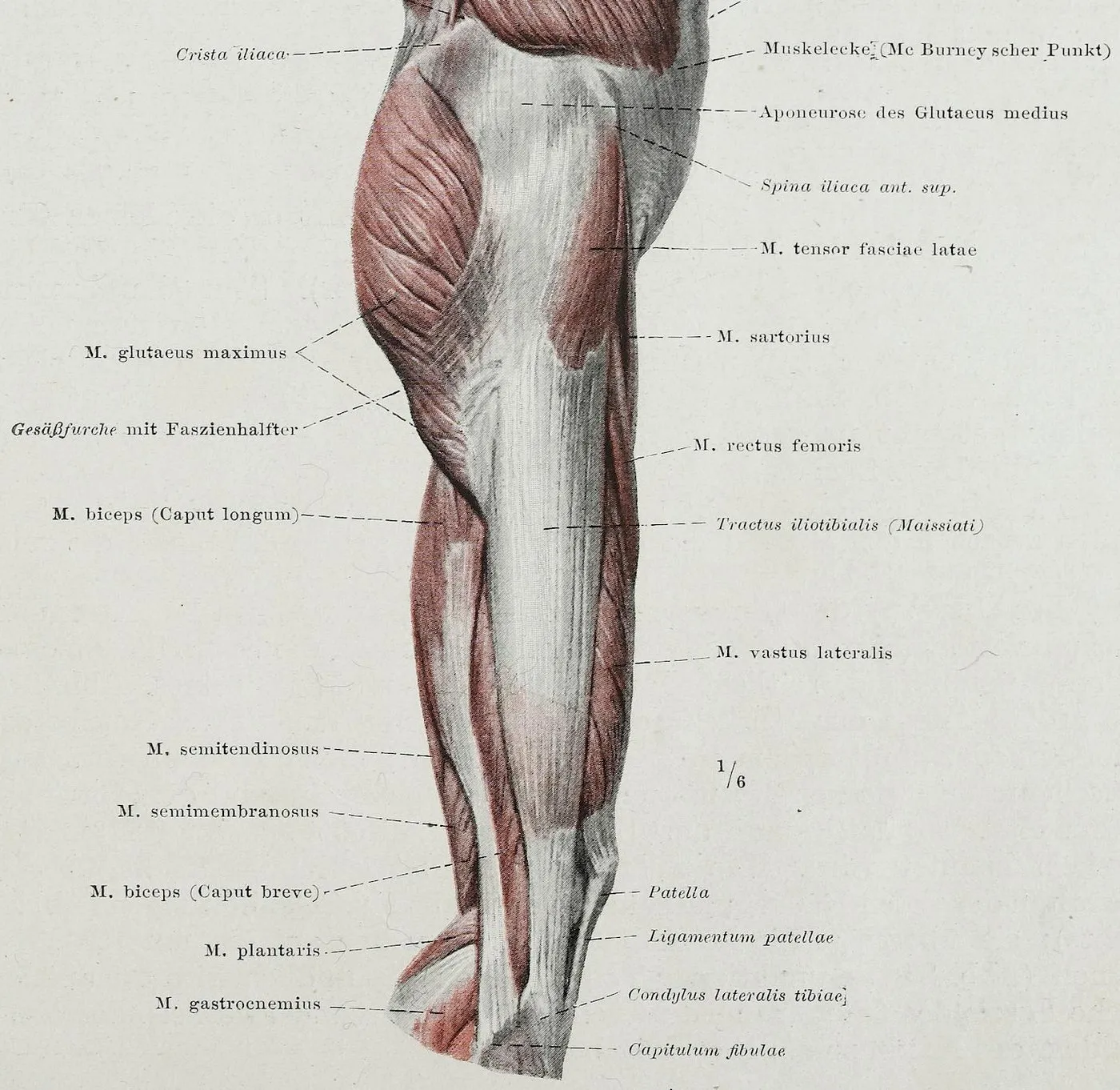
The iliotibial band is a long band of tough tissue down the outer thigh. A review describes it running from the iliac crest (the curved top rim of the hip bone) to the outer upper tibia (shinbone)6.
Friction, pressure and other proposed causes
A 2020 review says the condition has many causes, and lists several proposed mechanisms1:
- the lower band rubbing against the outer bump of the femur (thigh bone)1
- the band being pinched near 30 degrees of knee bend1
- weak hip abductors (the muscles that move the thigh out to the side)1
- inflammation of a tissue pocket or bursa (a small fluid-filled sac) beneath the band1
A 2021 clinical update argues the friction model rested on a limited or incorrect grasp of the anatomy, mechanics and tissue science2. It proposes the name iliotibial band impingement (pinching) syndrome2.
A review of the band says pressure on nerve-rich fat between band and bone is now proposed6. It suggests the condition should be classed as a compression syndrome6. One anatomy study of 15 cadavers (bodies donated for study), six volunteers and two athletes found no bursa beneath the lower band7.
Who it affects
How common it is
Studies have counted it in runners, cyclists and military recruits1,8. Incidence means new cases in a group over a set time, and prevalence the share with a condition at one time. Osteoarthritis is a long-term joint disease in which the cartilage lining the joint wears away.
| Group studied | What was found |
|---|---|
| Runners, in a systematic review | The most common outer knee injury, with incidence estimated at 5% to 14%9 |
| Runners in studies that looked back or at one time point, in a review | 7.9% of running injuries, among the five most prevalent10 |
| 839 recreational runners in a 24-week trial | 8 new cases, 7.1% of injuries11 |
| 138 recreational runners with a new running knee injury | The most reported cause (23.2%), level with osteoarthritis or a worn meniscus (knee cartilage pad)12 |
| Runners at one sports medicine centre over two years | The second most common injury, after patellofemoral pain (pain around or behind the kneecap)13 |
| 28,829 US Marine Corps recruits, 2011 to 2016 | Among the most common injury types8 |
Across 15 studies in a 2020 review, 65% of athletes who mainly did one sport were runners, and 18.4% were cyclists1.
Men and women: sources differ
One review cites men as 50% to 81% of those affected6. A systematic review and meta-analysis (which pools results from several studies) describes it as twice as likely in female runners as male runners14. At one sports medicine centre, being younger than 34 was reported as a risk factor in male runners13.
Factors linked with it in runners
A 2026 systematic review looked at knee injuries in adult endurance runners15. It covered patellofemoral pain, this condition and patellar tendinopathy (local pain in the kneecap tendon)15. Across the three, the strongest recurring risk factors were previous injury, more training load or volume, and structural malalignment (bones or joints out of line)15. For this condition, movement and force measures were reported most often15. Their moderate to very large effects were linked to abnormal pelvic motion and poor shock absorption15.
A review of the band says pain often starts gradually after a recent jump in running load6. That jump is usually more distance or more downhill running6. A systematic review of 13 studies in runners included one that followed people forward in time16. Stance is the part of each step when the foot is on the ground. Female runners in shoes who later developed it showed more peak hip adduction (thigh moving toward the midline) and inward knee turning during stance16.
Hip strength and band tension: findings differ
Studies of hip abductor strength point in different directions17,18:
- In 24 distance runners with the condition, the affected leg had weaker hip abduction than the other leg and than 30 other runners17.
- In 10 runners with the condition and 10 without, hip abductor strength did not differ significantly in any test18.
- A meta-analysis found female runners with current symptoms had lower isometric (holding, no joint movement) hip abductor strength than controls14.
- A systematic review of 11 studies in distance runners found hip abduction weakness may be linked with the condition19.
- Another systematic review found it unclear whether weak hip abductors play a major role9.
In 14 recreational runners with the condition and 14 healthy controls, band tension did not differ between groups or legs20. The study used shear wave elastography, an ultrasound method that estimates how stiff a tissue is20.
What studies found
How it changes over time
In a 24-week trial of recreational runners, 6 cases cleared up during follow-up11. The median (middle) time from first pain to full relief was 56 days, from 14 to 16811. A 2024 systematic review cites 44% of runners back in their sport after 6 to 8 weeks of non-surgical care21. A 2022 review notes high rates of symptoms coming back22.
What reviews say about the evidence
Reviews from 2007 to 2023 report on how much evidence exists on non-surgical care, and its quality3,5. Anti-inflammatory drugs reduce inflammation, the swelling and soreness of irritated tissue. The reviews found:
- 2007 systematic review: four randomised trials, including anti-inflammatory drugs, deep friction massage and a corticosteroid injection, with limited evidence that any gave significant benefit5.
- 2012 systematic review, runners: poor study quality and highly conflicting results9.
- 2020 systematic review: of 5 randomised trials, one rated good, two fair and two poor1. Varied outcome measures stopped a direct comparison of surgical and non-surgical care1.
- 2023 scoping review: 98 studies: 66 reviews and 32 original clinical studies, of which 7 were randomised trials3.
The 2023 scoping review looked at recommendations too3. It concluded that recommendations for non-surgical care rest mostly on expert opinion and review articles3. Stretching appeared in 78% of review articles but in 31% of clinical studies3.
A 2024 review in runners
A 2024 systematic review of non-surgical approaches in adult runners found 13 studies with 201 people, five of them randomised trials21. The studies differed too much to pool21. From before to after, over 2 to 8 weeks, pain fell by 27% to 100% and function rose by 10% to 57%21. Only three studies reported long-term follow-up21.
Hip abductor strengthening was a common approach across the studies21. Shockwave therapy means pulses of sound energy aimed through the skin, and manual therapy means hands-on methods. The authors concluded that a non-surgical approach including hip abductor strengthening, possibly with either, is effective for pain and function21. They said gait retraining, changing how a person runs, needs rigorous trials21.
A 2022 review takes a more doubtful view22. It notes a lack of scientific evidence for the usual recommendations22. It argues hip abductor strengthening may correct excess hip adduction but may also raise strain on the band22.
Trials that compared approaches
| People studied | What was compared | What was found |
|---|---|---|
| 43 athletes | A placebo (dummy pill), an anti-inflammatory drug, or a painkiller plus anti-inflammatory, compared over 7 days, with rest and the same outpatient programme | Pain on a running test fell in every group; only the combined group improved running time and distance23 |
| 18 runners with recent onset | A corticosteroid (a drug that copies a hormone the body makes) injection with local anaesthetic (a numbing drug), or local anaesthetic alone | Over the first 7 days, the corticosteroid’s greater fall in running pain was only a tendency24; from day 7 to 14 it was significantly greater24 |
| 24 runners | Three weekly sessions of shockwave or manual therapy, each with exercise | No significant difference in pain reduction at 4 or 8 weeks25 |
| 40 people | Dry needling (putting thin needles into the tissue) or shockwave therapy | Both groups improved; the authors report them similar except for a better pain score with dry needling four weeks after the sessions26 |
| 24 female runners, in a small pilot study | Band stretching, conventional exercise, or a hip strengthening programme | No statistical differences between the three groups27 |
| 16 people | Hip strength training with or without myofascial release (hands-on pressure to soft tissue) | More pain reduction at week 2 with the added release; no difference in knee function scores at any time28 |
| 60 national-level Greco-Roman wrestlers | 8 weeks of functional motor control (movement control) exercise, conventional exercise, or no programme | Both exercise groups reduced pain and gained function and strength over the control group, with larger gains after motor control exercise29 |
In a case series (a group report with no comparison group) of 24 distance runners, 22 were pain-free and running after 6 weeks17. That programme focused on the gluteus medius (a buttock muscle beneath the gluteus maximus), and no recurrence was reported at 6 months17. In 16 people on a 6-week hip abductor programme, a trend toward a weaker injured side at the start had gone by 6 weeks30.
Surgery
In the 2020 systematic review, every surgical study (9 of 9) involved people who first had 3 to 6 months of non-surgical care1. It found no study offering surgery first, so it is unknown whether earlier surgery would shorten time away from sport1. Return to sport was the outcome reported most, in 7 of 9 studies, at rates of 81% to 100%1.
Single surgical studies reported these results31,32:
- Removing the bursa under the band, in 11 long-standing cases: a return to pre-injury activity, and pain scores 6 points lower on average31.
- Open release of the band in 21 cyclists: 17 back at their earlier level of sport at 8 weeks1.
- Z-plasty lengthening of the band. Z-plasty is a surgical cut made in a Z shape to lengthen tissue. Of 11 patients, 8 were followed about 75.6 months, and all reported full relief of outer knee pain33.
- Lengthening through the skin with arthroscopic release (keyhole surgery) in 14 distance runners: all were back in their sport, after an average of 4 months (range 2.5 to 6)34. No complications were recorded34.
- Ultrasound-guided release in 32 patients, mostly recreational runners: all satisfied after 3 months and back in sport without limits32.
Connections
The condition is named for the iliotibial band and affects the outer side of the knee5.
One of the hip programmes above focused on strengthening the gluteus medius17. Of 12 exercises tested in 21 healthy, active people, side-lying hip abduction gave the most gluteus medius activity35.
The 2026 review of endurance runners grouped it with patellofemoral pain and patellar tendinopathy15.
Iliotibial band syndrome involves
Iliotibial band syndrome affects the outer side of
Iliotibial band syndrome has hip abductor strength studies involving
Iliotibial band syndrome shares runner risk factors with
Iliotibial band syndrome has hip abductor studies relevant to
Sources
- Bolia IK, Gammons P, Scholten DJ, Weber AE, Waterman BR (2020). Operative Versus Nonoperative Management of Distal Iliotibial Band Syndrome-Where Do We Stand? A Systematic Review.. Arthroscopy, sports medicine, and rehabilitation. doi:10.1016/j.asmr.2020.04.001 PMID 32875305
- Geisler PR (2021). Current Clinical Concepts: Synthesizing the Available Evidence for Improved Clinical Outcomes in Iliotibial Band Impingement Syndrome.. Journal of athletic training. doi:10.4085/1062-6050-548-19 PMID 34375405
- Nguyen AP, Detrembleur C, Van Cant J (2023). Conservative treatment for iliotibial band syndrome: Are we facing a research gap? A scoping review of 98 studies with clinical perspectives.. Physical therapy in sport : official journal of the Association of Chartered Physiotherapists in Sports Medicine. doi:10.1016/j.ptsp.2023.05.002 PMID 37300970
- Jiménez Díaz F, Gitto S, Sconfienza LM, Draghi F (2020). Ultrasound of iliotibial band syndrome.. Journal of ultrasound. doi:10.1007/s40477-020-00478-3 PMID 32514741
- Ellis R, Hing W, Reid D (2007). Iliotibial band friction syndrome--a systematic review.. Manual therapy. doi:10.1016/j.math.2006.08.004 PMID 17208506
- Hutchinson LA, Lichtwark GA, Willy RW, Kelly LA (2022). The Iliotibial Band: A Complex Structure with Versatile Functions.. Sports medicine (Auckland, N.Z.). doi:10.1007/s40279-021-01634-3 PMID 35072941
- Fairclough J, Hayashi K, Toumi H, Lyons K, Bydder G, Phillips N, Best TM, Benjamin M (2006). The functional anatomy of the iliotibial band during flexion and extension of the knee: implications for understanding iliotibial band syndrome.. Journal of anatomy. doi:10.1111/j.1469-7580.2006.00531.x PMID 16533314
- Jensen AE, Laird M, Jameson JT, Kelly KR (2019). Prevalence of Musculoskeletal Injuries Sustained During Marine Corps Recruit Training.. Military medicine. doi:10.1093/milmed/usy387 PMID 30901397
- van der Worp MP, van der Horst N, de Wijer A, Backx FJ, Nijhuis-van der Sanden MW (2012). Iliotibial band syndrome in runners. Sports medicine (Auckland, N.Z.). doi:10.2165/11635400-000000000-00000 PMID 22994651
- Kakouris N, Yener N, Fong DTP (2021). A systematic review of running-related musculoskeletal injuries in runners.. Journal of sport and health science. doi:10.1016/j.jshs.2021.04.001 PMID 33862272
- Mulvad B, Nielsen RO, Lind M, Ramskov D (2018). Diagnoses and time to recovery among injured recreational runners in the RUN CLEVER trial.. PloS one. doi:10.1371/journal.pone.0204742 PMID 30312310
- Cloosterman KLA, Fokkema T, de Vos RJ, Bierma-Zeinstra SMA, van Middelkoop M (2020). Consequences and Prognosis of Running-Related Knee Injuries Among Recreational Runners.. Clinical journal of sport medicine : official journal of the Canadian Academy of Sport Medicine. doi:10.1097/JSM.0000000000000861 PMID 32941372
- Taunton JE, Ryan MB, Clement DB, McKenzie DC, Lloyd-Smith DR, Zumbo BD (2002). A retrospective case-control analysis of 2002 running injuries.. British journal of sports medicine. doi:10.1136/bjsm.36.2.95 PMID 11916889
- Foch E, Brindle RA, Pohl MB (2023). Lower extremity kinematics during running and hip abductor strength in iliotibial band syndrome: A systematic review and meta-analysis.. Gait & posture. doi:10.1016/j.gaitpost.2023.02.001 PMID 36758425
- Senthil K, Whitaker S, Nazarov M, Cassidy B, Edge C, Cyrus J, O'Neill C, Goodloe J (2026). Common Risk Factors for Knee Injuries in Runners: A Systematic Review.. Orthopaedic journal of sports medicine. doi:10.1177/23259671261444314 PMID 42221209
- Aderem J, Louw QA (2015). Biomechanical risk factors associated with iliotibial band syndrome in runners: a systematic review.. BMC musculoskeletal disorders. doi:10.1186/s12891-015-0808-7 PMID 26573859
- Fredericson M, Cookingham CL, Chaudhari AM, Dowdell BC, Oestreicher N, Sahrmann SA (2000). Hip abductor weakness in distance runners with iliotibial band syndrome.. Clinical journal of sport medicine : official journal of the Canadian Academy of Sport Medicine. doi:10.1097/00042752-200007000-00004 PMID 10959926
- Grau S, Krauss I, Maiwald C, Best R, Horstmann T (2008). Hip abductor weakness is not the cause for iliotibial band syndrome.. International journal of sports medicine. doi:10.1055/s-2007-989323 PMID 18050060
- Mucha MD, Caldwell W, Schlueter EL, Walters C, Hassen A (2017). Hip abductor strength and lower extremity running related injury in distance runners: A systematic review.. Journal of Science and Medicine in Sport. doi:10.1016/j.jsams.2016.09.002 PMID 27693442
- Friede MC, Klauser A, Fink C, Csapo R (2020). Stiffness of the iliotibial band and associated muscles in runner's knee: Assessing the effects of physiotherapy through ultrasound shear wave elastography.. Physical therapy in sport : official journal of the Association of Chartered Physiotherapists in Sports Medicine. doi:10.1016/j.ptsp.2020.06.015 PMID 32769015
- Sanchez-Alvarado A, Bokil C, Cassel M, Engel T (2024). Effects of conservative treatment strategies for iliotibial band syndrome on pain and function in runners: a systematic review.. Frontiers in sports and active living. doi:10.3389/fspor.2024.1386456 PMID 39247485
- Friede MC, Innerhofer G, Fink C, Alegre LM, Csapo R (2022). Conservative treatment of iliotibial band syndrome in runners: Are we targeting the right goals?. Physical therapy in sport : official journal of the Association of Chartered Physiotherapists in Sports Medicine. doi:10.1016/j.ptsp.2021.12.006 PMID 35007886
- Schwellnus MP, Theunissen L, Noakes TD, Reinach SG (1991). Anti-inflammatory and combined anti-inflammatory/analgesic medication in the early management of iliotibial band friction syndrome. A clinical trial.. South African medical journal = Suid-Afrikaanse tydskrif vir geneeskunde. PMID 2028354
- Gunter P, Schwellnus MP (2004). Local corticosteroid injection in iliotibial band friction syndrome in runners: a randomised controlled trial.. British journal of sports medicine. doi:10.1136/bjsm.2003.000283 PMID 15155424
- Weckström K, Söderström J (2016). Radial extracorporeal shockwave therapy compared with manual therapy in runners with iliotibial band syndrome.. Journal of back and musculoskeletal rehabilitation. doi:10.3233/BMR-150612 PMID 26406193
- Razie M, Leila K, Saied K (2021). Shockwave Therapy Versus Dry Needling for the Management of Iliotibial Band Syndrome: A Randomized Clinical Trial. Galen medical journal. doi:10.31661/gmj.v10i0.2174 PMID 35855103
- McKay J, Maffulli N, Aicale R, Taunton J (2020). Iliotibial band syndrome rehabilitation in female runners: a pilot randomized study.. Journal of orthopaedic surgery and research. doi:10.1186/s13018-020-01713-7 PMID 32448384
- Ming Z, Dong G, Luo L, Yuan L, Li Y (2025). The combined effect of myofascial release and hip strength training on iliotibial band syndrome: A preliminary randomized controlled trial.. Complementary therapies in medicine. doi:10.1016/j.ctim.2025.103274 PMID 41167567
- Jahanshahi M, Nasermelli MH, Baker RL, Rabiei P, Moen M, Fredericson M (2022). Comparing Functional Motor Control Exercises With Therapeutic Exercise in Wrestlers With Iliotibial Band Syndrome.. Journal of sport rehabilitation. doi:10.1123/jsr.2020-0541 PMID 35894991
- Beers A, Ryan M, Kasubuchi Z, Fraser S, Taunton JE (2008). Effects of Multi-modal Physiotherapy, Including Hip Abductor Strengthening, in Patients with Iliotibial Band Friction Syndrome.. Physiotherapy Canada. Physiotherapie Canada. doi:10.3138/physio.60.2.180 PMID 20145781
- Hariri S, Savidge ET, Reinold MM, Zachazewski J, Gill TJ (2009). Treatment of Recalcitrant Iliotibial Band Friction Syndrome with Open Iliotibial Band Bursectomy. The American journal of sports medicine. doi:10.1177/0363546509332039 PMID 19286912
- Villanueva M, Iborra Á, Sanz-Ruiz P, Noriega C (2021). Ultrasound-guided release for iliotibial band syndrome: A novel ultraminimally invasive surgical procedure.. The Knee. doi:10.1016/j.knee.2021.02.021 PMID 33784536
- Barber FA, Boothby MH, Troop RL (2007). Z-plasty lengthening for iliotibial band friction syndrome.. The journal of knee surgery. PMID 17993068
- Arnal-Burró J, Vidal-Fernández C, Igualada-Blazquez C, Cuervas-Mons M, Martínez-Ayora Á, Santos-Vaquinhas AD (2023). PLAR: a combined percutaneous and arthroscopic treatment for iliotibial band syndrome description of surgical technique and short-term results: description of surgical technique and short-term results.. BMC sports science, medicine & rehabilitation. doi:10.1186/s13102-023-00723-2 PMID 37950302
- Distefano LJ, Blackburn JT, Marshall SW, Padua DA (2009). Gluteal muscle activation during common therapeutic exercises.. Journal of Orthopaedic and Sports Physical Therapy. doi:10.2519/jospt.2009.2796 PMID 19574661
Changes
- A supporting claim was narrowed to match its source; the page text is unchanged.