Femoroacetabular impingement
Also called hip impingement, FAI, FAI syndrome, femoroacetabular impingement syndrome, FAIS
Early contact between the thigh bone and the hip socket that comes with symptoms. How consensus groups define it, how common it and its bone shapes are, and what trials of surgery and exercise programmes found.
- Region
- Hip
- Updated
- October 7, 2026
- Reviewed
- October 7, 2026 · how entries are checked
What it is
How consensus groups define it
The 2016 Warwick Agreement, an international consensus, introduced the term femoroacetabular impingement syndrome2. The term was meant to reflect the central part that symptoms play2. Under the agreement, the label needs three things together: fitting symptoms, positive clinical signs, and findings on imaging2.
A 2021 paper describes the syndrome as a motion-related disorder of the hip1. In it, the upper femur (thigh bone) and the hip socket make early contact that causes symptoms1.
A 2024 paper on a cohort, a group of people followed over time, sums up the 2016 consensus10. In its summary, cam morphology on imaging alone does not make the syndrome10. Hip or groin pain tied to movement or position should also be present10.
The two bone shapes
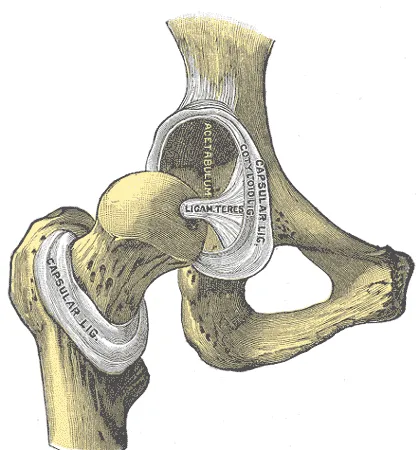
The hip is a ball-and-socket joint: the ball is the head of the femur and the socket is the acetabulum (hip socket)11. The 2021 paper describes two shape patterns in the syndrome, cam and pincer1. The UK FASHIoN trial report describes each5:
- Cam morphology (morphology means shape): a flattening or outward curve where the head of the femur meets its neck5.
- Pincer morphology: the socket covers too much of the head of the femur, in one place or the whole way round5.
The 2022 Oxford consensus describes primary cam morphology as a mostly benign (harmless) bony bump that is highly prevalent in many athlete populations12.
The tissues inside the joint
The UK FASHIoN report says the syndrome brings damage inside the joint that builds over time5. That damage includes the hip labrum, a rim of tough tissue around the edge of a joint socket5. It also includes the articular cartilage, the thin layer covering the ends of bones where they meet in a joint5. The report says the syndrome is associated with the development of hip osteoarthritis5. Osteoarthritis is a long-term joint disease in which the cartilage lining the joint wears away.
Who it affects
How common the syndrome is
In a survey of 500 white adults aged 20 to 49 in Vancouver, Canada, 3.0% had the syndrome4. A 2026 systematic review of 18 population-based studies found a single study reporting how common the syndrome is14. It concluded that the true prevalence, the share of people in a group who have a condition at a given time, is largely unknown14.
In a geographic database study of 1,893 people aged 14 to 50 seen for hip pain, 716 (38%) met a three-part definition15. That gave an incidence (how many new cases appear in a group over a set time) of 54.4 per 100,000 person-years15. Person-years are a count of people multiplied by the years each was followed. Recorded cases were more frequent in female than male patients, at 73.2 against 36.1 per 100,000 person-years15.
How common the bone shapes are
| Group | Cam morphology | Pincer morphology |
|---|---|---|
| Adults in population-based studies (2026 systematic review) | 7.3% to 38.2% of people14 | 7.6% to 17.9% of people, with definitions that varied between studies14 |
| Volunteers with no symptoms (2015 systematic review) | 37% of hips, from 7% to 100% between studies3 | 67% of hips, from 61% to 76% between studies; the review noted the shape was poorly defined3 |
| Athletes aged 10 to 35 (2026 meta-analysis of 47 studies) | An estimated 48%16 | An estimated 18%16 |
Two 2016 systematic reviews reached different conclusions about athletes17,18. One, of 60 imaging studies, found cam-type findings significantly more common in athletes than in people without symptoms17. The other, of 30 studies, could not show a higher prevalence in athletes, and judged the data insufficient to determine the true prevalence18. The 2026 review of athletes found that few studies reported findings in female athletes16.
A prospective study followed 63 preprofessional soccer players for about 2.4 years19. Cam prominence rose from 2.1% to 17.7% of hips whose growth plate was open at the start19. A growth plate is a layer of cartilage near the end of a growing bone. After it had closed, there was no significant increase19.
What studies found
The bone shapes and later osteoarthritis
Pooled prospective studies, which follow people forward in time, link cam morphology with later osteoarthritis, and findings on pincer morphology are mixed20. An odds ratio is how many times higher the odds of an outcome are in one group than in another.
- Cam: a 2021 meta-analysis found hips with cam morphology more likely to develop hip osteoarthritis in prospective studies, with an odds ratio of 2.5220. A 2026 meta-analysis of 23,886 hips found an odds ratio of 1.87 for developing osteoarthritis on X-ray within 4 to 8 years21.
- Pincer: the 2021 meta-analysis found pincer morphology associated with hip osteoarthritis in cross-sectional studies, which look at a group once, but not in prospective studies20. In 2026 prospective data on 18,935 hips, severe pincer morphology was associated with developing osteoarthritis on X-ray within 8 years22. Moderate pincer morphology was not22.
In one prospective cohort of 1,002 people aged 45 to 65, 21 of 1,386 hips met criteria for the syndrome with cam morphology10. Those 21 hips had 6.85 times the odds of new osteoarthritis on X-ray within 10 years, compared with hips meeting no criteria10. The confidence interval, a range that shows how precise a result is, ran from 2.10 to 22.3510.
A 2026 review article states that not everybody with cam morphology will develop femoroacetabular impingement syndrome or osteoarthritis23. The same article calls the shape a causal risk factor for hip osteoarthritis23.
The course without surgery
In a prospective study, 76 patients with the syndrome (93 hips, mean age 15.3) followed a stepped non-surgical protocol for about 27 months24. Of the hips, 70% were managed with rest, therapy sessions and activity changes alone, and 18% went on to arthroscopy24. In a second study of 100 adolescents with hip pain and a positive impingement sign, 51 were available at a mean of 5 years25. Their mean score on a hip scale had risen from 69.6 to 89.5, with no significant drop between 2 and 5 years25.
A 2023 meta-analysis covered 1,153 patients with non-arthritic hip-related pain, including this syndrome26. It found moderate-certainty evidence that 54% responded satisfactorily to non-surgical care26. The confidence interval ran from 32% to 76%26. The review said the essential elements of that care remain unclear26.
One randomised trial, PhysioFIRST, compared two exercise programmes in 154 people aged 18 to 50 with the syndrome27. Six months of targeted strengthening and six months of standardised stretching did not differ in change in hip-related quality of life27. In a secondary analysis, 72% of the strengthening group and 52% of the stretching group rated their pain as improved at six months27.
Trials of arthroscopy against non-surgical programmes
Four randomised trials, which assign people to groups by chance, have compared arthroscopy with a non-surgical programme1,5,6,7.
| Trial | Who was studied | What was found |
|---|---|---|
| UK FASHIoN | 348 people aged 16 or over with the syndrome and no osteoarthritis, at 23 UK hospitals5 | At 12 months, an adjusted difference of 6.8 points in hip-related quality of life favoured arthroscopy, above the 6.1-point minimum clinically important difference5 |
| FAIT | 222 people aged 18 to 60 with symptomatic impingement6 | At eight months, a daily living score was 10.0 points higher after arthroscopy once adjusted, against a minimum clinically important difference of 96 |
| Military trial | 80 patients at a military hospital, 91.3% of them active-duty service members7 | Both groups improved, and the difference between them was not significant at two years7 |
| Australian FASHIoN | 99 people, mean age 331 | At 12 months a cartilage MRI measure showed no statistically significant difference, and hip-related quality of life had improved by 14 units more after surgery1 |
In UK FASHIoN the non-surgical programme was typically 6 to 10 outpatient consultations aimed at strengthening the muscles around the hip28. In FAIT the programme was up to eight sessions that emphasised core stability and movement control, with activity changes6.
Pooled results read differently from UK FASHIoN and FAIT5,6,8,9. A 2025 meta-analysis of 21 randomised trials found statistically higher scores after arthroscopy on two measures, without reaching minimal clinically important differences8. A 2025 meta-analysis of six randomised trials compared arthroscopy with a non-surgical programme or joint washout9. It found a significant difference in function favouring arthroscopy at 12 months but not at 6 months9. Its authors judged that clinical superiority was not shown9.
Harms and later surgery
In UK FASHIoN, 72% of the arthroscopy group and 60% of the programme group reported an adverse event (an unwanted effect), most often muscle soreness5. Five of the six serious adverse events in the arthroscopy group were related to the procedure, including one hip joint infection5. FAIT reported no serious adverse events in either group6.
In UK FASHIoN, 38 people in the programme group (24%) chose arthroscopy between one and three years after randomisation28. In the military trial, 28 of those assigned to the programme went on to have surgery, which the authors list as a limitation7.
Sport after arthroscopy
Two reviews give different figures29,30. A 2018 meta-analysis covered 35 studies of athletes after surgery for the syndrome29. It found limited to moderate strength evidence that 74% returned at their preinjury level29. A 2015 systematic review of 18 case series covered athletes after hip surgery for femoroacetabular impingement30. On average, 87% returned to sport and 82% to the same level as before their symptoms30.
In a cross-sectional study of 189 athletes aged 18 to 30 from a Danish registry, 57.1% were playing their preinjury sport at preinjury level31. That was at a mean of 33 months after hip arthroscopy31. Of the whole sample, 16.9% reported optimal performance with full participation31. A 2021 meta-analysis of 20 studies estimated that 12.1% of athletes did not return to sport after arthroscopy for the syndrome32. It found evidence of publication bias, when studies with striking results are more likely to be published32.
Connections
The UK FASHIoN report names the hip labrum and articular cartilage as tissues damaged within the hip joint5.
Studies of movement relate to the back squat33. A 2018 meta-analysis of 14 studies found that people with the syndrome squatted to a lesser depth than controls33. Their range of hip flexion (bending) did not differ, and the differences between groups were small to moderate33. In a squatting study, 15 people with the syndrome, unlike 14 healthy controls, activated the obturator internus about as much going down as coming up34. That muscle is one of six deep hip rotators11.
A 2015 systematic review of 16 studies looked at people with symptomatic impingement35. The physical difference most often reported was reduced range of motion in the directions of impingement35. Others included reduced strength of the hip adductors and the hip flexors, the muscles that bend the hip35.
A 2026 European consensus of 57 experts recommended “hip joint-related groin pain” as one of five terms for athletes and physically active adults36. The other four terms, covered under athletic groin pain, are adductor, iliopsoas, inguinal and pubic-related groin pain36.
Femoroacetabular impingement involves
Femoroacetabular impingement has studies of squat depth in
Femoroacetabular impingement has been measured in studies of
Femoroacetabular impingement has studies of hip strength in
Femoroacetabular impingement is compared with
Sources
- Hunter DJ, Eyles J, Murphy NJ, Spiers L, Burns A, Davidson E, Dickenson E, Fary C, Foster NE, Fripp J, Griffin DR, Hall M, Kim YJ, Linklater JM, Molnar R, Neubert A, O'Connell RL, O'Donnell J, O'Sullivan M, Randhawa S, Reichenbach S, Schmaranzer F, Singh P, Tran P, Wilson D, Zhang H, Bennell KL (2021). Multi-centre randomised controlled trial comparing arthroscopic hip surgery to physiotherapist-led care for femoroacetabular impingement (FAI) syndrome on hip cartilage metabolism: the Australian FASHIoN trial.. BMC musculoskeletal disorders. doi:10.1186/s12891-021-04576-z PMID 34399702
- Griffin DR, Dickenson EJ, O'Donnell J, Agricola R, Awan T, Beck M, Clohisy JC, Dijkstra HP, Falvey E, Gimpel M, Hinman RS, Hölmich P, Kassarjian A, Martin HD, Martin R, Mather RC, Philippon MJ, Reiman MP, Takla A, Thorborg K, Walker S, Weir A, Bennell KL (2016). The Warwick Agreement on femoroacetabular impingement syndrome (FAI syndrome): an international consensus statement.. British journal of sports medicine. doi:10.1136/bjsports-2016-096743 PMID 27629403
- Frank JM, Harris JD, Erickson BJ, Slikker W, Bush-Joseph CA, Salata MJ, Nho SJ (2015). Prevalence of Femoroacetabular Impingement Imaging Findings in Asymptomatic Volunteers: A Systematic Review.. Arthroscopy. doi:10.1016/j.arthro.2014.11.042 PMID 25636988
- Kopec JA, Hong Q, Wong H, Zhang CJ, Ratzlaff C, Cibere J, Li LC, Prlic H, Wilson DR, Forster BB, Esdaile JM, IMPAKT-HIP Study Team (2020). Prevalence of Femoroacetabular Impingement Syndrome among Young and Middle-aged White Adults.. The Journal of rheumatology. doi:10.3899/jrheum.190345 PMID 31676695
- Griffin DR, Dickenson EJ, Wall PDH, Achana F, Donovan JL, Griffin J, Hobson R, Hutchinson CE, Jepson M, Parsons NR, Petrou S, Realpe A, Smith J, Foster NE, FASHIoN Study Group (2018). Hip arthroscopy versus best conservative care for the treatment of femoroacetabular impingement syndrome (UK FASHIoN): a multicentre randomised controlled trial.. Lancet (London, England). doi:10.1016/S0140-6736(18)31202-9 PMID 29893223
- Palmer AJR, Ayyar Gupta V, Fernquest S, Rombach I, Dutton SJ, Mansour R, Wood S, Khanduja V, Pollard TCB, McCaskie AW, Barker KL, Andrade TJMD, Carr AJ, Beard DJ, Glyn-Jones S, FAIT Study Group (2019). Arthroscopic hip surgery compared with physiotherapy and activity modification for the treatment of symptomatic femoroacetabular impingement: multicentre randomised controlled trial.. BMJ (Clinical research ed.). doi:10.1136/bmj.l185 PMID 30733197
- Mansell NS, Rhon DI, Meyer J, Slevin JM, Marchant BG (2018). Arthroscopic Surgery or Physical Therapy for Patients With Femoroacetabular Impingement Syndrome: A Randomized Controlled Trial With 2-Year Follow-up.. The American journal of sports medicine. doi:10.1177/0363546517751912 PMID 29443538
- Ramadanov N, Lettner J, Voss M, Hable R, Prill R, Dimitrov D, Becker R (2025). Conservative treatment versus hip arthroscopy in patients with femoroacetabular impingement. Bone & joint open. doi:10.1302/2633-1462.64.BJO-2024-0198.R1 PMID 40262760
- Lamo-Espinosa JM, Mariscal G, Gómez-Álvarez J, San-Julián M (2025). Efficacy and safety of arthroscopy in femoroacetabular impingement syndrome: a systematic review and meta-analysis of randomized clinical trials.. Scientific reports. doi:10.1038/s41598-025-91788-1 PMID 40044717
- Agricola R, van Buuren MMA, Kemp JL, Weinans H, Runhaar J, Bierma-Zeinstra SMA (2024). Femoroacetabular impingement syndrome in middle-aged individuals is strongly associated with the development of hip osteoarthritis within 10-year follow-up: a prospective cohort study (CHECK).. British journal of sports medicine. doi:10.1136/bjsports-2024-108222 PMID 39074968
- Betts JG, Young KA, Wise JA, Johnson E, Poe B, Kruse DH, Korol O, Johnson JE, Womble M, DeSaix P (2022). Anatomy and Physiology 2e. OpenStax. Link
- Dijkstra HP, Mc Auliffe S, Ardern CL, Kemp JL, Mosler AB, Price A, Blazey P, Richards D, Farooq A, Serner A, McNally E, Mascarenhas V, Willy RW, Oke JL, Khan KM, Glyn-Jones S, Clarke M, Greenhalgh T, Young Athlete’s Hip Research (YAHiR) Collaborative (2022). Oxford consensus on primary cam morphology and femoroacetabular impingement syndrome: part 1-definitions, terminology, taxonomy and imaging outcomes.. British journal of sports medicine. doi:10.1136/bjsports-2022-106085 PMID 36588401
- Reiman MP, Agricola R, Kemp JL, Heerey JJ, Weir A, van Klij P, Kassarjian A, Mosler AB, Ageberg E, Hölmich P, Warholm KM, Griffin D, Mayes S, Khan KM, Crossley KM, Bizzini M, Bloom N, Casartelli NC, Diamond LE, Di Stasi S, Drew M, Friedman DJ, Freke M, Gojanovic B, Glyn-Jones S, Harris-Hayes M, Hunt MA, Impellizzeri FM, Ishøi L, Jones DM, King MG, Lawrenson PR, Leunig M, Lewis CL, Mathieu N, Moksnes H, Risberg MA, Scholes MJ, Semciw AI, Serner A, Thorborg K, Wörner T, Dijkstra HP (2020). Consensus recommendations on the classification, definition and diagnostic criteria of hip-related pain in young and middle-aged active adults from the International Hip-related Pain Research Network, Zurich 2018.. British Journal of Sports Medicine. doi:10.1136/bjsports-2019-101453 PMID 31959678
- Low WX, Liew I, Fortune M, Khanduja V (2026). Prevalence of femoroacetabular impingement in the general adult population: A systematic review of population-based studies.. International orthopaedics. doi:10.1007/s00264-026-06899-9 PMID 42329261
- Hale RF, Melugin HP, Zhou J, LaPrade MD, Bernard C, Leland D, Levy BA, Krych AJ (2021). Incidence of Femoroacetabular Impingement and Surgical Management Trends Over Time.. The American journal of sports medicine. doi:10.1177/0363546520970914 PMID 33226833
- Martin M, Moore JAM, Gomes DA, Morris N, Hayden KA, Galarneau JM, Bullock GS, Kemp J, Mohtadi NG, Schneider G, Emery CA (2026). Prevalence of Cam and Pincer Morphology in the Young Athlete's Hip: A Systematic Review With Meta-Analysis.. The Journal of orthopaedic and sports physical therapy. doi:10.2519/jospt.2026.13606 PMID 42224020
- Mascarenhas VV, Rego P, Dantas P, Morais F, McWilliams J, Collado D, Marques H, Gaspar A, Soldado F, Consciência JG (2016). Imaging prevalence of femoroacetabular impingement in symptomatic patients, athletes, and asymptomatic individuals: A systematic review.. European journal of radiology. doi:10.1016/j.ejrad.2015.10.016 PMID 26724652
- Dickenson E, Wall PD, Robinson B, Fernandez M, Parsons H, Buchbinder R, Griffin DR (2016). Prevalence of cam hip shape morphology: a systematic review.. Osteoarthritis and cartilage. doi:10.1016/j.joca.2015.12.020 PMID 26778530
- Agricola R, Heijboer MP, Ginai AZ, Roels P, Zadpoor AA, Verhaar JA, Weinans H, Waarsing JH (2014). A cam deformity is gradually acquired during skeletal maturation in adolescent and young male soccer players. The American journal of sports medicine. doi:10.1177/0363546514524364 PMID 24585362
- Casartelli NC, Maffiuletti NA, Valenzuela PL, Grassi A, Ferrari E, van Buuren MMA, Nevitt MC, Leunig M, Agricola R (2021). Is hip morphology a risk factor for developing hip osteoarthritis? A systematic review with meta-analysis.. Osteoarthritis and cartilage. doi:10.1016/j.joca.2021.06.007 PMID 34171473
- Tang J, Boel F, van Buuren MM, Riedstra NS, van den Berg MA, Ahedi H, Arden NK, Bierma-Zeinstra SMA, Boer CG, Cicutini F, Cootes T, Crossley KM, Felson DT, Gielis WP, Heerey JJ, Jones G, Kluzek S, Lane NE, Lindner C, Lynch JA, van Meurs J, Mosler AB, Nelson AE, Nevitt M, Oei EHG, Runhaar J, Weinans H, Agricola R (2026). Cam morphology and the risk of developing radiographic hip osteoarthritis within 8 years: an individual participant data meta-analysis of 23 886 hips from the world COACH consortium.. British journal of sports medicine. doi:10.1136/bjsports-2025-110144 PMID 41314784
- Riedstra N, Boel F, van Buuren MM, Ahedi H, Arbabi V, Arden NK, Baart SJ, Bierma-Zeinstra SMA, Cicutini F, Cootes T, Crossley KM, Felson DT, Gielis WP, Heerey JJ, Jones G, Kluzek S, Lane NE, Lindner C, Lynch JA, van Meurs J, Mosler AB, Nelson AE, Nevitt MC, Oei EHG, Runhaar J, Tang J, Weinans H, Agricola R (2026). Severe pincer morphology is associated with incident hip osteoarthritis: prospective individual participant data from 18 935 hips from the World COACH consortium.. British journal of sports medicine. doi:10.1136/bjsports-2024-109595 PMID 41192959
- Heerey J, Kemp J, van Klij P, Mascarenhas V, Scholes M, Boel F, Dijkstra P, Crossley K, Bierma-Zeinstra S, Agricola R (2026). Cam morphology and the development of femoroacetabular impingement syndrome and hip osteoarthritis.. Nature reviews. Rheumatology. doi:10.1038/s41584-025-01328-4 PMID 41298958
- Pennock AT, Bomar JD, Johnson KP, Randich K, Upasani VV (2018). Nonoperative Management of Femoroacetabular Impingement: A Prospective Study.. The American journal of sports medicine. doi:10.1177/0363546518804805 PMID 30398893
- Zogby AM, Bomar JD, Johnson KP, Upasani VV, Pennock AT (2021). Nonoperative Management of Femoroacetabular Impingement in Adolescents: Clinical Outcomes at a Mean of 5 Years: A Prospective Study.. The American journal of sports medicine. doi:10.1177/03635465211030512 PMID 34357811
- Probst DT, Sookochoff MF, Harris-Hayes M, Prather H, Lipsey KL, Cheng AL (2023). What is the Rate of Response to Nonoperative Treatment for Hip-Related Pain? A Systematic Review With Meta-analysis.. The Journal of orthopaedic and sports physical therapy. doi:10.2519/jospt.2023.11666 PMID 36892224
- Kemp JL, Scholes MJ, Smith AJ, Coburn SL, Johnston RRT, Jones DM, Girdwood MA, King MG, Mentiplay BF, De Oliveira Silva D, Pazzinatto M, Schache AG, Gomes DA, Coburn GM, Crossley KM (2026). Physiotherapist-led treatment for femoroacetabular impingement syndrome (the PhysioFIRST study): an assessor-blinded, limited disclosure randomised controlled trial.. British journal of sports medicine. doi:10.1136/bjsports-2025-110986 PMID 42082318
- Griffin DR, Dickenson EJ, Achana F, Griffin J, Smith J, Wall PD, Realpe A, Parsons N, Hobson R, Fry J, Jepson M, Petrou S, Hutchinson C, Foster N, Donovan J (2022). Arthroscopic hip surgery compared with personalised hip therapy in people over 16 years old with femoroacetabular impingement syndrome: UK FASHIoN RCT.. Health technology assessment (Winchester, England). doi:10.3310/FXII0508 PMID 35229713
- Reiman MP, Peters S, Sylvain J, Hagymasi S, Mather RC, Goode AP (2018). Femoroacetabular impingement surgery allows 74% of athletes to return to the same competitive level of sports participation but their level of performance remains unreported: a systematic review with meta-analysis.. British journal of sports medicine. doi:10.1136/bjsports-2017-098696 PMID 29581142
- Casartelli NC, Leunig M, Maffiuletti NA, Bizzini M (2015). Return to sport after hip surgery for femoroacetabular impingement: a systematic review.. British journal of sports medicine. doi:10.1136/bjsports-2014-094414 PMID 25841163
- Ishøi L, Thorborg K, Kraemer O, Hölmich P (2018). Return to Sport and Performance After Hip Arthroscopy for Femoroacetabular Impingement in 18- to 30-Year-Old Athletes: A Cross-sectional Cohort Study of 189 Athletes.. The American journal of sports medicine. doi:10.1177/0363546518789070 PMID 30067071
- Weber AE, Bolia IK, Mayfield CK, Ihn H, Kang HP, Bedi A, Nho SJ, Philippon MJ (2021). Can We Identify Why Athletes Fail to Return to Sport After Hip Arthroscopy for Femoroacetabular Impingement Syndrome? A Systematic Review and Meta-analysis.. The American journal of sports medicine. doi:10.1177/0363546520956292 PMID 33017544
- King MG, Lawrenson PR, Semciw AI, Middleton KJ, Crossley KM (2018). Lower limb biomechanics in femoroacetabular impingement syndrome: a systematic review and meta-analysis.. British journal of sports medicine. doi:10.1136/bjsports-2017-097839 PMID 29439949
- Diamond LE, van den Hoorn W, Bennell KL, Wrigley TV, Hinman RS, O'Donnell J, Hodges PW (2019). Deep hip muscle activation during squatting in femoroacetabular impingement syndrome. Clinical Biomechanics. doi:10.1016/j.clinbiomech.2019.07.017 PMID 31351343
- Diamond LE, Dobson FL, Bennell KL, Wrigley TV, Hodges PW, Hinman RS (2015). Physical impairments and activity limitations in people with femoroacetabular impingement: a systematic review.. British journal of sports medicine. doi:10.1136/bjsports-2013-093340 PMID 25246442
- Hölmich P, Weir A, Papadopoulou T, Papavasiliou A, Thorborg K, Canata GL, Villa FD, Laver L, Marin-Peña O, Paajanen H, Badhe N, Ahmad SS, Aydingöz Ü, Hanff D, Ayeni O, Thoreux P, Beaufils P, ESSKA‐EHPA‐ESMA Rating Group, Khanduja V (2026). Hip and groin pain in physically active adults with a focus on terminology, clinical examination and imaging: A formal ESSKA-EHPA-ESMA Consensus.. Knee surgery, sports traumatology, arthroscopy : official journal of the ESSKA. doi:10.1002/ksa.70565 PMID 42704670
Changes
- First published.