Radial nerve
Also called posterior interosseous nerve, superficial radial nerve
The nerve that winds round the back of the upper arm to the back of the forearm and hand. Where it runs, what it supplies, where it gets pressed on, and what studies report about recovery.
- Region
- Forearm
- Updated
- October 14, 2026
- Reviewed
- October 14, 2026 · how entries are checked
Function
Where it starts and what it does
The radial nerve arises from the spinal nerves labelled C5 to T11. It belongs to the brachial plexus, the network of nerves, starting at the neck, that serves the arm1. It leaves from the network’s posterior cord, one of its large nerve bundles, along with the axillary nerve7,8.
The nerve carries both movement and feeling1. Its motor branches, which carry signals to muscles, drive the muscles of the back of the arm and forearm1. Those include the forearm muscles that straighten the wrist and fingers1.
Its path down the upper arm
A review describes the nerve leaving the armpit behind the brachial artery, the main artery of the upper arm6. It passes between two heads of the triceps brachii, the three-headed muscle on the back of the upper arm6. It then runs in the radial groove, a shallow channel that winds around the back of the upper arm bone6. That bone is the humerus, and the groove lies on the middle third of it9.
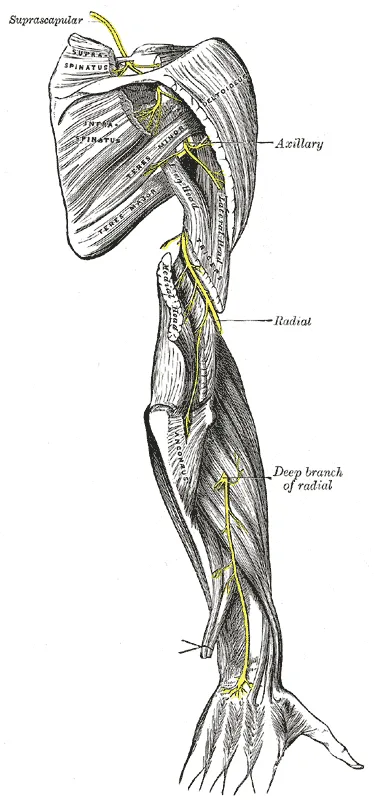
In the upper third of the arm, triceps muscle lies between the nerve and the bone, one review states10. In the lower third the nerve lies straight on the bone’s covering, with no muscle between10. The nerve pierces the lateral intermuscular septum, a sheet of tough tissue that separates groups of muscles6,10. It then runs between the brachialis and the brachioradialis, two muscles that bend the elbow6,10.
Its two branches below the elbow
The nerve divides into a superficial (shallow) branch and a deep branch11. In 20 limbs from cadavers (bodies donated for study), the split lay within 2.1 cm of the outer elbow bump in every limb12.
- The deep branch normally passes between the heads of the supinator into the back of the forearm11. The supinator is a muscle that helps turn the hand palm-up13. The branch comes out as the posterior interosseous nerve, which supplies the muscles there11. On its way it passes through the radial tunnel6,14. A review defines that tunnel as the space from the elbow joint down to the lower edge of the supinator’s shallow layer6.
- The superficial branch is described as purely sensory in one source and mainly sensory in another6,15. It comes out from under the brachioradialis to lie beneath the skin of the back of the forearm6. At the wrist it splits into branches to the back of the thumb, index finger and half the middle finger6.
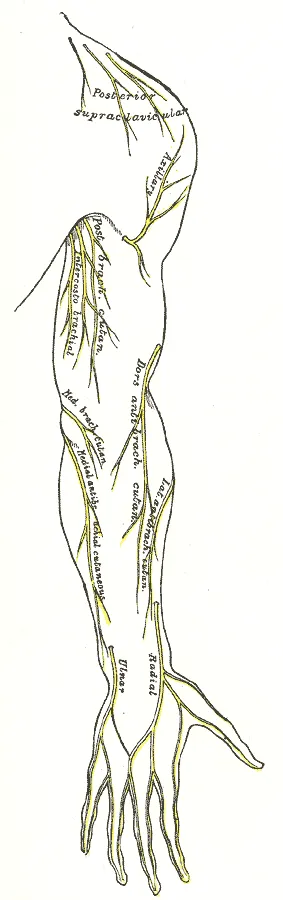
The nerve’s sensory branches supply skin on the back of the forearm, and on the back and thumb side of the wrist and hand1. On the hand its share of skin shrinks from the thumb towards the ring finger1. The finger pads belong to the median nerve and the ulnar nerve1.
How it slides as the arm moves
One study measured how far the nerve had to slide in ten arms from five cadavers16.
| Movement, in the same ten cadaver arms | Where the slide was measured | Slide needed (mm) |
|---|---|---|
| Wrist, tilted 15 degrees to the thumb side, then 30 to the other | Wrist | 4.316 |
| Elbow, from 10 to 90 degrees | Elbow | 8.816 |
| Wrist, fingers, elbow and shoulder movements combined | Wrist | 9.416 |
| Wrist, fingers, elbow and shoulder movements combined | Elbow | 14.216 |
Over that elbow movement, the same study measured 28% strain, or stretch as a share of length, in the nerve at the elbow16.
Where it crosses the septum
Two cadaver studies looked at the nerve near the lateral intermuscular septum17,18. In eight paired arms, it slid less in the upper arm than the median and ulnar nerves did17. Bending the elbow to 90 degrees doubled its slide, and cutting the septum as well tripled it17. In 27 specimens, the nerve had very little mobility where it entered the front of the arm, between the septum and the bone18. A review states that the nerve’s movement is greatly restricted where it pierces that septum10.
Measurements in living people
In healthy people, ultrasound (a scan made with sound waves) showed the nerve sliding 0.41 to 4.03 mm as the wrist bent forward19. A 2014 review of sliding measured in living people included 12 studies, and none was on the radial nerve20.
A 2017 review of limb movement and nerve stretch in living people covered 22 studies, 15 on the median nerve21. The rest were on the sciatic (four), tibial (two), ulnar (one) and peroneal (one) nerves21. Its authors state that nerve behaviour under stretch is not well established in living people21. The studies differed too much in nerves, sites and joint positions to pool21.
Breakdown
Pressure in the upper arm
In 20 years of US emergency department records, sleeping position was the main mechanism of radial nerve injury, at 62%2.
A review defines “Saturday night palsy” as direct pressure on the nerve in the arm from a firm object, usually at the radial groove6.
Wrist drop is the loss of wrist straightening after radial nerve injury6. In a study of 25 patients with posture-related wrist drop, 68% of cases followed sleeping after getting drunk22. Most of the 25 (88%) had been pressed on for 2 to 4 hours22. A review states that injury in the arm does not much affect the triceps, so the elbow can still be straightened10.
Hard muscular effort
A review names three places in the arm where the nerve is prone to being squeezed10:
- between the heads of the triceps10;
- in the groove of the humerus10;
- where it pierces the lateral intermuscular septum10.
A systematic review is a study that searches for all the research on a question in a checkable way. One such review of squeezing in the upper arm without injury found only 12 studies, with 21 patients23. In 16 cases the mechanism was sudden or repeated elbow straightening with forceful muscle contraction23.
The sport evidence cited here is three reports, each on one or two people24,25,26:
- an elite bodybuilder, whose palsy was put down to the bulk of enlarged muscle pressing on the nerve24;
- a 21-year-old collegiate baseball pitcher, with outer arm pain and weak wrist straightening after pitching25;
- two competitive softball players, whose severe nerve injuries were attributed to the “windmill” pitching motion26.
A broken upper arm
One systematic review found radial nerve palsy in 11.8% of humeral shaft fractures (breaks of the upper arm bone’s shaft), 532 of 4,5173. An updated review, covering studies from 1964 to 2017, put the figure at 12.3%27.
The deep branch in the forearm
The arcade of Frohse is the tendon-like upper edge of the supinator’s shallow layer, and the deep branch passes beneath it28. A meta-analysis is a study that pools the results of several earlier studies. One meta-analysis reports that the arcade is considered the most common place for that branch to be squeezed28. Pooling 20 anatomical studies, it found the arcade in 66% of adults28.
Two patterns are described, and sources disagree about one of them6,29:
- Posterior interosseous nerve syndrome often shows as weakness straightening the fingers and thumb, with wrist straightening kept11. Skin feeling stays normal6.
- Radial tunnel syndrome is described in one review as pain and tenderness along the same nerve, with no muscle weakness or loss of feeling6. A 1999 review argues it is debatable whether squeezing of the radial nerve causes that pain29.
One study compared 21 industrial workers who had radial tunnel syndrome with 21 matched workers who did not30. Odds were higher for those who worked with the elbow fully straight, and no link was found with sport or leisure activities30. A review of sports nerve injuries lists posterior interosseous nerve syndrome in sports with repeated forearm turning and wrist straightening31.
The superficial branch at the wrist
A review defines Wartenberg syndrome as a squeezing problem affecting only the superficial branch6. The branch is thought to be open to outside pressure at the wrist because it runs just under the skin close to the bone6.
The first dorsal compartment of the wrist holds two tendons32,33. In 20 cadaver arms, the nearest branch of the superficial radial nerve lay a mean of 0.4 cm from the centre of that compartment12. De Quervain’s disease is painful swelling around two thumb tendons at the wrist. It was present in half of a series of 52 cases of squeezing of the superficial branch34. A review states that Wartenberg syndrome is sometimes confused with De Quervain’s6.
Recovery
What the grade of injury means
A review of nerve tissue states that most nerve compressions are the mildest grade of injury, neurapraxia35. Another describes neurapraxia as a temporary signal block that clears fully within 12 weeks36. Where the fibres themselves are damaged, regrowth is slow, about 1 mm a day, and often incomplete36.
After pressure or effort in the arm
| Group studied | What was reported |
|---|---|
| Pressure palsies of the nerve in the arm, in a review | Typically complete in 2 or 3 months; up to 6 in more severe cases6 |
| 25 patients with wrist drop after holding one posture for a long time | A mean of 2.4 weeks passed before improvement began22 |
| 51 patients with a radial nerve problem from pressure, confirmed by nerve testing | All 23 with follow-up recovered completely, a mean of 3.4 months after onset4 |
| 21 published patients with squeezing in the upper arm without injury | All four not operated on recovered completely; of 18 operated on, 12 recovered completely, one partly and four not at all23 |
After a broken upper arm
One systematic review found that 88.1% of nerves recovered overall after palsy with a humeral shaft fracture3. In patients not operated on, 70.7% recovered on their own3. An updated review found recovery on its own in 77.2% of patients not operated on27. It found recovery in 89.8% of those who had surgery to explore the nerve and repair the fracture within 3 weeks27.
In the forearm and at the wrist
A 2008 systematic review found no randomised or controlled trials (studies that compare groups) of any approach to radial tunnel syndrome5. The authors of a 2024 systematic review conclude that outcomes are hard to compare across studies37.
In the series of 52 superficial branch cases, 71% of those not operated on had excellent or good results34. So did 74% of those operated on34.
Connections
The muscles it supplies
The triceps is mainly supplied by the radial nerve38. Branches straight from the main trunk supply, in order, the triceps, anconeus, brachioradialis and extensor carpi radialis longus6. The anconeus is a small muscle at the back of the elbow, and the last is a forearm muscle that pulls the wrist back. In Gray’s account, most other muscles of the back of the forearm, the forearm extensors, are supplied through the deep branch13.
A review gives the order in which the posterior interosseous nerve reaches them6:
- first the supinator and the extensor carpi radialis brevis6;
- then, through one branch past the supinator, the extensor carpi ulnaris and the long and short thumb extensors6;
- through the other, the extensor digitorum, extensor digiti minimi, extensor indicis and abductor pollicis longus6.
Exercises and stretches that load it
In five cadaver elbows, pressure in the radial tunnel rose when the wrist moved from neutral to a bent-forward, palm-down position39. Related exercise pages: wrist extensor stretch, wrist extension, triceps extension1,38,39.
Radial nerve supplies
Radial nerve runs in a groove on the back of
Radial nerve leaves the brachial plexus alongside
Radial nerve shares the skin of the hand with
Radial nerve sends branches to
Radial nerve has skin branches lying beside
Radial nerve has a branch whose squeezing is sometimes confused with
Radial nerve has a forearm pain syndrome that is compared with pain at
Radial nerve is loaded by
Radial nerve supplies the muscles worked in
Radial nerve supplies the muscle worked in
Sources
- Glover NM, Black AC, Murphy PB (2023). Anatomy, Shoulder and Upper Limb, Radial Nerve.. StatPearls. PMID 30521261
- Boroumand S, Ajjawi I, Gu E, Littleton A, Flores-Pérez P, Vafa AZ, Klimitz FJ, Diatta F (2026). Exploring 20 years of peripheral nerve injuries of the upper extremity: An analysis of median, radial, and ulnar nerve injuries presenting to US emergency departments.. Journal of Hand Therapy. doi:10.1016/j.jht.2026.02.012 PMID 41966926
- Shao YC, Harwood P, Grotz MR, Limb D, Giannoudis PV (2005). Radial nerve palsy associated with fractures of the shaft of the humerus: a systematic review.. Journal of Bone and Joint Surgery. British Volume. doi:10.1302/0301-620X.87B12.16132 PMID 16326879
- Arnold WD, Krishna VR, Freimer M, Kissel JT, Elsheikh B (2012). Prognosis of acute compressive radial neuropathy.. Muscle & nerve. doi:10.1002/mus.23305 PMID 22581545
- Huisstede B, Miedema HS, van Opstal T, de Ronde MT, Verhaar JA, Koes BW (2008). Interventions for treating the radial tunnel syndrome: a systematic review of observational studies.. The Journal of hand surgery. doi:10.1016/j.jhsa.2007.10.001 PMID 18261668
- Węgiel A, Karauda P, Zielinska N, Tubbs RS, Olewnik Ł (2023). Radial nerve compression: anatomical perspective and clinical consequences.. Neurosurgical review. doi:10.1007/s10143-023-01944-2 PMID 36781706
- Stokey PJ, Kaur S, Lee A, Behrens K, Ebraheim N (2024). Anatomy and Deficiency of the Deltoid Muscle: A Review of Literature.. Orthopedic Reviews. doi:10.52965/001c.115352 PMID 38562147
- Ayik G, Kolac UC, Kaymakoglu M, McFarland E, Huri G (2025). Dark side of the shoulder: suprascapular and axillary nerve compressions.. International Orthopaedics. doi:10.1007/s00264-025-06465-9 PMID 40082300
- Bounds EJ, Frane N, Jajou L, Weishuhn LJ, Kok SJ (2023). Humeral Shaft Fractures.. StatPearls. PMID 28846218
- Latef TJ, Bilal M, Vetter M, Iwanaga J, Oskouian RJ, Tubbs RS (2018). Injury of the Radial Nerve in the Arm: A Review.. Cureus. doi:10.7759/cureus.2199 PMID 29666777
- Wheeler R, DeCastro A (2023). Posterior Interosseous Nerve Syndrome.. StatPearls. PMID 31082090
- Abrams RA, Brown RA, Botte MJ (1992). The superficial branch of the radial nerve: an anatomic study with surgical implications.. The Journal of hand surgery. doi:10.1016/s0363-5023(09)91056-5 PMID 1430933
- Gray H; Lewis WH (editor) (1918). Anatomy of the Human Body. Lea & Febiger, Philadelphia (20th edition). Link
- Shamrock AG, Das JM (2023). Radial Tunnel Syndrome.. StatPearls. PMID 32310397
- Dua A, Hoffler CE (2026). Cheiralgia Paresthetica (Wartenberg Syndrome).. StatPearls. PMID 31424784
- Wright TW, Glowczewskie F, Cowin D, Wheeler DL (2005). Radial nerve excursion and strain at the elbow and wrist associated with upper-extremity motion.. The Journal of hand surgery. doi:10.1016/j.jhsa.2005.06.008 PMID 16182056
- Chen WA, Luo TD, Wigton MD, Li Z (2018). Anatomical Factors Contributing to Radial Nerve Excursion at the Brachium: A Cadaveric Study.. The Journal of hand surgery. doi:10.1016/j.jhsa.2017.09.023 PMID 29122426
- Carlan D, Pratt J, Patterson JMM, Weiland AJ, Boyer MI, Gelberman RH (2007). The radial nerve in the brachium: an anatomic study in human cadavers.. The Journal of hand surgery. doi:10.1016/j.jhsa.2006.07.001 PMID 17923300
- Kasehagen B, Ellis R, Mawston G, Allen S, Hing W (2016). Assessing the Reliability of Ultrasound Imaging to Examine Radial Nerve Excursion.. Ultrasound in medicine & biology. doi:10.1016/j.ultrasmedbio.2016.02.013 PMID 27087692
- Silva A, Manso A, Andrade R, Domingues V, Brandão MP, Silva AG (2014). Quantitative in vivo longitudinal nerve excursion and strain in response to joint movement: A systematic literature review.. Clinical Biomechanics. doi:10.1016/j.clinbiomech.2014.07.006 PMID 25168082
- Szikszay T, Hall T, von Piekartz H (2017). In vivo effects of limb movement on nerve stretch, strain, and tension: A systematic review.. Journal of Back and Musculoskeletal Rehabilitation. doi:10.3233/BMR-169720 PMID 28869435
- Han BR, Cho YJ, Yang JS, Kang SH, Choi HJ (2014). Clinical features of wrist drop caused by compressive radial neuropathy and its anatomical considerations.. Journal of Korean Neurosurgical Society. doi:10.3340/jkns.2014.55.3.148 PMID 24851150
- Laumonerie P, Dufournier B, Vari N, Manchec O, Tibbo ME, Cintas P, Mansat P, Faruch-Bifeld M (2022). Atraumatic proximal radial nerve entrapment. Illustrative cases and systematic review of literature.. European journal of orthopaedic surgery & traumatology : orthopedie traumatologie. doi:10.1007/s00590-021-03037-6 PMID 34143309
- Ng AB, Borhan J, Ashton HR, Misra AN, Redfern DR (2003). Radial nerve palsy in an elite bodybuilder.. British journal of sports medicine. doi:10.1136/bjsm.37.2.185 PMID 12663366
- Wellington IJ, Garvin PM, Stelzer JW, Morgan C, Alessi A, Hall M, Rodner C, Edgar C (2022). Transient Exertional Compressive Radial Neuropathy in a Collegiate Baseball Pitcher: A Case Report.. JBJS case connector. doi:10.2106/JBJS.CC.22.00352 PMID 36820758
- Sinson G, Zager EL, Kline DG (1994). Windmill pitcher's radial neuropathy.. Neurosurgery. PMID 8084398
- Ilyas AM, Mangan JJ, Graham J (2020). Radial Nerve Palsy Recovery With Fractures of the Humerus: An Updated Systematic Review.. Journal of the American Academy of Orthopaedic Surgeons. doi:10.5435/JAAOS-D-18-00142 PMID 31714418
- Benes M, Kachlik D, Kunc V, Kunc V (2021). The arcade of Frohse: a systematic review and meta-analysis.. Surgical and radiologic anatomy : SRA. doi:10.1007/s00276-021-02718-5 PMID 33677682
- Rosenbaum R (1999). Disputed radial tunnel syndrome.. Muscle & nerve. doi:10.1002/(sici)1097-4598(199907)22:7<960::aid-mus26>3.0.co;2-c PMID 10398221
- Roquelaure Y, Raimbeau G, Dano C, Martin YH, Pelier-Cady MC, Mechali S, Benetti F, Mariel J, Fanello S, Penneau-Fontbonne D (2000). Occupational risk factors for radial tunnel syndrome in industrial workers.. Scandinavian journal of work, environment & health. doi:10.5271/sjweh.575 PMID 11201398
- Farag JI, McDougall AN, Catapano M (2025). Common sports-related nerve injuries seen by the electrodiagnostic medical consultant.. Muscle & nerve. doi:10.1002/mus.28298 PMID 39535438
- Beutel BG, Taylor K, Michols NJ, Taqi M (2025). Intersection Syndrome.. StatPearls. PMID 28613649
- Bonczar M, Walocha J, Pasternak A, Depukat P, Dziedzic M, Ostrowski P, Bonczar T, Warchoł Ł, Koziej M (2023). Anatomical variations in the first dorsal compartment of the wrist: meta-analysis.. Folia morphologica. doi:10.5603/FM.a2022.0081 PMID 36165900
- Lanzetta M, Foucher G (1993). Entrapment of the superficial branch of the radial nerve (Wartenberg's syndrome). International orthopaedics. doi:10.1007/BF00180450 PMID 8163306
- Menorca RM, Fussell TS, Elfar JC (2013). Nerve physiology. Hand Clinics. doi:10.1016/j.hcl.2013.04.002 PMID 23895713
- Grinsell D, Keating CP (2014). Peripheral nerve reconstruction after injury: a review of clinical and experimental therapies.. BioMed Research International. doi:10.1155/2014/698256 PMID 25276813
- Hones KM, Cueto RJ, Ndjonko LC, Raymond BT, Buchanan TR, Aibinder WR, Srinivasan RC, Wright TW, King JJ, Hao KA (2024). Establishing the diagnosis of radial tunnel syndrome: a systematic review of published clinical series.. European journal of orthopaedic surgery & traumatology : orthopedie traumatologie. doi:10.1007/s00590-024-04003-8 PMID 38782802
- Mohel HK, Khorwal G, Sharma R, Sharma B (2025). Variable Innervation of the Triceps Brachii: Anatomical and Clinical Perspectives in a Narrative Review.. Cureus. doi:10.7759/cureus.100537 PMID 41625801
- Erak S, Day R, Wang A (2004). The role of supinator in the pathogenesis of chronic lateral elbow pain: a biomechanical study.. Journal of hand surgery (Edinburgh, Scotland). doi:10.1016/j.jhsb.2004.06.001 PMID 15336750
Changes
- First published.