De Quervain's tenosynovitis
Also called De Quervain's, de Quervain's tenosynovitis, De Quervain tenosynovitis, De Quervain's disease, De Quervain disease, De Quervain's syndrome, De Quervain tendinopathy
A painful condition of two thumb tendons where they pass the thumb side of the wrist. How reviews describe it, who it affects, and what studies of injections, splints, exercise and surgery found.
- Region
- Wrist & hand
- Updated
- October 14, 2026
- Reviewed
- October 14, 2026 · how entries are checked
What it is
How a review and a consensus describe it
The authors of a 2023 network meta-analysis of randomised trials describe De Quervain’s tenosynovitis as a stenosing (narrowing) overuse condition1. A network meta-analysis is a meta-analysis that compares many options at once. In their description it affects the synovial sheath in the wrist’s first extensor compartment1.
A European consensus of 35 experts traces its pain to resisted gliding of two tendons in a canal of bone and fibrous tissue6. Tenosynovitis means swelling of the lining that surrounds a tendon.
The two tendons and their tunnel
The first of six compartments on the back of the wrist holds two tendons: abductor pollicis longus and extensor pollicis brevis7,8. Abductor pollicis longus moves the thumb away from the hand2. The main job given for extensor pollicis brevis is straightening the thumb at its knuckle9. The two pass through a tunnel along the radial styloid, the bony point on the thumb side of the wrist10,11.
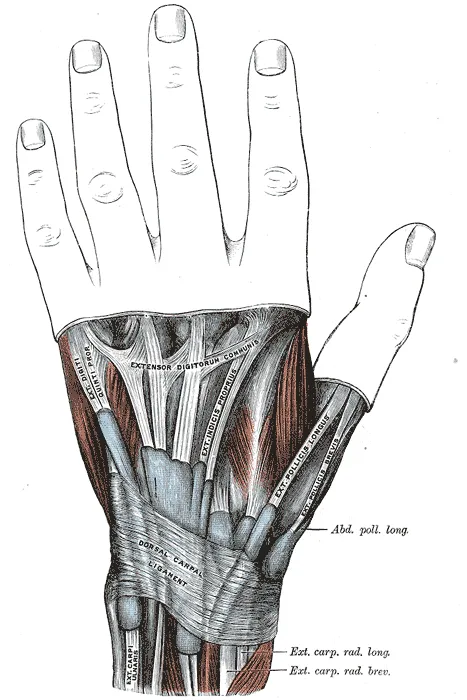
The page on the first dorsal compartment tendons covers this anatomy, including the septum (dividing wall) between the two tendons in some wrists12.
Whether the tissue is inflamed
Studies of tissue removed at surgery disagree on inflammation, the body’s response to injury or irritation13,14. In 23 people operated on, compared with 24 controls, the condition was marked by a thickened sheath rather than by inflammation13. In 35 people, the thickening was due to fibrosis, a build-up of scar-like tissue15. The authors of another study found inflammatory markers in samples from 13 people, and concluded that inflammation is present14.
In samples from 16 people, cells staining for three inflammatory factors were more frequent in more advanced samples16. Its authors read this as inflammation increasing as the condition progresses16.
What cadaver studies measured
The authors of a cadaver study wrote that the cause of De Quervain’s disease is unknown17. In their 15 cadaver wrists, one tendon met significantly more gliding resistance with the wrist bent forward 60 degrees than in six other positions17. A statistically significant difference is one unlikely to be due to chance alone.
Two tests named after their authors
A 2018 study’s authors wrote that Finkelstein’s 1930 account brought on pain by pulling the thumb, worse with the hand bent toward the little finger18. In Eichhoff’s version, the fingers gripped the thumb in the palm before someone else bent the wrist that way18. Another study’s authors wrote that Eichhoff’s test is often wrongly named Finkelstein’s19.
In the 2018 study, 36 people without symptoms had both tests18. For Finkelstein’s, each bent the wrist toward the little finger, and the examiner folded the thumb into the palm18. For Eichhoff’s, each clenched the fingers over the thumb, and the examiner moved the whole hand18.
In their 72 wrists, none with tenosynovitis on ultrasound, Eichhoff’s test gave eight false-positive results and Finkelstein’s none18. The authors wrote that moving the whole hand bends the wrist further toward the little finger18. They suggested that the added stretch and shear (a sliding force) at the radial styloid can cause pain in a normal wrist18.
Who it affects
How common it is
Counts differ with the group studied20,21. Prevalence is the share of people in a group who have a condition at a given time.
| Group studied | What was found |
|---|---|
| 9,696 working-age adults picked at random from the general population | Prevalence of 0.5% in men and 1.3% in women20 |
| 3,710 workers from a French region | 1.2% had it: 0.6% of men and 2.1% of women22 |
| United States military personnel, 1998 to 2006 | 2.8 first presentations per 1,000 person-years in women and 0.6 in men21 |
| 33,420 people recorded with it in a commercial insurance database | 77.5% were women, and new cases peaked at ages 40 to 593 |
In that database, four conditions were each linked with a higher risk of De Quervain’s being recorded3. They were diabetes, rheumatoid arthritis (an immune disease of the joints), lupus and hypothyroidism (an underactive thyroid)3.
Pregnancy and infant care
A claims study matched 357,534 women after delivery with 357,803 women who were not pregnant23. Pregnancy was linked with higher odds of a record in the first year after delivery, with an odds ratio of 5.1123. An odds ratio is how many times higher the odds of an outcome are in one group than in another.
Work
A systematic review pooled controlled cohort studies, which follow groups over time, of repetitive, forceful or ergonomically stressful manual work24. It gave an odds ratio of 2.8924. The same review, of 80 articles, concluded the evidence was not sufficient to confirm that work causes the condition24.
Sport and training
The reports from sport and training cited here are few25,26:
- In a case series of 45 volleyball players with the condition, those with severe signs had done significantly more training than those with mild signs25.
- By 2019, one published case report attributed De Quervain’s to kettlebell training, from repeated trauma to the extensor pollicis brevis tendon26.
What studies found
The authors of the 2023 network meta-analysis wrote that definitive guidelines for managing the condition do not exist1. They also noted that some of its trials identified the condition by the Finkelstein test alone, which may have been inadequate1. The UK Medical Research Council funded that review and had no role in its design, conduct, analysis or reporting1.
Its course, and pregnancy and infant care
A 2009 Cochrane review, one done to the Cochrane Collaboration’s published standards, searched up to April 200927. It found no reports of the condition’s natural course without any intervention27. Its authors called for future studies of that course27. In a 2001 report on cases arising during infant care, care without an operation succeeded in 77% of the cases reviewed28. An operation succeeded in the rest28.
In a randomised study of 18 pregnant or breast-feeding women, none of those given thumb splints had complete pain relief29. Eight of the women given splints had spontaneous resolution of symptoms at the end of breast-feeding29. The authors called the condition self-limited, meaning it ends by itself, in pregnancy and lactation29. It was the one study in the 2009 Cochrane review, which describes allocation by order of application, a method that imitates chance without using it27. It adds that neither the women, those caring for them nor the outcome assessors were blinded, meaning kept unaware of each woman’s group27.
One comparison followed 30 women who had recently given birth and 30 non-pregnant women, each given wrist splinting and then further conservative care30. Over six months, one woman in the first group had surgery because that care failed, against 25 of the non-pregnant women30.
Corticosteroid injection
A 2015 meta-analysis of five randomised trials (165 patients) compared injection with a thumb splint alone, a placebo (dummy) injection or acupuncture4. Symptoms resolved more often after the injection, with a risk ratio of 2.594. A risk ratio is how many times more often something happens in one group than in another. The same review found that no trial had a low risk of bias4.
That review rated a 2010 Iranian trial at high risk of bias4. It compared injection plus a thumb spica cast, which holds the thumb still, with the cast alone, in 37 and 36 people4. The review recorded “No” for random sequence, concealed allocation and blinding4.
In one randomised, placebo-controlled trial, 11 general practitioners (family doctors) enrolled 21 people31. At one week, 78% given one or two injections of the corticosteroid triamcinolone had responded, against 25% given saline, sterile salt water27,31. Allocations were sealed in opaque envelopes, and the authors report that participants and outcome assessors were blinded31.
A 2024 network meta-analysis of 14 randomised controlled trials looked at pain scores within six weeks32. Corticosteroid injection alone and an orthosis (a support worn on the body) alone were among the options that did not differ significantly from placebo32. Injection combined with casting showed favourable outcomes32.
Injection guided by ultrasound
In the 2023 network meta-analysis, approaches that included an ultrasound-guided injection ranked at the top for short-term pain1. Two pooled studies, with 92 participants by the review’s count, compared guided with conventional injection1. Short-term pain favoured guidance by 2.1 points, a difference that was not statistically significant, on very low certainty evidence1.
They were a 2012 open-label study, in which everyone knew the injection given, and a 2020 randomised comparison1. The first allocated 44 wrists with a separate extensor pollicis brevis compartment, and pain fell significantly more with guidance than with manual injection33. The second compared guided with blind injection in 48 wrists of 44 people34. It found no significant difference in pain, other outcomes, or skin lightening or thinning34.
After a single injection
One study enrolled 50 consecutive people given a single injection35. Six weeks later 82% had resolved symptoms, and 24 people later had symptoms return, at a median of 84 days35.
Studies disagree on whether a septum changes the result36,37. Among 50 consecutive people given a single injection, a septum seen on ultrasound was linked with a higher rate of symptoms returning within six weeks36. In a review of the records of 234 wrists followed for more than a year, a septum did not affect outcomes37.
Splints and casts
The 2023 network meta-analysis pooled trials that added three to four weeks of thumb immobilisation to an injection1. Immobilisation means keeping a limb still, as in a cast or brace. Function was better by 10.5 points in the short term and 9.4 in the mid term, on evidence of moderate certainty1. The differences were statistically significant but, by the review’s judgement, too small to matter clinically1. In its ranking for short-term pain, a placebo saline injection and thumb spica immobilisation alone had the highest probability of being least effective1.
One randomised trial followed 20 people for six months38. Of 26 people randomised, six then refused to take part, leaving 2038. At least two of three symptoms resolved completely in 88% of the nine given an injection alone38. The figure was 73% of the 11 also immobilised for three weeks38. The same surgeon gave and evaluated the care, and the authors state that they received no financial support38.
Exercise
A randomised feasibility trial studied isometric thumb extension, in which the muscle works but the joint does not move39. After two weeks of an orthosis, education and movement exercises, its 28 people did high-load or low-load versions for four weeks39. Pain and function improved over time, with no significant difference between the groups39. The authors wrote that exercise could not be separated from the rest of the programme, so its efficacy could not be concluded39.
Surgery
A 2022 meta-analysis covered 21 studies of surgical release, with 939 patients5. At follow-up, 5% of patients did not have complete remission of pain5. The pooled complication rate was 11%, and nerve injuries had a prevalence of 3%5. The review rated the strength of evidence as poor for the included studies, apart from four randomised controlled trials5. In the 2023 network meta-analysis, surgery could not be compared with the other approaches for pain or function1.
A second 2022 review, of three randomised trials comparing surgical methods, reported limits in blinding participants, staff and outcome assessors40. Its authors noted that blinding was not possible, because the incisions could be seen40.
One randomised trial compared injection with surgery in 56 people41. They had not responded to at least three months of anti-inflammatory drugs, changed wrist use and night splinting41. In the surgery group, each person had symptom relief at six weeks, with no recurrence at one year41. In the injection group, 25% had relief at six weeks and 32% had a recurrence at one year41. Allocation used a computer-generated random number table41.
Its single author designed the study, collected and analysed the data and wrote the report41. The report declares no conflict of interest, with “None declared” for financial disclosure, and analysed people in their allocated groups41.
Connections
The condition involves the first dorsal compartment tendons, abductor pollicis longus and extensor pollicis brevis1. Higher up the forearm, those two cross over the two radial wrist extensors, covered on the forearm extensors page7. A review names De Quervain’s as the main condition that intersection syndrome, a problem at that crossing, has to be told apart from42.
In 20 cadaver arms, the nearest branch of the superficial radial nerve lay a mean of 0.4 cm from the compartment’s centre43. In a study of 130 people having the release, surgeons met at least one branch of the superficial radial nerve in 61% of operations44. In a series of 52 cases of entrapment of that branch, De Quervain’s disease was present in half45.
De Quervain's tenosynovitis involves
De Quervain's tenosynovitis is compared with intersection syndrome of
De Quervain's tenosynovitis has been reported alongside entrapment of a branch of
De Quervain's tenosynovitis has one case report from
Sources
- Challoumas D, Ramasubbu R, Rooney E, Seymour-Jackson E, Putti A, Millar NL (2023). Management of de Quervain Tenosynovitis. JAMA network open. doi:10.1001/jamanetworkopen.2023.37001 PMID 37889490
- Shah DS, Middleton C, Gurdezi S, Horwitz MD, Kedgley AE (2018). The importance of abductor pollicis longus in wrist motions: A physiological wrist simulator study.. Journal of biomechanics. doi:10.1016/j.jbiomech.2018.07.011 PMID 30054091
- Hassan K, Sohn A, Shi L, Lee M, Wolf JM (2022). De Quervain Tenosynovitis: An Evaluation of the Epidemiology and Utility of Multiple Injections Using a National Database.. The Journal of hand surgery. doi:10.1016/j.jhsa.2021.04.018 PMID 34147317
- Rowland P, Phelan N, Gardiner S, Linton KN, Galvin R (2015). The Effectiveness of Corticosteroid Injection for De Quervain's Stenosing Tenosynovitis (DQST): A Systematic Review and Meta-Analysis.. The open orthopaedics journal. doi:10.2174/1874325001509010437 PMID 26587059
- Bosman R, Duraku LS, van der Oest MJW, Hundepool CA, Rajaratnam V, Power DM, Selles RW, Zuidam JM (2022). Surgical Treatment Outcome of de Quervain's Disease: A Systematic Review and Meta-analysis.. Plastic and reconstructive surgery. Global open. doi:10.1097/GOX.0000000000004305 PMID 35539295
- Huisstede BM, Coert JH, Fridén J, Hoogvliet P (2014). Consensus on a multidisciplinary treatment guideline for de Quervain disease: results from the European HANDGUIDE study.. Physical therapy. doi:10.2522/ptj.20130069 PMID 24700135
- Beutel BG, Taylor K, Michols NJ, Taqi M (2025). Intersection Syndrome.. StatPearls. PMID 28613649
- Bonczar M, Walocha J, Pasternak A, Depukat P, Dziedzic M, Ostrowski P, Bonczar T, Warchoł Ł, Koziej M (2023). Anatomical variations in the first dorsal compartment of the wrist: meta-analysis.. Folia morphologica. doi:10.5603/FM.a2022.0081 PMID 36165900
- Jabir S, Lyall H, Iwuagwu FC (2013). The extensor pollicis brevis: a review of its anatomy and variations.. Eplasty. PMID 23882301
- Satteson E, Tannan SC (2023). De Quervain Tenosynovitis.. StatPearls. PMID 28723034
- Gupta A, Mirzaee F, Farahanchi Baradaran A, Aslani MA, Aslani H (2021). Biomechanical study of the abductor pollicis longus & extensor pollicis brevis after release and reconstruction of the first dorsal compartment of the wrist.. Annals of medicine and surgery (2012). doi:10.1016/j.amsu.2021.102863 PMID 34584688
- Abi-Rafeh J, Mojtahed Jaberi M, Kazan R, Alabdulkarim A, Boily M, Thibaudeau S (2022). Utility of Ultrasonography and Significance of Surgical Anatomy in the Management of de Quervain Disease: A Systematic Review and Meta-Analysis.. Plastic and reconstructive surgery. doi:10.1097/PRS.0000000000008792 PMID 35077418
- Clarke MT, Lyall HA, Grant JW, Matthewson MH (1998). The histopathology of de Quervain's disease.. Journal of hand surgery (Edinburgh, Scotland). doi:10.1016/s0266-7681(98)80085-5 PMID 9888670
- Kuo YL, Hsu CC, Kuo LC, Wu PT, Shao CJ, Wu KC, Wu TT, Jou IM (2015). Inflammation is present in de Quervain Disease--correlation study between biochemical and histopathological evaluation.. Annals of plastic surgery. doi:10.1097/SAP.0000000000000459 PMID 25650747
- Takahashi Y, Hashizume H, Inoue H, Ogura T (1994). Clinicopathological analysis of de Quervain's disease.. Acta medica Okayama. PMID 8191920
- Shen PC, Wang PH, Wu PT, Wu KC, Hsieh JL, Jou IM (2015). The Estrogen Receptor-β Expression in De Quervain's Disease.. International journal of molecular sciences. doi:10.3390/ijms161125968 PMID 26556342
- Kutsumi K, Amadio PC, Zhao C, Zobitz ME, An KN (2005). Gliding resistance of the extensor pollicis brevis tendon and abductor pollicis longus tendon within the first dorsal compartment in fixed wrist positions.. Journal of orthopaedic research : official publication of the Orthopaedic Research Society. doi:10.1016/j.orthres.2004.06.014 PMID 15734232
- Wu F, Rajpura A, Sandher D (2018). Finkelstein's Test Is Superior to Eichhoff's Test in the Investigation of de Quervain's Disease.. Journal of hand and microsurgery. doi:10.1055/s-0038-1626690 PMID 30154628
- Goubau JF, Goubau L, Van Tongel A, Van Hoonacker P, Kerckhove D, Berghs B (2014). The wrist hyperflexion and abduction of the thumb (WHAT) test: a more specific and sensitive test to diagnose de Quervain tenosynovitis than the Eichhoff's Test.. The Journal of hand surgery, European volume. doi:10.1177/1753193412475043 PMID 23340762
- Walker-Bone K, Palmer KT, Reading I, Coggon D, Cooper C (2004). Prevalence and impact of musculoskeletal disorders of the upper limb in the general population.. Arthritis and rheumatism. doi:10.1002/art.20535 PMID 15334439
- Wolf JM, Sturdivant RX, Owens BD (2009). Incidence of de Quervain's tenosynovitis in a young, active population.. The Journal of hand surgery. doi:10.1016/j.jhsa.2008.08.020 PMID 19081683
- Petit Le Manac'h A, Roquelaure Y, Ha C, Bodin J, Meyer G, Bigot F, Veaudor M, Descatha A, Goldberg M, Imbernon E (2011). Risk factors for de Quervain's disease in a French working population.. Scandinavian journal of work, environment & health. doi:10.5271/sjweh.3160 PMID 21431276
- Smith GB, Young B, Titan AL, Kenney DE, Ladd AL (2025). Incidence and Risk Factors for Soft Tissue Hand and Wrist Conditions in Pregnancy and Postpartum.. Journal of hand surgery global online. doi:10.1016/j.jhsg.2025.100778 PMID 40746749
- Stahl S, Vida D, Meisner C, Lotter O, Rothenberger J, Schaller HE, Stahl AS (2013). Systematic review and meta-analysis on the work-related cause of de Quervain tenosynovitis. Plastic and reconstructive surgery. doi:10.1097/01.prs.0000434409.32594.1b PMID 24005369
- Rossi C, Cellocco P, Margaritondo E, Bizzarri F, Costanzo G (2005). De Quervain disease in volleyball players.. The American journal of sports medicine. doi:10.1177/0363546504268134 PMID 15716259
- Meigh NJ, Keogh JWL, Schram B, Hing WA (2019). Kettlebell training in clinical practice: a scoping review.. BMC sports science, medicine & rehabilitation. doi:10.1186/s13102-019-0130-z PMID 31497302
- Peters-Veluthamaningal C, van der Windt DA, Winters JC, Meyboom-de Jong B (2009). Corticosteroid injection for de Quervain's tenosynovitis.. The Cochrane database of systematic reviews. doi:10.1002/14651858.CD005616.pub2 PMID 19588376
- Skoff HD (2001). "Postpartum/newborn" de Quervain's tenosynovitis of the wrist.. American journal of orthopedics (Belle Mead, N.J.). PMID 11370952
- Avci S, Yilmaz C, Sayli U (2002). Comparison of nonsurgical treatment measures for de Quervain's disease of pregnancy and lactation.. The Journal of hand surgery. doi:10.1053/jhsu.2002.32084 PMID 11901392
- Capasso G, Testa V, Maffulli N, Turco G, Piluso G (2002). Surgical release of de Quervain's stenosing tenosynovitis postpartum: can it wait?. International orthopaedics. doi:10.1007/s00264-001-0302-8 PMID 11954843
- Peters-Veluthamaningal C, Winters JC, Groenier KH, Meyboom-DeJong B (2009). Randomised controlled trial of local corticosteroid injections for de Quervain's tenosynovitis in general practice.. BMC musculoskeletal disorders. doi:10.1186/1471-2474-10-131 PMID 19860883
- Chong HH, Pradhan A, Dhingra M, Liong W, Hau MYT, Shah R (2024). Advancements in de Quervain Tenosynovitis Management: A Comprehensive Network Meta-Analysis.. The Journal of hand surgery. doi:10.1016/j.jhsa.2024.03.003 PMID 38613563
- Kume K, Amano K, Yamada S, Amano K, Kuwaba N, Ohta H (2012). In de Quervain's with a separate EPB compartment, ultrasound-guided steroid injection is more effective than a clinical injection technique: a prospective open-label study.. The Journal of hand surgery, European volume. doi:10.1177/1753193411427829 PMID 22095403
- Shin YH, Choi SW, Kim JK (2020). Prospective randomized comparison of ultrasonography-guided and blind corticosteroid injection for de Quervain's disease.. Orthopaedics & traumatology, surgery & research. doi:10.1016/j.otsr.2019.11.015 PMID 31899117
- Earp BE, Han CH, Floyd WE, Rozental TD, Blazar PE (2015). De Quervain tendinopathy: survivorship and prognostic indicators of recurrence following a single corticosteroid injection.. The Journal of hand surgery. doi:10.1016/j.jhsa.2014.12.027 PMID 25936736
- Kitridis D, Perdikakis E, Potoupnis M, Pavlidis L, Karagergou E, Givissis P (2024). De Quervain Tendinopathy: Anatomical Prognostic Indicators of Corticosteroid Injection Success.. Journal of personalized medicine. doi:10.3390/jpm14090928 PMID 39338182
- Sato J, Ishii Y, Noguchi H, Takahashi I (2026). Impact of Intracompartmental Septation on Long-Term Treatment Result for de Quernain's Disease.. Hand (New York, N.Y.). doi:10.1177/15589447261430051 PMID 41933489
- Ippolito JA, Hauser S, Patel J, Vosbikian M, Ahmed I (2018). Nonsurgical Treatment of De Quervain Tenosynovitis: A Prospective Randomized Trial.. Hand (New York, N.Y.). doi:10.1177/1558944718791187 PMID 30060681
- McBain B, Rio E, Cook J, Sanderson J, Docking S (2023). Isometric thumb extension exercise as part of a multimodal intervention for de Quervain's syndrome: A randomised feasibility trial.. Hand therapy. doi:10.1177/17589983231158499 PMID 37904860
- Suwannaphisit S, Chuaychoosakoon C (2022). Effectiveness of surgical interventions for treating de Quervain's disease: A systematic review and meta-analysis.. Annals of medicine and surgery. doi:10.1016/j.amsu.2022.103620 PMID 35638053
- Saaiq M (2021). Management Outcome of de Quervain's Disease with Corticosteroid Injection Versus Surgical Decompression.. The archives of bone and joint surgery. PMID 34026933
- Balakatounis K, Angoules AG, Angoules NA, Panagiotopoulou K (2017). Synthesis of evidence for the treatment of intersection syndrome.. World journal of orthopedics. doi:10.5312/wjo.v8.i8.619 PMID 28875127
- Abrams RA, Brown RA, Botte MJ (1992). The superficial branch of the radial nerve: an anatomic study with surgical implications.. The Journal of hand surgery. doi:10.1016/s0363-5023(09)91056-5 PMID 1430933
- Matzon JL, Graham JG, Lutsky KF, Takei TR, Gallant GG, Beredjiklian PK (2019). A Prospective Evaluation of the Anatomy of the First Dorsal Compartment in Patients Requiring Surgery for De Quervain's Tenosynovitis.. Journal of wrist surgery. doi:10.1055/s-0039-1688700 PMID 31579546
- Lanzetta M, Foucher G (1993). Entrapment of the superficial branch of the radial nerve (Wartenberg's syndrome). International orthopaedics. doi:10.1007/BF00180450 PMID 8163306
Changes
- First published.