Humeral shaft fracture
Also called humerus shaft fracture, broken humeral shaft
A break in the long middle part of the upper arm bone. How reviews define it, who it affects, and what trials of surgery against a brace found.
- Region
- Upper arm
- Updated
- October 15, 2026
- Reviewed
- October 15, 2026 · how entries are checked
What it is
How reviews define the shaft
A 2026 educational review says the AO/OTA system is the most common way to sort these fractures1. That system counts a shaft fracture as one lying between the upper and lower end segments of the humerus1. Each end segment is marked out by a square as wide as that end of the bone1. The review states that it mixes its authors’ expert opinion with current evidence1.
The FISH trial used its own rule, read from the x-ray2. The upper limit was the upper edge of the pectoralis major (the large, fan-shaped muscle at the front of the chest) tendon’s attachment2. The lower limit was a line 5 cm above the olecranon fossa, a hollow on the back of the humerus just above the elbow2.
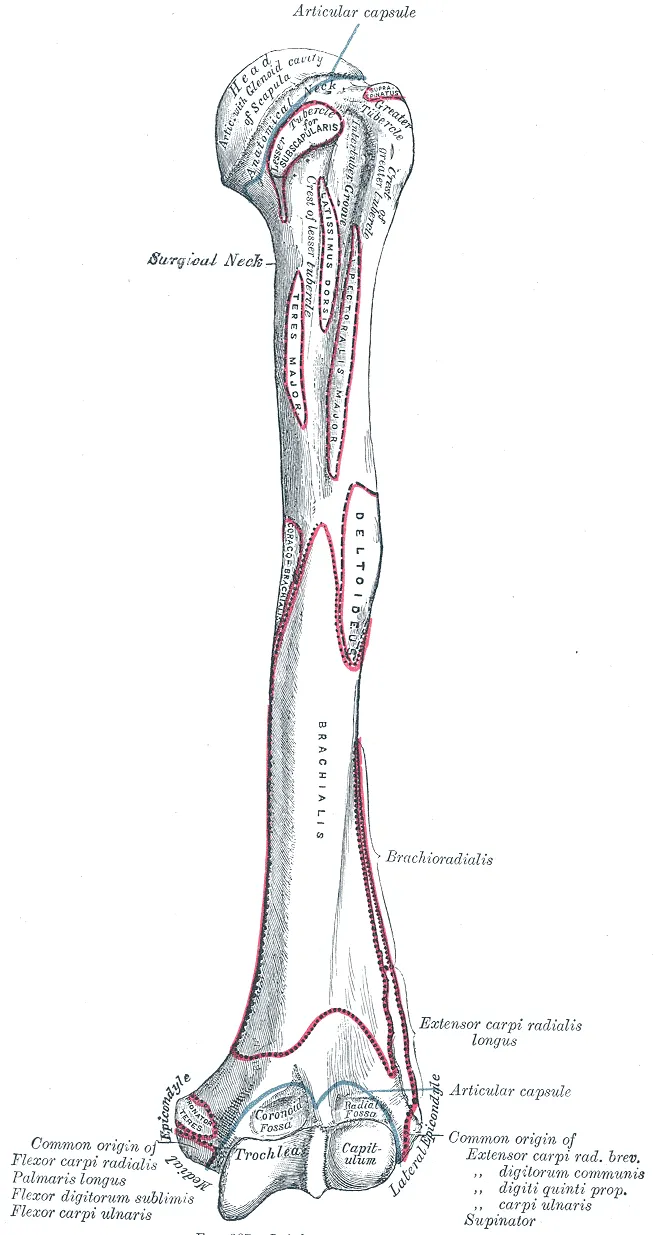
In the figure, the shaft is the long part between the two ends1. The shaft is shaped like a cylinder, with the deltoid tuberosity (a rough patch where the deltoid attaches) on its outer side5,6,7,8. The radial groove on its back carries the radial nerve9.
How the breaks are sorted
The AO/OTA system has three main types: simple, wedge and multifragmentary (in many pieces)1. Each type has three subtypes and is placed in the upper, middle or lower third of the shaft1. The 2026 review says surgeons agree only moderately when applying it1. The same review says plain descriptions of the break’s site and pieces are often preferred in practice1.
Falls or blows can break the shaft straight across (transverse) or in a spiral8. A 2019 review says most shaft fractures in the general population come from a direct blow10. In athletes, it says, spiral breaks from indirect force, as in throwing or arm wrestling, occur more often than in the general population10.
Who it affects
How common it is
| Group studied | What was found |
|---|---|
| Adults, in a 2026 review | 10 to 30 per 100,000 people a year, rising to more than 100 per 100,000 at age 80 or over1 |
| 23,718 fractures in adults in a Danish registry, 1996 to 2018 | 25 per 100,000 a year, stable over 23 years; 62% female and 78% over 5011 |
| 936 fractures at one Helsinki hospital, 2006 to 2016 | Over 60% from simple falls; 3.0% of typical injury fractures were open (through the skin)12 |
The 2026 review describes two peaks: younger men with high-energy injuries, and older women with low-energy falls1. The Helsinki study also found rates peaked in older women and young men12. In the Danish registry, 87% were managed without surgery11.
The 2026 review also summarises a Finnish hospital cohort (a group followed over time)1. In it, sports injuries caused 8%1. Arm wrestling and horse riding each caused 3%1. In the same cohort, 46% of breaks were in the middle of the shaft, 34% in the upper part and 20% in the lower1.
Throwing and arm wrestling
Studies of two sports describe the break13,14:
- Throwing. In 90 recreational baseball players who broke the shaft while throwing, 89 were men, with an average age of 2513. Every break was a spiral, most often in the lower half of the bone except in early teens13. The authors conclude the throwing action itself causes it13.
- Arm wrestling. A systematic review of 57 studies found 153 people, 82% of them males aged 15 to 3414. Every break was a spiral, and 90% were in the lower third or where it meets the middle third14. All 46 with known match details broke it when one opponent suddenly added force14.
When the nerve is hurt too
The radial nerve lies directly on the bone in the lower third of the arm, with no muscle between15. A study of 27 cadavers concluded that fractures, and surgery to fix them, put it at risk along the outer side of that third16.
A 2021 review of closed fractures found palsy in none of 17 upper-third breaks and 19 of 152 lower-third breaks4. Palsy was reported in 18.4% of arm-wrestling breaks and 16% of throwing breaks13,14. A review of children’s shaft fractures put it at 4.34%17. The radial nerve page covers the nerve itself.
What studies found
How the trial evidence grew
A 2012 Cochrane review searched to October 2011 for randomised trials of surgery against non-surgical care in adults18. It found none, so it had no trial evidence on which gave a better outcome18. A 2023 meta-analysis later pooled four such trials, with 292 patients3. The 2025 HU-FIX report names four published trials, 292 patients in all, among them FISH and a Brazilian trial19.
The brace
In the FISH trial, the functional brace ran from shoulder to elbow but left both joints free to move2. The 2026 review says Sarmiento’s group brought it in during 1977 and it became the standard non-surgical approach1. The same review notes that evidence comparing non-surgical methods is limited1.
In a series of 922 braced patients, 620 could be followed22. Nonunion occurred in 6% of open fractures and under 2% of closed ones22. Later trials, covered below, report higher rates with a brace: 25% in FISH and 18% in HU-FIX2,19. In the HU-FIX trial, braced patients spent a median of 87 days immobilised in the brace19.
Trials of surgery against the brace
Two trials compared plate fixation, surgery that holds a broken bone together with a metal plate, with a functional brace2,19. Both scored arm function with DASH, a questionnaire that scores disability of the arm, shoulder and hand2,19.
| Trial | Who and what | Main finding |
|---|---|---|
| FISH, 2 Finnish trauma centres | 82 adults with closed, displaced breaks; plate (38) or brace (44)2 | DASH at 12 months 8.9 against 12.0, not a significant difference2 |
| HU-FIX, 1 UK trauma centre | 70 adults with isolated, closed breaks; plate (36) or brace (34)19 | Surgery scored better at 6 weeks and 3 months, but not at 6 or 12 months19 |
In FISH, the smallest gap counted as clinically important was 10 points2. In its brace group, 30% had surgery within 12 months to help healing, and 25% developed a nonunion2. In the plate group, 8% developed a temporary radial nerve palsy2.
At two years in FISH, the 14 braced patients who needed later surgery scored about 11 points worse than either other group23. At five years in the FISH trial of 82 adults, mean DASH scores were 8.6 after surgery and 8.4 with bracing24. That is a gap of 0.2 points24. By then, those who had needed later surgery no longer differed significantly from the other groups24. The authors note a meaningful difference cannot be fully ruled out, and 18% were lost to follow-up24.
In HU-FIX, nonunion occurred in 6% after surgery and 18% with bracing, a difference that was not statistically significant19. The authors report two deep infections after surgery, one in a patient who died after further surgery19.
A Brazilian randomised trial of 110 patients compared minimally invasive plating with a functional brace25. DASH scores favoured plating only at 6 months, at 10.9 against 16.9, and nonunion was 0% against 15%25. Its authors called the advantage of uncertain clinical benefit25. The trial’s 2013 published protocol records funding from the São Paulo Research Foundation (FAPESP), a noncommercial government agency26.
What pooled studies found
- The 2023 meta-analysis of trials: function scores were better after surgery at 6 months, but not at 1 year3. It found no differences in pain or quality of life3. Nonunion was 0.7% after surgery and 15.7% without, but short-lived radial nerve palsy was 17.4% against 0.7%3.
- A 2024 network meta-analysis, which compares many options at once, of 25 studies: nonunion was highest without surgery, at 15.87%27. Its authors conclude that their results support surgery giving better function and faster healing27.
- A review of 12 studies found fewer nonunions after surgery, but more deep infections28.
- A meta-analysis of 17 studies reported a trend toward fewer nonunions after surgery29.
The 2026 review sums up three trials as suggesting faster recovery and less nonunion after surgery, with more nerve palsy or infection1. It reads long-term results as comparable between surgery and a brace that worked1. It estimates 5 to 9 operations prevent one nonunion, while 13 to 50 cause one infection or nerve palsy1.
A cohort of 390 adults with simple or wedge breaks, in 29 hospitals, found better function after surgery up to 6 months1,30. It found more nonunion without surgery30. Its authors favour surgery as the first choice for simple and wedge breaks1,30. But the groups differed at the start: those operated on were younger and less often female30.
Nonunion
The 2026 review calls nonunion the most common problem after non-surgical care1. It links nonunion with worse longer-term outcomes, even when the bone later heals after surgery1. A retrospective study (one that looks back at records) covered 663 fractures at one Edinburgh centre20. Nonunion occurred in 22.7% without surgery and 2.9% after it20. Taking NSAIDs (drugs, such as ibuprofen, that ease pain and inflammation) before the injury was linked with nonunion without surgery, as was shoulder arthritis20.
The radial nerve after the fracture
The 2021 review of closed fractures found no difference in nerve recovery between surgery that explored the nerve (98%) and no surgery (91%)4. The radial nerve page reports recovery rates from other reviews31.
Return to work and sport
An Edinburgh retrospective cohort asked people about work and sport by postal questionnaire21. Of 177 in work before the injury, followed for a mean of 5.8 years, 85% returned at a mean of 14 weeks21. Only 60% went back full-time to the same job21. Return to work did not differ between those managed with and without surgery21.
Of 182 who played sport, 89% returned, 70% within a year, though activity level fell on average21. Age 60 or over was linked with not returning to sport21.
In HU-FIX, 78% of 32 sport players returned at a median of 13 weeks19. More returned after surgery (17 of 18) than after bracing (8 of 14), while time to return did not differ significantly19. Return to work did not differ significantly between the groups19. In a surgeon survey of throwers’ breaks, 48 of 52 athletes returned to sport, faster after plating but with more complications32. The return rate and healing time did not differ significantly by approach32.
Connections
The break is in the shaft of the humerus, whose page covers its shape, how it heals and how throwing strengthens it5,8,33. The deltoid attaches to the deltoid tuberosity on the outer side of the shaft6,7,8. The radial nerve runs in the groove on its back9. Nerves lie close to the bone, so fractures of it may damage them8. Overuse damage to the shaft is described on the stress fracture page34.
Humeral shaft fracture is a break of
Humeral shaft fracture can injure
Humeral shaft fracture affects the bone that anchors
Humeral shaft fracture has a low-risk stress site described in
Sources
- Ibounig T, Wolf O, Oliver WM, Karimi D, Viberg B, Ratasvuori M, Launonen AP, Lähdeoja T, Rasmussen JV, Rämö L (2026). An Acta Orthopaedica educational article: Treatment of adult patients with a humeral shaft fracture.. Acta Orthopaedica. doi:10.2340/17453674.2026.45597 PMID 41842657
- Rämö L, Sumrein BO, Lepola V, Lähdeoja T, Ranstam J, Paavola M, Järvinen T, Taimela S (2020). Effect of Surgery vs Functional Bracing on Functional Outcome Among Patients With Closed Displaced Humeral Shaft Fractures: The FISH Randomized Clinical Trial.. JAMA. doi:10.1001/jama.2020.3182 PMID 32396179
- Oliver WM, Bell KR, Molyneux SG, White TO, Clement ND, Duckworth AD (2023). Surgical Versus Nonsurgical Management of Humeral Shaft Fractures: A Systematic Review and Meta-Analysis of Randomized Trials.. Journal of the American Academy of Orthopaedic Surgeons. doi:10.5435/JAAOS-D-22-00432 PMID 36580054
- Hendrickx LAM, Hilgersom NFJ, Alkaduhimi H, Doornberg JN, van den Bekerom MPJ (2021). Radial nerve palsy associated with closed humeral shaft fractures: a systematic review of 1758 patients.. Archives of orthopaedic and trauma surgery. doi:10.1007/s00402-020-03446-y PMID 32285189
- Mostafa E, Imonugo O, Varacallo MA (2023). Anatomy, Shoulder and Upper Limb, Humerus.. StatPearls. PMID 30521242
- Stokey PJ, Kaur S, Lee A, Behrens K, Ebraheim N (2024). Anatomy and Deficiency of the Deltoid Muscle: A Review of Literature.. Orthopedic Reviews. doi:10.52965/001c.115352 PMID 38562147
- Sanderson B, Bogard M, Jazayeri R (2021). Traumatic rupture of the posterior deltoid tendon during weight lifting: A case report and review of literature.. Clinical Case Reports. doi:10.1002/ccr3.3710 PMID 34466228
- Betts JG, Young KA, Wise JA, Johnson E, Poe B, Kruse DH, Korol O, Johnson JE, Womble M, DeSaix P (2022). Anatomy and Physiology 2e. OpenStax. Link
- Bounds EJ, Frane N, Jajou L, Weishuhn LJ, Kok SJ (2023). Humeral Shaft Fractures.. StatPearls. PMID 28846218
- Burnier M, Barlow JD, Sanchez-Sotelo J (2019). Shoulder and Elbow Fractures in Athletes.. Current Reviews in Musculoskeletal Medicine. doi:10.1007/s12178-019-09530-0 PMID 30706285
- Karimi D, Qvistgaard SW, Gundtoft PH, Brorson S, Viberg B (2023). Unchanged incidence but change in treatment trends from 1996 to 2018: 23,718 humeral shaft fractures from the Danish National Patient Registry.. Acta Orthopaedica. doi:10.2340/17453674.2023.21125 PMID 37831408
- Mattila H, Keskitalo T, Simons T, Ibounig T, Rämö L (2023). Epidemiology of 936 humeral shaft fractures in a large Finnish trauma center.. Journal of Shoulder and Elbow Surgery. doi:10.1016/j.jse.2022.10.020 PMID 36435484
- Ogawa K, Yoshida A (1998). Throwing fracture of the humeral shaft. The American journal of sports medicine. doi:10.1177/03635465980260021401 PMID 9548118
- Ogawa K, Yoshida A, Matsumura N, Inokuchi W (2022). Fractures of the humeral shaft caused by arm wrestling: a systematic review.. JSES reviews, reports, and techniques. doi:10.1016/j.xrrt.2022.05.005 PMID 37588473
- Latef TJ, Bilal M, Vetter M, Iwanaga J, Oskouian RJ, Tubbs RS (2018). Injury of the Radial Nerve in the Arm: A Review.. Cureus. doi:10.7759/cureus.2199 PMID 29666777
- Carlan D, Pratt J, Patterson JMM, Weiland AJ, Boyer MI, Gelberman RH (2007). The radial nerve in the brachium: an anatomic study in human cadavers.. The Journal of hand surgery. doi:10.1016/j.jhsa.2006.07.001 PMID 17923300
- Wiktor Ł, Tomaszewski R, Damps M (2023). Radial Nerve Palsy Associated with Humeral Shaft Fractures in Children.. BioMed research international. doi:10.1155/2023/3974604 PMID 38075371
- Gosler MW, Testroote M, Morrenhof JW, Janzing HM (2012). Surgical versus non-surgical interventions for treating humeral shaft fractures in adults.. Cochrane Database of Systematic Reviews. doi:10.1002/14651858.CD008832.pub2 PMID 22258990
- Oliver WM, Bell KR, Carter TH, Graham C, White TO, Clement ND, Duckworth AD, Molyneux SG (2025). Operative vs Nonoperative Management of Fractures of the Humeral Diaphysis: The Humeral Shaft Fracture Fixation Randomized Clinical Trial.. JAMA Surgery. doi:10.1001/jamasurg.2025.0301 PMID 40136271
- Oliver WM, Searle HKC, Ng ZH, Molyneux SG, White TO, Clement ND, Duckworth AD (2021). Factors associated with humeral shaft nonunion.. Journal of Shoulder and Elbow Surgery. doi:10.1016/j.jse.2021.01.029 PMID 33636324
- Oliver WM, Molyneux SG, White TO, Clement ND, Duckworth AD (2022). Return to work and sport after a humeral shaft fracture.. Bone & Joint Open. doi:10.1302/2633-1462.33.BJO-2021-0198.R1 PMID 35293229
- Sarmiento A, Zagorski JB, Zych GA, Latta LL, Capps CA (2000). Functional bracing for the treatment of fractures of the humeral diaphysis.. Journal of Bone and Joint Surgery (American volume). doi:10.2106/00004623-200004000-00003 PMID 10761938
- Rämö L, Paavola M, Sumrein BO, Lepola V, Lähdeoja T, Ranstam J, Järvinen TLN, Taimela S (2021). Outcomes With Surgery vs Functional Bracing for Patients With Closed, Displaced Humeral Shaft Fractures and the Need for Secondary Surgery: A Prespecified Secondary Analysis of the FISH Randomized Clinical Trial.. JAMA Surgery. doi:10.1001/jamasurg.2021.0906 PMID 33851991
- Rämö L, Ibounig T, Sumrein BO, Lepola V, Paavola M, Taimela S, Järvinen TLN (2024). Five-Year Follow-Up of Surgery vs Functional Bracing for Closed Displaced Humeral Shaft Fractures.. JAMA. doi:10.1001/jama.2024.2671 PMID 38436996
- Matsunaga FT, Tamaoki MJ, Matsumoto MH, Netto NA, Faloppa F, Belloti JC (2017). Minimally Invasive Osteosynthesis with a Bridge Plate Versus a Functional Brace for Humeral Shaft Fractures: A Randomized Controlled Trial.. Journal of Bone and Joint Surgery (American volume). doi:10.2106/JBJS.16.00628 PMID 28375891
- Matsunaga FT, Tamaoki MJ, Matsumoto MH, dos Santos JB, Faloppa F, Belloti JC (2013). Treatment of the humeral shaft fractures--minimally invasive osteosynthesis with bridge plate versus conservative treatment with functional brace: study protocol for a randomised controlled trial.. Trials. doi:10.1186/1745-6215-14-246 PMID 23924198
- Colasanti CA, Anil U, Cerasani MN, Li ZI, Morgan AM, Simovitch RW, Leucht P, Zuckerman JD (2024). Management of Humeral Shaft Fracture: A Network Meta-Analysis of Individual Treatment Modalities.. Journal of Orthopaedic Trauma. doi:10.1097/BOT.0000000000002808 PMID 38578605
- Lode I, Nordviste V, Erichsen JL, Schmal H, Viberg B (2020). Operative versus nonoperative treatment of humeral shaft fractures: a systematic review and meta-analysis.. Journal of Shoulder and Elbow Surgery. doi:10.1016/j.jse.2020.05.030 PMID 32553853
- Li Y, Luo Y, Peng J, Fan J, Long XT (2024). Clinical effect of operative vs nonoperative treatment on humeral shaft fractures: Systematic review and meta-analysis of clinical trials.. World Journal of Orthopedics. doi:10.5312/wjo.v15.i8.783 PMID 39165869
- Den Hartog D, Van Bergen SH, Mahabier KC, Verhofstad MHJ, Van Lieshout EMM (2022). Functional and clinical outcome after operative versus nonoperative treatment of a humeral shaft fracture (HUMMER): results of a multicenter prospective cohort study.. European Journal of Trauma and Emergency Surgery. doi:10.1007/s00068-022-01890-6 PMID 35138426
- Shao YC, Harwood P, Grotz MR, Limb D, Giannoudis PV (2005). Radial nerve palsy associated with fractures of the shaft of the humerus: a systematic review.. Journal of Bone and Joint Surgery. British Volume. doi:10.1302/0301-620X.87B12.16132 PMID 16326879
- Altintas B, Anderson NL, Boykin R, Millett PJ (2019). Operative treatment of torsional humeral shaft fractures in throwers leads to an earlier return to sport: a survey of expert shoulder and elbow surgeons.. Knee Surgery, Sports Traumatology, Arthroscopy. doi:10.1007/s00167-019-05733-7 PMID 31612264
- Warden SJ, Mantila Roosa SM, Kersh ME, Hurd AL, Fleisig GS, Pandy MG, Fuchs RK (2014). Physical activity when young provides lifelong benefits to cortical bone size and strength in men.. Proceedings of the National Academy of Sciences of the United States of America. doi:10.1073/pnas.1321605111 PMID 24706816
- Hoenig T, Ackerman KE, Beck BR, Bouxsein ML, Burr DB, Hollander K, Popp KL, Rolvien T, Tenforde AS, Warden SJ (2022). Bone stress injuries. Nature reviews. Disease primers. doi:10.1038/s41572-022-00352-y PMID 35484131
Changes
- First published.