Distal biceps tendon
Also called biceps tendon at the elbow
The tendon that joins the biceps to the radius just below the elbow. How its two parts attach, why it may be weak in the middle, how and in whom it tears, and what studies record afterwards.
- Region
- Elbow
- Muscles
- biceps brachii
- Updated
- September 29, 2026
- Reviewed
- September 29, 2026 · how entries are checked
Function
What the tendon joins
The biceps brachii is the two-headed muscle on the front of the upper arm1. The short head starts at the coracoid process, a hooked bony point at the front of the scapula (shoulder blade)1. The long head starts at the supraglenoid tubercle, a bump just above the shoulder socket, and at the top of the labrum, the socket’s rim1. Its tendon at the shoulder is the long head of biceps tendon8.
At its lower end, the biceps attaches through this tendon to the radial tuberosity, a bump on the radius1. The radius is the forearm bone on the thumb side. The muscle crosses both the shoulder and the elbow9.
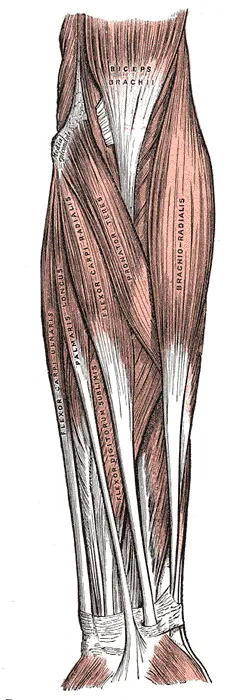
How two heads become one tendon
The two heads often keep separate tendons for part of the way10,11. In 17 cadaver (donated body) elbows, the tendon was in two distinct parts, one from each head, in 1010. In the other seven, the two muscle parts interlocked instead10. On MRI (magnetic resonance imaging) scans of 106 elbows, 96 tendons left the muscle as two11. In 87 of those 96, the two then joined before reaching the radius11.
In 15 cadaver arms, the muscle and tendon turned 90 degrees outward on the way from shoulder to forearm12. The long-head part attached to the upper part of the tuberosity, and the short-head part to the lower part12. In the 17-elbow study, the short head attached further down, placed to be the stronger elbow bender10. The long head attached further from the forearm’s turning axis, placed to be the stronger supinator10.
How big the attachment is
Three studies measured the tendon and its footprint, the patch where it attaches to bone11,12,13:
| Study | What was measured |
|---|---|
| 15 cadaver arms | Footprint about 21 mm long, 7 mm wide and 108 mm² in area12. It began about 23 mm below the joint edge at the top of the radius12 |
| 18 cadaver elbows | A ribbon shape on the little-finger side of the tuberosity, covering 63% of its length and 13% of its width13 |
| MRI scans of 106 elbows | Tendon about 65 mm long; footprint about 16 mm long and 10 mm wide11 |
What the tendon does
The biceps bends the elbow and helps turn the forearm palm up, a movement called supination9. With the elbow straight, it acts as a bender of the forearm2. With the elbow bent it becomes the forearm’s most powerful supinator2.
A moment arm is a muscle’s leverage, meaning how far its line of pull sits from the joint it turns. In two donor arms and a computer model, the biceps’ moment arm for bending the elbow peaked with the elbow straighter14. Its peak was larger with the palm turned up14.
Stress is the force in a tendon for each unit of its cross-sectional area. In 11 young men pulling against resistance without moving the elbow, ultrasound showed tendon stress differed with forearm position15. It was about 52% greater with the palm up or the thumb up than with the palm down15.
The flat sheet that fans off it
At its lower end, the biceps also continues as the bicipital aponeurosis, a broad, flat sheet of tendon2. It crosses the elbow and joins the radius and the fascia of the forearm, a sheet of tough tissue that wraps muscles2. In 17 cadaver elbows, it had three layers and fully wrapped the forearm flexor muscles on the little-finger side10. The authors suggest it may help steady the tendons10.
In ten cadaver arms in an elbow machine, an intact sheet lowered the biceps’ leverage for supination at every elbow angle16. With the elbow fully straight, it even made the biceps act as a pronator, turning the palm down16.
Breakdown
Why the tendon may be weak in the middle
An anatomic study found three zones of blood supply along the tendon17. Arteries fed the upper and lower zones, with a poorly supplied zone averaging 2.14 cm between them17. In the same study, the tendon filled 85% of the space at the upper joint between the two forearm bones with the palm fully down17. CT scans are pictures of the inside of the body built from X-rays. In the same study, CT scans showed that space narrowing by half from palm fully up to palm fully down17.
The authors propose that pinching during forearm turning, and the poorly supplied sections, may add to ruptures from wear17. A review lists possible reasons for rupture18. These include earlier inflammation or wear in the tendon, a relatively poor blood supply, and a spur on the tuberosity18. These are suggested explanations, not measured causes18.
Camera checks inside the elbows of 53 cadavers, average age 70, found partial tears with no known injury in 40%19. In every one, the fibres had come away on the tendon’s outer side only19.
How ruptures happen
Studies disagree on the kind of muscle work at the moment of rupture4,20. Eccentric work is muscle work done while the muscle lengthens. In a series of 14 people, all described excessive eccentric tension while the arm was pushed out of a bent position20. In 57 videos of ruptures, 88% happened during an isometric contraction, where the muscle works but the joint does not move4. Just 7% of the 57 were eccentric4.
The two video studies agree on arm position3,4:
- In 57 videos, 98% of ruptures happened with the palm turned up and 89% with the elbow bent 10 degrees or less4.
- In 56 videos, 55 of them of men, 96.4% happened with the palm up and the elbow straight or slightly bent3.
- In those 56 videos, the deadlift was the most common activity, at 71.4%3.
A systematic review sums up the research on a question in a set, checkable way. One review of risk factors found heavy weight lifting the most common way the injury happened, at 53.2%6. In a review of 16 athletes with 18 complete ruptures during athletic activity, weightlifting caused 56%21. One case report, a report on a single patient, describes a recreational lifter tearing both tendons at once during a preacher curl22.
How often it tears
Rates vary by where and how they were counted5,20:
| Population | Ruptures per 100,000 people a year |
|---|---|
| One health plan, over five years | 1.220 |
| US insurance database, national estimate | 2.555 |
| Same US study, regional chart review | 5.355 |
Across adults in Finland and Sweden, surgery for this rupture in men rose from 1997 to 201623. Person-years are people times the years each was followed. In Finnish men, it went from 1.3 to 9.6 per 100,000 person-years23. In Swedish men, it went from 0.2 to 5.623.
Who tears it
Most people in these studies were men, with average ages in the mid-forties5,6. In the US study, men made up 95% of cases nationally, and regional patients averaged 46.3 years5. A review of about 7,500 patients found an average age of 46.8, with 96.7% men6. It described 94.7% as having an affinity for sport6. It also found that on average 55.8% had a physical job6.
Some factors went with more ruptures or injuries of this tendon5,20,24. These findings are associations, not proof of cause:
- In one health plan, 43% of people with a rupture smoked, against 9% of members; smokers had 7.5 times the risk20.
- In the US study, smoking and higher body mass index went with more ruptures, while diabetes did not5.
- A database study compared people aged 35 to 75 who filled a testosterone prescription for at least three months with a control group24. Their odds of this injury within a year were about four times higher24.
- A review found tobacco use in 20.8% of cases and anabolic steroid use, a drug related to testosterone, in 2.5%6.
- Its authors conclude that steroid use does not seem to raise the risk significantly6.
Tendinopathy
Tendinopathy is local pain in a tendon that comes with activities that load it. Across 1,180 elbow MRI reports, 10% showed signs of tendinopathy in this tendon on the scan25. Of those, 53% were found by chance in people without pain at the front of the elbow25. It was most common at ages 40 to 49.9, then 50 to 59.9, and was significantly linked to rising age25.
Recovery
The studies below record strength in groups of people after a rupture, with or without repair26. A meta-analysis is a study that pools several earlier studies into one answer. Results differed between studies7,27,28:
| Study | What was found |
|---|---|
| 10 patients, 3 without repair | Those three lost on average 40% of supination strength and about 30% of bending strength27 |
| Same study, 4 reattached straight away | Normal bending and supination strength by one year; in the one person checked at four months, not yet27 |
| 18 people, 20 unrepaired ruptures | Median (middle value) supination strength 63% and bending strength 93% of the other arm28 |
| Meta-analysis of 53 studies, 1,380 patients | Strength scores with surgery: bending 94.7%, supination 89.2%; without: 83.0% and 62.6%7 |
In the 18-person study, compared with a historical group who had surgery, the supination gap was significant but the bending gap was not28. Another meta-analysis covered 2,481 ruptures, 79 of them not repaired26. Repair went with higher strength and endurance for both bending and supination26. People’s own questionnaire scores for arm function were also significantly better after surgical repair26.
In a cohort study at one large institution, 36% of people first managed without surgery went on to have surgery29. That rate did not differ significantly between partial tears, at 34%, and complete tears, at 39%29.
Strength after repair
A meta-analysis covered 272 ruptures repaired within 30 days, followed for a mean of 39.6 months30. The repaired arm had significantly lower bending and supination strength than the uninjured arm30. It also had significantly less range: about 1 degree less bending, and about 8 to 9 degrees less turning of the forearm30. In a series of 183 competitive strength athletes after repair, 73% reported full strength in the arm, and 3% tore the tendon again31.
Returning to sport and work
Three reviews and one league study report how many people went back to sport or work32,33,34,35:
| Group studied | What was found |
|---|---|
| Review of 1,093 people after surgical repair | 91.5% returned to sport, and 85.2% to their earlier level or higher, at a mean of 6.3 months32 |
| Review of 157 athletes, all with surgical repair | 97.5% returned to sport, at a mean of 6.2 months33 |
| NFL (American football) players, 2009–10 to 2022–23 seasons | 73.1% returned to play, but 52.6% returned to their earlier level of performance34 |
| Review of 1,270 people after surgical repair | 89% fully returned to work without changed duties, at a mean of about 14 weeks where time was reported35 |
In the 1,093-person review, the mean age was 44.9 and 99.2% were men32. The injury was linked to sport in 43.5%, and was in the dominant arm in 64.9%32.
Complications after repair
A systematic review pooled 3,091 first-time repairs of this tendon36. Overall, 25% had a complication, 4.6% had a major one, and 1.4% tore again36. The most common problem, in 9.2%, was injury to the lateral cutaneous nerve of the forearm36. This nerve carries feeling and runs along the outer side of the tendon18. Across all nerve injuries in the review, most resolved without further intervention36.
Early movement compared with keeping the arm still
A meta-analysis of 50 studies and 1,577 patients compared outcomes after repair37. It set early movement against a period of immobilisation37. Re-rupture rates, arm-function questionnaire scores and strength did not differ significantly between the two37. The authors rated the quality of the evidence as low to very low37.
Partial tears and tendinopathy
A systematic review looked at partial tears and tendinopathy of this tendon38. Studies reported less elbow pain and better function both with and without surgery38. The evidence was low-level and the studies differed, so results could not be pooled or compared statistically38.
Connections
The muscles that bend the elbow with it
The muscles that bend the elbow include the biceps, the brachialis and the brachioradialis, a forearm muscle9. The brachialis lies under the biceps and adds power to bending the forearm9. In 15 young healthy men bending the elbow as hard as they could, all three were very active39. That held with the palm up, the palm down and the thumb up39.
The other end of the biceps
The long head of biceps tendon starts at the top of the shoulder socket8. In the middle third of the upper arm, it joins the short head as both become muscle8. That muscle then attaches across the elbow to the radial tuberosity, through this tendon1,8.
What studies of the biceps curl show
Related exercise pages: biceps curl. In 11 young men, isometric elbow bending was about 50% stronger with the palm up or thumb up than palm down15. Strain is how much something stretches, as a share of its resting length. In the same men, tendon strain was about 36% greater with the thumb up than palm down15.
Distal biceps tendon is loaded by
Distal biceps tendon shares a muscle with
Distal biceps tendon tore most often in online videos during
Sources
- Hsu D, Anand P, Mabrouk A, Chang KV (2023). Biceps Tendon Rupture.. StatPearls. PMID 30020607
- Tiwana MS, Charlick M, Varacallo MA (2024). Anatomy, Shoulder and Upper Limb, Biceps Muscle.. StatPearls. PMID 30137823
- Lappen S, Siebenlist S, Kadantsev P, Hinz M, Seilern Und Aspang J, Lutz PM, et al (2022). Distal biceps tendon ruptures occur with the almost extended elbow and supinated forearm - an online video analytic study.. BMC Musculoskeletal Disorders. doi:10.1186/s12891-022-05546-9 PMID 35733124
- Jukes C, Dirckx M, Bellringer S, Chaundy W, Phadnis J (2022). Challenging the mechanism of distal biceps tendon rupture using a video analysis study.. Bone & Joint Open. doi:10.1302/2633-1462.310.BJO-2022-0123.R1 PMID 36243942
- Kelly MP, Perkinson SG, Ablove RH, Tueting JL (2015). Distal Biceps Tendon Ruptures. American Journal of Sports Medicine. doi:10.1177/0363546515587738 PMID 26063401
- Jaschke M, Kołodziej Ł, Wilk A, Droździk M (2025). Which risk factors are involved in a distal biceps tendon injury? A systematic review.. Advances in Clinical and Experimental Medicine. doi:10.17219/acem/187891 PMID 39530845
- Cuzzolin M, Secco D, Guerra E, Altamura SA, Filardo G, Candrian C (2021). Operative Versus Nonoperative Management for Distal Biceps Brachii Tendon Lesions: A Systematic Review and Meta-analysis.. Orthopaedic Journal of Sports Medicine. doi:10.1177/23259671211037311 PMID 34734095
- Varacallo MA, Mair SD (2023). Proximal Biceps Tendinitis and Tendinopathy.. StatPearls. PMID 30422594
- Betts JG, Young KA, Wise JA, Johnson E, Poe B, Kruse DH, Korol O, Johnson JE, Womble M, DeSaix P (2022). Anatomy and Physiology 2e. OpenStax. Link
- Eames MH, Bain GI, Fogg QA, van Riet RP (2007). Distal Biceps Tendon Anatomy. Journal of Bone and Joint Surgery (American Volume). doi:10.2106/JBJS.D.02992 PMID 17473142
- Boyle AB, Uri Ke J, Ragg A, MacLean SBM (2022). Anatomy of the distal biceps tendon: an in vivo 3-T magnetic resonance imaging study.. Journal of Shoulder and Elbow Surgery. doi:10.1016/j.jse.2021.11.015 PMID 34973425
- Athwal GS, Steinmann SP, Rispoli DM (2007). The distal biceps tendon: footprint and relevant clinical anatomy.. Journal of Hand Surgery (American Volume). doi:10.1016/j.jhsa.2007.05.027 PMID 17923307
- Mazzocca AD, Cohen M, Berkson E, Nicholson G, Carofino BC, Arciero R, et al (2007). The anatomy of the bicipital tuberosity and distal biceps tendon.. Journal of Shoulder and Elbow Surgery. doi:10.1016/j.jse.2006.04.012 PMID 17055747
- Murray WM, Delp SL, Buchanan TS (1995). Variation of muscle moment arms with elbow and forearm position.. Journal of Biomechanics. doi:10.1016/0021-9290(94)00114-j PMID 7775488
- Smart RR, Kohn S, Richardson CM, Jakobi JM (2018). Influence of forearm orientation on biceps brachii tendon mechanics and elbow flexor force steadiness.. Journal of Biomechanics. doi:10.1016/j.jbiomech.2018.05.039 PMID 29954597
- Miller MC, Schimoler PJ, Kharlamov A, Hammerstedt J, Angelides G, Sumarriva G, et al (2025). The lacertus fibrosus substantially Alters flexion and supination moment arms: A cadaveric study.. Journal of Biomechanics. doi:10.1016/j.jbiomech.2025.112760 PMID 40409120
- Seiler JG 3rd, Parker LM, Chamberland PD, Sherbourne GM, Carpenter WA (1995). The distal biceps tendon. Journal of Shoulder and Elbow Surgery. doi:10.1016/s1058-2746(05)80044-8 PMID 7552670
- Caekebeke P, Duerinckx J, van Riet R (2021). Acute complete and partial distal biceps tendon ruptures: what have we learned? A review.. EFORT Open Reviews. doi:10.1302/2058-5241.6.200145 PMID 34760294
- Dworkin JD, Schmidt CC, Cooke SP, Buce JG, Cook AJ, Miller MC, et al (2023). The pathoanatomy of atraumatic partial distal biceps tears: a cadaveric study.. JSES International. doi:10.1016/j.jseint.2023.01.004 PMID 37266172
- Safran MR, Graham SM (2002). Distal biceps tendon ruptures: incidence, demographics, and the effect of smoking.. Clinical Orthopaedics and Related Research. PMID 12439270
- Kolaczko JG, Knapik DM, McMellen CJ, Mengers SR, Gillespie RJ, Voos JE (2022). Complete Isolated Ruptures of the Distal Biceps Brachii During Athletic Activity: A Systematic Review.. Cureus. doi:10.7759/cureus.27899 PMID 35971400
- Rokito AS, lofin I (2008). Simultaneous bilateral distal biceps tendon rupture during a preacher curl exercise: a case report.. Bulletin of the NYU Hospital for Joint Diseases. PMID 18333833
- Launonen AP, Huttunen TT, Lepola V, Niemi ST, Kannus P, Felländer-Tsai L, et al (2020). Distal Biceps Tendon Rupture Surgery: Changing Incidence in Finnish and Swedish Men Between 1997 and 2016.. Journal of Hand Surgery (American Volume). doi:10.1016/j.jhsa.2020.07.024 PMID 33012613
- Rebello E, Albright JA, Testa EJ, Alsoof D, Daniels AH, Arcand M (2023). The use of prescription testosterone is associated with an increased likelihood of experiencing a distal biceps tendon injury and subsequently requiring surgical repair.. Journal of Shoulder and Elbow Surgery. doi:10.1016/j.jse.2023.02.122 PMID 36918119
- Tuik CK, Cross RE, Hoftiezer YAJ, Raasveld FV, Van Den Bekerom MPJ, Chen NC (2024). Tendinopathy of the Distal Biceps Tendon is a Common Incidental Finding on Magnetic Resonance Imaging of the Elbow.. Archives of Bone and Joint Surgery. PMID 39478842
- Looney AM, Day J, Bodendorfer BM, Wang D, Fryar CM, Murphy JP, et al (2022). Operative vs. nonoperative treatment of distal biceps ruptures: a systematic review and meta-analysis.. Journal of Shoulder and Elbow Surgery. doi:10.1016/j.jse.2021.12.001 PMID 34999236
- Morrey BF, Askew LJ, An KN, Dobyns JH (1985). Rupture of the distal tendon of the biceps brachii. A biomechanical study.. Journal of Bone and Joint Surgery (American Volume). PMID 3972866
- Freeman CR, McCormick KR, Mahoney D, Baratz M, Lubahn JD (2009). Nonoperative treatment of distal biceps tendon ruptures compared with a historical control group.. Journal of Bone and Joint Surgery (American Volume). doi:10.2106/JBJS.H.01150 PMID 19797566
- Schultz MJ, Riebesell S, Kwan S, Radack T, Rivlin M, Tulipan J (2026). Thirty-Six Percent Conversion to Surgery Rate for Nonsurgical Treatment of Complete and Partial Distal Biceps Tears.. Journal of Hand Surgery (American Volume). doi:10.1016/j.jhsa.2025.12.027 PMID 41925673
- Calderazzi F, Lucchetta L, Donelli D, Costantino C, Vaienti E (2025). Surgically treated acute distal biceps tendon injuries: What results do they have in comparison with the contralateral healthy arm? A systematic review and meta-analysis.. Orthopaedics & Traumatology: Surgery & Research. doi:10.1016/j.otsr.2023.103785 PMID 38070732
- Lappen S, Fritsch L, Hinz M, Lacheta L, Siebenlist S, Ritsch M (2025). Distal Biceps Tendon Repair in Competitive Strength Athletes: A Retrospective Series of 183 Athletes.. Orthopaedic Journal of Sports Medicine. doi:10.1177/23259671251322700 PMID 40182566
- Boufadel P, Daher M, Lopez R, Fares MY, Lawand J, Khan AZ, et al (2025). Return to Sport After Distal Biceps Tendon Repair: A Systematic Review.. American Journal of Sports Medicine. doi:10.1177/03635465241295618 PMID 39836380
- Pitsilos C, Gigis I, Chitas K, Papadopoulos P, Ditsios K (2022). Systematic review of distal biceps tendon rupture in athletes: treatment and rehabilitation.. Journal of Shoulder and Elbow Surgery. doi:10.1016/j.jse.2022.02.027 PMID 35367620
- Garlapaty AR, Jones M, Baumann J, Gunn C, Cook JL, DeFroda SF (2025). Characterization of distal biceps tendon and triceps tendon injuries in National Football League players from 2009 to 2022.. Journal of Orthopaedics. doi:10.1016/j.jor.2025.01.033 PMID 39991508
- Rubinger L, Solow M, Johal H, Al-Asiri J (2020). Return to work following a distal biceps repair: a systematic review of the literature.. Journal of Shoulder and Elbow Surgery. doi:10.1016/j.jse.2019.12.006 PMID 32147339
- Amarasooriya M, Bain GI, Roper T, Bryant K, Iqbal K, Phadnis J (2020). Complications After Distal Biceps Tendon Repair: A Systematic Review.. American Journal of Sports Medicine. doi:10.1177/0363546519899933 PMID 32091914
- Schönweger F, Cuzzolin M, Sangiorgio A, Guerra E, Filardo G, Candrian C (2026). Distal biceps tendon repair: immobilization versus early mobilization. A systematic review and meta-analysis.. EFORT Open Reviews. doi:10.1530/EOR-2025-0152 PMID 42383714
- Sebastiani RS, Herman ZJ, Rothrauff BB, Fowler JR, Lin A (2026). Clinical outcomes following treatment of distal biceps tendon partial tears and tendinopathy: a systematic review.. JSES Reviews, Reports, and Techniques. doi:10.1016/j.xrrt.2026.100770 PMID 42305929
- Caufriez B, Dugailly PM, Brassinne E, Schuind F (2018). The Role of the Muscle Brachioradialis in Elbow Flexion: An Electromyographic Study.. Journal of Hand Surgery Asian-Pacific Volume. doi:10.1142/S2424835518500145 PMID 29409427
Changes
- Tidy pass: minor review findings fixed, glosses aligned with the reviewed glossary.
- First published.