Long head of biceps tendon
Also called long head biceps tendon, LHB tendon
The tendon that runs from the top of the shoulder socket, down a groove in the upper arm bone, to the biceps. How it runs, what holds it in place, how it wears, tears and slips, and what surgery studies report.
- Region
- Shoulder
- Muscles
- biceps brachii
- Updated
- September 29, 2026
- Reviewed
- September 29, 2026 · how entries are checked
Function
Where the tendon starts
The biceps brachii is the two-headed muscle on the front of the upper arm, and this tendon belongs to its long head1,2. The tendon starts at the top of the shoulder socket1. There it attaches to the supraglenoid tubercle, a bump of bone, and to the upper labrum, the rim of tough tissue around the socket1.
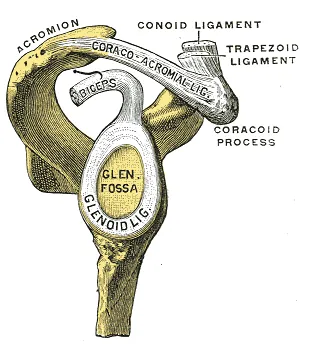
The exact starting point varies from person to person6. In about half of people it starts mainly from the back part of the labrum6. In about 20% it starts straight from the bony tubercle, and in about 30% from both6. The tendon is widest at this starting point6.
How it runs down the arm
The tendon averages about 9 cm long6. In 207 shoulders measured during arthroscopy (keyhole surgery inside a joint), it averaged 6.0 mm wide, with a range of 3 to 10 mm7. It runs inside the shoulder joint but outside the joint’s synovial lining, the thin inner layer of the joint6. It narrows as it runs at a slant toward a groove in the humerus6.
That groove, the intertubercular or bicipital groove, runs between two bumps on the humerus called the greater and lesser tubercles2. Where the tendon leaves the top of the groove, it turns 30 to 40 degrees toward its start point6. For that reason, the soft tissues at this bend are described as critical to keeping it in place6.
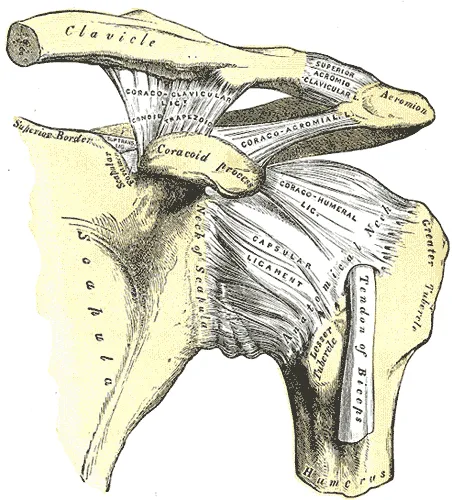
Its shape changes along the way8. In seven fresh-frozen tendons, it was flatter where it passed over the humeral head (the ball at the top of the humerus)8. It was more triangular inside the groove8.
What holds it in the groove
At the groove, a sling of soft tissue holds the tendon, known as the biceps pulley1. It is made of these parts1:
- part of the subscapularis, a rotator cuff muscle on the front of the shoulder blade1;
- part of the supraspinatus, a rotator cuff muscle along the top of the shoulder blade1;
- the coracohumeral ligament, a tough band of tissue that holds bones together1;
- the superior glenohumeral ligament, a ligament at the top of the main shoulder joint1.
A scoping review reports growing agreement that this pulley is the main thing keeping the tendon in its groove3.
What the biceps does
The biceps crosses both the shoulder and the elbow2. It bends the elbow, helps supinate the forearm (turn the palm up), and helps raise the arm forward at the shoulder2. With the elbow straight it bends the elbow, but with the elbow bent it becomes the forearm’s strongest supinator9. Abduction means lifting the arm out to the side. One reference text states that, with the arm turned outward, the biceps supplies about 10% of the total power for abduction1.
What studies disagree on at the shoulder
Studies disagree on whether the long head works at a healthy shoulder3. A scoping review found six studies showing long head activity as the arm was raised, and four finding no significant activity3. Two studies with the elbow braced show the split10,11:
| Study | What it found |
|---|---|
| 11 healthy men, sensors on the skin | Both biceps heads were active in every arm-raising task tested, and more so as the arm rose10 |
| Ten shoulders, fine wires in the long head | No electrical activity during shoulder movement, even with a 5-pound weight11 |
The same review found 13 studies of intact shoulders in cadavers, bodies donated for study3. It found six more that simulated injuries such as rotator cuff tears3. Ten showed a role in steadying the shoulder, and six a role in holding the humeral head down3. Across 214 articles, the review concluded that the long head does little to raise or steady a healthy shoulder3. It found a larger role when the rotator cuff has failed or the tendon is missing3.
How strong it is and where its blood comes from
In pull tests of seven fresh-frozen tendons, the tendon failed at 32.5 megapascals (a unit of force per area)8. Its modulus, a measure of how stiff the material is in itself, was 421 megapascals8. Every one of the seven failed in its middle part8.
The tendon’s blood comes from an artery called the anterior humeral circumflex artery1. Studies have found two areas with little blood supply1. One is on its deep underside in the groove, and one is near its start at the top of the socket1.
Breakdown
The kinds of problem
A scoping review lists the common long head problems3:
- instability of the tendon, where it partly or fully slips out of its groove3,7;
- tendinopathy, including tears and ruptures3;
- pulley lesions3;
- abnormal grooves3;
- superior labral (SLAP) lesions, at the upper labrum3;
- a missing tendon3.
A scoping review found anatomical variations in 36 studies, most often unusual starting points, extra heads and a missing long head tendon3. In 229 shoulders seen during arthroscopy, the tendon was missing in 21, or 9.2%7.
How it goes with rotator cuff problems
Long head problems and rotator cuff problems tend to be found together4,12. In 406 shoulder MRI reports from adults with shoulder pain, any cuff problem was linked to a long head problem4. The odds ratio, how many times higher the odds are in one group, was 6.94. When the long head showed tendinopathy, only 5% of supraspinatus tendons were normal4. When the supraspinatus showed tendinopathy, about half of long head tendons were normal4.
A systematic review sums up the research on a question in a set, checkable way. One such review of five studies found long head lesions in 22% to 78.5% of people with long-term supraspinatus problems12. The smaller studies reported the higher rates12. A scoping review found that the two often occur together, but whether one causes the other has not been shown3.
Impingement is pinching of tissue in the space beneath the acromion, the bony point at the top of the shoulder. In 200 shoulders having surgery for impingement, 40% showed visible wear of the long head tendon13. Of those shoulders, 91% also had rotator cuff tears13.
How it changes with age
In the 406 MRI reports, long head tendinopathy grew more common with age, by about 4% per year4. Among the adults imaged for shoulder pain, everyone aged 85 or older had both long head and rotator cuff tendinopathy4.
When the pulley tears and the tendon slips
In one group of shoulders seen during arthroscopy, 67 of 207, or 32.4%, had a torn biceps pulley7. People with pulley tears were older, 57 years against 44 on average7. Pulley tears were linked to the tendon partly or fully slipping out of its groove7. The pulley was torn in all 27 shoulders where the tendon had fully slipped out7. Pulley tears were also linked to rotator cuff injury7.
A scoping review found a strong link between an unstable tendon and rotator cuff problems in twelve articles3. Eight of them involved subscapularis tears3.
When the tendon ruptures
One study followed 27 people with a sudden long head rupture who had MRI scans14. Of these, 74% were men, and their average age was 6114. In 85% the injury was low-energy, and 41% had shoulder pain beforehand14. The scans showed rotator cuff disease in 93%, including 13 full-thickness tears, tears right through the tendon14. A case report, which covers a single patient, describes a young, active man who ruptured the tendon during 25-pound biceps curls15.
Recovery
After a rupture, with and without repair
One study compared people whose ruptures were repaired by surgery with people managed without surgery16. Lasting arm pain was uncommon16. Elbow weakness was self-reported by 20 of 30 people without surgery, against 4 of 27 repaired shoulders16. The group without surgery went back to work sooner16. But 11 of them could not return to full work capacity, against 2 in the surgery group16.
In the same study, 13 people without surgery had their strength tested16. On average they had lost 21% of their supination strength and 8% of their elbow-bending strength16. They had no loss in grip, in turning the palm down, or in straightening the elbow16.
Cutting versus reattaching the tendon
Tenotomy means cutting the long head tendon, and tenodesis means reattaching it5. Reviews and randomised trials, which assign people to groups by chance, report these results5,17,18,19. They include Popeye deformity, a bulge of the biceps low in the upper arm17,19:
| Study | Pain and function | Popeye deformity or arm shape |
|---|---|---|
| Meta-analysis of 8 studies, 615 people | No difference in long-term pain or a shoulder function score5 | More common after cutting, odds ratio 4.705 |
| Meta-analysis of 11 randomised trials, 860 people | Similar reported function and pain17 | Less common after reattaching, odds ratio 0.2917 |
| Review of 5 randomised trials, 468 people, mean age about 60 | Only one of the trials that tested strength found a difference: better supination after reattaching18 | Cosmetic deformity in 23.3% after cutting and 6.8% after reattaching18 |
| One randomised trial, followed to 24 months | Younger people with a deformity were less satisfied with it, though the study found no difference in function at 24 months19 | 33% after cutting and 9.5% after reattaching19 |
Returning to sport and duty after reattaching
Two systematic reviews looked at return to sport after tenodesis20,21. One covered 17 studies with 374 cases, and found that 217 of 269 cases, or 80.7%, returned to sport20. Of 59 cases, 43, or 72.9%, returned to the same level20. The average time to return was 5.4 months20. In the same review, 79.6% of overhead athletes returned to play, and 82.4% of military personnel returned to duty20.
The second review covered nine studies of 161 people aged 35 or younger, with a mean age of 2521. Across those studies, return-to-sport rates ranged widely, from 35% to 100%21.
When the rotator cuff is torn too
In 291 people with full-thickness rotator cuff tears that could not be repaired, the long head tendon was cut3. Afterwards, the humeral head moved significantly upward3. A scoping review also looked at people whose long head tendon was healthy3. Adding tenotomy or tenodesis to a cuff repair gave no extra improvement over the cuff repair alone3.
Connections
The rest of the biceps
Below the groove, the long head joins the short head in the middle third of the upper arm1. The muscle then crosses the elbow and attaches to the radial tuberosity, a bump on the forearm bone1. It also attaches to the forearm’s fascia, a sheet of tough tissue that wraps or joins muscles1. The distal biceps tendon is the tendon at that elbow end22.
What studies of the biceps curl show
Related exercise pages: biceps curl15,23. One study used shear wave elastography, an ultrasound method, to estimate tension in this tendon in 13 healthy women23. With the elbow bent to 90 degrees, tension was lower with the palm up than palm down during a contraction without weight23. When holding a weight, tension did not differ significantly between the two forearm positions23.
The rotator cuff
The rotator cuff is formed by the tendons of four muscles that join the shoulder blade to the humerus2. Two of those muscles, the subscapularis and supraspinatus, form part of the sling that holds this tendon in its groove1. A scoping review found early and excess long head activity in people with unstable shoulders or rotator cuff tears that cause symptoms3. This came from studies using electromyography (EMG), measuring a muscle’s activity by picking up its electrical signals3. The authors suggest the long head may be compensating in these injured shoulders3.
Long head of biceps tendon is loaded by
Long head of biceps tendon shares a muscle with
Long head of biceps tendon works with at the shoulder
Sources
- Varacallo MA, Mair SD (2023). Proximal Biceps Tendinitis and Tendinopathy.. StatPearls. PMID 30422594
- Betts JG, Young KA, Wise JA, Johnson E, Poe B, Kruse DH, Korol O, Johnson JE, Womble M, DeSaix P (2022). Anatomy and Physiology 2e. OpenStax. Link
- Diplock B, Hing W, Marks D (2023). The long head of biceps at the shoulder: a scoping review.. BMC Musculoskeletal Disorders. doi:10.1186/s12891-023-06346-5 PMID 36978047
- Canavan K, Zai Q, Bruni D, Alexander J, Oude Nijhuis KD, Ring D (2025). Long Head of Biceps Tendinopathy Is Associated With Age and Cuff Tendinopathy on MRI Obtained for Evaluation of Shoulder Pain.. Clinical Orthopaedics and Related Research. doi:10.1097/CORR.0000000000003342 PMID 39679662
- Pozzetti Daou J, Nagaya DY, Matsunaga FT, Sugawara Tamaoki MJ (2021). Does Biceps Tenotomy or Tenodesis Have Better Results After Surgery? A Systematic Review and Meta-analysis.. Clinical Orthopaedics and Related Research. doi:10.1097/CORR.0000000000001672 PMID 33617158
- Varacallo MA, Mair SD (2023). Biceps Tendon Dislocation and Instability.. StatPearls. PMID 30475566
- Braun S, Horan MP, Elser F, Millett PJ (2011). Lesions of the biceps pulley.. The American Journal of Sports Medicine. doi:10.1177/0363546510393942 PMID 21335355
- McGough RL, Debski RE, Taskiran E, Fu FH, Woo SL (1996). Mechanical properties of the long head of the biceps tendon.. Knee Surgery, Sports Traumatology, Arthroscopy. doi:10.1007/BF01466622 PMID 8739718
- Tiwana MS, Charlick M, Varacallo MA (2024). Anatomy, Shoulder and Upper Limb, Biceps Muscle.. StatPearls. PMID 30137823
- Sakurai G, Ozaki J, Tomita Y, Nishimoto K, Tamai S (1998). Electromyographic analysis of shoulder joint function of the biceps brachii muscle during isometric contraction.. Clinical Orthopaedics and Related Research. doi:10.1097/00003086-199809000-00015 PMID 9755771
- Levy AS, Kelly BT, Lintner SA, Osbahr DC, Speer KP (2001). Function of the long head of the biceps at the shoulder: electromyographic analysis.. Journal of Shoulder and Elbow Surgery. doi:10.1067/mse.2001.113087 PMID 11408907
- Redondo-Alonso L, Chamorro-Moriana G, Jiménez-Rejano JJ, López-Tarrida P, Ridao-Fernández C (2014). Relationship between chronic pathologies of the supraspinatus tendon and the long head of the biceps tendon: systematic review.. BMC Musculoskeletal Disorders. doi:10.1186/1471-2474-15-377 PMID 25408141
- Murthi AM, Vosburgh CL, Neviaser TJ (2000). The incidence of pathologic changes of the long head of the biceps tendon.. Journal of Shoulder and Elbow Surgery. doi:10.1067/mse.2000.108386 PMID 11075320
- Vestermark GL, Van Doren BA, Connor PM, Fleischli JE, Piasecki DP, Hamid N (2018). The prevalence of rotator cuff pathology in the setting of acute proximal biceps tendon rupture.. Journal of Shoulder and Elbow Surgery. doi:10.1016/j.jse.2018.01.006 PMID 29478942
- Miller KE, Solomon DJ (2008). Paralabral rupture of the proximal biceps tendon from light weightlifting.. Military Medicine. doi:10.7205/milmed.173.12.1238 PMID 19149346
- Mariani EM, Cofield RH, Askew LJ, Li GP, Chao EY (1988). Rupture of the tendon of the long head of the biceps brachii. Surgical versus nonsurgical treatment.. Clinical Orthopaedics and Related Research. PMID 3342572
- Hartland AW, Islam R, Teoh KH, Rashid MS (2022). Clinical effectiveness of tenotomy versus tenodesis for long head of biceps pathology: a systematic review and meta-analysis.. BMJ Open. doi:10.1136/bmjopen-2022-061954 PMID 36220319
- Belk JW, Kraeutler MJ, Houck DA, Chrisman AN, Scillia AJ, McCarty EC (2021). Biceps tenodesis versus tenotomy: a systematic review and meta-analysis of level I randomized controlled trials.. Journal of Shoulder and Elbow Surgery. doi:10.1016/j.jse.2020.11.012 PMID 33373685
- Woodmass JM, McRae SMB, Lapner PL, Sasyniuk T, Old J, Stranges G, Dubberly J, Verhulst FV, MacDonald PB (2021). Effect of age, gender, and body mass index on incidence and satisfaction of a Popeye deformity following biceps tenotomy or tenodesis: secondary analysis of a randomized clinical trial.. Journal of Shoulder and Elbow Surgery. doi:10.1016/j.jse.2021.05.003 PMID 34022365
- Cassidy JT, Hurley ET, Moore D, Pauzenberger L, Mullett H (2021). The majority of patients return to athletic activity following biceps tenodesis.. Knee Surgery, Sports Traumatology, Arthroscopy. doi:10.1007/s00167-020-05930-9 PMID 32185452
- Jackson GR, Tuthill T, Allahabadi S, Brusalis CM, Kaplan DJ, Rea P, Sugrañes J, Obioha O, Knapik DM, Chahla J, Verma NN (2023). Biceps Tenodesis in Patients Age 35 Years and Younger Yields Favorable Clinical Outcomes With Variable Rates of Return to Sport and Complications: A Systematic Review.. Arthroscopy. doi:10.1016/j.arthro.2022.12.009 PMID 36528216
- Hsu D, Anand P, Mabrouk A, Chang KV (2023). Biceps Tendon Rupture.. StatPearls. PMID 30020607
- Pederson Z, Giambini H (2026). In Vivo Long Head of the Biceps Tendon Stiffness Varies with Forearm Position During Active Contraction: Implications for Personalized Rehabilitation After SLAP Lesions.. Journal of Personalized Medicine. doi:10.3390/jpm16040194 PMID 42042560
Changes
- Tidy pass: minor review findings fixed, glosses aligned with the reviewed glossary.
- First published.