Infraspinatus
Also called infraspinatus muscle
The rotator cuff muscle on the back of the shoulder blade that turns the arm outward. Where it attaches, how it wastes in overhead athletes and after cuff tears, how it responds to training, and what it works with.
- Region
- Shoulder
- Starts on
- the inner two-thirds of the infraspinous fossa, the hollow below the shoulder blade's ridge, and the fascia covering the muscle8,9
- Ends on
- the middle impression on the greater tubercle, a bump on the outer side of the upper arm bone (Rotator cuff tendons)8,9
- Tendons
- Rotator cuff tendons
- Updated
- October 8, 2026
- Reviewed
- October 8, 2026 · how entries are checked
Function
Where it sits and attaches
A thick muscle shaped like a triangle, the infraspinatus fills a large part of the infraspinous fossa on the scapula (shoulder blade)7. This fossa is the hollow on the back of the shoulder blade, below its ridge. The muscle arises from the inner two-thirds of that hollow8. It also arises from the fascia that covers it, a sheet of tough connective tissue8.
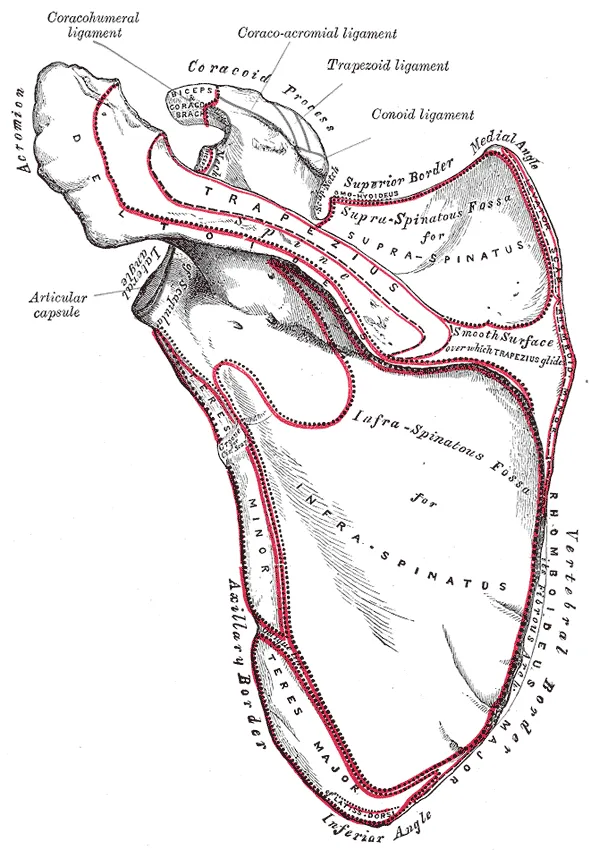
Its fibres converge to a tendon, a tough cord of tissue that connects a muscle to a bone8. The tendon crosses the back of the shoulder’s joint capsule, the sleeve of tough tissue that encloses a joint8. It ends on the greater tubercle of the humerus (upper arm bone), at a mark called the middle impression8. The greater tubercle, a bony bump, lies on the outer side of the upper humerus9.
Four tendons form the rotator cuff, a ring of tendons around the shoulder joint9. They belong to the infraspinatus, subscapularis, supraspinatus and teres minor9.
Its nerve supply
The suprascapular nerve supplies the infraspinatus, with fibres from the fifth and sixth nerves of the neck8.
What it does
Gray’s Anatomy says that the infraspinatus and teres minor turn the head of the humerus outward and help carry the arm backward8. Gray’s Anatomy also counts protecting the shoulder joint among the most important uses of the supraspinatus, infraspinatus and teres minor8. It describes the last two as supporting the joint from behind8.
Its share of external rotation
External rotation means turning a limb outward, away from the middle of the body. Three studies bear on the share the infraspinatus supplies1,10,11:
- In 11 volunteers, a nerve block that paralysed only the infraspinatus removed about 70% of external rotation strength1. A nerve block is an injection that numbs a nerve for a short time. The block also removed about 45% of abduction strength, the strength for lifting the arm out to the side1.
- A study of moment arms, or leverage, covered 10 shoulder muscles in four arm positions10. It concluded that the infraspinatus is potentially the strongest external rotator, with the arm at the side or raised10.
- A study of 10 specimens from cadavers (bodies donated for study) judged force-producing capacity by physiological cross-sectional area, a measure of muscle size11. The infraspinatus ranked second of the four cuff muscles, after the subscapularis11.
How it steadies the joint
In the same 10 specimens, the infraspinatus and supraspinatus were under relatively high passive tension at rest11. Passive tension is the pull of a stretched muscle that is not contracting. The authors take this to mean the two muscles hold the joint steady at rest11.
What the cuff does in throwing
Two sources describe when the shoulder muscles work hardest in a throw12,13.
A review of shoulder muscle activity in sport covers overhead throwing12. It says shoulder forces and muscle activity are generally greatest in two phases, called arm cocking and arm deceleration (slowing)12. For baseball pitching, it gives peak rotator cuff activity during arm cocking as 49–99% of a maximal voluntary isometric contraction12. That is a muscle’s hardest effort while the joint stays still. During arm deceleration, the figure it gives is 37–84%12.
A preliminary report studied five men with electrodes in the deltoid and rotator cuff muscles while they threw and pitched13. In that report, the follow-through was the most active stage, and all the muscles were firing intensely13. The authors describe the pattern as largely an attempt to slow the arm13.
Breakdown
This section covers two patterns: wasting in overhead athletes, and fat build-up after rotator cuff tears2,5. Tears of the tendon itself are covered on the rotator cuff page.
Wasting in overhead athletes
Atrophy means wasting or shrinking of a body part. A review reports infraspinatus atrophy in 4–34% of athletes such as volleyball, tennis and baseball players2. It says many keep performing at the same level without symptoms2. The atrophy is thought to track how long and at what level an athlete has played2.
| Athletes examined | What was found |
|---|---|
| 96 top-level volleyball players, 1985 European Championships | 12 had painless paralysis of the infraspinatus alone, on the dominant side14 |
| 84 professional beach volleyball players | Atrophy in 30% of hitting shoulders, typically not noticed by the players15 |
| 82 professional volleyball players, 2021 study | A smaller infraspinatus on physical examination in 9% of the men and 12% of the women, each with external rotation weakness16 |
| 153 male professional tennis players | Visible atrophy in the dominant arm in 92 (60.1%)4 |
| 125 professional female tennis players | Atrophy on physical examination in the dominant shoulder in 65 (52%), and in the other shoulder in no player3 |
| 1,491 Major League Baseball players, end of the 1999 season | Appreciable atrophy in 12: 4% of pitchers (10 of 494) against 0.2% of position players17 |
Among the tennis women, atrophy was more common in players ranked in the top 100, at 58% against 40%3. It was not linked to other shoulder disorders or to ranking performance3. Among the baseball players, affected pitchers had played more years and thrown more innings17. In the 82 volleyball players, no one with a smaller infraspinatus reported pain or reduced performance16.
In the 84 beach volleyball players, external rotation strength averaged 8.2 kg in the hitting shoulder against 9.5 kg in the other15. In 24 male professional volleyball players, the 12 with atrophy of the infraspinatus alone had less abduction and external rotation strength18. They also had significantly poorer static and dynamic shoulder stability than their other shoulder and than the 12 healthy players18.
Whether the nerve is the cause
Studies disagree on how far the suprascapular nerve explains the wasting19,20. Some authors found or inferred a nerve cause:
- Three top-level volleyball players with painless infraspinatus paralysis were tested14. The tests showed denervation (lost nerve supply) of the muscle and about a 22% loss of external rotation strength14. The authors put it down to repeated stretching of the nerve during the serve14.
- In 35 male professional beach volleyball players, nerve conduction tests showed a longer delay and a smaller signal in the hitting shoulder19. These are electrical tests of how well a nerve carries signals. The authors read this as suprascapular nerve involvement from repetitive strain19.
Others did not observe one15,20:
- The 84 beach volleyball players were examined at a tournament, and no compression of the suprascapular nerve was observed15.
- Eighteen high-performance beach volleyball players had nerve conduction studies and needle electromyography, which records a muscle’s electrical signals20. No nerve-related changes were found in the infraspinatus of any player20. Five had atrophy of the muscles this nerve supplies, and the authors conclude a biomechanical cause has to be considered20.
When the suprascapular nerve is squeezed at the spinoglenoid notch, a notch in the shoulder blade, the infraspinatus is affected and the supraspinatus is spared2. Cysts beside the labrum, a rim of tough tissue around the edge of the joint socket, usually compress the nerve in this region2. A review notes that nerve compression at this notch may cause no obvious weakness2. The deltoid and teres minor can make up for some of the lost external rotation strength2.
Fat build-up after rotator cuff tears
These studies use two names for fat in the muscle: fatty infiltration and fatty degeneration5,21. CT scans (detailed X-ray pictures of the inside of the body) of 63 patients were taken before rotator cuff repair21. They showed that fatty degeneration of the infraspinatus can occur with large tears at the front and top of the cuff21. This happened even when the infraspinatus tendon itself was not torn, and it worsened with time21.
A larger study read the scans of 1,688 patients operated on for rotator cuff tears5. Fatty infiltration of the infraspinatus was greater when its own tendon was torn and when several tendons were torn5. It was also greater with a longer delay since symptoms began and with older age5. Moderate infiltration appeared on average two and a half years after symptoms began, and severe infiltration at about four years5.
Recovery
After a rotator cuff repair
In two studies, fat in the muscle did not reverse after a torn cuff was repaired; in one, wasting did not reverse either21,22:
- Patients in the CT study were re-scanned on average 17.7 months after repair21. After an effective repair, fatty degeneration of the infraspinatus did not regress in any patient, and it increased in three21.
- Thirty-eight patients were re-scanned one year after repair22. A successful repair did not improve or reverse wasting and fat build-up in the supraspinatus and infraspinatus22. Strength in raising the arm forward improved significantly, while external rotation strength did not22.
Two systematic reviews, which gather and sum up the research on a question, linked fat in the cuff muscles to later retears23,24. A 2016 review of 11 studies and 925 shoulders compared cuffs by the fatty infiltration seen before repair23. Retears followed in 59% with moderate or marked infiltration, against 25% with little or none23. A 2025 review of 18 studies and 1,997 patients looked at the infraspinatus after cuff repair24. The odds of a retear were higher with moderate than with mild infiltration, and with severe than with moderate24.
In athletes with atrophy
Strength rose with training in one study, muscle bulk stayed the same in another, and bulk recovery varied after nerve surgery in a third6,25,26:
- Eighteen elite volleyball players with infraspinatus atrophy did 32 sessions of progressive external-rotator strengthening over 8 weeks6. External rotation strength improved significantly6. It reached the level of non-athletes, but not of elite players without atrophy6.
- A series followed 35 competitive volleyball players with painless atrophy of the infraspinatus alone, who did external-rotator strengthening exercises25. Sixteen of them were reviewed after a mean of 5.5 years, and infraspinatus atrophy was unchanged in all 1625.
- Ten volleyball players were followed for a mean of 77.9 months after keyhole surgery to take pressure off the suprascapular nerve26. Infraspinatus bulk recovered completely in 5, partly in 2 and not at all in 326. External rotation strength was 8 kg on the operated side against 12.65 kg on the other26.
Connections
The teres minor
The teres minor shares the infraspinatus’s outward-turning action8. Seven healthy volunteers were imaged after elastic-band external rotation27. The infraspinatus was the most active muscle with the arm at the side, and the teres minor at 90° of abduction27.
Exercises and stretches that load it
Studies have recorded infraspinatus activity in several exercises, and its stiffness after one stretch28,29,30. Related exercise pages: band external rotation, pull-up, push-up, dip, bench press and sleeper stretch.
| Exercise | What studies found |
|---|---|
| External rotation exercises | In 30 healthy people, infraspinatus activity did not differ significantly between five external-rotation exercises28 |
| External rotation exercises | Ten healthy young adults did external rotation with the arm raised from 0° toward 90° of abduction31. Raising the arm reduced infraspinatus activity and increased activity in the posterior deltoid, the back part of the deltoid31 |
| Pull-up | In 21 men and 4 women, average infraspinatus activity was 71–79% of a maximal still effort across three pull-up styles29 |
| Push-up | In 12 healthy men, infraspinatus activity was greatest at the narrow hand width of three32 |
| Dip | In 13 experienced men, peak infraspinatus activation was not higher in the bar dip than in the bench dip33 |
| Bench press | In 15 volunteers, the infraspinatus was significantly more active than the subscapularis34 |
| Sleeper stretch | In 24 college baseball players with limited inward shoulder rotation, infraspinatus stiffness fell in the group assigned four weeks of a modified sleeper stretch30 |
Infraspinatus pulls through
Infraspinatus starts on
Infraspinatus attaches to
Infraspinatus works with to turn the arm outward
Infraspinatus works with to steady the shoulder at rest
Infraspinatus works with in external rotation
Infraspinatus has a nerve that can be compressed by cysts beside
Infraspinatus is loaded by
Infraspinatus is stretched by
Sources
- Gerber C, Blumenthal S, Curt A, Werner CM (2007). Effect of selective experimental suprascapular nerve block on abduction and external rotation strength of the shoulder.. Journal of Shoulder and Elbow Surgery. doi:10.1016/j.jse.2007.02.120 PMID 17931906
- Ayik G, Kolac UC, Kaymakoglu M, McFarland E, Huri G (2025). Dark side of the shoulder: suprascapular and axillary nerve compressions.. International Orthopaedics. doi:10.1007/s00264-025-06465-9 PMID 40082300
- Young SW, Dakic J, Stroia K, Nguyen ML, Harris AH, Safran MR (2015). High Incidence of Infraspinatus Muscle Atrophy in Elite Professional Female Tennis Players.. The American Journal of Sports Medicine. doi:10.1177/0363546515588177 PMID 26078449
- Ellenbecker TS, Dines DM, Renstrom PA, Windler GS (2020). Visual Observation of Apparent Infraspinatus Muscle Atrophy in Male Professional Tennis Players.. Orthopaedic Journal of Sports Medicine. doi:10.1177/2325967120958834 PMID 33195711
- Melis B, Wall B, Walch G (2010). Natural history of infraspinatus fatty infiltration in rotator cuff tears.. Journal of Shoulder and Elbow Surgery. doi:10.1016/j.jse.2009.12.002 PMID 20363160
- Salles JI, Guimarães JM, Filho GM, Morrissey D (2018). Effect of a specific exercise strategy on strength and proprioception in volleyball players with infraspinatus muscle atrophy.. Scandinavian Journal of Medicine and Science in Sports. doi:10.1111/sms.13216 PMID 29772095
- Williams JM, Sinkler MA, Obremskey W (2023). Anatomy, Shoulder and Upper Limb, Infraspinatus Muscle.. StatPearls. PMID 30020627
- Gray H; Lewis WH (editor) (1918). Anatomy of the Human Body. Lea & Febiger, Philadelphia (20th edition). Link
- Betts JG, Young KA, Wise JA, Johnson E, Poe B, Kruse DH, Korol O, Johnson JE, Womble M, DeSaix P (2022). Anatomy and Physiology 2e. OpenStax. Link
- Kuechle DK, Newman SR, Itoi E, Niebur GL, Morrey BF, An KN (2000). The relevance of the moment arm of shoulder muscles with respect to axial rotation of the glenohumeral joint in four positions.. Clinical Biomechanics. doi:10.1016/s0268-0033(99)00081-9 PMID 10758292
- Ward SR, Hentzen ER, Smallwood LH, Eastlack RK, Burns KA, Fithian DC, Friden J, Lieber RL (2006). Rotator cuff muscle architecture: implications for glenohumeral stability.. Clinical Orthopaedics and Related Research. PMID 16826111
- Escamilla RF, Andrews JR (2009). Shoulder muscle recruitment patterns and related biomechanics during upper extremity sports.. Sports Medicine. doi:10.2165/00007256-200939070-00004 PMID 19530752
- Jobe FW, Tibone JE, Perry J, Moynes D (1983). An EMG analysis of the shoulder in throwing and pitching. The American Journal of Sports Medicine. doi:10.1177/036354658301100102 PMID 6829838
- Ferretti A, Cerullo G, Russo G (1987). Suprascapular neuropathy in volleyball players.. The Journal of Bone and Joint Surgery. American Volume. PMID 3805088
- Lajtai G, Pfirrmann CW, Aitzetmüller G, Pirkl C, Gerber C, Jost B (2009). The Shoulders of Professional Beach Volleyball Players. The American Journal of Sports Medicine. doi:10.1177/0363546509333850 PMID 19359418
- Mazza D, Iorio R, Drogo P, Gaj E, Viglietta E, Rossi G, Monaco E, Ferretti A (2021). Did the prevalence of suprascapular neuropathy in professional volleyball players decrease with the changes occurred in serving technique?. The Physician and Sportsmedicine. doi:10.1080/00913847.2020.1766344 PMID 32372683
- Cummins CA, Messer TM, Schafer MF (2004). Infraspinatus muscle atrophy in professional baseball players.. The American Journal of Sports Medicine. doi:10.1177/0363546503260731 PMID 14754733
- Contemori S, Biscarini A, Botti FM, Busti D, Panichi R, Pettorossi VE (2018). Sensorimotor Control of the Shoulder in Professional Volleyball Players With Isolated Infraspinatus Muscle Atrophy.. Journal of Sport Rehabilitation. doi:10.1123/jsr.2016-0183 PMID 28605232
- Lajtai G, Wieser K, Ofner M, Raimann G, Aitzetmüller G, Jost B (2012). Electromyography and nerve conduction velocity for the evaluation of the infraspinatus muscle and the suprascapular nerve in professional beach volleyball players.. The American Journal of Sports Medicine. doi:10.1177/0363546512455395 PMID 22875791
- Pieber K, Herceg M, Fialka C, Oberleitner G, Gruther W, Paternostro-Sluga T (2014). Is suprascapular neuropathy common in high-performance beach volleyball players? A retrospective analysis.. Wiener klinische Wochenschrift. doi:10.1007/s00508-014-0595-4 PMID 25193481
- Goutallier D, Postel JM, Bernageau J, Lavau L, Voisin MC (1994). Fatty muscle degeneration in cuff ruptures. Pre- and postoperative evaluation by CT scan.. Clinical Orthopaedics and Related Research. PMID 8020238
- Gladstone JN, Bishop JY, Lo IK, Flatow EL (2007). Fatty infiltration and atrophy of the rotator cuff do not improve after rotator cuff repair and correlate with poor functional outcome.. The American Journal of Sports Medicine. doi:10.1177/0363546506297539 PMID 17337727
- Khair MM, Lehman J, Tsouris N, Gulotta LV (2016). A Systematic Review of Preoperative Fatty Infiltration and Rotator Cuff Outcomes.. HSS Journal. doi:10.1007/s11420-015-9465-5 PMID 27385947
- Wu HT, Liu Q, Lin JH (2025). Fatty infiltration predicts retear and functional impairment following rotator cuff repair: systematic review and meta-analysis.. Journal of Orthopaedic Surgery and Research. doi:10.1186/s13018-025-05702-6 PMID 40119431
- Ferretti A, De Carli A, Fontana M (1998). Injury of the Suprascapular Nerve at the Spinoglenoid Notch. The American Journal of Sports Medicine. doi:10.1177/03635465980260060401 PMID 9850775
- Brzoska R, Laprus H, Klaptocz P, Malik SS, Solecki W, Blasiak A (2023). Arm Function After Arthroscopic Decompression of the Suprascapular Nerve at the Spinoglenoid Notch and Suprascapular Notch in Volleyball Players.. Orthopaedic Journal of Sports Medicine. doi:10.1177/23259671221147892 PMID 36874055
- Kurokawa D, Sano H, Nagamoto H, Omi R, Shinozaki N, Watanuki S, Kishimoto KN, Yamamoto N, Hiraoka K, Tashiro M, Itoi E (2014). Muscle activity pattern of the shoulder external rotators differs in adduction and abduction: an analysis using positron emission tomography.. Journal of Shoulder and Elbow Surgery. doi:10.1016/j.jse.2013.12.021 PMID 24613183
- Alizadehkhaiyat O, Hawkes DH, Kemp GJ, Frostick SP (2015). Electromyographic Analysis of the Shoulder Girdle Musculature During External Rotation Exercises.. Orthopaedic Journal of Sports Medicine. doi:10.1177/2325967115613988 PMID 26740950
- Youdas JW, Amundson CL, Cicero KS, Hahn JJ, Harezlak DT, Hollman JH (2010). Surface electromyographic activation patterns and elbow joint motion during a pull-up, chin-up, or perfect-pullup™ rotational exercise.. Journal of strength and conditioning research. doi:10.1519/JSC.0b013e3181f1598c PMID 21068680
- Yamauchi T, Hasegawa S, Nakamura M, Nishishita S, Yanase K, Fujita K, et al. (2016). Effects of two stretching methods on shoulder range of motion and muscle stiffness in baseball players with posterior shoulder tightness: a randomized controlled trial.. Journal of shoulder and elbow surgery. doi:10.1016/j.jse.2016.04.025 PMID 27475455
- Ryan G, Johnston H, Moreside J (2018). Infraspinatus Isolation During External Rotation Exercise at Varying Degrees of Abduction.. Journal of Sport Rehabilitation. doi:10.1123/jsr.2016-0217 PMID 28513278
- Kim YS, Kim DY, Ha MS (2016). Effect of the push-up exercise at different palmar width on muscle activities.. Journal of physical therapy science. doi:10.1589/jpts.28.446 PMID 27064571
- McKenzie A, Crowley-McHattan Z, Meir R, Whitting J, Volschenk W (2022). Bench, Bar, and Ring Dips: Do Kinematics and Muscle Activity Differ?. International Journal of Environmental Research and Public Health. doi:10.3390/ijerph192013211 PMID 36293792
- Wattanaprakornkul D, Halaki M, Cathers I, Ginn KA (2011). Direction-specific recruitment of rotator cuff muscles during bench press and row.. Journal of Electromyography and Kinesiology. doi:10.1016/j.jelekin.2011.09.002 PMID 21978788
Changes
- Revised to report sources added after their published corrections were read