Skier's thumb
Also called skier's thumb, skiers thumb, gamekeeper's thumb, gamekeepers thumb, thumb UCL tear, thumb UCL rupture, thumb ulnar collateral ligament tear, thumb ulnar collateral ligament rupture
A partial or complete tear of the ulnar collateral ligament at the base of the thumb. How papers define and name it, who it affects, and what studies of splints, casts, operations and return to sport found.
- Region
- Wrist & hand
- Updated
- October 14, 2026
- Reviewed
- October 14, 2026 · how entries are checked
What it is
How papers define and name it
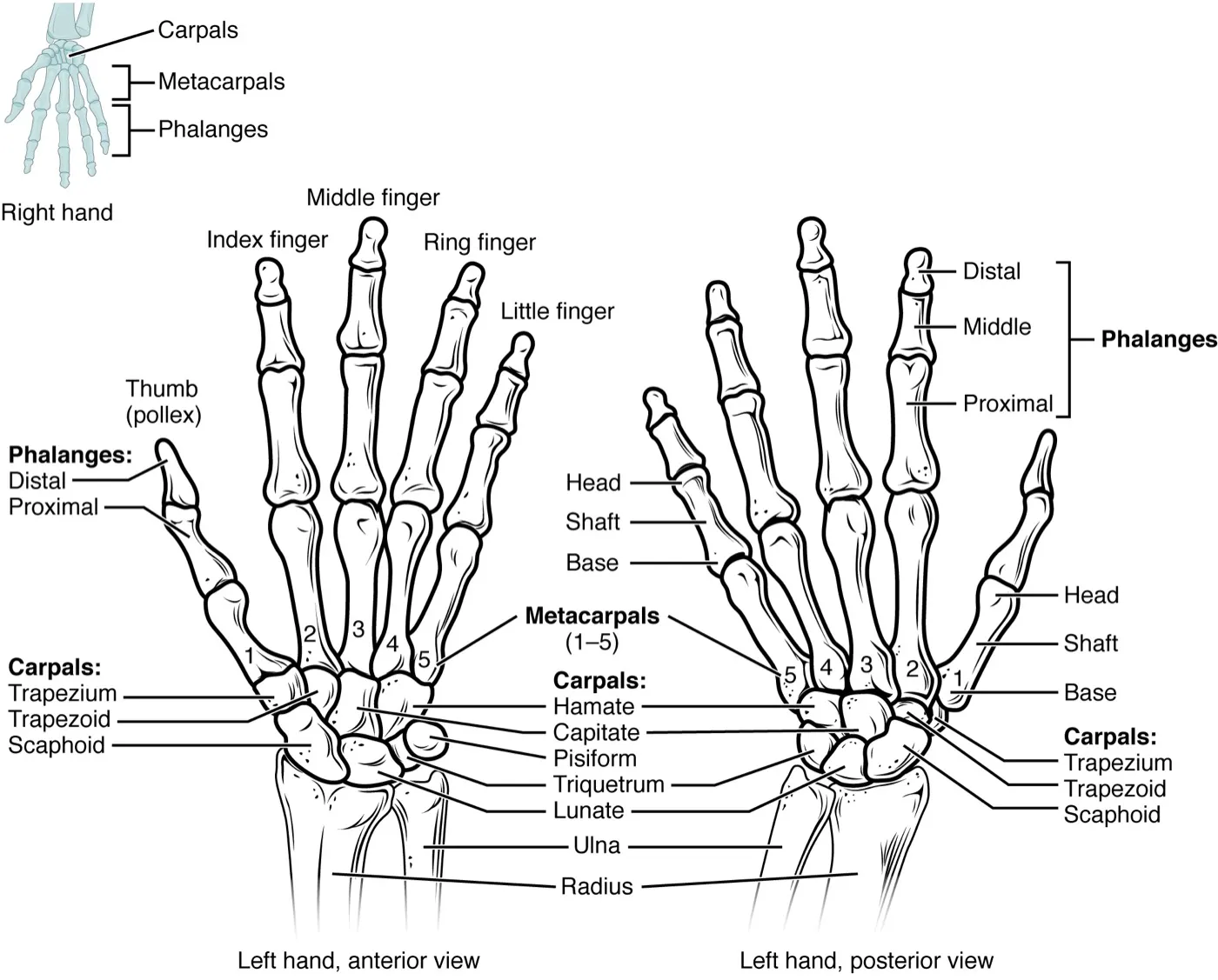
A 2013 paper defines skier’s thumb as a rupture, partial or complete, of the thumb’s ulnar collateral ligament1. A ligament is a tough band of tissue that holds bones together at a joint. This one belongs to the thumb’s metacarpophalangeal joint, the knuckle at the base of the thumb1. The ulnar collateral ligament of the thumb page covers the ligament’s anatomy and how it tears.
The injury has two names, and papers do not use them the same way6. A 2010 paper says “gamekeeper’s thumb” refers to a chronic (long-lasting) injury, with the ligament stretched thin by repeated stress6. It says “skier’s thumb” refers to an acute injury of the ligament6. It adds that the first term is sometimes used incorrectly for any injury of the ligament6.
What is torn
The ligament is injured by loads that push the thumb toward the radial side, the thumb’s side of the hand7,8. Tears are commonly graded in three tiers by stability7. Grade 1 is painful without instability, grade 2 is a partial tear, and grade 3 is a complete tear with laxity (looseness in the joint)7. One paper reports that a bony avulsion fracture accompanies 20% to 30% of ruptures8. An avulsion is a tear in which a ligament pulls away from the bone it attaches to.
A 2013 paper states that a rupture left alone may lead to pain, instability, weaker pinch and osteoarthritis9. Osteoarthritis is a long-term joint disease in which the cartilage lining the joint wears away.
The Stener lesion
In a Stener lesion the ligament is torn completely from the proximal phalanx, a thumb bone, and displaced10. It comes to lie on the surface of the aponeurosis of the adductor pollicis, a muscle in the hand8,10. An aponeurosis is a broad, flat sheet of tendon. That sheet then sits between the ligament and the joint10.
Sources differ on what this means for healing1,10. A 2019 paper states that the sheet lying between the ligament and the joint impedes healing10. Authors who searched PubMed in November 2012 looked at the general idea that a ligament out of contact with its insertion is unable to heal1. They report that no evidence for it can be found in the literature1.
Reports of how often the lesion occurs differ too2. The authors of a 2018 systematic review note a rate as low as 12% in one series and as high as 70% in others2. They suggest the spread may reflect unreliable and inaccurate ways of detecting it2.
Who it affects
Injuries of the ligament have an estimated incidence of 50 for each 100,000 emergency room visitors11. Incidence is how many new cases appear in a group over a set time. One paper states that about 10,500 patients a year in the Netherlands are found to have an acute injury11. It also states that around 75% of injuries are complete ruptures11.
One paper states that the injuries most often occur in athletes or adults of working age5. Two trauma centres operated on 1,582 patients for a rupture of the ligament between 1992 and 201512. Of these, 1,094 were male and 488 female12. Their mean age was 41 years, with a range of 9 to 9012. Another paper reports that the injury makes up between 7% and 32% of skiing injuries, depending on the study1.
What studies found
No trial of operating against not operating
A 2018 systematic review searched four databases and found no study comparing operation with no operation for complete ruptures2. It found six studies with a comparison group: three randomised trials and three retrospective comparative case series2. A randomised trial assigns people to groups by chance, then compares the groups. The review judged each of the six to be at high risk of bias, meaning design flaws may have skewed the result2. One of its authors was funded by the NIHR, and the review states the funders had no role in the study2.
A 2023 guideline of Britain’s Society for Surgery of the Hand ran its own systematic review of adults injured no more than 3 weeks before4. It found three randomised trials: a splint against a plaster cast, and two of early movement after surgery4. It states that no other randomised trials in the English literature fit its criteria4. It calls the natural history of complete ruptures, their course when left alone, uncertain, because management without surgery fails at widely varying rates4.
Two guidelines are reported differently11,13:
- Dutch guidelines. One paper reports that they recommend 4 to 6 weeks in a cast for grade 1 and 2 injuries11. For complete ruptures they recommend immediate operation followed by a cast11.
- The British society’s guideline. A 2024 summary says patients without significant laxity can be managed without surgery13. Those with significant laxity may have either immobilisation without surgery or surgical repair, as a shared decision with their clinician13. The 2023 document says minor sprains without instability are generally managed with early movement as pain allows, while complete ruptures are more controversial4. It lists no funding sources and no relevant conflicts of interest4.
The paper reporting the Dutch guidelines states that the advice to operate rests on low-quality observational case series, anatomic theories and expert opinion11. It is the protocol of a multicentre randomised trial registered in 202111. That trial assigns adults with an acute complete rupture, Stener lesions included, to a cast alone or to operation followed by a cast11. The protocol names ZonMW, a Netherlands health research organisation, as funder11.
Splints and casts without an operation
Three reports follow thumbs held still without an operation3,11,14.
| Who was studied | What was found |
|---|---|
| 39 patients with 40 acute complete ruptures, in a splint for 8 to 12 weeks | 34 injuries (85%) healed without significant instability, arthrosis (joint wear), pain or stiffness; six (15%) went on to surgical reconstruction3 |
| 71 patients in two observational studies of a cast for complete ruptures, Stener lesions included, as one paper sums them up | 63 of them (89%) reported feeling normal or minimally disabled after 1 year; those who stayed symptomatic went on to surgery11 |
| 43 cases scanned with MRI in a 2015 study, with surgery planned for Stener lesions14 | Partial tears and tears displaced less than 3 mm typically healed with immobilisation alone; of tears displaced by over 3 mm, 90% failed it14 |
The 2018 review’s authors note that 30% of the patients in the first series had displaced fractures2.
A 2013 systematic review points the other way9. Of its 293 thumbs, 32 were managed without operation, and it reported that this often failed and led to surgery9. It also reported that excellent outcomes were still reached after a long delay or after a failed attempt without operation9. Twelve of its 14 articles were level IV evidence, a low rung on a scale that ranks study designs9.
One randomised study of 63 thumbs compared a plaster cast with a splint that let the joint bend and straighten15. It included thumbs operated on, but only where the torn ligament was judged displaced15. At follow-up it found no difference between the groups in stability, range of motion, strength or length of sick leave15. The 2018 review’s authors report that this trial gave too little data for further analysis2.
The trial’s own paper says thumbs were assigned using a random table15. It names LIC Ortopedi, of Solna in Sweden, as the study’s supporter15. The 2023 guideline, by contrast, rated it at high risk of bias and found the randomisation method not clearly described4. It also found little detail on blinding, which keeps assessors or patients unaware of each patient’s group4.
The guideline states that immobilisation without surgery can use a cast or a custom splint4. It found no evidence that any one type is better4.
What reviews of operations found
A 2025 systematic review and meta-analysis pooled 24 studies with 616 thumbs, followed for an average of 47 months5. A meta-analysis pools the results of several earlier studies. It sorted operations into three groups5:
- Primary repair. The torn ligament is fixed to nearby soft tissue or through tunnels drilled in bone5.
- Suture anchor repair. A suture anchor is a small anchor set in bone to hold a stitch. Some repairs add an internal brace, a strip of suture tape for extra support5.
- Reconstruction. The ligament is rebuilt with an autograft, a tendon or other tissue taken from the same patient5.
A thumb counted as stable if the patient or examiner judged it so, or if it had under 10 degrees of laxity5.
| Operation | Average time from injury to surgery | Thumbs stable | Returned to unrestricted activities |
|---|---|---|---|
| Primary repair | 9.3 days5 | 95%5 | 96%5 |
| Suture anchor repair | 4.1 months5 | 95%5 | 93%5 |
| Reconstruction | 19.1 months5 | 81%5 | 84%5 |
The 2025 review’s authors state that surgical technique could not be separated from the time between injury and surgery5. Four of the 24 studies had a comparison group5. Aftercare, including how long the thumb was kept still, was unique to each study, and technique within each group varied too much to compare separately5. The overall complication rate was 12%, and 1% for complications that needed intervention5. The authors declare no commercial interest related to the subject5.
For chronic injuries, a 2026 systematic review of 24 studies found no randomised or comparative trials16.
Early or late surgery
Studies of timing do not agree17,18:
- A retrospective review covered 500 consecutive patients operated on for complete ruptures of either collateral ligament of the thumb17. Those operated on within 3 weeks regained stable, pain-free thumbs, and 5% of later operations failed17.
- A study collected outcomes from 76 patients who had open repair of a complete rupture18. It found no difference between surgery within 3 weeks and later surgery, up to 6 months18.
Moving the thumb early after repair
Two randomised trials tested early movement after surgical repair19,20. One assigned 30 patients to a splint that allowed immediate movement or to a standard splint19. It took complete tears and left out suspected partial tears2,4. Its authors report faster and better functional results with immediate movement19. The 2023 guideline rated it as having some concerns, with low risk of bias from randomisation4.
The other, a small pilot trial, compared early active movement with standard immobilisation after repair with a bone anchor20. It had 12 adults, six in each group, and the standard was 4 weeks in a plaster cast around the thumb2,4. The 2023 guideline rated it at high risk of bias, citing its small sample and inadequate randomisation method4. Its authors said a larger trial was warranted20.
The 2018 review concluded there is weak evidence to suggest early movement may be beneficial after repair2.
Years after repair
Two series followed patients for an average of 15 years or more21,22. In a single-surgeon series of 30 patients with an acute injury repaired, 22 answered at a mean of 183 months21. Of those, 82% were satisfied21. Another study saw 12 of 21 living patients an average of 24.5 years after repair of a chronic tear22. In it, 88% had some degree of osteoarthritis22.
Return to sport and duty
A 2023 systematic review of athletes operated on for the injury pooled 311 patients from 11 articles23. Of those, 98.1% returned to play and 10.3% had complications after surgery23. Its authors say the information is limited by low-quality evidence and expert recommendations23. The review discloses that one author had received prior funding from Evolution Surgical/Arthrex23.
| Group, after surgery | What was found |
|---|---|
| 23 National Football League players | 22 played in at least one league game afterwards, at an average of 132.2 days24 |
| 21 Major League Baseball players | Each played in at least one league game afterwards, at a mean of 120.0 days25 |
| 35 active duty military personnel, repaired with a suture anchor | Mean return to duty at 11.8 weeks; 94.3% back to unrestricted duty within 3 months26 |
Connections
The condition is a tear in the ulnar collateral ligament of the thumb1. One paper states that injuries of this ligament are about 10 times more common than injuries of the radial collateral ligament7.
One paper names the muscles that act as dynamic restraints to valgus stress at the joint, meaning they help hold it steady as they work8. Valgus stress here is a load toward the radial side7,8. Three of the muscles come from the forearm8:
- Flexor pollicis longus, in the deep group of the forearm flexors8,27.
- Extensor pollicis longus and extensor pollicis brevis, in the deep group of the forearm extensors8,28.
Skier's thumb involves
Skier's thumb involves a joint held by
Sources
- Mahajan M, Rhemrev SJ (2013). Rupture of the ulnar collateral ligament of the thumb - a review.. International journal of emergency medicine. doi:10.1186/1865-1380-6-31 PMID 23938194
- Mikhail M, Wormald JCR, Thurley N, Riley N, Dean BJF (2018). Therapeutic interventions for acute complete ruptures of the ulnar collateral ligament of the thumb: a systematic review.. F1000Research. doi:10.12688/f1000research.15065.1 PMID 30057756
- Landsman JC, Seitz WH, Froimson AI, Leb RB, Bachner EJ (1995). Splint immobilization of gamekeeper's thumb.. Orthopedics. doi:10.3928/0147-7447-19951201-06 PMID 8749294
- Dean B, Rodrigues J, Riley N, Rabey N, Donnison E, Challen K, Bradford S; British Society for Surgery of the Hand (2023). Evidence based management of adults with acute ulnar collateral ligament (UCL) of the thumb injuries. British Society for Surgery of the Hand Evidence for Surgical Treatment (BEST). British Society for Surgery of the Hand (BEST guideline, NICE-accredited process; published April 2023). Link
- Schumaier A, Zeng F, McCarthy C (2025). Surgical Management of Thumb Ulnar Collateral Ligament Injuries: A Systematic Review and Meta-analysis of 614 Patients With a Minimum 1 Year Follow-up.. Journal of the American Academy of Orthopaedic Surgeons. Global research & reviews. doi:10.5435/JAAOSGlobal-D-25-00082 PMID 40327019
- Ritting AW, Baldwin PC, Rodner CM (2010). Ulnar collateral ligament injury of the thumb metacarpophalangeal joint.. Clinical journal of sport medicine : official journal of the Canadian Academy of Sport Medicine. doi:10.1097/JSM.0b013e3181d23710 PMID 20215892
- Avery DM 3rd, Inkellis ER, Carlson MG (2017). Thumb collateral ligament injuries in the athlete.. Current reviews in musculoskeletal medicine. doi:10.1007/s12178-017-9381-z PMID 28133709
- Madan SS, Pai DR, Kaur A, Dixit R (2014). Injury to ulnar collateral ligament of thumb.. Orthopaedic surgery. doi:10.1111/os.12084 PMID 24590986
- Samora JB, Harris JD, Griesser MJ, Ruff ME, Awan HM (2013). Outcomes after injury to the thumb ulnar collateral ligament--a systematic review.. Clinical journal of sport medicine : official journal of the Canadian Academy of Sport Medicine. doi:10.1097/JSM.0b013e318289c6ff PMID 23615487
- Beutel BG, Melamed E, Rettig ME (2019). The Stener Lesion and Complete Ulnar Collateral Ligament Injuries of the Thumb A Review.. Bulletin of the Hospital for Joint Disease (2013). PMID 30865860
- de Haas L, van Hoorn B, van de Lücht V, Schep N, Dijkgraaf M, van Heijl M, MUSCAT Trial Collaborator group (2024). Study protocol for a multicenter non-inferiority randomized controlled trial to assess functional outcomes and cost-effectiveness of a primarily non-operative treatment strategy with cast immobilization versus immediate operative treatment followed by cast immobilization for patients with complete ulnar collateral ligament ruptures, including Stener lesions: MUSCAT study.. Trials. doi:10.1186/s13063-024-08576-x PMID 39468632
- Boesmueller S, Huf W, Rettl G, Dahm F, Meznik A, Muschitz G, Kitzinger H, Bukaty A, Fialka C, Vierhapper M (2017). The influence of sex and trauma impact on the rupture site of the ulnar collateral ligament of the thumb.. PloS one. doi:10.1371/journal.pone.0181754 PMID 28738083
- Dean B, Rodrigues J, Riley N, Rabey N, Donnison E, Challen K, Bradford S, BSSH BEST UCL Guideline Developmnent Group (2024). Guideline on managing thumb ulnar collateral ligament injuries: the British Society of Surgery for the Hand Evidence for Surgical Treatment (BEST) findings and recommendations.. The Journal of hand surgery, European volume. doi:10.1177/17531934241274612 PMID 39315553
- Milner CS, Manon-Matos Y, Thirkannad SM (2015). Gamekeeper's thumb--a treatment-oriented magnetic resonance imaging classification.. The Journal of hand surgery. doi:10.1016/j.jhsa.2014.08.033 PMID 25300993
- Sollerman C, Abrahamsson SO, Lundborg G, Adalbert K (1991). Functional splinting versus plaster cast for ruptures of the ulnar collateral ligament of the thumb. A prospective randomized study of 63 cases.. Acta orthopaedica Scandinavica. doi:10.3109/17453679108994487 PMID 1767639
- Mohammed MSE, Tan AMY, Goon PKY (2026). Surgical Management of Chronic Ulnar Collateral Ligament Injury of the Thumb: A Systematic Review.. Hand (New York, N.Y.). doi:10.1177/15589447261430050 PMID 41933492
- Posner MA, Retaillaud JL, Green SM (2022). Collateral Ligament Ruptures of the Thumb Metacarpophalangeal Joint A Review of 500 Surgical Cases.. Bulletin of the Hospital for Joint Disease (2013). PMID 35643470
- Legerstee IWF, van der Oest MJW, Souer JS, Hundepool CA, Duraku LS, Selles RW, Zuidam JM, Hand-Wrist Study Group (2023). Patient-Reported Outcomes and Function After Surgical Repair of the Ulnar Collateral Ligament of the Thumb.. The Journal of hand surgery. doi:10.1016/j.jhsa.2023.05.003 PMID 37294237
- Rocchi L, Merolli A, Morini A, Monteleone G, Foti C (2014). A modified spica-splint in postoperative early-motion management of skier's thumb lesion: a randomized clinical trial.. European journal of physical and rehabilitation medicine. PMID 24185690
- Crowley TP, Stevenson S, Taghizadeh R, Addison P, Milner RH (2013). Early active mobilization following UCL repair With Mitek bone anchor.. Techniques in hand & upper extremity surgery. doi:10.1097/BTH.0b013e318284dbd7 PMID 23970193
- Oag EC, Stirling PHC, McEachan JE (2022). Long-term outcomes following surgical repair of acute injuries of the thumb metacarpophalangeal joint ulnar collateral ligament.. Hand surgery & rehabilitation. doi:10.1016/j.hansur.2021.11.007 PMID 34864217
- Christensen T, Sarfani S, Shin AY, Kakar S (2016). Long-Term Outcomes of Primary Repair of Chronic Thumb Ulnar Collateral Ligament Injuries.. Hand (New York, N.Y.). doi:10.1177/1558944716628482 PMID 27698632
- Allahabadi S, Kwong JW, Pandya NK, Shin SS, Immerman I, Lee NH (2023). Return to Play After Thumb Ulnar Collateral Ligament Injuries Managed Surgically in Athletes-A Systematic Review.. Journal of hand surgery global online. doi:10.1016/j.jhsg.2023.03.005 PMID 37323971
- Sochacki KR, Jack RA, Nauert R, Liberman SR, McCulloch PC, Lintner DM, Harris JD (2019). Performance and Return to Sport After Thumb Ulnar Collateral Ligament Surgery in National Football League Players.. Hand (New York, N.Y.). doi:10.1177/1558944718760001 PMID 29480741
- Jack RA, Sochacki KR, Gagliano B, Lintner DM, Harris JD, McCulloch PC (2018). Performance and Return to Sport After Thumb Ulnar Collateral Ligament Repair in Major League Baseball Players.. Orthopaedic journal of sports medicine. doi:10.1177/2325967117747268 PMID 29326958
- Lee J, Chung JI, Yun Y, Jeong C, Lee SM, Woo I, Son S, Cheon JH, Ha C (2026). Return to duty after suture anchor repair of thumb metacarpophalangeal ulnar collateral ligament injuries in active duty soldiers.. Injury. doi:10.1016/j.injury.2026.113711 PMID 42731146
- Gray H; Lewis WH (editor) (1918). Anatomy of the Human Body. Lea & Febiger, Philadelphia (20th edition). Link
- Fazal ZL, Hafeez AM, Sinkler MA, Arain A (2023). Anatomy, Shoulder and Upper Limb, Forearm Compartments.. StatPearls. PMID 30969606
Changes
- First published.