Ulnar collateral ligament of the thumb
Also called thumb UCL, UCL of the thumb, thumb ulnar collateral ligament
The band on the little-finger side of the thumb's metacarpophalangeal joint that holds it against sideways opening. Its two parts, how falls and ski poles tear it, the Stener lesion, and what laboratory tests found.
- Region
- Wrist & hand
- Muscles
- adductor pollicis, abductor pollicis brevis, flexor pollicis brevis, flexor pollicis longus, extensor pollicis longus, extensor pollicis brevis
- Updated
- October 14, 2026
- Reviewed
- October 14, 2026 · how entries are checked
Function
Two parts across one joint
The ulnar collateral ligament of the thumb has two parts, a proper collateral ligament and an accessory one1,2. A ligament is a tough band of tissue that holds bones together at a joint. This page calls it the ligament. One paper describes it as a thick band 4 to 8 mm wide and 12 to 14 mm long5. On MRI scans of 34 volunteers without symptoms, it was typically less than 3 mm thick10.
The proper part runs from the back of the head of the thumb metacarpal to the palm side of the base of the proximal phalanx2,5. A metacarpal is one of the long bones of the hand. The proximal phalanx is the thumb bone nearest the hand. The accessory part starts on the palm side of the proper part and runs on continuously with it2,5. It attaches to the volar (palm-side) plate2,5.
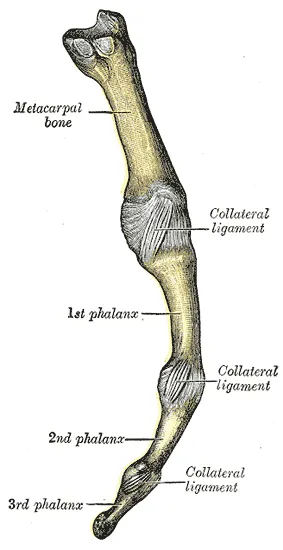
The joint these parts cross is the thumb’s metacarpophalangeal joint, called the joint on this page3,4. The plate below is from Gray’s Anatomy of 1918. It shows the collateral ligaments of a finger, not of the thumb.
What the ligament holds
The joint has variably flattened condyles and moves mainly in flexion (bending) and extension (straightening)5. Its radial and ulnar collateral ligaments are the primary stabilisers against varus and valgus stress2. Varus and valgus stress are sideways loads in opposite directions. The ulnar one is the primary restraint to valgus stress3,4.
One paper describes the loads that injure it as valgus or radially directed3,5. The ligament resists forces that push the thumb radially during forceful grasping2.
A laboratory study simulated pinch and grip in 16 fresh-frozen thumbs from male cadavers8. Strain in the ligament correlated significantly with pinch force, but not with low grip force8. Strain here is how far something stretches as a share of its resting length.
How the two parts share the work
The proper part is taut when the joint is flexed, and the accessory part is taut when it is straight1,2. Two cadaver studies cut the parts in turn:
- Half of the proper part. In 11 cadaver thumbs, this cut produced no significant increase in laxity (looseness in a joint) in any direction4.
- The whole proper part. In autopsy specimens, this cut significantly increased valgus instability of the flexed joint11. Laxity was significantly less when the joint was tested straight11.
- The accessory part and palmar plate as well. In those autopsy specimens, valgus instability of the straight joint then rose11. It no longer differed significantly from the instability at 30 degrees of flexion11.
How loose a normal thumb is
Side-to-side laxity of the joint varies among normal thumbs and across the arc of flexion and extension3. In 750 normal thumbs examined in three positions, full flexion was the most stable12.
A person’s two thumbs can differ. Among 100 normal individuals examined with the thumb joint straight, the two thumbs differed by 10 degrees or more in 34%13. In 12% they differed by at least 15 degrees13. Another study tested 100 participants without symptoms with the joint straight. Their maximum passive radial deviation differed between left and right by a mean of 4.5 degrees14.
Breakdown
How the ligament is injured
Loads directed into valgus or toward the radial side produce hyperabduction at the joint, which is how the ligament is injured3,5. The injury can be a partial or a complete rupture5. It can also extend into the dorsal (back) capsule and the volar plate5. A 2013 paper defines skier’s thumb as a partial or complete rupture of this ligament1. That page covers the condition’s definition, its course and the trials.
A 1995 paper states that the usual setting is a skier whose pole forces the thumb to deviate radially15. A 1982 study suggests that a falling skier holds the pole until the hand hits the ground16. The handle then stays in the hand and acts as a fulcrum, levering the thumb into extension and abduction16.
One paper says the injury is now commonly seen in falls onto an abducted thumb5. It also follows a racquet or ball hitting the thumb’s ulnar side5. Another paper says it occurs in rugby, soccer, handball, basketball and volleyball, and even after a handshake3.
How often it happens, and to whom
The incidence of injuries to this ligament is estimated at 50 for each 100,000 emergency room visitors7. One paper states that they are about 10 times more common than injuries of the radial collateral ligament5.
The share of cases that come from skiing differs between three reports1,18,19.
| Where the patients were seen | Share injured while skiing (%) |
|---|---|
| 127 patients with an acute rupture repaired at one unit over 10 years | 2.418 |
| One paper’s own inner-city hospital | 101 |
| 1,582 patients operated on at two trauma centres from 1992 to 2015 | 3519 |
In the 127 patients, the most common cause was a fall, at 49%18. In the inner-city hospital it was falling on the hand, most often off a bicycle or motorcycle, in about 40%1. In the 1,582 patients, sporting accidents were the most common cause, at 51%19.
Studies of skiers and of college and professional athletes report these figures17,20:
- One ski area. In a six-year study of 1,711 ski injuries, 40% of upper limb injuries involved the thumb, and 85% of those included this ligament17.
- College sport. Across all 25 NCAA sports from 2004-2005 to 2013-2014, tears of this ligament were 8.7% of the hand and wrist injuries classed as severe20.
- One college football team. A sprain of this ligament was the most common of 168 hand and wrist injuries reviewed from 2003 to 2020, at 19.6%21.
- One professional football team. From 1991 to 2014, 36 thumbs in 32 players had a collateral ligament injury at this joint22.
Where it tears
Most tears occur at the ligament’s far attachment on the proximal phalanx3. Among 1,582 surgically managed ruptures, 84% were at the distal end, 11% in the midsubstance and 5% at the proximal end19. Distal means farther from the centre of the body, and the midsubstance is the middle of the ligament. One paper reports that a bony avulsion fracture accompanies 20% to 30% of ruptures3. An avulsion is a tear in which a ligament pulls away from the bone it attaches to.
Tears are commonly graded in three tiers by stability5:
- Grade 1 is painful without instability5.
- Grade 2 is a partial tear, with more laxity than the other side but a firm endpoint5.
- Grade 3 is a complete tear, with laxity and no endpoint5.
The Stener lesion
The adductor pollicis, a muscle in the hand, attaches to the proximal phalanx and lies superficial to the ligament2,3. In a Stener lesion the ligament is torn completely from the proximal phalanx6. It is displaced to lie superficial to the aponeurosis of the adductor pollicis6. An aponeurosis is a broad, flat sheet of tendon. The aponeurosis then sits between the ligament and the joint6.
Reports of how common the lesion is differ1,7:
- A paper on the lesion’s history notes that Stener’s original paper reported it in 64% of cases23. It adds that a later study found it in as few as 20% of operated ruptures23.
- One paper states that between 64% and 87% of complete ruptures have one1.
- Another source gives a range across studies of 11% to 87% of complete ruptures7.
What load breaks it
Two laboratory studies loaded intact ligaments from cadavers until they failed, and their figures differ8,9. A newton is a unit of force.
| Specimens | Mean load at failure (newtons) |
|---|---|
| 16 fresh-frozen thumbs from male cadavers | 2948 |
| Nine paired fresh-frozen hands, pulled in tension | 3799 |
In the nine-hand study, the ligament tore in its midsubstance in 7 specimens9.
Recovery
Whether a displaced ligament can heal
Sources do not agree on whether the ligament can heal once a Stener lesion has moved it1,24:
- A paper on the lesion’s history reports that Stener argued the ligament could not undergo natural repair without an operation23. His reason was that the aponeurosis blocked its insertion point23.
- A 1997 paper states that with a Stener lesion present, primary healing of the ligament cannot occur without an operation24.
- A 2019 paper states that the aponeurosis lying between the ligament and the joint impedes healing6.
- Authors who searched PubMed in November 2012 report finding no evidence for the general idea1. That idea is that the ligament cannot heal when it is out of contact with its insertion1.
A 2018 systematic review found no study comparing operation with no operation for complete ruptures25. A 2023 guideline from Britain’s Society for Surgery of the Hand calls the natural history (the course without surgery) of complete ruptures uncertain26. Its reason is that how often management without surgery fails varies widely26. The skier’s thumb page reports the trials and follow-up studies.
What laboratory tests of repairs found
Cadaver studies have compared repaired or reconstructed ligaments with intact ones9,27:
- In nine paired fresh-frozen hands, ligaments repaired with two suture anchors failed at a mean of 84 newtons, against 379 newtons for the intact ligaments9.
- In 11 cadavers with loads applied to thumb muscles, cutting the ligament, its accessory part, the dorsal capsule and the volar plate increased joint laxity27. Reconstructing the ligament restored normal laxity27.
A 2023 paper states that no repair or reconstruction using native tissues provides strength equal to the ligament’s before injury28. The authors of the nine-hand study state in their introduction that adequate healing of a repaired ligament occurs at about 10 to 12 weeks9.
Connections
The ligament joins the thumb metacarpal to the proximal phalanx and, through its accessory part, to the volar plate2,5. The volar plate, the dorsal capsule and the collateral ligaments hold the joint statically5. The muscles crossing the joint hold it dynamically5.
One paper names the muscles that act as dynamic restraints to valgus stress at the joint3. Three come from the forearm:
- Flexor pollicis longus, in the deep group of the forearm flexors3,29.
- Extensor pollicis longus, in the deep group of the forearm extensors3,30.
- Extensor pollicis brevis, whose tendon passes through the wrist’s first dorsal compartment3,31,32.
Three are in the hand: adductor pollicis, abductor pollicis brevis and flexor pollicis brevis3.
The elbow has a ligament that is also called the ulnar collateral ligament33. It has its own page, the ulnar collateral ligament of the elbow. The condition page for the thumb’s ligament is skier’s thumb1.
Ulnar collateral ligament of the thumb is torn in
Ulnar collateral ligament of the thumb works with
Ulnar collateral ligament of the thumb shares a name with
Sources
- Mahajan M, Rhemrev SJ (2013). Rupture of the ulnar collateral ligament of the thumb - a review.. International journal of emergency medicine. doi:10.1186/1865-1380-6-31 PMID 23938194
- Hung CY, Varacallo MA, Chang KV (2023). Gamekeeper's Thumb (Archived).. StatPearls. PMID 29763146
- Madan SS, Pai DR, Kaur A, Dixit R (2014). Injury to ulnar collateral ligament of thumb.. Orthopaedic surgery. doi:10.1111/os.12084 PMID 24590986
- Lin CC, Patel NA, Itami Y, McGarry MH, Shin SS, Lee TQ (2019). Biomechanical Analysis of Thumb Ulnar Collateral Ligament Tear Kinematics.. Hand (New York, N.Y.). doi:10.1177/1558944719868518 PMID 31431075
- Avery DM 3rd, Inkellis ER, Carlson MG (2017). Thumb collateral ligament injuries in the athlete.. Current reviews in musculoskeletal medicine. doi:10.1007/s12178-017-9381-z PMID 28133709
- Beutel BG, Melamed E, Rettig ME (2019). The Stener Lesion and Complete Ulnar Collateral Ligament Injuries of the Thumb A Review.. Bulletin of the Hospital for Joint Disease (2013). PMID 30865860
- de Haas L, van Hoorn B, van de Lücht V, Schep N, Dijkgraaf M, van Heijl M, MUSCAT Trial Collaborator group (2024). Study protocol for a multicenter non-inferiority randomized controlled trial to assess functional outcomes and cost-effectiveness of a primarily non-operative treatment strategy with cast immobilization versus immediate operative treatment followed by cast immobilization for patients with complete ulnar collateral ligament ruptures, including Stener lesions: MUSCAT study.. Trials. doi:10.1186/s13063-024-08576-x PMID 39468632
- Firoozbakhsh K, Yi IS, Moneim MS, Umada Y (2002). A study of ulnar collateral ligament of the thumb metacarpophalangeal joint.. Clinical orthopaedics and related research. doi:10.1097/00003086-200210000-00035 PMID 12360033
- Gil JA, Chambers A, Shah KN, Crisco JJ, Got C, Akelman E (2018). A Biomechanical Evaluation of a 2-Suture Anchor Repair Technique for Thumb Metacarpophalangeal Joint Ulnar Collateral Ligament Injuries.. Hand (New York, N.Y.). doi:10.1177/1558944717725380 PMID 28836462
- Hirschmann A, Sutter R, Schweizer A, Pfirrmann CW (2014). MRI of the thumb: anatomy and spectrum of findings in asymptomatic volunteers.. AJR. American journal of roentgenology. doi:10.2214/AJR.13.11397 PMID 24660712
- Heyman P, Gelberman RH, Duncan K, Hipp JA (1993). Injuries of the ulnar collateral ligament of the thumb metacarpophalangeal joint. Biomechanical and prospective clinical studies on the usefulness of valgus stress testing.. Clinical orthopaedics and related research. PMID 8519106
- Palmer AK, Louis DS (1978). Assessing ulnar instability of the metacarpophalangeal joint of the thumb.. The Journal of hand surgery. doi:10.1016/s0363-5023(78)80003-3 PMID 722028
- Malik AK, Morris T, Chou D, Sorene E, Taylor E (2009). Clinical testing of ulnar collateral ligament injuries of the thumb.. The Journal of hand surgery, European volume. doi:10.1177/1753193408100957 PMID 19349298
- Patel A, Patel A, Edelstein D, Choueka J (2013). Fluoroscopy-assisted stress testing of the thumb metacarpophalangeal joint to assess the ulnar collateral ligament.. Hand (New York, N.Y.). doi:10.1007/s11552-013-9500-2 PMID 24426920
- Fricker R, Hintermann B (1995). Skier's thumb. Treatment, prevention and recommendations.. Sports medicine (Auckland, N.Z.). doi:10.2165/00007256-199519010-00006 PMID 7740248
- Engkvist O, Balkfors B, Lindsjö U (1982). Thumb injuries in downhill skiing.. International journal of sports medicine. doi:10.1055/s-2008-1026063 PMID 7068299
- Carr D, Johnson RJ, Pope MH (1981). Upper extremity injuries in skiing.. The American journal of sports medicine. doi:10.1177/036354658100900607 PMID 7316019
- Chuter GS, Muwanga CL, Irwin LR (2009). Ulnar collateral ligament injuries of the thumb: 10 years of surgical experience.. Injury. doi:10.1016/j.injury.2009.01.107 PMID 19389670
- Boesmueller S, Huf W, Rettl G, Dahm F, Meznik A, Muschitz G, Kitzinger H, Bukaty A, Fialka C, Vierhapper M (2017). The influence of sex and trauma impact on the rupture site of the ulnar collateral ligament of the thumb.. PloS one. doi:10.1371/journal.pone.0181754 PMID 28738083
- Chan JJ, Xiao RC, Hasija R, Huang HH, Kim JM (2023). Epidemiology of Hand and Wrist Injuries in Collegiate-Level Athletes in the United States.. The Journal of hand surgery. doi:10.1016/j.jhsa.2021.10.011 PMID 34895779
- Bougioukli S, Bolia IK, Mayfield CK, Nicholson LT, Weber AE, Bashrum BS, Romano R, Tibone JE, Shin S, Gamradt SC (2023). Management of Hand and Wrist Injuries in NCAA Division I Football Players From a Single Institution: Factors Associated With Epidemiology, Surgical Intervention, and Return to Play.. Orthopaedic journal of sports medicine. doi:10.1177/23259671231188969 PMID 37954865
- Werner BC, Belkin NS, Kennelly S, Weiss L, Barnes RP, Rodeo SA, Warren RF, Hotchkiss RN (2017). Injuries to the Collateral Ligaments of the Metacarpophalangeal Joint of the Thumb, Including Simultaneous Combined Thumb Ulnar and Radial Collateral Ligament Injuries, in National Football League Athletes.. The American journal of sports medicine. doi:10.1177/0363546516660979 PMID 27566241
- Lark ME, Maroukis BL, Chung KC (2017). The Stener Lesion: Historical Perspective and Evolution of Diagnostic Criteria.. Hand (New York, N.Y.). doi:10.1177/1558944716661999 PMID 28453338
- Heyman P (1997). Injuries to the Ulnar Collateral Ligament of the Thumb Metacarpophalangeal Joint.. The Journal of the American Academy of Orthopaedic Surgeons. doi:10.5435/00124635-199707000-00006 PMID 10797225
- Mikhail M, Wormald JCR, Thurley N, Riley N, Dean BJF (2018). Therapeutic interventions for acute complete ruptures of the ulnar collateral ligament of the thumb: a systematic review.. F1000Research. doi:10.12688/f1000research.15065.1 PMID 30057756
- Dean B, Rodrigues J, Riley N, Rabey N, Donnison E, Challen K, Bradford S; British Society for Surgery of the Hand (2023). Evidence based management of adults with acute ulnar collateral ligament (UCL) of the thumb injuries. British Society for Surgery of the Hand Evidence for Surgical Treatment (BEST). British Society for Surgery of the Hand (BEST guideline, NICE-accredited process; published April 2023). Link
- Draganich LF, Greenspahn S, Mass DP (2004). Effects of the adductor pollicis and abductor pollicis brevis on thumb metacarpophalangeal joint laxity before and after ulnar collateral ligament reconstruction.. The Journal of hand surgery. doi:10.1016/j.jhsa.2004.01.004 PMID 15140493
- Chang AL, Merkow DB, Bookman JS, Glickel SZ (2023). Thumb Metacarpophalangeal Joint Ulnar Collateral Ligament Injuries: Management and Biomechanical Evaluation.. The Journal of the American Academy of Orthopaedic Surgeons. doi:10.5435/JAAOS-D-22-00112 PMID 36548149
- Gray H; Lewis WH (editor) (1918). Anatomy of the Human Body. Lea & Febiger, Philadelphia (20th edition). Link
- Fazal ZL, Hafeez AM, Sinkler MA, Arain A (2023). Anatomy, Shoulder and Upper Limb, Forearm Compartments.. StatPearls. PMID 30969606
- Beutel BG, Taylor K, Michols NJ, Taqi M (2025). Intersection Syndrome.. StatPearls. PMID 28613649
- Bonczar M, Walocha J, Pasternak A, Depukat P, Dziedzic M, Ostrowski P, Bonczar T, Warchoł Ł, Koziej M (2023). Anatomical variations in the first dorsal compartment of the wrist: meta-analysis.. Folia morphologica. doi:10.5603/FM.a2022.0081 PMID 36165900
- Labott JR, Aibinder WR, Dines JS, Camp CL (2018). Understanding the medial ulnar collateral ligament of the elbow: Review of native ligament anatomy and function.. World journal of orthopedics. doi:10.5312/wjo.v9.i6.78 PMID 29984194
Changes
- First published.