Sacroiliac joint pain
Also called SI joint pain, SIJ pain, sacroiliac joint complex pain, sacroiliac pain
How research defines pain from the sacroiliac joint, how studies confirm the joint as the source, who has been counted with it, and what trials of exercise, injections and fusion surgery found.
- Region
- Spine
- Updated
- October 9, 2026
- Reviewed
- October 9, 2026 · how entries are checked
What it is
How research defines it
A 2024 narrative review defines sacroiliac joint pain as pain localised in the anatomical region of the sacroiliac joint1. The sacroiliac joint is where the sacrum meets the ilium7. The sacrum is the triangle-shaped bone at the base of the spine, and the ilium is the wide upper part of the hip bone.
A 2025 multispecialty guideline describes the sacroiliac joint complex as the joint together with its network of ligaments at the back and the front2. A ligament is a tough band of tissue that holds bones together at a joint. In the guideline’s account, these parts contain nociceptors (nerve endings that sense possible harm to tissue) and can generate pain2. The guideline concluded that the pain can come from different portions of the parts inside the joint and the parts outside it2.
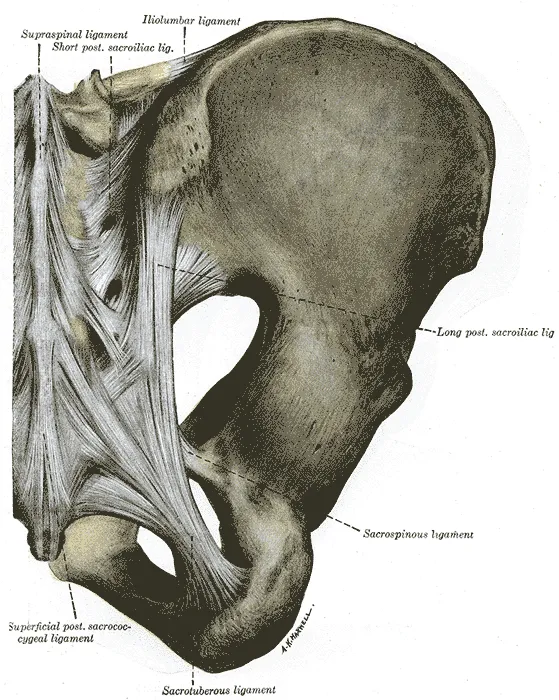
Some trials enrolled people described as having sacroiliac joint dysfunction8,9.
How studies confirm the joint as the source
A systematic review looked at 18 studies of one international pain association’s criteria for sacroiliac joint pain10. A systematic review is a study that gathers the research on a question in a set, checkable way. The studies used an injection into the joint as their reference standard, the yardstick other tests are judged against10. No study had tested the validity of that injection, or of the criteria set as a whole10. The 2025 guideline committee found such injections valid for identifying pain that arises inside the joint, but not pain that arises outside it2.
Two studies checked physical examination against an anaesthetic block, an injection of a numbing drug into the joint4,11:
- A prospective study (one that follows people forward in time) tested 85 patients11. No feature of the history showed worthwhile value for identifying the pain11. Nor did any of 12 physical tests, or any combination of them11.
- In a study of 48 patients, six provocation tests were used4. Its authors drew a conclusion for cases where all six fail to provoke the familiar pain4. In those cases, the joint can be excluded as a source of current low back pain4.
A systematic review of test accuracy turned such results into certainty3. Assuming 20% of those tested have sacroiliac joint pain, a positive cluster of provocation tests gave 35% certainty that the joint was correctly identified3. A negative result was correct with 92% certainty3. The same review pooled five studies of test clusters and rated its accuracy estimates as very low in certainty3. The 2025 guideline committee also found that negative tests have greater predictive value than positive ones2.
Who it affects
Among people with low back pain
Counts vary with who was studied and how the joint was confirmed2,12. Prevalence is the share of people in a group who have a condition at a given time.
| Study | Who was counted | Share with sacroiliac joint pain |
|---|---|---|
| Study of 43 patients13 | Consecutive patients with chronic (long-lasting) low back pain, worst below the L5-S1 level | 30%, relieved by an anaesthetic block |
| Study of 54 patients14 | Patients selected because their one-sided low back pain appeared sacroiliac in origin | 18.5%, relieved by a first block and a confirming second block |
| Chart review, 170 cases15 | Low back pain cases that had procedures to find the pain source at an academic spine centre | 18% |
| Systematic review12 | Varied with the setting | 10% to 62%, with most of the studies analysed suggesting about 25% |
L5-S1 is the joint between the lowest vertebra of the lower back and the top of the sacrum. The 2025 guideline reports figures of 29% to 63% from studies using a single joint injection, and 10% to 33% from studies using two2. It notes that these figures apply to people already suspected of sacroiliac joint pain, not to the whole population of patients with low back pain2. The same guideline concluded that sacroiliac joint complex pain affects 15% to 30% of patients whose axial pain is predominantly below the L5 level2.
After spinal surgery
A systematic review and meta-analysis covered 12 observational studies (studies that watch people without assigning them to groups) of 3,570 spinal surgery patients16. A meta-analysis is a study that pools the results of several earlier studies. This one put the incidence of new sacroiliac joint pain after spinal surgery at 9.40%16. Incidence is how many new cases appear in a group over a set time.
The new pain was associated with female sex and with the number of segments (levels of the spine) operated on16. It was also associated with fusion down to the sacrum and with pelvic tilt (how the pelvis is tipped) after surgery16.
A second systematic review pooled 12 observational studies of moderate to low quality17. After lumbosacral spinal fusion (fusion of the lower back and the sacrum), it put the incidence at 15.8% overall17. The figure was 32.9% when the fusion extended to the sacrum, and the studies’ results differed widely17.
Athletes
A systematic review with meta-analysis covered 13 studies of 2,842 athletes18. Reported prevalence of sacroiliac joint pain or dysfunction varied widely18. It averaged 10.72% among the athletes as a whole and 32.39% among those who had low back pain18. The authors concluded that an accurate prevalence cannot be reported18. The review named years of experience, stress injuries and biomechanical movements as risk factors, from studies of low to moderate quality18.
What studies found
Exercise and manual therapy
The 2025 guideline found the evidence base for non-interventional approaches to be indirect2. That evidence was extrapolated mostly from studies of low back pain2.
A single-blind randomised trial enrolled 51 patients with low back or buttock pain from sacroiliac joint dysfunction9. In a single-blind trial, one party does not know who is in which group. An exercise group, a manipulation group and a combined group each improved in pain and disability9. There was no significant difference among them at 24 weeks9. The trial had no control group outside these three programmes9.
A meta-analysis of 16 randomised trials (421 adults) compared manual therapy (hands-on methods) of the joint mostly with exercise-based programmes19. Manual therapy did not significantly reduce pain, and had a moderate effect on disability19. Certainty was low for disability and very low for pain19. A 2025 meta-analysis of randomised controlled trials in sacroiliac joint dysfunction found statistically significant improvements with exercise in pain and disability20.
Injections and radiofrequency
A 2023 systematic review and meta-analysis of injections into the joint included 11 randomised trials, five positive and six negative, and three observational studies21. It graded the evidence as Level III, or fair21. The 2025 guideline committee found that steroid injections inside and outside the joint both give at least four weeks of relief in well-selected patients2.
Three sources report on radiofrequency denervation, also called radiofrequency ablation2,22,23. It is a procedure that heats a small nerve, with the aim of stopping it carrying pain signals.
- The 2025 guideline committee found strong evidence for ablation of the sacral lateral branch nerves (small nerves at the sacrum)2. The evidence was of relief for at least six months in people whose pain source lies outside the joint2.
- A 2015 review with meta-analyses of randomised trials included two studies of sacroiliac joint pain22. It found low-quality evidence of no differences from placebo (a dummy version) in pain or function over the short term22. One study showed a small effect over the intermediate term22.
- A randomised trial enrolled 228 participants with chronic low back pain and a positive anaesthetic block at the sacroiliac joints23. It was pragmatic (run as in everyday care) and non-blinded23. Adding denervation to a three-month exercise programme changed pain at three months by −0.71 points on a 0–10 scale, against the control group23. That was less than the 2 points set in advance as clinically important23.
Fusion surgery
Fusion, also called arthrodesis, is an operation that fixes the bones of a joint together. In an open-label trial, the people taking part know which group they are in8. Three randomised trials compared fusion of the sacroiliac joint with something else5,8,24:
- One compared it with non-surgical management in 148 people with sacroiliac joint dysfunction8. The implant’s maker sponsored this open-label trial and completed the statistical analyses8. The 46 assigned to non-surgical management had a mean six-month change in joint pain of 12.2 points on a 100-point scale8. That was 38.3 points smaller than in the 102 assigned to minimally invasive fusion with triangular titanium implants8. Crossover to surgery was allowed after six months8.
- One compared it with conservative management (care without surgery) in 103 adults with chronic sacroiliac joint pain24. This trial was also open-label, and the maker of the implant system funded it24. Subjects marked their own pain on a line (a visual analogue scale), which the 2025 guideline gives as 0 to 1002,24. At two years, mean low back pain had improved by 45 points after fusion with triangular titanium implants and by 11 after conservative management24.
- One, a double-blind trial, compared minimally invasive fusion with sham surgery in 63 patients with injection-confirmed sacroiliac joint pain5. Neither participants nor assessors knew who was in which group, and the trial describes itself as not sponsored by industry5. At six months, pain on a 0–10 scale had fallen by 2.6 points after fusion and 1.7 after sham surgery5. The difference was −1.0, with a 95% confidence interval (a range showing how precise a result is) from −2.2 to 0.35. The trial could not show fusion to be superior to sham surgery5.
Once the sham trial was unblinded at six months, 26 of the sham group’s 31 patients crossed over to fusion25. At two years, its authors could not determine the effect of fusion compared with sham surgery25.
The sham trial’s authors noted that earlier studies had measured larger effects of surgery than theirs5. In their account, industry bias and, chiefly, missing blinding can help to produce such differences5. The authors of both open-label trials named the absence of blinding among their study’s main limitations8,24. The second trial’s authors also wrote that their large effect sizes argue strongly against a marked contribution from placebo effects24.
A 2022 systematic review covered 40 studies, two of them randomised trials26. Its conclusion concerned patients who have not responded to conservative care26. For them, minimally invasive fusion probably does more than conservative management to reduce pain and improve physical function26. The same review found that adverse events (unwanted effects) appear to be higher after minimally invasive fusion than with conservative management through six months26. It judged revision surgery (a repeat operation) likely no more frequent than 3.8% at two years26.
What two guidance documents say
Two guidance documents judged the fusion evidence available when each was written, and this page endorses neither2,27. UK guidance from NICE, published in 2017, covers minimally invasive fusion for chronic sacroiliac pain27. It calls the evidence on safety and efficacy adequate to support the operation’s use27. It adds a proviso: standard arrangements for clinical governance, consent and audit27. It also says patients having it should have confirmed sacroiliac joint dysfunction due to degenerative sacroiliitis (joint inflammation) or sacroiliac joint disruption27.
The 2025 multispecialty guideline found the evidence weak or very weak that minimally invasive fusion can give benefit lasting a year or more2. That finding was for carefully selected patients whose pain arises inside the joint2. They had not improved with conservative approaches2.
The same guideline notes that the two open-label trials’ publications were sponsored by industry2. For fusion from the side (the lateral approach), it judged the evidence conflicting: two positive randomised trials against one negative sham-controlled one2.
A neighbouring group: pelvic girdle pain in pregnancy
The trials in this section enrolled a related but separate group: women with pelvic girdle pain during or after pregnancy6,28. The two reviews are described by what each covered29,30. A European guideline group concluded that pelvic girdle pain is one specific form of low back pain31.
What studies of exercise, belts and acupuncture found
Two trials reported less pain with stabilising exercises28,32:
- In a randomised single-blind trial of 386 pregnant women with pelvic girdle pain, one group added six weeks of stabilising exercises to the standard programme32. That group had less pain than the group on the standard programme alone32. The acupuncture (fine needles put into set points on the skin) group had less evening pain than the stabilising exercise group32.
- In a randomised controlled trial of 81 women with pelvic girdle pain after pregnancy, one group’s 20-week programme focused on specific stabilising exercises28. After the programme and one year after delivery, that group had lower pain and disability than a group whose individualised programme left them out28.
Pooling six of its seven studies, a 2025 meta-analysis of pelvic belts in pregnancy found that pain scores fell by a mean of 20.1729. The 95% confidence interval ran from −40.73 to 0.4, and the evidence was rated low and very low29.
A 2015 review covered pregnancy-related lumbopelvic pain (pain in the lower back, the pelvis or both)30. It rated the evidence as strong for positive effects of acupuncture and of pelvic belts during pregnancy30. It rated the evidence as low for specific stabilising exercises and for exercise in general30.
Connections
The sacroiliac joint page covers the joint itself, which is the transition from the spine to the pelvis7. Several studies on this page counted sacroiliac joint pain among people with low back pain13,15.
Sacroiliac joint pain involves
Sacroiliac joint pain has been counted among people with
Sacroiliac joint pain has been counted after surgery on
Sources
- Szadek K, Cohen SP, de Andrès Ares J, Steegers M, Van Zundert J, Kallewaard JW (2024). 5. Sacroiliac joint pain.. Pain practice : the official journal of World Institute of Pain. doi:10.1111/papr.13338 PMID 38155419
- McCormick ZL, Hurley RW, Anitescu M, Bhaskar A, Bhatia A, Cassidy RC, Chen AS, Dawson TC, De Andrés Ares J, de Campos JL, Hayek SM, Hernández-Porras BC, Kissoon NR, Kohan LR, Elgueta Le Beuffe MF, Moon JY, Provenzano DA, Reece DE, Schuster NM, Smith CC, Stout A, Szadek K, Thomas DA, Tontisirin N, Vagg MF, Van Zundert J, Woodbury A, Cohen SP (2025). Consensus practice guidelines on sacroiliac joint complex pain from a multispecialty, international working group.. Pain medicine (Malden, Mass.). doi:10.1093/pm/pnaf129 PMID 41318933
- Saueressig T, Owen PJ, Diemer F, Zebisch J, Belavy DL (2021). Diagnostic Accuracy of Clusters of Pain Provocation Tests for Detecting Sacroiliac Joint Pain: Systematic Review With Meta-analysis.. The Journal of orthopaedic and sports physical therapy. doi:10.2519/jospt.2021.10469 PMID 34210160
- Laslett M, Aprill CN, McDonald B, Young SB (2005). Diagnosis of sacroiliac joint pain: validity of individual provocation tests and composites of tests.. Manual therapy. doi:10.1016/j.math.2005.01.003 PMID 16038856
- Randers EM, Gerdhem P, Stuge B, Diarbakerli E, Nordsletten L, Röhrl SM, Kibsgård TJ (2024). The effect of minimally invasive sacroiliac joint fusion compared to sham operation: a double-blind randomized placebo-controlled trial.. EClinicalMedicine. doi:10.1016/j.eclinm.2024.102438 PMID 38328752
- Elden H, Hagberg H, Olsen MF, Ladfors L, Ostgaard HC (2008). Regression of pelvic girdle pain after delivery: follow-up of a randomised single blind controlled trial with different treatment modalities.. Acta obstetricia et gynecologica Scandinavica. doi:10.1080/00016340701823959 PMID 18231889
- Wong M, Sinkler MA, Kiel J (2023). Anatomy, Abdomen and Pelvis, Sacroiliac Joint. StatPearls. PMID 29939578
- Polly DW, Swofford J, Whang PG, Frank CJ, Glaser JA, Limoni RP, Cher DJ, Wine KD, Sembrano JN (2016). Two-Year Outcomes from a Randomized Controlled Trial of Minimally Invasive Sacroiliac Joint Fusion vs. Non-Surgical Management for Sacroiliac Joint Dysfunction.. International journal of spine surgery. doi:10.14444/3028 PMID 27652199
- Nejati P, Safarcherati A, Karimi F (2019). Effectiveness of Exercise Therapy and Manipulation on Sacroiliac Joint Dysfunction: A Randomized Controlled Trial.. Pain physician. PMID 30700068
- Szadek KM, van der Wurff P, van Tulder MW, Zuurmond WW, Perez RS (2009). Diagnostic validity of criteria for sacroiliac joint pain: a systematic review.. The journal of pain. doi:10.1016/j.jpain.2008.09.014 PMID 19101212
- Dreyfuss P, Michaelsen M, Pauza K, McLarty J, Bogduk N (1996). The value of medical history and physical examination in diagnosing sacroiliac joint pain.. Spine. doi:10.1097/00007632-199611150-00009 PMID 8961447
- Simopoulos TT, Manchikanti L, Singh V, Gupta S, Hameed H, Diwan S, Cohen SP (2012). A systematic evaluation of prevalence and diagnostic accuracy of sacroiliac joint interventions.. Pain physician. PMID 22622915
- Schwarzer AC, Aprill CN, Bogduk N (1995). The sacroiliac joint in chronic low back pain.. Spine. doi:10.1097/00007632-199501000-00007 PMID 7709277
- Maigne JY, Aivaliklis A, Pfefer F (1996). Results of sacroiliac joint double block and value of sacroiliac pain provocation tests in 54 patients with low back pain.. Spine. doi:10.1097/00007632-199608150-00012 PMID 8875721
- DePalma MJ, Ketchum JM, Saullo T (2011). What is the source of chronic low back pain and does age play a role?. Pain medicine (Malden, Mass.). doi:10.1111/j.1526-4637.2010.01045.x PMID 21266006
- Xu C, Lin X, Zhou Y, Zhuo H, Yang L, Chai X, Huang Y (2024). Incidence and risk factors of new-onset sacroiliac joint pain after spinal surgery: a systematic review and meta-analysis.. PeerJ. doi:10.7717/peerj.18083 PMID 39346039
- Shen J, Boudier-Reveret M, Majdalani C, Truong VT, Shedid D, Boubez G, Yuh SJ, Wang Z (2023). Incidence of sacroiliac joint pain after lumbosacral spine fusion: A systematic review.. Neuro-Chirurgie. doi:10.1016/j.neuchi.2023.101419 PMID 36754146
- Mirdamadi N, Khadembashiri MM, Moghadam N, Kordi R (2025). Prevalence and Risk Factors of Sacroiliac Joint Pain in Athletes: A Systematic Review and Proportional Meta-Analysis.. Clinical journal of sport medicine : official journal of the Canadian Academy of Sport Medicine. doi:10.1097/JSM.0000000000001341 PMID 40135982
- Trager RJ, Baumann AN, Rogers H, Tidd J, Orellana K, Preston G, Baldwin K (2024). Efficacy of manual therapy for sacroiliac joint pain syndrome: a systematic review and meta-analysis of randomized controlled trials.. The Journal of manual & manipulative therapy. doi:10.1080/10669817.2024.2316420 PMID 38353102
- Jangra P, Kaur J, Malik M, Rani M (2025). A systematic review and meta-analysis of randomized controlled trials on the effect of various therapeutic interventions on sacroiliac joint dysfunction.. Journal of bodywork and movement therapies. doi:10.1016/j.jbmt.2025.09.019 PMID 41316629
- Janapala RN, Knezevic E, Knezevic NN, Pasupuleti R, Sanapati MR, Kaye AD, Pampati V, Manchikanti L (2023). Systematic Review and Meta-Analysis of Effectiveness of Therapeutic Sacroiliac Joint Injections.. Pain physician. PMID 37774179
- Maas ET, Ostelo RW, Niemisto L, Jousimaa J, Hurri H, Malmivaara A, van Tulder MW (2015). Radiofrequency denervation for chronic low back pain.. The Cochrane database of systematic reviews. doi:10.1002/14651858.CD008572.pub2 PMID 26495910
- Juch JNS, Maas ET, Ostelo RWJG, Groeneweg JG, Kallewaard JW, Koes BW, Verhagen AP, van Dongen JM, Huygen FJPM, van Tulder MW (2017). Effect of Radiofrequency Denervation on Pain Intensity Among Patients With Chronic Low Back Pain. JAMA. doi:10.1001/jama.2017.7918 PMID 28672319
- Dengler J, Kools D, Pflugmacher R, Gasbarrini A, Prestamburgo D, Gaetani P, Cher D, Van Eeckhoven E, Annertz M, Sturesson B (2019). Randomized Trial of Sacroiliac Joint Arthrodesis Compared with Conservative Management for Chronic Low Back Pain Attributed to the Sacroiliac Joint.. The Journal of bone and joint surgery. American volume. doi:10.2106/JBJS.18.00022 PMID 30845034
- Kibsgård TJ, Gerdhem P, Diarbakerli E, Randers EM (2026). Minimally Invasive Sacroiliac Joint Fusion Compared with Sham Operation (SIFSO Trial). The Journal of bone and joint surgery. American volume. doi:10.2106/JBJS.25.00918 PMID 42154897
- Chang E, Rains C, Ali R, Wines RC, Kahwati LC (2022). Minimally invasive sacroiliac joint fusion for chronic sacroiliac joint pain: a systematic review.. The spine journal : official journal of the North American Spine Society. doi:10.1016/j.spinee.2022.01.005 PMID 35017057
- National Institute for Health and Care Excellence (2017). Minimally invasive sacroiliac joint fusion surgery for chronic sacroiliac pain. National Institute for Health and Care Excellence (interventional procedures guidance IPG578, now HealthTech guidance HTG436). Link
- Stuge B, Laerum E, Kirkesola G, Vøllestad N (2004). The efficacy of a treatment program focusing on specific stabilizing exercises for pelvic girdle pain after pregnancy: a randomized controlled trial.. Spine. doi:10.1097/01.brs.0000090827.16926.1d PMID 15094530
- Lauridsen J, Dalbøge A, Jahn A (2025). The effect of pelvic belts to manage low back and pelvic pain during pregnancy a systematic review and meta-analysis.. Midwifery. doi:10.1016/j.midw.2025.104529 PMID 40716213
- Gutke A, Betten C, Degerskär K, Pousette S, Olsén MF (2015). Treatments for pregnancy-related lumbopelvic pain: a systematic review of physiotherapy modalities.. Acta obstetricia et gynecologica Scandinavica. doi:10.1111/aogs.12681 PMID 26018758
- Vleeming A, Albert HB, Ostgaard HC, Sturesson B, Stuge B (2008). European guidelines for the diagnosis and treatment of pelvic girdle pain.. European spine journal : official publication of the European Spine Society, the European Spinal Deformity Society, and the European Section of the Cervical Spine Research Society. doi:10.1007/s00586-008-0602-4 PMID 18259783
- Elden H, Ladfors L, Olsen MF, Ostgaard HC, Hagberg H (2005). Effects of acupuncture and stabilising exercises as adjunct to standard treatment in pregnant women with pelvic girdle pain: randomised single blind controlled trial.. BMJ (Clinical research ed.). doi:10.1136/bmj.38397.507014.E0 PMID 15778231
Changes
- First published.