AC joint dislocation (AC separation)
Also called AC separation, acromioclavicular joint separation, acromioclavicular joint dislocation, acromioclavicular dislocation, shoulder separation, AC joint sprain, acromioclavicular joint sprain, AC joint injury
An injury to the ligaments that hold the collarbone to the shoulder blade. How studies grade it, who it affects, how low-grade injuries fare, and what trials of surgery against a sling found.
- Region
- Shoulder
- Updated
- October 8, 2026
- Reviewed
- October 8, 2026 · how entries are checked
What it is
How studies name and grade it
The acromioclavicular (AC) joint is the joint where the collarbone meets the top of the shoulder blade. Rockwood described a six-part classification of separations of this joint in 19841. It grades the injury by the direction and distance the clavicle (collarbone) moves, and by how much soft tissue is involved1.
A United States Military Academy cohort called Rockwood types I and II low-grade sprains; a sprain is a stretched or torn ligament7. One source uses “shoulder separation” for a full dislocation of the joint, with both sets of ligaments ruptured8.
A ligament is a tough band of tissue that holds bones together at a joint. The acromioclavicular ligaments reinforce the joint’s thin capsule9. The coracoclavicular ligament joins the clavicle to the coracoid process, a hooked bony point at the front of the shoulder blade10.
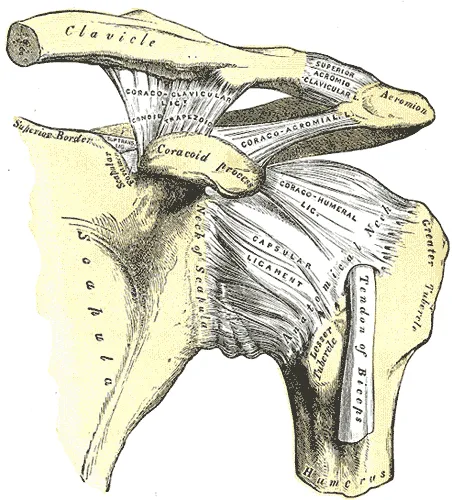
| Rockwood type | What the classification describes |
|---|---|
| I | A sprain of the acromioclavicular ligaments, with the joint intact9 |
| II | Acromioclavicular ligaments torn, coracoclavicular ligaments intact9. One account describes the coracoclavicular ligaments as sprained rather than intact1 |
| III | Both sets of ligaments torn, with the fascia (a sheet of tough connective tissue) of the deltoid and trapezius muscles intact9 |
| IV | A complete dislocation, with the outer clavicle displaced backward into or through the trapezius fascia9 |
| V | More soft-tissue damage, with the deltoid and trapezius fascia stripped off the acromion (the bony point at the top of the shoulder) and the clavicle9 |
| VI | A downward dislocation, to beneath the acromion or the coracoid9 |
In a series of 158 adults with a dislocation of the joint, a direct force to the shoulder caused 96% of them11. The acromioclavicular joint page covers the joint’s anatomy and how these injuries happen.
The split of type III
A consensus statement from an ISAKOS committee proposed dividing type III in two12. Type IIIA is a stable joint, and type IIIB is an unstable one with shoulder blade dysfunction that persists12. A European panel, polled in rounds by the Delphi method, held Rockwood with this change to be the most valid classification13.
One cohort applied the split at 6 weeks to adults aged 18 to 60 whose acute dislocation was managed without surgery14. The 9 patients later referred for surgery came from the 69 graded unstable, but the difference was not statistically significant14. The authors concluded that the split is not clinically applicable14.
How well raters agree on the grade
Five studies had several raters grade the same radiographs2,3,4,5,15. Most reported agreement as kappa, a score of how well raters agree2,4.
| Raters and images | Agreement between raters |
|---|---|
| 6 surgeons, radiographs of 50 patients | Fair (kappa 0.278)2 |
| 10 surgeons, radiographs of 28 dislocations | Fair (kappa 0.214); adding three-dimensional CT scans did not improve it3 |
| 6 surgeons and 6 residents, radiographs of 45 patients | Moderate on Rockwood type (kappa 0.52); substantial on whether to operate (kappa 0.78)4 |
| 4 investigators, radiographs of 58 patients | Good when judged by eye (0.72 to 0.74); excellent with digital measurement (0.85 to 0.93)5 |
| 6 surgeons, 40 radiographs, graded with the ISAKOS change | Substantial overall (kappa 0.637); fair for type IIIA (kappa 0.215) and moderate for type IIIB (kappa 0.473)15 |
When six surgeons graded the radiographs of 50 patients by Rockwood type, the six gave the same type to 4 of them2. A review of the Rockwood classification concludes that agreement between observers is only moderate1. It gives the likely reason as plain radiographs being unable to fully assess a soft-tissue injury1.
Who it affects
How common it is
A 2021 European consensus paper states that AC joint injuries account for 3 to 12% of shoulder injuries13. It puts the share at 40 to 50% in contact sports13. Incidence means new cases over a set time, and person-years are people multiplied by the years each was followed.
| Place and people | What was found |
|---|---|
| Oslo, one emergency department, 2650 shoulder injuries | AC joint injuries were 11% of them, or 45 per 100,000 person-years; 68% were sprains and 32% dislocations16 |
| Capital region of Denmark, 549,225 residents, one year | 106 acute dislocations, or 19.3 per 100,000 person-years; type III was the most common, at 55.7%17 |
| A general population, 158 adults aged 18 to 75 | 2.0 dislocations per 10,000 person-years; the rate fell with age group and was 7.6 times higher in men11 |
| United States Military Academy, 2005 to 2009 | 162 new injuries, or 9.2 per 1000 person-years; 89% were low-grade sprains and 91% happened during athletics7 |
Among the 287 injuries in Oslo, the median age was 32 years and 82% were men16.
In sport
In the Danish count, 80 of the 106 dislocations happened in sport, 51 of them in cycling17.
- College sport: 844 AC joint sprains were reported in 25 NCAA sports, half of them in football18.
- Rugby union: in English professional players, it was the most common shoulder injury in matches, at 32%19.
What studies found
What usual practice is, by grade
A 2021 European consensus paper describes usual practice13. Types I and II are usually managed without surgery, and symptomatic types IV to VI routinely with surgery13. How to manage acute type III injuries is still disputed13.
How low-grade injuries fare over time
Four follow-up studies of types I and II report on pain, later surgery and shoulder scores20,21,22,23.
- 47 patients, by questionnaire: 14 (40%) called their pain significant at six months, and 5 (14%) at 12 months or later20.
- 33 patients, graded by the Tossy system: 9 (27%) went on to surgery for chronic joint problems, a mean of 26 months after injury21. At the latest follow-up, 17 (52%) had no symptoms21.
- 23 patients, a mean of 10.2 years on: 12 (52%) reported at least occasional symptoms from the joint22. The average Constant score was 70.5 in the injured shoulder and 86.8 in the other22.
- 75 patients, a median of 85 months on: the mean Constant score was 88.6 in the injured shoulder and 93.3 in the other23. The authors judged that difference not clinically relevant23.
The Constant score rates shoulder pain, daily activity, movement and strength. In the cohort of 75, osteolysis (wearing away) of the outer clavicle was seen in 31% of injured shoulders against 0% of the others23. Degenerative changes were about as common on both sides, at 44% and 46%23.
Surgery against a sling: the 2019 Cochrane review
A 2019 Cochrane review compared surgery with non-surgical care in six trials of 357 mainly young, mostly male adults6. Surgery meant fixing the joint with hook plates, tunnelled suspension devices, screws, pins or wires6. Non-surgical care meant a sling or a similar support for the arm6.
| Outcome | What the 2019 Cochrane review found |
|---|---|
| Shoulder function at six weeks | Low-quality evidence that it may be better after non-surgical care6 |
| Shoulder function at one year | Low-quality evidence showed no evidence of a difference, from two studies of 112 people6 |
| Return to former sports or work at one year | Low-quality evidence of possibly little or no difference: 57 of 67 after surgery against 62 of 706 |
| The first approach failing | Very low-quality evidence that surgery may not lower the risk: 14 of 168 after surgery against 15 of 1746 |
| Adverse events | Very low-quality evidence of a greater risk after surgery: 45 of 168 against 16 of 1746 |
The hook plate trials and later reviews
Two randomised trials, which assign people to groups by chance, compared hook plate fixation with non-surgical care24,25.
The first was a multicentre trial of 83 patients with acute type III, IV or V dislocations24. DASH scores, from a questionnaire on arm, shoulder and hand disability, were better without surgery at 6 weeks and 3 months24. They did not differ significantly at 6 months, 1 year or 2 years24. The hook plate gave better alignment on radiographs, but the reoperation rate was significantly lower without surgery24.
The second was a single-centre trial of 124 patients aged 18 to 65 with type III or V dislocations25. The non-surgical groups had better shoulder scores and less pain at 3 months, with no significant differences at 6, 12 or 24 months25. Of those assigned to non-surgical care, 11 (18%) had surgery within 19 months25.
Three later meta-analyses, which pool the results of earlier studies, report as follows26,27,28.
- Types III to V: a 2026 meta-analysis of 5 randomised trials (367 patients) compared Constant scores at 2 years or more26. The means were 92.4 after surgery and 90.1 without, with no significant difference26.
- Type III alone: a 2024 meta-analysis of four randomised trials (244 patients) found no significant difference in long-term Constant scores27. Surgery gave better early pain relief, but more post-traumatic osteoarthritis and hardware-related problems27.
- Types IV and V: a 2026 meta-analysis concluded that evidence on type IV is notably insufficient, and that data on type V remain limited28.
Return to sport, by grade
Three studies report mean days lost, or days to return to play, by grade or by surgery7,29,30.
| Group | Mean days |
|---|---|
| Military academy, low-grade sprains (types I and II) | 10.4 days7 |
| Military academy, high-grade injuries | 63.7 days7 |
| National Football League, per AC joint injury | 9.8 days29 |
| National Football League, players who had surgery | 56.2 days29 |
| National Hockey League, grades 1 and 2 | 20.1 days30 |
| National Hockey League, grade 3 managed without surgery | 28.3 days30 |
In a United States Military Academy cohort, low-grade sprains cost an average of 10.4 days and high-grade injuries 63.7 days7. The hockey figures leave out cases with other injuries, surgery or recovery running into the off-season30. The gap between grades in that series was not statistically significant30.
After surgery for types III to VI, a 2019 review of 12 studies found 94% of sporting patients returned31. The weighted mean time was 4.0 months31. Its authors rated the level of evidence as low31. A 2024 review of 120 studies concluded that the literature lacks consensus on what makes a return to play safe32.
Connections
The injury is to the ligaments of the acromioclavicular joint, which sits between the outer end of the clavicle and the acromion9,33. The clavicle page covers fractures of that bone.
The acromion is part of the scapula, the shoulder blade33. In 34 patients with a chronic type III dislocation, scapular dyskinesis (changed shoulder blade movement) was seen with the arms at rest in 2434.
The fascia shared by the deltoid and trapezius is the last of the joint’s soft tissues assumed to fail as force on the acromion rises11.
AC joint dislocation (AC separation) involves
AC joint dislocation (AC separation) in its higher grades involves the fascia of
Sources
- Gorbaty JD, Hsu JE, Gee AO (2017). Classifications in Brief: Rockwood Classification of Acromioclavicular Joint Separations.. Clinical orthopaedics and related research. doi:10.1007/s11999-016-5079-6 PMID 27637619
- Ringenberg JD, Foughty Z, Hall AD, Aldridge JM, Wilson JB, Kuremsky MA (2018). Interobserver and intraobserver reliability of radiographic classification of acromioclavicular joint dislocations.. Journal of shoulder and elbow surgery. doi:10.1016/j.jse.2017.09.021 PMID 29174018
- Cho CH, Hwang I, Seo JS, Choi CH, Ko SH, Park HB, Dan J (2014). Reliability of the classification and treatment of dislocations of the acromioclavicular joint.. Journal of shoulder and elbow surgery. doi:10.1016/j.jse.2014.02.005 PMID 24745314
- Velasquez Garcia A, Liendo R, Ekdahl M, Calvo C, Vidal C (2023). The Reliability of Acromioclavicular Joint Dislocation Classification Systems: A Comparison Between the Rockwood and Kraus Classifications.. Orthopaedic journal of sports medicine. doi:10.1177/23259671221149391 PMID 36814765
- Schneider MM, Balke M, Koenen P, Fröhlich M, Wafaisade A, Bouillon B, Banerjee M (2014). Inter- and intraobserver reliability of the Rockwood classification in acute acromioclavicular joint dislocations.. Knee surgery, sports traumatology, arthroscopy : official journal of the ESSKA. doi:10.1007/s00167-014-3436-0 PMID 25399347
- Tamaoki MJ, Lenza M, Matsunaga FT, Belloti JC, Matsumoto MH, Faloppa F (2019). Surgical versus conservative interventions for treating acromioclavicular dislocation of the shoulder in adults.. The Cochrane database of systematic reviews. doi:10.1002/14651858.CD007429.pub3 PMID 31604007
- Pallis M, Cameron KL, Svoboda SJ, Owens BD (2012). Epidemiology of acromioclavicular joint injury in young athletes.. The American journal of sports medicine. doi:10.1177/0363546512450162 PMID 22707749
- Betts JG, Young KA, Wise JA, Johnson E, Poe B, Kruse DH, Korol O, Johnson JE, Womble M, DeSaix P (2022). Anatomy and Physiology 2e. OpenStax. Link
- Saccomanno MF, DE Ieso C, Milano G (2014). Acromioclavicular joint instability: anatomy, biomechanics and evaluation.. Joints. doi:10.11138/jts/2014.2.2.087 PMID 25606549
- Gray H; Lewis WH (editor) (1918). Anatomy of the Human Body. Lea & Febiger, Philadelphia (20th edition). Link
- Nordin JS, Olsson O, Lunsjö K (2020). Acromioclavicular joint dislocations: incidence, injury profile, and patient characteristics from a prospective case series.. JSES international. doi:10.1016/j.jseint.2020.01.009 PMID 32490410
- Beitzel K, Mazzocca AD, Bak K, Itoi E, Kibler WB, Mirzayan R, Imhoff AB, Calvo E, Arce G, Shea K (2014). ISAKOS upper extremity committee consensus statement on the need for diversification of the Rockwood classification for acromioclavicular joint injuries.. Arthroscopy. doi:10.1016/j.arthro.2013.11.005 PMID 24485119
- Rosso C, Martetschläger F, Saccomanno MF, Voss A, Lacheta L, Beitzel K, Milano G (2021). High degree of consensus achieved regarding diagnosis and treatment of acromioclavicular joint instability among ESA-ESSKA members.. Knee surgery, sports traumatology, arthroscopy. doi:10.1007/s00167-020-06286-w PMID 32980887
- Haugaard KB, Bak K, Ryberg D, Muharemovic O, Hölmich P, Barfod KW (2024). The ISAKOS subclassification of Rockwood type III AC joint dislocations in a stable type A and an unstable type B is not clinically relevant.. Knee surgery, sports traumatology, arthroscopy : official journal of the ESSKA. doi:10.1002/ksa.12253 PMID 38769778
- Velasquez Garcia A, Abdo G (2022). Reliability of the ISAKOS Modification to Subclassify Rockwood Type III Acromioclavicular Joint Injuries.. Orthopaedic journal of sports medicine. doi:10.1177/23259671221133379 PMID 36570359
- Skjaker SA, Enger M, Engebretsen L, Brox JI, Bøe B (2021). Young men in sports are at highest risk of acromioclavicular joint injuries: a prospective cohort study.. Knee surgery, sports traumatology, arthroscopy. doi:10.1007/s00167-020-05958-x PMID 32270265
- Haugaard KB, Bak K, Seem K, Hölmich P, Barfod KW (2023). Rockwood type III is the most common type of acromioclavicular joint dislocation: A prospective cohort study investigating the incidence and epidemiology of acute acromioclavicular joint dislocations in an urban population.. Shoulder & elbow. doi:10.1177/17585732221123314 PMID 37811384
- Hibberd EE, Kerr ZY, Roos KG, Djoko A, Dompier TP (2016). Epidemiology of Acromioclavicular Joint Sprains in 25 National Collegiate Athletic Association Sports. The American journal of sports medicine. doi:10.1177/0363546516643721 PMID 27159287
- Headey J, Brooks JH, Kemp SP (2007). The epidemiology of shoulder injuries in English professional rugby union.. The American journal of sports medicine. doi:10.1177/0363546507300691 PMID 17452514
- Shaw MB, McInerney JJ, Dias JJ, Evans PA (2003). Acromioclavicular joint sprains: the post-injury recovery interval.. Injury. doi:10.1016/s0020-1383(02)00187-0 PMID 12767790
- Mouhsine E, Garofalo R, Crevoisier X, Farron A (2003). Grade I and II acromioclavicular dislocations: results of conservative treatment.. Journal of shoulder and elbow surgery. doi:10.1016/s1058-2746(03)00215-5 PMID 14671526
- Mikek M (2008). Long-term shoulder function after type I and II acromioclavicular joint disruption.. The American journal of sports medicine. doi:10.1177/0363546508319047 PMID 18583520
- Verstift DE, Kilsdonk ID, van Wier MF, Haverlag R, van den Bekerom MPJ (2021). Long-term Outcome After Nonoperative Treatment for Rockwood I and II Acromioclavicular Joint Injuries.. The American journal of sports medicine. doi:10.1177/0363546520981993 PMID 33439041
- Canadian Orthopaedic Trauma Society (2015). Multicenter Randomized Clinical Trial of Nonoperative Versus Operative Treatment of Acute Acromio-Clavicular Joint Dislocation.. Journal of orthopaedic trauma. doi:10.1097/BOT.0000000000000437 PMID 26489055
- Boström Windhamre H, von Heideken J, Une-Larsson V, Ekström W, Ekelund A (2022). No difference in clinical outcome at 2-year follow-up in patients with type III and V acromioclavicular joint dislocation treated with hook plate or physiotherapy: a randomized controlled trial.. Journal of shoulder and elbow surgery. doi:10.1016/j.jse.2021.12.003 PMID 35007749
- Lameire DL, Cecere M, Chan A, Pinsker E, Schemitsch G, Hall JA, Chahal J, Whelan DB (2026). Outcomes After Operative Versus Nonoperative Management of Type III to V Acromioclavicular Joint Dislocations: A Systematic Review and Meta-analysis of Randomized Controlled Trials.. Orthopaedic journal of sports medicine. doi:10.1177/23259671261440812 PMID 42433472
- Xie C, Fan S, Chen L, Huang L, Chen C, Luo H (2024). Comparative efficacy of operative versus conservative treatment for Rockwood type III acromioclavicular joint dislocation: a systematic review and meta-analysis of randomized controlled trials.. BMC musculoskeletal disorders. doi:10.1186/s12891-024-08100-x PMID 39587562
- Wen L, Chen C, Liu K, Chen G (2026). Surgical versus conservative treatment of acute rockwood type Ⅲ-Ⅴ acromioclavicular joint dislocation: A systematic review and meta-analysis of randomized controlled trials.. Injury. doi:10.1016/j.injury.2026.113125 PMID 41724020
- Lynch TS, Saltzman MD, Ghodasra JH, Bilimoria KY, Bowen MK, Nuber GW (2013). Acromioclavicular joint injuries in the National Football League. The American journal of sports medicine. doi:10.1177/0363546513504284 PMID 24057030
- White LM, Ehmann J, Bleakney RR, Griffin AM, Theodoropoulos J (2020). Acromioclavicular Joint Injuries in Professional Ice Hockey Players: Epidemiologic and MRI Findings and Association With Return to Play.. Orthopaedic journal of sports medicine. doi:10.1177/2325967120964474 PMID 33283007
- Verstift DE, Welsink CL, Spaans AJ, van den Bekerom MPJ (2019). Return to sport after surgical treatment for high-grade (Rockwood III-VI) acromioclavicular dislocation.. Knee surgery, sports traumatology, arthroscopy : official journal of the ESSKA. doi:10.1007/s00167-019-05528-w PMID 31089792
- Cleary BP, Hurley ET, Kilkenny CJ, Robinson J, Khan SU, Davey MS, Anakwenze O, Klifto CS, Mullett H (2024). Return to Play After Surgical Treatment for Acromioclavicular Joint Dislocation: A Systematic Review.. The American journal of sports medicine. doi:10.1177/03635465231178784 PMID 37345238
- La Rose J, Tiwari V (2026). Anatomy, Shoulder and Upper Limb, Acromioclavicular Joint.. StatPearls. PMID 29763033
- Gumina S, Carbone S, Postacchini F (2009). Scapular dyskinesis and SICK scapula syndrome in patients with chronic type III acromioclavicular dislocation.. Arthroscopy : the journal of arthroscopic & related surgery : official publication of the Arthroscopy Association of North America and the International Arthroscopy Association. doi:10.1016/j.arthro.2008.08.019 PMID 19111217
Changes
- Revised to report sources added after their published corrections were read