Elbow stiffness
Also called post-traumatic elbow stiffness, stiff elbow, elbow contracture
Lost elbow motion, most often after an injury or surgery. How reviews define it, who it affects, and what studies of stretching, splints, surgery, machine-driven movement and drugs found.
- Region
- Elbow
- Updated
- October 22, 2026
- Reviewed
- October 22, 2026 · how entries are checked
What it is
How reviews define it
A 2025 systematic review defines elbow stiffness as lost range of motion in at least one of three directions1:
- extension (straightening the joint) that falls 30 degrees short of full1
- flexion (bending the joint) below 120 degrees1
- a forearm rotation arc, turning the palm down and up, of 100 degrees, or 50 each way1
The same review reports that losing half of elbow motion represents losing 80% of upper limb function1. A 2025 review says a markedly restricted range can impair daily and work activities2.
Early and later stiffness
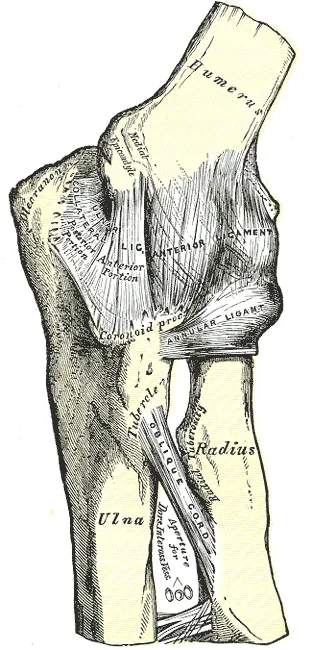
The 2025 systematic review links early (acute) stiffness to inflammation, with swelling of the tissues around the joint or fluid inside it1. It describes later (chronic) stiffness as the result of long-term changes1. These include fibrosis (scarring) and contracture (lasting tightening) of the joint capsule, the sleeve of tissue that encloses a joint1. They also include heterotopic ossification (bone forming in soft tissue, where bone does not normally grow) and muscle shortening1.
What causes it
The 2025 systematic review sorts the causes of stiffness after injury into three groups1:
- Intrinsic: for example, osteophytes (bone spurs at the edge of a joint) that catch, or adhesions (tissue layers sticking together) inside the joint1.
- Extrinsic: for example, a contracted joint capsule or heterotopic ossification1.
- Mixed: both kinds together, which the review calls frequent1.
A literature review describes heterotopic ossification at the elbow as mature bone that forms in soft tissue near the joint and mechanically blocks motion6. It reports an incidence (new cases over a set time) from 1.6% up to 56%6. The rate rises with the extent of trauma, dislocation, surgery, prolonged immobilisation, burns or neurological injury6.
Who it affects
How often it follows an injury
Reported rates vary widely between reviews and studies2,7,8.
| Group studied | What was found |
|---|---|
| Patients after elbow trauma, in a 2025 review | 10% to 15%2 |
| Children and adolescents after elbow fractures, in a 2026 review | Up to 21%7 |
| 10,672 patients in an insurance database after surgery for elbow trauma | 8.4% later recorded with a contracture, on average 3.6 months after the fracture8 |
| 4,878 simple dislocations put back without surgery, people 16 or older in Ontario | 1.2% later had surgery to release a contracture9 |
Factors linked with it
An odds ratio is how many times higher the odds of an outcome are in one group than in another. Studies have linked these factors with stiffness, or with worse stiffness8,10,11:
- In the insurance database: male sex, obesity, opioid use, a burn or head injury, blood-thinning drugs after surgery and a more severe fracture8.
- Time in a cast: one centre’s case-control study compared 688 patients with and without stiffness10. Without surgery, longer casting went with stiffness (odds ratio 2.02)10.
- Injury energy: a retrospective study looked back at 169 patients with stiffness11. Higher-energy injuries went with severe stiffness (odds ratio 4.45)11.
- Injuries managed with surgery: a drug trial followed 151 adults with elbow fractures or dislocations12. The arc at 12 weeks was 117 degrees in those managed with surgery and 128 in those managed without12. The drug was randomised, but whether a person had surgery was not12.
A terrible triad injury is an elbow dislocation with fractures of both the radial head and the coronoid process13. A retrospective study looked back at 100 patients operated on for one; 30 ended with an arc below 100 degrees14. High-energy injury, more than a week to surgery and over 2 weeks of immobilisation after it were independent risk factors14.
After a dislocation
A 2023 narrative review reports on 3 weeks in plaster after a simple dislocation, followed by self-assisted exercises15. This gave functional results, with mild or moderate stiffness left in extension15. Trials of early movement against plaster are reported on elbow dislocation16.
What studies found
Where the guidance stands
The 2025 systematic review states that there are no established guidelines for non-surgical, therapist-led care of stiffness after injury1. A 2024 systematic review found five studies of non-surgical approaches, too varied to pool17. It concluded that the best one cannot be determined with certainty, as confidence in the results was low to very low17.
For surgery, a 2026 multinational clinical practice guideline made 28 recommendations on open release in adults18. It describes itself as the first comprehensive guideline on the subject18. The Chinese National Center for Orthopaedics and Asan Medical Center in Seoul initiated, sponsored and organised it18.
How motion changes over time
In 25 people followed for a year after a traumatic elbow injury, range of motion kept improving up to one year19. At one year, 12% had not regained a functional range, and 12% had needed another operation for contracture19. The 2025 systematic review notes research suggesting that a lack of progress after three months may signal a developing contracture1.
Stretching, splints and braces
The 2025 systematic review of stretching included nine studies with 312 adults1. Three were small randomised trials of hold-relax stretching in early stiffness, and six studied braces in persistent stiffness1. Both approaches were followed by clinically important gains in flexion and extension1. Bracing had more adverse events, and the studies were too varied to pool1. Of 204 patients in the bracing studies, 4% later needed surgery1.
Hold-relax stretching is a form of proprioceptive neuromuscular facilitation (PNF), a method that mixes held stretches with contractions of the muscle being stretched20. Two single trials, each in people stiff after injury, tested it and graded motor imagery20,21:
- PNF against static stretching: a single-blind randomised trial compared the two in 40 people after an elbow fracture, both added to exercise20. PNF improved DASH scores and flexion slightly more20. The DASH is a questionnaire that scores disability of the arm, shoulder and hand.
- Graded motor imagery: a trial split 50 people into two groups21. Six weeks of left-right discrimination, imagined movement and mirror work improved DASH scores more than structured exercise21.
A randomised trial of 66 people with stiffness after injury compared dynamic splints with static progressive (turnbuckle) splints22. A dynamic splint pulls steadily on a joint using springs or elastic. Analysed by assigned group, flexion arc did not differ significantly at any point over twelve months22. The arc gained about 28 to 29 degrees by three months and 47 to 49 degrees by twelve22.
Surgery to free the joint
A 2025 review reports that surgical release may be considered when 6 months of non-surgical care has not brought substantial improvement2. Release is done open, through a cut, or by arthroscopy, keyhole surgery inside a joint23. The Mayo score is a clinician-rated score of elbow function.
| Review | What it found |
|---|---|
| 2013, 30 studies, 798 patients | No randomised trials; average gain 51 degrees open and 40 arthroscopic; complications in 23% and 5%23 |
| 2023, 27 studies, 1,666 patients | Good or excellent Mayo scores in 88.8% open and 91.8% arthroscopic; revision 6.3% against 1.6%24 |
| 2026, 11 studies in children and adolescents | Gain of 58 degrees open and 33 arthroscopic; complications of 14% and 7% did not differ significantly7 |
| 2017, 27 studies of open release, 836 patients | Release at 6 to 10 months after injury had the largest gain and fewest complications; recurrence and Mayo scores were similar; level IV evidence25 |
The 2023 review reports that its studies were all retrospective, with no randomised trials comparing the options24. One randomised trial has since compared the two in 192 people whose stiffness had not responded to non-surgical care3. Both gave large gains in motion and function at one year3. The difference favoured arthroscopic release but was below the minimal clinically important difference, the smallest change people notice, of 25 degrees3. Total costs were similar3.
Machine-driven movement after surgery
Continuous passive motion (CPM) uses a machine to move the joint without the person’s own effort. Studies of it after release point in different directions26,27:
- In a single-blind randomised trial of 51 patients after arthroscopic release, CPM gave 9 degrees more motion at one year than therapist-led exercise26.
- In a randomised trial of 61 patients, adding four weeks of early CPM to exercise gave better motion and Mayo scores up to six months28.
- A matched look back compared 16 patients who used CPM after open release with 16 who did not. The arc gained 59 degrees in both groups27. Unlike the two trials above, this was a small retrospective comparison26,27,28.
A 2025 literature review states that there is no consensus on aftercare, braces or CPM after release29.
Trials aimed at bone forming in soft tissue
Trials after elbow injury or surgery have tested drugs and radiation, with mixed results4,5,30. The two indomethacin trials disagree4,5:
- A double-blind trial gave indomethacin or a placebo (dummy version) to 164 patients after surgery for elbow trauma4. At one year, heterotopic ossification was seen in 49% and 55%, a difference that was not significant4.
- A randomised trial studied 86 adults with acute elbow injuries that needed surgical fixation5. Ossification developed in 14.3% given indomethacin for three weeks and 35.7% given nothing5. The authors note differences in injury severity between the groups at the start5.
A 2025 meta-analysis (a pooling of several studies) combined one randomised trial and five retrospective studies of elbow trauma surgery31. It found anti-inflammatory drugs taken together lowered ossification by 27% in relative terms31. Neither celecoxib nor indomethacin alone differed significantly from controls, and the authors rated the evidence’s power as low31.
A randomised trial at three centres gave one dose of radiation within 72 hours of surgery for elbow fractures30. It was stopped early because of adverse events30. Nonunion, a broken bone that fails to heal, occurred in 38% of the radiation group and 4% of controls30. Ossification and motion showed no difference30.
A drug tested for motion
A placebo-controlled trial studied 151 adults with elbow fractures or dislocations12. Six weeks of the drug ketotifen did not change the arc at 12 weeks12. The arc was 122 degrees with ketotifen and 124 with placebo12.
Connections
The elbow joint page reports a review naming trauma, arthritis after trauma and heterotopic ossification as the most common causes of stiffness6. The same review links the elbow’s tendency to stiffen to its close-fitting bones, tight ligaments and close-lying muscles6.
A 2018 review describes a complex of three ligaments on the inner side, covered on the ulnar collateral ligament page32. The elbow dislocation page reports a trial in which early movement gave a larger arc at 6 weeks than 3 weeks in plaster16. In the bracing studies, one later operation was for problems with the ulnar nerve1.
Elbow stiffness involves
Elbow stiffness can follow
Elbow stiffness involves a joint held by
Elbow stiffness has complications reported in studies of
Sources
- Wistow G, Newman M, Hannink E, Barker KL (2025). Investigating the effectiveness of stretching interventions on post-traumatic elbow stiffness: a systematic review.. JSES international. doi:10.1016/j.jseint.2025.06.015 PMID 41584546
- Fan M, Xu F, Fei C, Liu Y, Yang Z, Song Z (2025). Post-traumatic elbow stiffness: etiology, risk factors and current treatments.. Frontiers in surgery. doi:10.3389/fsurg.2025.1643326 PMID 40932855
- Lu S, Wang Y, Yu S, Huang L, Wang R, Ding J (2025). The efficacy and cost-effectiveness of arthroscopic release for post-traumatic elbow stiffness: a single centre prospective randomized trial.. International orthopaedics. doi:10.1007/s00264-025-06668-0 PMID 41060390
- Atwan Y, Abdulla I, Grewal R, Faber KJ, King GJW, Athwal GS (2023). Indomethacin for heterotopic ossification prophylaxis following surgical treatment of elbow trauma: a randomized controlled trial.. Journal of shoulder and elbow surgery. doi:10.1016/j.jse.2023.02.119 PMID 36907317
- C A, Aduri TT, Kumar D, Bhayana H, Aggarwal S, Goni VG (2026). Effect of indomethacin prophylaxis on heterotopic ossification after surgical fixation of elbow injuries: a randomized controlled trial.. JSES international. doi:10.1016/j.jseint.2026.101740 PMID 42388258
- Siemensma MF, van der Windt AE, van Es EM, Colaris JW, Eygendaal D (2023). Management of the stiff elbow: a literature review. EFORT open reviews. doi:10.1530/EOR-23-0039 PMID 37158372
- Khorram R, Ahmad A, Vafadar R, Shamus RJ, Namdari S, Huffman GR, Kachooei AR (2026). Surgical treatment of post-traumatic elbow stiffness in pediatric patients: a systematic review and meta-analysis.. JSES reviews, reports, and techniques. doi:10.1016/j.xrrt.2025.100646 PMID 41659788
- Wessel LE, Gu A, Richardson SS, Fufa DT, Osei DA (2019). Elbow contracture following operative fixation of fractures about the elbow. JSES open access. doi:10.1016/j.jses.2019.09.004 PMID 31891023
- Modi CS, Wasserstein D, Mayne IP, Henry PD, Mahomed N, Veillette CJ (2015). The frequency and risk factors for subsequent surgery after a simple elbow dislocation.. Injury. doi:10.1016/j.injury.2015.02.009 PMID 25796345
- Qian Y, Yu S, Shi Y, Huang H, Fan C (2020). Risk Factors for the Occurrence and Progression of Posttraumatic Elbow Stiffness: A Case-Control Study of 688 Cases.. Frontiers in medicine. doi:10.3389/fmed.2020.604056 PMID 33392226
- Zheng W, Liu J, Song J, Fan C (2018). Risk factors for development of severe post-traumatic elbow stiffness.. International orthopaedics. doi:10.1007/s00264-017-3657-1 PMID 28988397
- Hildebrand KA, Schneider PS, Mohtadi NGH, Ademola A, White NJ, Garven A, Walker REA, Sajobi TT (2020). PrEvention of Posttraumatic contractuRes with Ketotifen 1 (PERK 1): A Randomized Clinical Trial.. Journal of orthopaedic trauma. doi:10.1097/BOT.0000000000001878 PMID 32639394
- Chen HW, Liu GD, Wu LJ (2014). Complications of treating terrible triad injury of the elbow: a systematic review.. PloS one. doi:10.1371/journal.pone.0097476 PMID 24832627
- He X, Fen Q, Yang J, Lei Y, Heng L, Zhang K (2021). Risk Factors of Elbow Stiffness After Open Reduction and Internal Fixation of the Terrible Triad of the Elbow Joint.. Orthopaedic surgery. doi:10.1111/os.12879 PMID 33619861
- Barco R, Gonzalez-Escobar S, Acerboni-Flores F, Vaquero-Picado A (2023). Acute elbow dislocation: a critical appraisal of the literature.. JSES international. doi:10.1016/j.jseint.2023.03.019 PMID 37969505
- Iordens GI, Van Lieshout EM, Schep NW, De Haan J, Tuinebreijer WE, Eygendaal D, Van Beeck E, Patka P, Verhofstad MH, Den Hartog D, FuncSiE Trial Investigators (2015). Early mobilisation versus plaster immobilisation of simple elbow dislocations: results of the FuncSiE multicentre randomised clinical trial.. British journal of sports medicine. doi:10.1136/bjsports-2015-094704 PMID 26175020
- Piacenza A, Zerilli A, Viccari I, Castelli G (2024). Effectiveness of conservative treatment in the management of post-traumatic elbow stiffness: A systematic review.. Musculoskeletal science & practice. doi:10.1016/j.msksp.2024.103194 PMID 39342760
- Sun Z, Li J, van Riet R, Ho PC, Hildebrand KA, Puah KL, Shih JT, Li Z, Chanlalit C, Kekatpure AL, Zhang K, Liu S, Gong M, Huang F, Yan H, Mi J, Lu J, Zha Y, Xiang Z, Xiang M, Li F, Jiang S, Liu W, Zhong B, Ding J, Ruan H, Ouyang Y, Wang W, Yu S, Chen S, Qian Y, Xu Y, Hu Y, Xu J, Jiang X, Jeon IH, Fan C (2026). Clinical guideline on the open arthrolysis for post-traumatic elbow stiffness in adult patients.. Journal of shoulder and elbow surgery. doi:10.1016/j.jse.2025.07.015 PMID 40865905
- Myden C, Hildebrand K (2011). Elbow joint contracture after traumatic injury. Journal of shoulder and elbow surgery. doi:10.1016/j.jse.2010.07.013 PMID 21050779
- Birinci T, Razak Ozdincler A, Altun S, Kural C (2019). A structured exercise programme combined with proprioceptive neuromuscular facilitation stretching or static stretching in posttraumatic stiffness of the elbow: a randomized controlled trial.. Clinical rehabilitation. doi:10.1177/0269215518802886 PMID 30304958
- Birinci T, Kaya Mutlu E, Altun S (2022). The efficacy of graded motor imagery in post-traumatic stiffness of elbow: a randomized controlled trial.. Journal of shoulder and elbow surgery. doi:10.1016/j.jse.2022.05.031 PMID 35803550
- Lindenhovius AL, Doornberg JN, Brouwer KM, Jupiter JB, Mudgal CS, Ring D (2012). A prospective randomized controlled trial of dynamic versus static progressive elbow splinting for posttraumatic elbow stiffness.. The Journal of bone and joint surgery. American volume. doi:10.2106/JBJS.J.01761 PMID 22517385
- Kodde IF, van Rijn J, van den Bekerom MP, Eygendaal D (2013). Surgical treatment of post-traumatic elbow stiffness: a systematic review.. Journal of shoulder and elbow surgery. doi:10.1016/j.jse.2012.11.010 PMID 23375881
- Lanzerath F, Wegmann K, Hackl M, Uschok S, Ott N, Müller LP, Leschinger T (2023). Surgical arthrolysis of the stiff elbow: a systematic review.. Archives of orthopaedic and trauma surgery. doi:10.1007/s00402-022-04442-0 PMID 35482109
- Sun C, Zhou X, Yao C, Poonit K, Fan C, Yan H (2017). The timing of open surgical release of post-traumatic elbow stiffness: A systematic review.. Medicine. doi:10.1097/MD.0000000000009121 PMID 29245348
- O'Driscoll SW, Lievano JR, Morrey ME, Sanchez-Sotelo J, Shukla DR, Olson TS, Fitzsimmons JS, Vaichinger AM, Shields MN (2022). Prospective Randomized Trial of Continuous Passive Motion Versus Physical Therapy After Arthroscopic Release of Elbow Contracture.. The Journal of bone and joint surgery. American volume. doi:10.2106/JBJS.21.00685 PMID 35234723
- Lindenhovius AL, van de Luijtgaarden K, Ring D, Jupiter J (2009). Open elbow contracture release: postoperative management with and without continuous passive motion.. The Journal of hand surgery. doi:10.1016/j.jhsa.2009.01.003 PMID 19362791
- Huang L, Wang Y, Ma Y, Ding J, Lu S (2025). Does Early Continuous Passive Motion Improves Effectiveness of Physical Therapy After Arthroscopic Release of Elbow Contracture: A Prospective Randomized Trial.. American journal of physical medicine & rehabilitation. doi:10.1097/PHM.0000000000002646 PMID 39418651
- Schneider MM, Rentschler V, Geyer S, Jung C, Hollinger B, Pfalzer F, Beitzel K, Burkhart K, Schoch C (2025). Rehabilitation after surgical release of the stiff elbow: A literature review.. Journal of orthopaedics. doi:10.1016/j.jor.2024.10.061 PMID 39691650
- Hamid N, Ashraf N, Bosse MJ, Connor PM, Kellam JF, Sims SH, Stull DE, Jeray KJ, Hymes RA, Lowe TJ (2010). Radiation therapy for heterotopic ossification prophylaxis acutely after elbow trauma: a prospective randomized study.. The Journal of bone and joint surgery. American volume. doi:10.2106/JBJS.I.01435 PMID 20810853
- Ahmad A, Khorram R, Ghayyad K, Amin V, Kachooei AR, Huffman GR, Osbahr DC, Oh LS (2025). Postoperative nonsteroidal anti-inflammatory drug prophylaxis for elbow heterotopic ossification: a systematic review and meta-analysis comparing COX-2 selective and nonselective inhibitors.. JSES reviews, reports, and techniques. doi:10.1016/j.xrrt.2025.100628 PMID 41551971
- Labott JR, Aibinder WR, Dines JS, Camp CL (2018). Understanding the medial ulnar collateral ligament of the elbow: Review of native ligament anatomy and function.. World journal of orthopedics. doi:10.5312/wjo.v9.i6.78 PMID 29984194
Changes
- First published.