Elbow dislocation
Also called dislocated elbow, simple elbow dislocation, complex elbow dislocation
The bones of the elbow forced out of place, with or without a fracture. How reviews define it, who it affects, and what trials of early movement, plaster and ligament surgery found.
- Region
- Elbow
- Updated
- October 22, 2026
- Reviewed
- October 22, 2026 · how entries are checked
What it is
Simple and complex dislocations
A dislocation is when a bone is forced fully out of its normal place at a joint. A 2024 systematic review comparing approaches describes elbow dislocations as simple, with no fracture, or complex, with added bone injuries1. The fractures in complex cases can be of the lower humerus, the radial head (top of the radius), the upper ulna or the coronoid process7. The coronoid process is a bony lip at the front of the top of the ulna.
A 2014 systematic review describes the “terrible triad” as a dislocation with fractures of both the radial head and the coronoid process8. It notes this injury has long been linked with complications and poor outcomes8. A second 2024 review, of 1,081 elbows, called a simple dislocation persistent when it stayed out of joint for more than 3 weeks9.
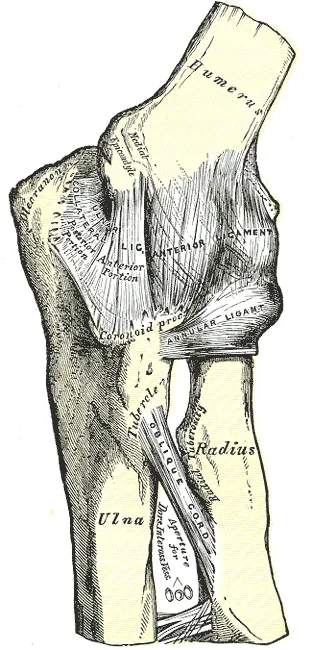
What tears inside the elbow
A 2015 meta-analysis, which pools the results of several studies, calls a simple dislocation a complex soft-tissue injury that can leave lasting symptoms10. It found that the wider the soft-tissue damage, the worse the outcome10. Several studies describe what is torn:
- Ligaments on both sides. A review pooled 78 elbows explored at surgery7. The inner collateral ligament was torn or pulled off the bone in all 78, and the outer one in all 46 explored on that side7.
- Muscle origins. In 31 patients without a fracture, most ligament tears came with torn muscle origins at the epicondyles11. An epicondyle is a bony bump at the elbow.
- Bone, cartilage and capsule. A 2023 narrative review reports osteochondral fractures, of joint cartilage and the bone beneath, in 48.8% of cases on MRI2. A narrative review sums up research without a set, checkable search method. In one MRI study it cites, the most common injury was a full tear of the front of the joint capsule (75%)2. MRI is a scan that shows soft tissue in detail, and the joint capsule is the sleeve of tough tissue around a joint.
The 2023 review reports studies finding that dislocations to the back and inner side bring more severe soft-tissue injury2. Such dislocations also brought more heterotopic ossification (bone forming in soft tissue), more early ulnar nerve problems and more surgery2.
How it happens
The 2023 review names a fall on an outstretched hand in sport, or high-impact trauma, as the most common cause2. The 2024 review comparing approaches notes that the older account was tearing in sequence from the outer side to the inner side1. More recent studies, it says, describe hyperextension (straightening past the normal limit) combined with a valgus (outward-bending) force and load along the arm1.
How stability is judged
The 2023 review says surgeons disagree on how to define an unstable elbow after a dislocation2. One that dislocates again after being put back is usually called unstable, and one that stays put through normal movement stable2. Studies have graded it by how far the joint opens under side-to-side stress on X-ray: under 10, 10 to 20, or over 20 degrees2.
In posterolateral rotatory instability, the joint between ulna and humerus briefly rotates out of place, toward the back and outer side12. Surgeons who described it in five patients put it down to a lax outer ligament12. A 2025 review says it generally follows elbow trauma13. It can bring pain, clicking, partial slips and repeat dislocations13.
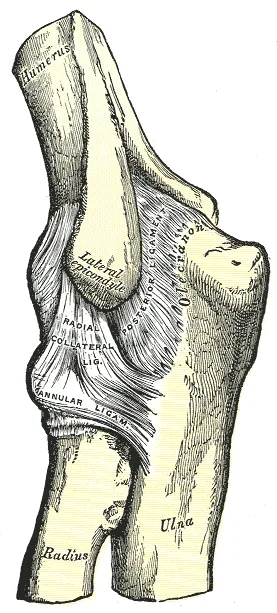
Who it affects
The 2023 review puts dislocations at 11% to 28% of elbow injuries2. In children the elbow is the most often dislocated joint, and 45% of cases are at ages 10 to 192.
Sources look at sex in different ways. The 2023 review says high-energy injuries are typical of young men and lower-energy ones of older women2. The 2024 review comparing approaches links men with assault or sport, and women with direct impacts such as a fall from height1. A study of United States emergency departments, described on the elbow joint page, found almost no difference in rate between males and females14.
In sport
Surveillance studies count athlete-exposures, one athlete taking part in one practice or game15. The college study also counted subluxations, partial slips of a joint15:
| Group studied | What was found |
|---|---|
| United States college (NCAA) athletes, 2009–10 to 2013–14 | 0.04 dislocations or subluxations per 10,000 exposures; highest in men’s wrestling (1.08), then women’s gymnastics (0.74)15 |
| The same NCAA athletes | Every one came from contact, and they were 3 times more likely in competition than practice15 |
| NFL players, 2000 to 2011 | 62 of 35,324 recorded injuries (0.17%), over half while tackling16 |
What studies found
How much trial evidence there is
A 2012 Cochrane review, a systematic review done to the Cochrane Collaboration’s published standards, found two small randomised trials, with 80 people in all5. Such trials assign people to groups by chance. It judged both flawed and possibly biased, and did not pool them5. A 2021 review names them as the Rafai trial and the Josefsson trial, both described below6.
The review found too little trial evidence to say which approach suits simple dislocations in adults5. A 2023 review counted one level I study and three level II randomised trials, with the rest at lower levels of evidence2.
The 2024 review comparing approaches also found few trials, with widely varied surgery and follow-up times1.
Early movement against plaster
In a multicentre trial of 100 adults with a simple dislocation, people were assigned by chance to early movement or 3 weeks in plaster3,17. This was the FuncSiE trial, whose protocol planned for 25 centres in the Netherlands17. The results came at two points:
- At 6 weeks, the early-movement group reported less disability on the QuickDASH, a short questionnaire on arm, shoulder and hand disability (12 against 19 points)3. Their elbows bent and straightened through a larger arc (121 against 102 degrees), and they returned to work sooner (10 against 18 days)3.
- At 1 year, QuickDASH scores were similar: 4.0 against 4.2 points3. No elbow dislocated again within the year3.
The Rafai trial, read two ways
A smaller 1999 trial, by Rafai and colleagues, assigned 50 people with a dislocation to the back to 3 weeks in plaster or early movement19. A 2015 review reports that the early-movement group started on day 310. This is the 50-person trial in the 2012 Cochrane review5,6. Its readings differ:
- The trial’s own report found less stiffness after early movement and called the difference very significant19. Neither group had a repeat dislocation or instability19.
- The Cochrane review found fewer people with incomplete straightening after early movement at 1 year, but called the difference not statistically significant5. The 2015 review, working from the Cochrane review’s figures, also found no significant difference10.
A 2023 narrative review judged this trial probably underpowered, with an unclear way of assigning people to groups2.
What reviews of early movement found
Reviews pooling several studies add these findings10,20:
- A review of 15 studies reports three randomised trials comparing early movement with 21 days in plaster20. Early movement brought back range of motion (how far a joint moves), function and work sooner20. It brought more pain in the first six weeks20.
- The same review found similar rates of repeat dislocation after early movement and after plaster (1.3% against 2.2%)20. It found less heterotopic ossification after early movement20.
- The 2015 meta-analysis’s pooled data showed an earlier return to work after early movement10.
The 1,081-elbow review, of 37 articles, reported the mean arc of bending and straightening after each approach9:
| Approach (number of elbows) | Mean arc of movement (degrees) |
|---|---|
| Early movement (244) | 1379 |
| 1 to 3 weeks of immobilisation (239) | 1299 |
| 3 weeks or more of immobilisation (163) | 1319 |
| Open ligament repair or reconstruction (228) | 1289 |
It found early movement the most consistently satisfactory, but it remained unclear who would do better with surgery9.
Stiffness afterwards
The 2023 review reports that 3 weeks in plaster, then exercises, left mild or moderate stiffness in straightening2. Leftover instability was under 2%2. Stiffness in general has its own page, elbow stiffness.
Ligament surgery against none
In a 1987 trial by Josefsson and colleagues, 30 people aged 16 or older were assigned by chance to ligament repair or no surgery4. There was no evidence that repair gave better results4. A 2015 review states that earlier reviews, the 2012 Cochrane review among them, had only this one trial of surgery against none10. Reviews read the same trial this way:
- The Cochrane review found no significant differences in complaints, range of motion or grip strength5. It judged this weak, inconclusive evidence that did not suggest ligament repair improves long-term function5.
- The 2015 review reports a larger mean loss of straightening at 12 months after surgery, 18 against 10 degrees10. That difference was not significant10.
Other comparisons of surgery come from studies outside these trials, and reviews of them1,10,21:
- The 2015 meta-analysis pooled two retrospective studies, which look back at past cases, and found immediate repair of the ligaments no better than later surgery10.
- The 2024 review comparing approaches reports two studies with similar scores after surgery within 30 days and after 30 days1.
- The same review found too few cases to settle repairing one ligament against both1. It states there is no clear agreement on when surgery is indicated1.
- In 44 recreational athletes, two self-rated elbow scores favoured those without surgery21. Return to sport, pain and range of motion did not differ significantly between the two groups21.
When the joint is less stable
In 68 people managed without surgery, the 19 whose joint opened 10 degrees or more under stress had more complications (36.8% against 4.1%)22. Their risk of revision surgery, a repeat operation, was 8.4 times higher22. The 2024 review comparing approaches cites a study finding leftover valgus instability in up to 48% of people managed without surgery1. That review found surgery gave scores and range of motion similar to non-surgical care where the elbow was only slightly unstable at first1. The 2015 meta-analysis said it is still unknown whether surgery for highly unstable dislocations avoids lasting pain, stiffness and instability10.
Going back to sport
A 2026 review of 9 studies of athletes had return data for 27423. Of these, 272 (99.3%) went back to some sport, after a mean of 11.4 weeks23. Only 3 studies reported return to the same level, so firm conclusions were not possible23. Athletes without surgery returned sooner on average (8.95 against 16.3 weeks)23. The authors noted that more complex injuries more often had surgery, which may bias that comparison23.
Connections
The injury involves the elbow joint, whose dislocations are classed as simple or complex7. The ulnar collateral ligament page describes 31 patients whose inner-side ligaments were all fully torn or pulled off the bone11. Studies cited by the 2023 review link dislocations to the back and inner side with more early problems of the ulnar nerve2.
Stiffness can follow: of 4,878 simple dislocations in Ontario adults, 1.2% later had surgery to release a contracture, a stiff, shortened joint24. Elbow stiffness covers it in general. In adults, only the shoulder dislocates more often, as described in shoulder dislocation2.
Elbow dislocation involves
Elbow dislocation often comes with a tear of
Elbow dislocation can come with problems of
Elbow dislocation can be followed by
Elbow dislocation is the next most common adult dislocation after
Sources
- Breulmann FL, Lappen S, Ehmann Y, Bischofreiter M, Lacheta L, Siebenlist S (2024). Treatment strategies for simple elbow dislocation - a systematic review.. BMC musculoskeletal disorders. doi:10.1186/s12891-024-07260-0 PMID 38365699
- Barco R, Gonzalez-Escobar S, Acerboni-Flores F, Vaquero-Picado A (2023). Acute elbow dislocation: a critical appraisal of the literature.. JSES international. doi:10.1016/j.jseint.2023.03.019 PMID 37969505
- Iordens GI, Van Lieshout EM, Schep NW, De Haan J, Tuinebreijer WE, Eygendaal D, Van Beeck E, Patka P, Verhofstad MH, Den Hartog D, FuncSiE Trial Investigators (2015). Early mobilisation versus plaster immobilisation of simple elbow dislocations: results of the FuncSiE multicentre randomised clinical trial.. British journal of sports medicine. doi:10.1136/bjsports-2015-094704 PMID 26175020
- Josefsson PO, Gentz CF, Johnell O, Wendeberg B (1987). Surgical versus non-surgical treatment of ligamentous injuries following dislocation of the elbow joint. A prospective randomized study.. The Journal of bone and joint surgery. American volume. doi:10.2106/00004623-198769040-00018 PMID 3571318
- Taylor F, Sims M, Theis JC, Herbison GP (2012). Interventions for treating acute elbow dislocations in adults.. The Cochrane database of systematic reviews. doi:10.1002/14651858.CD007908.pub2 PMID 22513954
- Schubert I, Strohm PC, Maier D, Zwingmann J (2021). Simple traumatic elbow dislocations; benefit from early functional rehabilitation: A systematic review with meta-analysis including PRISMA criteria.. Medicine. doi:10.1097/MD.0000000000027168 PMID 34871203
- de Haan J, Schep NW, Eygendaal D, Kleinrensink GJ, Tuinebreijer WE, den Hartog D (2011). Stability of the elbow joint: relevant anatomy and clinical implications of in vitro biomechanical studies. The open orthopaedics journal. doi:10.2174/1874325001105010168 PMID 21633722
- Chen HW, Liu GD, Wu LJ (2014). Complications of treating terrible triad injury of the elbow: a systematic review.. PloS one. doi:10.1371/journal.pone.0097476 PMID 24832627
- Pott CMJM, de Klerk HH, Priester-Vink S, Eygendaal D, van den Bekerom MPJ (2024). Treatment Outcomes of Simple Elbow Dislocations: A Systematic Review of 1,081 Cases.. JBJS reviews. doi:10.2106/JBJS.RVW.23.00135 PMID 38181107
- Hackl M, Beyer F, Wegmann K, Leschinger T, Burkhart KJ, Müller LP (2015). The treatment of simple elbow dislocation in adults.. Deutsches Arzteblatt international. doi:10.3238/arztebl.2015.0311 PMID 26037467
- Josefsson PO, Johnell O, Wendeberg B (1987). Ligamentous injuries in dislocations of the elbow joint.. Clinical orthopaedics and related research. doi:10.1097/00003086-198708000-00027 PMID 3301144
- O'Driscoll SW, Bell DF, Morrey BF (1991). Posterolateral rotatory instability of the elbow. The Journal of bone and joint surgery. American volume. PMID 2002081
- Kholinne E, Ng ZH, Anastasia M, Singjie LC, Kwak JM, Jeon IH (2025). Surgical Outcomes of Lateral Ulnar Collateral Ligament Reconstruction Versus Repair for Posterolateral Rotatory Instability of the Elbow: A Systematic Review and Meta-analysis.. Orthopaedic journal of sports medicine. doi:10.1177/23259671241299831 PMID 39780951
- Stoneback JW, Owens BD, Sykes J, Athwal GS, Pointer L, Wolf JM (2012). Incidence of elbow dislocations in the United States population. The Journal of bone and joint surgery. American volume. doi:10.2106/JBJS.J.01663 PMID 22298056
- Goodman AD, Lemme N, DeFroda SF, Gil JA, Owens BD (2018). Elbow Dislocation and Subluxation Injuries in the National Collegiate Athletic Association, 2009-2010 Through 2013-2014.. Orthopaedic journal of sports medicine. doi:10.1177/2325967117750105 PMID 29372170
- Chang ES, Bishop ME, Dodson CC, Deluca PF, Ciccotti MG, Cohen SB, Ramsey ML (2018). Management of Elbow Dislocations in the National Football League.. Orthopaedic journal of sports medicine. doi:10.1177/2325967118755451 PMID 29497621
- de Haan J, den Hartog D, Tuinebreijer WE, Iordens GI, Breederveld RS, Bronkhorst MW, et al. (2010). Functional treatment versus plaster for simple elbow dislocations (FuncSiE): a randomized trial.. BMC musculoskeletal disorders. PMID 21073734
- Van Lieshout EMM, Iordens GIT, Polinder S, Eygendaal D, Verhofstad MHJ, Schep NWL, Den Hartog D, FuncSiE Trial Investigators (2020). Early mobilization versus plaster immobilization of simple elbow dislocations: a cost analysis of the FuncSiE multicenter randomized clinical trial.. Archives of orthopaedic and trauma surgery. doi:10.1007/s00402-019-03309-1 PMID 31760487
- Rafai M, Largab A, Cohen D, Trafeh M (1999). [Pure posterior luxation of the elbow in adults: immobilization or early mobilization. A randomized prospective study of 50 cases].. Chirurgie de la main. PMID 10855330
- Catapano M, Pupic N, Multani I, Wasserstein D, Henry P (2020). Early functional mobilization for non-operative treatment of simple elbow dislocations: a systematic review.. Shoulder & elbow. doi:10.1177/1758573220957631 PMID 35265188
- Nolte PC, Vorm Walde M, Elrick BP, Grützner PA, Porschke F, Schnetzke M (2023). High return to sport rate and good patient-reported outcomes in recreational athletes following simple elbow dislocations.. Journal of orthopaedic surgery and research. doi:10.1186/s13018-023-03914-2 PMID 37355594
- Schnetzke M, Aytac S, Studier-Fischer S, Grützner PA, Guehring T (2015). Initial joint stability affects the outcome after conservative treatment of simple elbow dislocations: a retrospective study.. Journal of orthopaedic surgery and research. doi:10.1186/s13018-015-0273-x PMID 26289111
- Albright AS, Chow AK, Kiritsis NR, Cuthbert AS, Smith MS, Satalich JR, Cyrus JW, Goodloe JB (2026). Return to Sport Following Elbow Dislocation: A Systematic Review.. Orthopaedic journal of sports medicine. doi:10.1177/23259671261419505 PMID 41929994
- Modi CS, Wasserstein D, Mayne IP, Henry PD, Mahomed N, Veillette CJ (2015). The frequency and risk factors for subsequent surgery after a simple elbow dislocation.. Injury. doi:10.1016/j.injury.2015.02.009 PMID 25796345
Changes
- First published.