Quadriceps contusion
Also called thigh contusion, thigh haematoma, quadriceps haematoma, Charley horse, dead leg
A bruise of the front thigh muscles from a direct blow. How reviews define and grade it, which sports have counted it, how long players were out, and how often bone formed in the muscle afterwards.
- Region
- Thigh
- Muscles
- vastus intermedius, vastus lateralis, vastus medialis, rectus femoris
- Updated
- October 22, 2026
- Reviewed
- October 22, 2026 · how entries are checked
What it is
How reviews define it
A contusion is a bruise. A 2010 review says a quadriceps contusion is usually caused by a direct blow to the muscle1. The blow tears muscle fibres at or next to the point of impact1. This typically leads to bleeding inside the muscle, with pain and loss of motion1. The same review says athletes usually recall a clear cause, often a knee from an opponent or a piece of equipment1.
A 2022 narrative review (a summary written without a set, checkable search method) covered front-thigh injuries in soccer players9. It says many are direct contusions from tackles or other collisions, also known as “Charley horse” and “dead leg”9. In these injuries the pain sits where the blow landed9. The review says severity depends on the energy and surface of the impact, and whether the muscle was tight or relaxed9.
Where it sits among muscle injuries
The 2013 Munich consensus statement, a report setting out what an expert panel agreed, classes muscle contusions as acute direct injuries10. It keeps them separate from the indirect injuries in its main classification10. A 2023 review draws the same line: strains come without contact, while contusions and cuts come from an outside impact11. Strains have their own page, muscle strain.
Which muscles are hurt
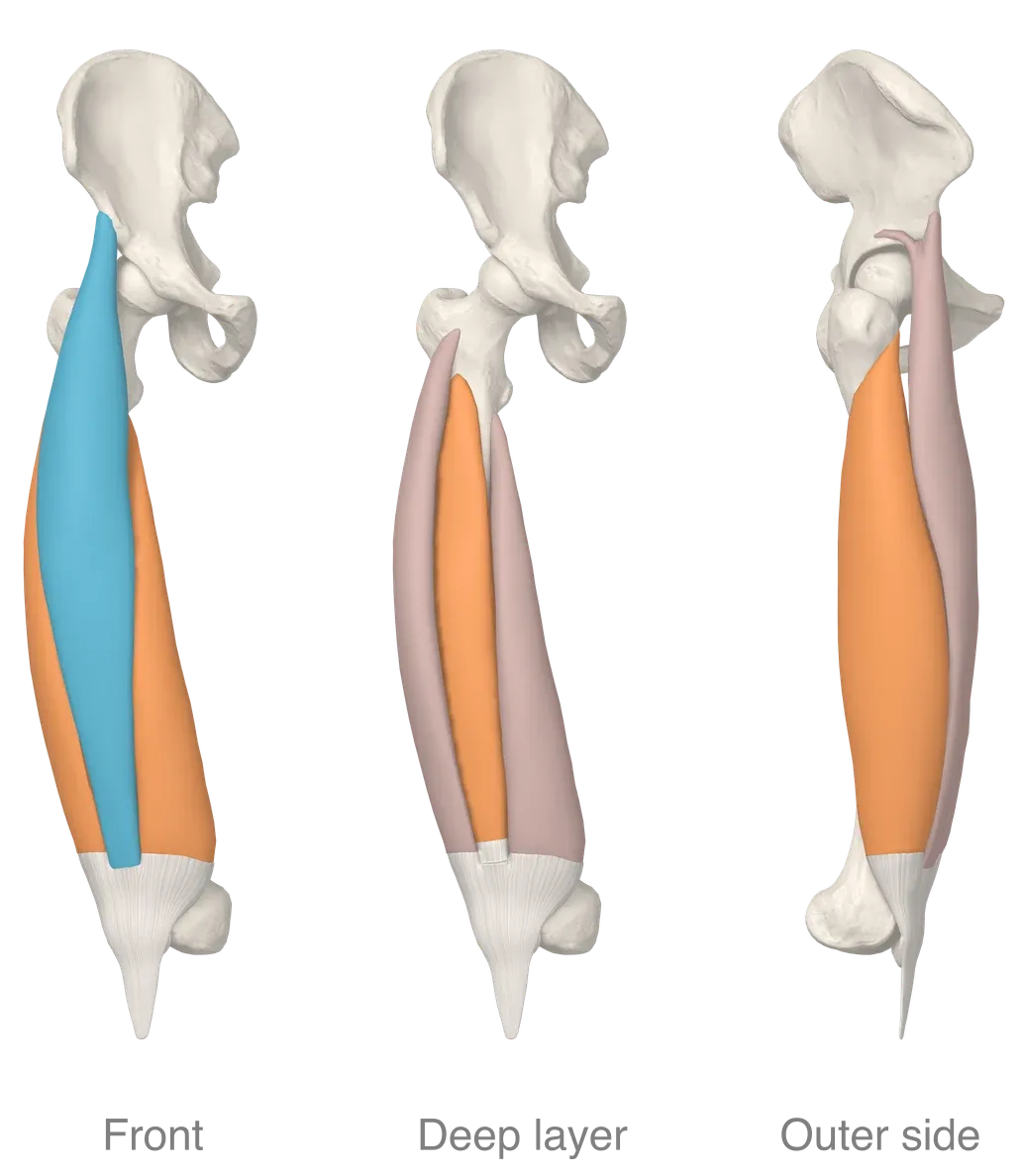
The quadriceps is a group of four muscles at the front of the thigh12. The rectus femoris sits at the front, the vastus lateralis on the outer side and the vastus medialis on the inner side12. The vastus intermedius lies between those two vasti, deep to the rectus femoris12.
The 2022 review says the three vasti, the intermedius, lateralis and medialis, are the muscles most often hurt by direct front-thigh contusions9.
How it is graded
The 2010 review gives a grading adapted from Jackson and Feagin1. It rests on how far the person can bend the knee unaided, and on how they walk1.
| Grade | Knee flexion (bending) reached | Walking |
|---|---|---|
| Mild | More than 90 degrees1 | Normal1 |
| Moderate | 45 to 90 degrees1 | With a limp1 |
| Severe | Less than 45 degrees1 | With a severe limp1 |
One case series, a report on a group of patients with no comparison group, followed seven people13. In it, the grade did not consistently estimate return to play13.
Who it affects
Sports that have counted it
The 2010 review says that, after strains, contusions are the most often reported kind of quadriceps injury in sport1.
| Group studied | What was found |
|---|---|
| 546 professional players at 12 clubs in rugby union’s English Premiership, over two seasons | Thigh haematomas were the most common match injury for forwards and for backs2 |
| 78 players in one national rugby union team, over 3 years | Quadriceps haematomas were the most common match injury, at 18.8 per 1000 match-hours3 |
| Four Welsh professional regional rugby union teams, 2012 to 2016 | Front-thigh haematomas in matches fell from 8.2 to 2.4 per 1000 hours14 |
| 1981 elite men’s football players in 30 teams, 2001 to 2013 | 12% of thigh muscle injuries were contusions, at 0.19 per 1000 hours against 1.48 for indirect injuries4 |
| 320 players at five amateur Australian football clubs, 1999 season | Thigh haematomas were the second most common injury, after hamstring strains15 |
| NBA players, 2015 to 2020 | 85 of 116 quadriceps muscle injuries (73.3%) were contusions16 |
In the elite football study, 76% of contusions happened in matches, and foul play was involved in 42% of them4. In a study of 60 people with quadriceps haematomas, all were aged 15 to 25, and 36 were hurt playing rugby17.
Playing surface and thigh padding
At two UK professional rugby union clubs, 157 players were followed over 209 matches18. Thigh haematomas were more frequent on artificial surfaces than on grass, with a rate ratio (one rate divided by the other) of 2.2518.
The 2010 review says better protective gear seems to be lowering how often these bruises happen, but no research supports this trend1. A 2013 review of Australian football injuries reports evidence that thigh pads can lower how often thigh haematomas happen19.
One season-long study compared two elite under-18 Australian football teams20. The team without thigh protectors had nine thigh haematomas, and the team wearing them had none20. Two players in the team without protectors tore a quadriceps within four weeks of a haematoma20. The protectors were uncomfortable in hot conditions20.
What studies found
How long people were out
- Elite men’s football, 30 teams: a mean of 7 days for contusions, against 18.5 days for indirect thigh injuries4.
- West Point cadets, 117 contusions: an average of 13 days for mild, 19 for moderate and 21 for severe contusions5.
- NBA players, 2015 to 2020: a median of two games missed across quadriceps muscle injuries, most of them contusions16.
- 60 people with quadriceps haematomas: the 40 with jobs spent an average of four weeks off work17.
For direct thigh blows, the 2022 review’s outlook is 2 to 5 days when mild, and 20 to 25 days or more when severe9.
When bone forms in the bruise
The 2010 review describes myositis ossificans as a non-cancerous growth of bone and cartilage where a severe quadriceps bruise was1. It gives a reported rate of 9 to 17% after contusions1. In the study of 60 people with haematomas, 10 developed heterotopic ossification, bone forming in soft tissue17. Attempts to predict which haematomas would turn to bone were unsuccessful17.
In the West Point cadets, myositis ossificans was associated with five factors5:
- knee motion under 120 degrees5;
- injury during football5;
- an earlier quadriceps injury5;
- a delay of more than 3 days before care5;
- an effusion (fluid build-up) in the knee on the same side5.
The 2022 review says the cause is not known with certainty, but that the risk is greater after large contusions than small ones9.
A 2021 review divides the condition after injury into three phases22. No calcification (calcium build-up) shows on X-ray in the first four weeks; it appears between weeks four and eight22. A mature phase follows, and after several months the calcification usually firms up and finally dissolves22.
In a radiology series of 68 cases from a UK centre, 73% were in lower-limb muscles, most of them in the quadriceps23. Of the 27 quadriceps cases, the vastus intermedius had 12 and the vastus lateralis 723. The vastus medialis had 6, and the rectus femoris 223. The authors describe the condition as generally self-limiting, with the growth often shrinking within 1 to 2 years23.
A 2018 review of myositis ossificans in sport reports that most people do well without surgery24. It says athletes typically return to light activity by 2 to 3 months24. Full activity typically follows by 6 months, and their earlier level by 1 year24.
In 32 athletes who had a mature growth removed by surgery, mostly from a thigh muscle, 81% had a good or excellent outcome25. Of the 32, 30 regained their pre-injury activity level25. A 2021 review says delaying surgery until the growth has matured is preferred, though conclusive data supporting the delay are lacking22.
Pressure in the thigh
A 2013 review of thigh contusion names myositis ossificans and compartment syndrome as complications to consider26. Compartment syndrome is a rise in pressure inside a closed space of muscle, wrapped by tough tissue and bone, which limits blood flow there. A systematic review of 9 case series, 89 patients in all, studied it in the thigh27. Blunt trauma was the most common cause (90%), motor vehicle accidents made up 36%, and the authors called the data limited27.
Studies of what was done after the injury
A 2016 narrative review of muscle injuries in football says current care principles have no firm scientific basis6. It says they are largely based on experience, because randomised studies that follow people forward in time are lacking6. An appraisal of a 2004 review of 22 randomised trials of ice for soft-tissue injury found none studied muscle contusions28.
| Study | What was done | What was found |
|---|---|---|
| 117 West Point cadets | The injured leg was rested with the knee bent rather than straight5 | Time out by grade is listed above; myositis ossificans in 9%5 |
| 47 US Naval Academy midshipmen, case series | The knee was held bent to 120 degrees for 24 hours straight after the injury7 | Full activity without limits after an average of 3.5 days (2 to 5)7; one case of myositis ossificans in the first 23 X-rayed7 |
| 40 athletes with thigh or calf bruises or strains, not randomised | A maximum compression bandage within 5 minutes, against no immediate compression8 | No significant reduction in haematoma size or time to full recovery8 |
The Naval Academy series had no control group, and compared its result with reports from other studies7.
A 2023 single-blind randomised trial, in which one party did not know who was in which group, enrolled 46 healthy people29. A tennis-ball serving machine struck each person’s rectus femoris, and groups wore an active or a placebo (dummy) red and blue light patch29. The active group had greater quadriceps peak torque (the greatest turning force a muscle produces about a joint) at one test speed29. It also had greater average power than the placebo group29. Two of the trial’s four authors list CareWear Corp, the maker of the patch tested, as their affiliation29.
Shock wave therapy aims pulses of sound energy at tissue from outside the body. A 2023 systematic review of it in muscle injuries covered eight studies of 143 adults30. Its contusion data came from three male professional football players in one retrospective study30. The authors concluded that higher-quality studies are needed30.
Connections
The bruise sits in the quadriceps, the group that straightens the knee through the kneecap and patellar ligament12.
A contusion is a direct injury, and the muscle strain page covers the indirect, non-contact kind11. How muscle repairs itself is on the muscle tissue page. A review describes three phases of repair31. They are breakdown with inflammation, regrowth as satellite cells (stem cells on muscle fibres) multiply, and maturing of the new fibres31. It says severe muscle injuries form scar tissue that impairs how the muscle works31.
Quadriceps contusion involves
Quadriceps contusion is one kind of injury to
Quadriceps contusion is classed as a direct injury, apart from
Sources
- Kary JM (2010). Diagnosis and management of quadriceps strains and contusions.. Current Reviews in Musculoskeletal Medicine. doi:10.1007/s12178-010-9064-5 PMID 21063497
- Brooks JH, Fuller CW, Kemp SP, Reddin DB (2005). Epidemiology of injuries in English professional rugby union: part 1 match injuries.. British Journal of Sports Medicine. doi:10.1136/bjsm.2005.018135 PMID 16183774
- Moore IS, Ranson C, Mathema P (2015). Injury Risk in International Rugby Union: Three-Year Injury Surveillance of the Welsh National Team.. Orthopaedic Journal of Sports Medicine. doi:10.1177/2325967115596194 PMID 26674339
- Ueblacker P, Müller-Wohlfahrt HW, Ekstrand J (2015). Epidemiological and clinical outcome comparison of indirect ('strain') versus direct ('contusion') anterior and posterior thigh muscle injuries in male elite football players: UEFA Elite League study of 2287 thigh injuries (2001-2013).. British Journal of Sports Medicine. doi:10.1136/bjsports-2014-094285 PMID 25755277
- Ryan JB, Wheeler JH, Hopkinson WJ, Arciero RA, Kolakowski KR (1991). Quadriceps contusions. West Point update.. The American Journal of Sports Medicine. doi:10.1177/036354659101900316 PMID 1867338
- Ueblacker P, Haensel L, Mueller-Wohlfahrt HW (2016). Treatment of muscle injuries in football.. Journal of Sports Sciences. doi:10.1080/02640414.2016.1252849 PMID 27849130
- Aronen JG, Garrick JG, Chronister RD, McDevitt ER (2006). Quadriceps contusions: clinical results of immediate immobilization in 120 degrees of knee flexion.. Clinical Journal of Sport Medicine. doi:10.1097/01.jsm.0000244605.34283.94 PMID 17016112
- Thorsson O, Lilja B, Nilsson P, Westlin N (1997). Immediate external compression in the management of an acute muscle injury.. Scandinavian Journal of Medicine & Science in Sports. doi:10.1111/j.1600-0838.1997.tb00137.x PMID 9200324
- Lempainen L, Mechó S, Valle X, Mazzoni S, Villalon J, Freschi M, Stefanini L, García-Romero-Pérez A, Burova M, Pleshkov P, Pruna R, Pasta G, Kosola J (2022). Management of anterior thigh injuries in soccer players: practical guide.. BMC Sports Science, Medicine and Rehabilitation. doi:10.1186/s13102-022-00428-y PMID 35303927
- Mueller-Wohlfahrt HW, Haensel L, Mithoefer K, Ekstrand J, English B, McNally S, Orchard J, van Dijk CN, Kerkhoffs GM, Schamasch P, Blottner D, Swaerd L, Goedhart E, Ueblacker P (2013). Terminology and classification of muscle injuries in sport: the Munich consensus statement.. British Journal of Sports Medicine. doi:10.1136/bjsports-2012-091448 PMID 23080315
- Edouard P, Reurink G, Mackey AL, Lieber RL, Pizzari T, Järvinen TAH, Gronwald T, Hollander K (2023). Traumatic muscle injury.. Nature reviews. Disease primers. doi:10.1038/s41572-023-00469-8 PMID 37857686
- Betts JG, Young KA, Wise JA, Johnson E, Poe B, Kruse DH, Korol O, Johnson JE, Womble M, DeSaix P (2022). Anatomy and Physiology 2e. OpenStax. Link
- Torres RJL, Hattori S, Kato Y, Yamada S, Ohuchi H (2018). Ultrasonography and return to play of the different clinical grading of quadriceps contusions: a case series.. Journal of Medical Ultrasonics. doi:10.1007/s10396-017-0833-2 PMID 28988329
- Bitchell CL, Mathema P, Moore IS (2020). Four-year match injury surveillance in male Welsh professional Rugby Union teams.. Physical Therapy in Sport. doi:10.1016/j.ptsp.2019.12.001 PMID 31869752
- Gabbe B, Finch C, Wajswelner H, Bennell K (2002). Australian football: injury profile at the community level.. Journal of Science and Medicine in Sport. doi:10.1016/s1440-2440(02)80036-6 PMID 12188087
- Parmar RP, Tummala SV, Morikawa L, Buckner-Petty S, Chhabra A (2026). Characterization of quadriceps muscle injuries in National Basketball Association athletes and effects on player performance following injury.. BMC Sports Science, Medicine and Rehabilitation. doi:10.1186/s13102-026-01595-y PMID 41709337
- Rothwell AG (1982). Quadriceps Hematoma. A prospective clinical study.. Clinical Orthopaedics and Related Research. PMID 6814806
- Ranson C, George J, Rafferty J, Miles J, Moore I (2018). Playing surface and UK professional rugby union injury risk.. Journal of Sports Sciences. doi:10.1080/02640414.2018.1458588 PMID 29595083
- Hrysomallis C (2013). Injury incidence, risk factors and prevention in Australian rules football.. Sports Medicine. doi:10.1007/s40279-013-0034-0 PMID 23529288
- Mitchell B (2000). Efficacy of thigh protectors in preventing thigh haematomas.. Journal of Science and Medicine in Sport. doi:10.1016/s1440-2440(00)80045-6 PMID 10839226
- Stammer A, Ashwood N, Amara V, Suryawanshi S, Wilson P, Dekker A (2025). The anatomical basis for surgical intervention in myositis ossificans-A systematic review.. Clinical Anatomy. doi:10.1002/ca.24238 PMID 39623749
- Savvidou O, Papakonstantinou O, Lakiotaki E, Melissaridou D, Korkolopoulou P, Papagelopoulos PJ (2021). Post-traumatic myositis ossificans: a benign lesion that simulates malignant bone and soft tissue tumours.. EFORT Open Reviews. doi:10.1302/2058-5241.6.210002 PMID 34377549
- Saad A, Azzopardi C, Patel A, Davies AM, Botchu R (2021). Myositis ossificans revisited - The largest reported case series.. Journal of Clinical Orthopaedics and Trauma. doi:10.1016/j.jcot.2021.03.005 PMID 33816108
- Devilbiss Z, Hess M, Ho GWK (2018). Myositis Ossificans in Sport: A Review.. Current Sports Medicine Reports. doi:10.1249/JSR.0000000000000515 PMID 30204632
- Orava S, Sinikumpu JJ, Sarimo J, Lempainen L, Mann G, Hetsroni I (2017). Surgical excision of symptomatic mature posttraumatic myositis ossificans: characteristics and outcomes in 32 athletes.. Knee Surgery, Sports Traumatology, Arthroscopy. doi:10.1007/s00167-017-4667-7 PMID 28780628
- Trojian TH (2013). Muscle contusion (thigh).. Clinics in Sports Medicine. doi:10.1016/j.csm.2012.12.009 PMID 23522512
- Ojike NI, Roberts CS, Giannoudis PV (2010). Compartment syndrome of the thigh: a systematic review.. Injury. doi:10.1016/j.injury.2009.03.016 PMID 19555950
- Hubbard TJ, Denegar CR (2004). Does Cryotherapy Improve Outcomes With Soft Tissue Injury?. Journal of Athletic Training. PMID 15496998
- Wells A, Rigby J, Castel C, Castel D (2023). Pulsed Red and Blue Photobiomodulation for the Treatment of Thigh Contusions and Soft Tissue Injury: A Randomized Controlled Trial.. Journal of Sport Rehabilitation. doi:10.1123/jsr.2022-0334 PMID 37917978
- Mazin Y, Lemos C, Paiva C, Amaral Oliveira L, Borges A, Lopes T (2023). The Role of Extracorporeal Shock Wave Therapy in the Treatment of Muscle Injuries: A Systematic Review.. Cureus. doi:10.7759/cureus.44196 PMID 37767244
- Laumonier T, Menetrey J (2016). Muscle injuries and strategies for improving their repair.. Journal of Experimental Orthopaedics. doi:10.1186/s40634-016-0051-7 PMID 27447481
Changes
- First published.