Turf toe
Also called first metatarsophalangeal joint sprain, first MTP joint sprain, big-toe joint sprain
A sprain of the joint at the base of the big toe. How studies define and grade it, who gets it, what is known about playing surfaces and shoes, and what the small body of outcome research found.
- Region
- Foot & ankle
- Muscles
- flexor hallucis brevis, flexor hallucis longus
- Updated
- October 22, 2026
- Reviewed
- October 22, 2026 · how entries are checked
What it is
How papers and reviews define it
The name comes from a 1976 paper6. It described a sprain of the capsule and ligaments on the sole side of the big-toe joint6. A capsule is the sleeve of tough tissue that encloses a joint, and a ligament is a tough band that holds bones together.
A 2014 study of college football used turf toe as an umbrella name for a sprained first metatarsophalangeal joint1. That is the joint where the first metatarsal meets the big toe. The study counted damage to the joint’s connective tissue or plantar plate, or a break in a sesamoid1. A 2018 review described injury to the sole-side tissues and sesamoids of the big-toe joint7. It called the condition fairly rare, seen particularly in American football after harder artificial surfaces came in7.
The joint involved
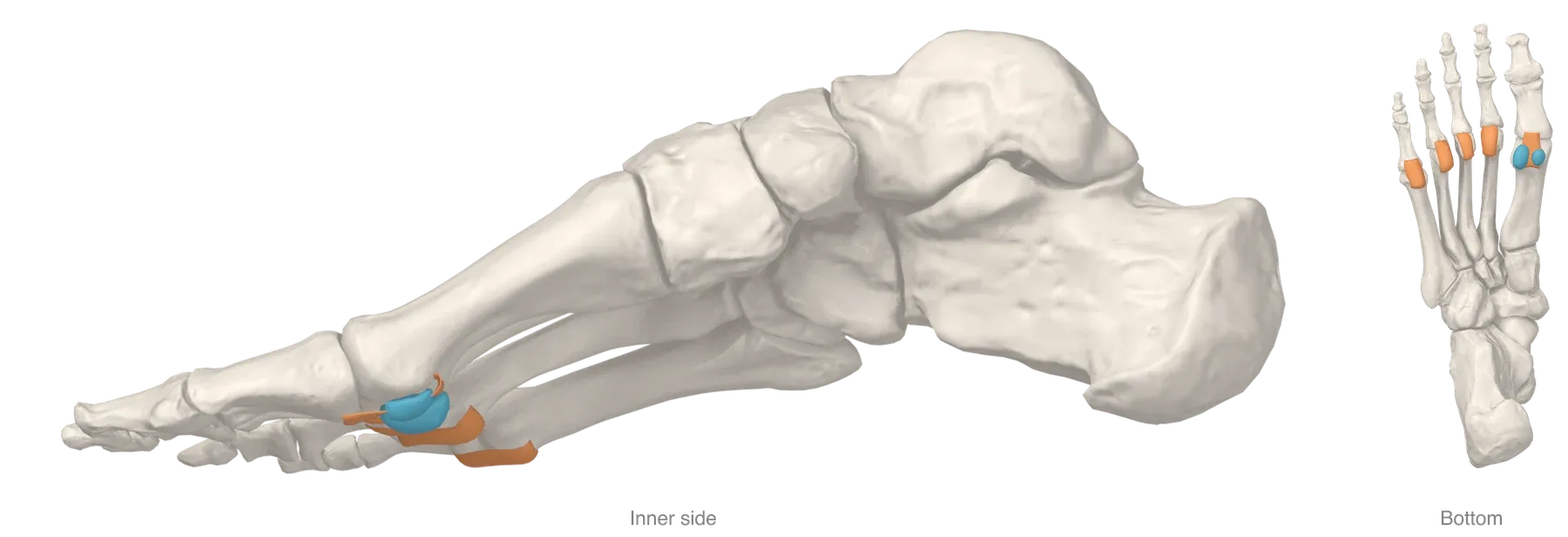
Four bones make up the first metatarsophalangeal joint8. They are the first metatarsal (the long bone behind the big toe), the first bone of the big toe, and two sesamoids8. Sesamoids are small bones partly or wholly embedded in a tendon9. The big-toe sesamoids sit on the sole side of the first metatarsal’s head, and the inner one is commonly in two parts9.
A review describes the joint as shallow, with little stability from its bones8. It relies on soft tissues such as the plantar plate, ligaments and muscles, as the metatarsals page describes8. One of the foot muscles is the flexor hallucis brevis, a short sole muscle that bends the big toe. It has a sesamoid in each of its two tendons10. The tendon of the flexor hallucis longus, a deep calf muscle that bends the big toe, runs between the two sesamoids10.
How it happens
A 2010 review says that typically, load is driven down through a foot with the heel raised and the big toe bent upward3. That forces the joint past its limit and stretches or tears its capsule and ligaments3. In football, this most often happens when a player lands on the back of a planted foot3. In 20 cadaver limbs (bodies donated for study), the estimated risk of injury reached 50% at 78 degrees of upward bending11.
How it is graded
A 2010 review describes three grades3:
| Grade | What the 2010 review describes |
|---|---|
| I | A sprain or stretching of the capsule and ligaments on the sole side3 |
| II | A partial rupture of the soft tissues on the sole side3 |
| III | A complete rupture of the structures on the sole side3 |
A 2018 review adds that a grade 3 injury may come with damage to the joint surface7. It may also come with a dislocation toward the top of the foot7. The 2010 review states that when the plantar plate ruptures, one or both sesamoids shift back toward the heel3.
The 2018 review says the sesamoids may also break alongside turf toe7. In a two-part sesamoid, the joint between the parts may be hurt instead7. A case series of 19 football players describes traumatic hallux valgus as a distinct variant of turf toe12.
Who it affects
Sports and settings
A 2023 review calls turf toe common among athletes2. It names football, soccer, basketball, dancing and wrestling2. A study of 12 non-athletes notes that it also occurs outside sport, though it is most common in athletes13.
How often it is seen
Studies in several sports have counted it1,7. An athlete-exposure is one athlete taking part in one practice or game.
| Group studied | What was found |
|---|---|
| College football, five seasons, 2004–05 to 2008–09 | 0.062 injuries per 1,000 athlete-exposures1 |
| 3,607 foot injuries in 25 college sports over 10 years | The most common named foot injury, ahead of fifth metatarsal fractures14 |
| 320 college players examined at the 2006 NFL Combine | 36 cases of toe joint (metatarsophalangeal) dislocation or turf toe, counted together: the third most common foot or ankle injury in their histories15 |
| 80 active professional football players, surveyed in 1990 | 45% had had it during their professional careers, as reported in a 2010 review3 |
| Rugby players over four seasons | 11% of all foot injuries, with about 0.4% of players affected per season, as reported in a 2018 review7 |
In the 2004 to 2009 college football data, players were nearly 14 times more likely to get turf toe in games than in practice1. Most cases came from hitting the playing surface (35.4%) or another player (32.7%)1. Running backs and quarterbacks were hurt most often1. Mean time lost was 10.1 days, and fewer than 2% of cases needed an operation1.
In 25 college sports, turf toe had the second-highest rate of career-ending injury among severe foot injuries14. Severe tendon injuries ranked first14.
Playing surfaces
The 1976 paper discussed surface hardness and shoe stiffness as two factors that seemed to make it more likely6. On natural grass it saw no cases, in stiff or flexible shoes6. It found turf toe “not uncommon” in players wearing soccer-style shoes on AstroTurf6. In the 1990 survey of 80 professional players, 83% reported their first turf toe on artificial turf16. Player age, years in professional football and the ankle’s range of upward bending were also significantly related to it16.
Later studies point in more than one direction1,17,18:
- College football, 2004 to 2009: the rate was significantly higher on third-generation artificial surfaces than on grass. It was 0.087 against 0.047 per 1,000 athlete-exposures1.
- NFL players, 2011 to 2014, found through online reports: of 71 cases, 29 were on grass and 29 on turf. The surface of 13 was not known17.
- 39 college football programmes, 2006 to 2020: imaging and surgical procedures for foot injuries were less frequent on heavyweight-infill turf than on grass. The rates were 0.6 against 1.1 per 10-game season18. One author declared research support from FieldTurf, a maker of artificial turf18.
A 2023 systematic review of 53 studies concluded that the evidence suggests more foot and ankle injuries on artificial turf than on grass19. That applied to older and newer types of turf, though the studies varied too much to pool19. The few studies finding more injuries overall on natural grass all had financial support from the artificial turf industry19.
Shoes
A 2017 review of football shoes reasons that a stiffer sole plate might lower the risk, since risk rises with upward toe bending20. It adds that extra stiffness may limit the toe bending that football play needs20. In a lab study of 10 college football players, shoes of three forefoot stiffnesses did not significantly change peak toe bending21.
What studies found
How much evidence there is
A 2020 systematic review found only 8 eligible studies: 5 case reports and 3 case series, covering 16 injured toes4. All were at the lowest level of evidence and rated poor quality, and it found no evidence-based guideline4. A 2018 review states that little research compares surgery with non-surgical approaches7. It reports that a 2017 review of 7 studies, presented at a conference, judged the evidence insufficient to say whether surgery is better7.
Time away from sport
The two reviews that give times by grade do not agree on grade III2,3:
| Grade | 2010 review | 2023 review |
|---|---|---|
| I | Typically, return to play as tolerated3 | May return once there is little or no pain with normal weight-bearing, traditionally after 3 to 5 days2 |
| II | Typically about 2 weeks3 | Typically 2 to 4 weeks2 |
| III | At least 10 to 16 weeks3 | 4 to 6 weeks or more, depending on the approach taken2 |
A 2019 systematic review and meta-analysis pooled 12 studies of 112 athletes22. Median return was 5.85 weeks without surgery and 14.70 weeks with it22. But the two groups had different injury grades22. The authors said very few studies report return to sport, and the low level of evidence carried a high risk of bias22.
In a study of 24 NFL players, 19 returned within the same regular season, after a mean of 36.7 days23. Three needed season-ending surgery23. Their performance over the next one and two years was similar to that of 436 comparison players23. A 2023 review states that athletes with low-grade turf toe typically reach their previous level2. Of those with higher-grade injuries, managed with or without surgery, about 70% are expected to keep their level2.
Case series
Case series follow a group of patients with no comparison group12,24,25,26:
- 15 football players, grade 3, after surgery: they missed an average of 16.5 weeks of play. Their mean AOFAS big-toe score, a foot and ankle score, was 91.3 at about 27.5 months24.
- 21 athletes surveyed after plantar plate repair for grade 3: 19 (90.5%) returned to their previous level, at a mean of 20.4 weeks25.
- 24 patients followed for an average 4.5 years: grades I and II were managed without surgery and grade III with surgery. Scores improved in both groups. Still, 29% of grade III and 20% of grade II patients did not resume previous activities26.
- 19 football players with traumatic hallux valgus, after surgery: 74% returned to their previous level, at an average of 3.4 months12.
A taping trial
A 2024 randomised trial split 60 people aged 25 to 30 with grade II turf toe into three groups of 205. One had kinesiology tape plus a 12-week exercise programme, one had dummy taping plus exercise, and one had exercise alone5. After 12 weeks, the real-tape group had a larger drop in pain and walked farther in six minutes5. It also gained more in step length, stride length, cadence (steps per minute) and walking speed5. The dummy-tape and exercise-only groups did not differ in walking measures5.
Over the longer term
In the 1990 study of 80 professional players, turf toe was followed by a significantly smaller range of motion at the big-toe joint16. Among 44 players from one NFL team, toes with past turf toe bent upward less, about 41 against 48 degrees27. They also had higher peak pressure under the big toe, an association, not a cause27. A 2010 review reports an earlier series of 20 people in which half had lasting pain and stiffness five years on3.
A 2018 review states that unrecognised turf toe can lead to long-term problems7. It lists weaker push-off, ongoing pain, worsening deformity and eventual joint wear7. It also names hallux rigidus, a stiff, arthritic big-toe joint, among possible results of a missed injury7.
One study found that big-toe motion differed by about 21 degrees between 123 college basketball players and 123 non-competitive people28. Its author concluded that subacute turf toe injuries likely occur in the players, leading to joint wear that limits big-toe motion28.
Connections
The injury centres on the joint where the first of the metatarsals meets the big toe, which relies on soft tissues for stability8. The foot muscles page covers the flexor hallucis brevis, whose two tendons each hold a sesamoid10. A 2000 review lists the big-toe sesamoids among high-risk sites for a stress fracture29. At the 2006 NFL Combine, toe joint (metatarsophalangeal) dislocation or turf toe, counted together, ranked third, after outer ankle sprains and high ankle sprains15.
Turf toe involves
Turf toe is studied alongside
Turf toe shares the big-toe sesamoids with
Sources
- George E, Harris AH, Dragoo JL, Hunt KJ (2014). Incidence and risk factors for turf toe injuries in intercollegiate football: data from the national collegiate athletic association injury surveillance system. Foot & ankle international. doi:10.1177/1071100713514038 PMID 24334272
- Gupta A, Singh PK, Xu AL, Bronheim RS, McDaniel CM, Aiyer AA (2023). Turf Toe Injuries in the Athlete: an Updated Review of Treatment Options, Rehabilitation Protocols, and Return-to-Play Outcomes. Current reviews in musculoskeletal medicine. doi:10.1007/s12178-023-09870-y PMID 37789169
- McCormick JJ, Anderson RB (2010). Turf toe: anatomy, diagnosis, and treatment. Sports health. doi:10.1177/1941738110386681 PMID 23015979
- Seow D, Tengku Yusof TNB, Yasui Y, Shimozono Y, Kennedy JG (2020). Treatment Options for Turf Toe: A Systematic Review. The Journal of foot and ankle surgery. doi:10.1053/j.jfas.2018.12.041 PMID 31882133
- Azab AR, Elnaggar RK, Aly SM, Basalem N, Alamri AM, Saleh AK, Ibrahim MN, Basha MA, Abdelbasset WK (2024). From injury to rehabilitation: How kinesiology taping helps patients with first metatarsophalangeal joint sprain (turf toe) in pain reduction, gait parameters and functional ability improvement. A randomized clinical trial. Heliyon. doi:10.1016/j.heliyon.2024.e29746 PMID 38681645
- Bowers KD Jr, Martin RB (1976). Turf-toe: a shoe-surface related football injury. Medicine and science in sports. PMID 957935
- Najefi AA, Jeyaseelan L, Welck M (2018). Turf toe: A clinical update. EFORT open reviews. doi:10.1302/2058-5241.3.180012 PMID 30305934
- Embaby OM, Elalfy MM (2025). First metatarsophalangeal joint: Embryology, anatomy and biomechanics. World journal of orthopedics. doi:10.5312/wjo.v16.i4.102506 PMID 40290610
- Nwawka OK, Hayashi D, Diaz LE, Goud AR, Arndt WF, Roemer FW, Malguria N, Guermazi A (2013). Sesamoids and accessory ossicles of the foot: anatomical variability and related pathology. Insights into imaging. doi:10.1007/s13244-013-0277-1 PMID 24006205
- Zaottini F, Picasso R, Pistoia F, Perez MM, Möller I, Rossi F, Bruns A, Tagliafico AS, Martinoli C (2023). Ultrasound of the plantar foot: a guide for the assessment of plantar intrinsic muscles.. Journal of Ultrasonography. doi:10.15557/jou.2023.0024 PMID 37732108
- Frimenko RE, Lievers WB, Riley PO, Park JS, Hogan MV, Crandall JR, Kent RW (2013). Development of an injury risk function for first metatarsophalangeal joint sprains. Medicine and science in sports and exercise. doi:10.1249/MSS.0b013e3182994a10 PMID 23657164
- Covell DJ, Lareau CR, Anderson RB (2017). Operative Treatment of Traumatic Hallux Valgus in Elite Athletes. Foot & ankle international. doi:10.1177/1071100717697961 PMID 28335617
- Pinter ZW, Farnell CG, Huntley S, Patel HA, Peng J, McMurtrie J, Ray JL, Naranje S, Shah AB (2020). Outcomes of Chronic Turf Toe Repair in Non-athlete Population: A Retrospective Study. Indian journal of orthopaedics. doi:10.1007/s43465-019-00010-8 PMID 32211128
- Chan JJ, Geller JS, Chen KK, Huang HH, Huntley SR, Vulcano E, Aiyer A (2021). Epidemiology of Severe Foot Injuries in US Collegiate Athletes. Orthopaedic journal of sports medicine. doi:10.1177/23259671211001131 PMID 33997068
- Kaplan LD, Jost PW, Honkamp N, Norwig J, West R, Bradley JP (2011). Incidence and variance of foot and ankle injuries in elite college football players. American journal of orthopedics (Belle Mead, N.J.). PMID 21720586
- Rodeo SA, O'Brien S, Warren RF, Barnes R, Wickiewicz TL, Dillingham MF (1990). Turf-toe: an analysis of metatarsophalangeal joint sprains in professional football players. The American journal of sports medicine. doi:10.1177/036354659001800311 PMID 2372079
- Madi NS, Parekh TJ, Parekh SG (2023). Outcome of Turf Toe Injuries in NFL Players. The Journal of foot and ankle surgery. doi:10.1053/j.jfas.2022.05.008 PMID 35697653
- Meyers MC, Sterling JC, Robinson SK (2024). Imaging and Surgical Procedures After Surface-Related Collegiate Football Injuries on Artificial Turf Versus Natural Grass: Prevalence and Trends Over 15 Seasons. Orthopaedic journal of sports medicine. doi:10.1177/23259671241274144 PMID 39345932
- Gould HP, Lostetter SJ, Samuelson ER, Guyton GP (2023). Lower Extremity Injury Rates on Artificial Turf Versus Natural Grass Playing Surfaces: A Systematic Review. The American journal of sports medicine. doi:10.1177/03635465211069562 PMID 35593739
- Jastifer J, Kent R, Crandall J, Sherwood C, Lessley D, McCullough KA, Coughlin MJ, Anderson RB (2017). The Athletic Shoe in Football. Sports health. doi:10.1177/1941738117690717 PMID 28151702
- Wannop JW, Schrier N, Worobets J, Stefanyshyn D (2020). Influence of forefoot bending stiffness on American football performance and metatarsophalangeal joint bending angle. Sports biomechanics. doi:10.1080/14763141.2020.1750682 PMID 32468921
- Vopat ML, Hassan M, Poppe T, Tarakemeh A, Zackula R, Mulcahey MK, Mullen S, Burkholder R, Schroeppel JP, Vopat BG (2019). Return to Sport After Turf Toe Injuries: A Systematic Review and Meta-analysis. Orthopaedic journal of sports medicine. doi:10.1177/2325967119875133 PMID 31663005
- Tran A, Kappa J, Smith E, Hoy M, Farrar J, Chandran A, Pandarinath R (2019). The Effect of Turf Toe Injuries on Player Performance in the National Football League. The Iowa orthopaedic journal. PMID 32577105
- Smith K, Waldrop N (2018). Operative Outcomes of Grade 3 Turf Toe Injuries in Competitive Football Players. Foot & ankle international. doi:10.1177/1071100718775967 PMID 29909648
- Cho D, Kukadia S, Josephson B, Stern J, Shamrock A, Johnson AH, O'Malley M, Drakos MC (2025). Return to Sport and Radiographic Postoperative Outcomes After Grade 3 Turf Toe Surgical Repair. The American journal of sports medicine. doi:10.1177/03635465251344313 PMID 40474355
- Nery C, Fonseca LF, Gonçalves JP, Mansur N, Lemos A, Maringolo L, Fonseca LF (2020). First MTP joint instability - Expanding the concept of "Turf-toe" injuries. Foot and ankle surgery. doi:10.1016/j.fas.2018.11.009 PMID 30509556
- Brophy RH, Gamradt SC, Ellis SJ, Barnes RP, Rodeo SA, Warren RF, Hillstrom H (2009). Effect of turf toe on foot contact pressures in professional American football players. Foot & ankle international. doi:10.3113/FAI-2009-0405 PMID 19439139
- Trégouët P (2014). An assessment of hallux limitus in university basketball players compared with noncompetitive individuals. Journal of the American Podiatric Medical Association. doi:10.7547/0003-0538-104.5.468 PMID 25275734
- Boden BP, Osbahr DC (2000). High-risk stress fractures: evaluation and treatment. The Journal of the American Academy of Orthopaedic Surgeons. doi:10.5435/00124635-200011000-00002 PMID 11104398
Changes
- First published.