Ankle sprain
Also called lateral ankle sprain, sprained ankle, inversion sprain, lateral ligament sprain
An injury to the ligaments on the outer side of the ankle, usually from rolling the foot inward. How research defines it, who it affects, how it tends to go, and what trials of casts, braces, exercise and surgery found.
- Region
- Foot & ankle
- Updated
- September 30, 2026
- Reviewed
- September 30, 2026 · how entries are checked
What it is
How researchers define it
A position statement from the International Ankle Consortium endorses one definition1. It calls an ankle sprain a sudden injury to the lateral ligament complex, the ligament group on the ankle’s outer side1. The cause is too much inversion (turning the sole of the foot inward) of the rear foot1. It can also come from plantar flexion (pointing the foot down) combined with adduction (moving the foot toward the body’s midline)1. The statement adds that it usually brings some early loss of function1.
The lateral ankle ligaments are three: the anterior talofibular (ATFL), calcaneofibular (CFL) and posterior talofibular (PTFL) ligaments6,7. In this kind of sprain, the ATFL is the first or only ligament damaged, and the CFL is the next most often hurt6,8.
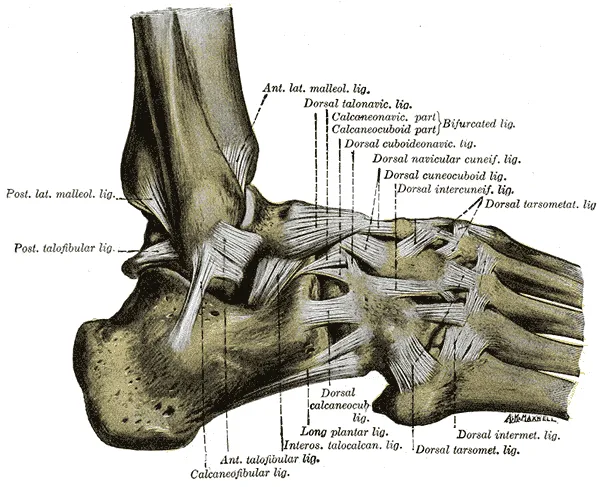
In one meta-analysis (a study that pools several earlier studies), outer-side sprains were the most common type9. Their risk was significantly higher than for inner-side (deltoid) sprains or high ankle sprains (sprains just above the ankle joint)9.
When problems last: chronic ankle instability
Chronic ankle instability involves a loose, unstable ankle that gets in the way of activity10. It can follow one sprain or repeated injuries to the outer ligaments10. For research, the consortium describes it as at least one significant sprain, the first at least 12 months earlier1. Added to that is a history of the ankle giving way, repeat sprains or feelings of instability1.
The consortium defines “giving way” as regular, uncontrolled, unpredictable episodes of the rear foot turning too far inward1. These episodes do not cause a new sprain1. The consortium wrote these criteria because studies had picked participants inconsistently, which limits how far their findings apply1. A 2018 consortium statement describes the condition as growing from mechanical and sensorimotor (sensing and controlling movement) problems that appear after a sprain2.
Who it affects
How common it is
A review of 227 studies covering 70 sports found the ankle was the most often injured body site in 24 of them11. Ankle sprain was the main ankle injury in 33 of 43 sports11. The consortium’s position statement cites an estimate that up to 55% of people who sprain an ankle do not see a health professional1. So health records may undercount sprains1.
| Group studied | What was found |
|---|---|
| US emergency departments, 2002 to 2006 | 2.15 sprains per 1,000 person-years (people multiplied by the years each was followed), highest at ages 15 to 1912 |
| 25 US college sports, 2009-10 to 2014-15 | The most often reported injury, 7.3% of all injuries13 |
| 751 adults aged 18 to 65 in New South Wales, Australia | 15.6% had a long-lasting ankle problem of muscles, bones or joints caused by injury14 |
Sex, age and sport
A meta-analysis of 181 studies found sprains were more frequent in females than males9. It also found them more frequent in children and teenagers than in adults9. Indoor and court sports had the highest rate of any sport group9. A review of risk factors found the most support for a past ankle injury15. It found the highest risk in athletes in court and field sports15.
Repeat sprains and lasting problems
A narrative review reports that people with a past sprain have about 3.5 times the risk of another10. It reports that 12% to 47% of sprains are repeats10. The consortium’s position statement reports repeat rates as high as 80% in high-risk sports1. It also reports that 32% to 74% of people with a past sprain have lasting symptoms, repeat sprains or both1.
Studies count chronic ankle instability after a sprain or across a whole group16,17:
- Cochrane review, after a sudden sprain: 10% to 20%16.
- Cohort study (following a group over time), after a first sprain: 40% at one year, as a narrative review reports it10.
- Whole group, 2,175 Japanese college athletes from 12 sports: 52.9% had had a sprain and 17.9% met the consortium’s criteria18. It was most common in basketball and handball18.
- Whole group, 829,791 young adults before military service: 0.7% mild and 0.4% severe in males, 0.3% and 0.4% in females17.
In those young adults, higher body mass index (a measure of weight for height) and greater height were each linked with it in both sexes17.
A consortium review links lasting problems after a sprain with lower activity, lower quality of life and rising rates of osteoarthritis after injury19. Osteoarthritis is a long-term joint disease in which the cartilage lining the joint wears away. In a Korean national insurance group of 195,393 people, those with a recorded sprain had a 46% higher rate of later ankle osteoarthritis20.
What studies found
How it changes over time
A review of 31 studies, 24 of them high quality, followed adults given usual care after a sudden outer-ankle sprain3. Reported pain fell quickly in the first 2 weeks3. Between 5% and 33% still had pain after 1 year3. Repeat sprains were found in 3% to 34%, recorded from 2 weeks to 96 months after injury3.
A systematic review (a study that searches for all the research on a question in a set, checkable way) looked at first sprains21. Its 15 studies showed lasting pain and felt instability falling over the first year21. By 12 months, 15.8% had sprained the ankle again21.
| Time after a first sprain | Still with pain (%) | Still feeling unstable (%) |
|---|---|---|
| 3 months | 48.621 | 37.921 |
| 6 months | 21.521 | 16.121 |
| 12 months | 6.721 | 8.121 |
In 44 adults followed an average of 204 weeks after a sprain, 18.1% had injured the ankle again22. On examination, 45.5% had pain around the ankle22. A quarter, all of them athletes, showed signs of anterior ankle impingement, a pinching at the front of the ankle22.
A cohort followed 82 people after a first sprain23. At 2 weeks, some could not complete a single-leg drop landing and a drop jump (a jump straight up right after landing from a box)23. This predicted instability at 12 months23. That test sorted 67.6% of cases correctly23.
Casts, supports and early exercise
A Cochrane review names three main approaches: a cast or splint, early movement with a support such as a brace, and surgery4.
One randomised trial (groups assigned by chance, then compared) included 584 people with severe sprains from eight UK emergency departments24. A 10-day below-knee cast gave faster recovery than a tubular compression bandage24. Ankle function was 9% better with the cast at 3 months24. A brace-style boot gave no benefit over the bandage24. At 9 months, no support differed significantly from the bandage24.
A randomised trial included 101 people with a grade 1 or 2 sudden sprain25. An early exercise group had better self-reported ankle function at weeks 1 and 2 than a group given protection, rest, ice, compression and elevation25. Pain and swelling did not differ between the groups25.
An overview of 46 systematic reviews looked at pain, swelling and function after a sudden sprain5. It found strong evidence for anti-inflammatory drugs (NSAIDs) and early movement5. It found moderate evidence for exercise and manual therapy (hands-on methods such as massage or moving a joint by hand)5. A 2018 Dutch guideline says anti-inflammatory drugs may reduce pain and swelling26. It adds that they have complications and may hold back natural healing26.
Braces and training against repeat sprains
A randomised trial included 522 athletes aged 12 to 70 after a sprain27. One group did eight weeks of home proprioceptive training (training the sense of joint position)27. Within a year, 22% of them reported a repeat sprain, against 33% of the comparison group27.
Another trial split 384 athletes into three groups after a sprain28. The share reporting a repeat sprain within a year was28:
Against training, bracing cut the number of repeat sprains but not how severe they were28. Time lost and costs did not differ between groups28.
A meta-analysis of 7 randomised trials, with 1,417 people, looked at exercise-based programmes after a sudden sprain29. At 7 to 12 months they were linked to fewer repeat injuries than usual care29. The odds ratio (how many times higher the odds are) was 0.5329. At 3 to 6 months the difference was not significant29. Programme time ranged from 3.5 to 21 hours, and the authors found no agreement on the best content or amount29.
The overview of 46 reviews found strong evidence that bracing reduced repeat sprains5. It found moderate evidence for neuromuscular training (exercise that trains nerves and muscles to work together)5. The 2018 Dutch guideline describes braces as an effective option against repeat outer-ankle sprains26.
Surgery
The Cochrane review of 20 trials compared surgery with non-surgical care for sudden outer-ankle ligament injuries4. Its 2,562 people were mostly young, active adult men, and every trial had weaknesses in its methods4. Apparent gains for surgery included fewer repeat sprains, less long-term pain and less instability4. These did not hold up in a second way of pooling the trials, or when one low-quality trial was removed4.
The same review found some limited evidence of longer recovery, more stiffness, less mobility and more complications after surgery4. It concluded the trials give too little evidence to judge the two against each other4. The overview of 46 reviews also found conflicting evidence on surgery for sudden sprains5.
Studies in chronic ankle instability
A Cochrane review of 10 randomised trials looked at people with chronic ankle instability16. In four of its trials, neuromuscular training gave better ankle function scores than no training after four weeks, and longer-term data were not available16. It found too little evidence to favour any one operation over another16. One trial of 40 people compared tenodesis (surgery that reattaches a tendon to bone) with anatomical reconstruction, which rebuilds the ligament in place16. Nerve injuries were more common after tenodesis16.
Connections
The injury centres on the lateral ankle ligaments, one of three ligament groups that steady the ankle joint30. The other two are the syndesmosis between the shin bones and the deltoid ligaments on the inner side30.
Related exercise pages: drop landing, single-leg squat. A meta-analysis of 21 studies looked at single-leg landings in people with chronic ankle instability31. They landed with the foot more pointed and less knee and hip bend than controls31. They also had less activity in the peroneus longus, an outer-leg muscle, just before landing31.
Two small studies of people with chronic ankle instability measured gluteus maximus (the large muscle of the buttock) activity in different squats32,33. One, of 48, found more in the single-leg squat test than healthy controls and people who had recovered well from a sprain32. The other, of 18, found less than healthy people in a rotational squat33.
Ankle sprain involves
Ankle sprain is compared with injuries of
Ankle sprain has been studied in people with
Sources
- Gribble PA, Delahunt E, Bleakley CM, Caulfield B, Docherty CL, Fong DT, Fourchet F, Hertel J, Hiller CE, Kaminski TW, McKeon PO, Refshauge KM, van der Wees P, Vicenzino W, Wikstrom EA (2014). Selection criteria for patients with chronic ankle instability in controlled research: a position statement of the International Ankle Consortium.. Journal of athletic training. doi:10.4085/1062-6050-49.1.14 PMID 24377963
- Delahunt E, Bleakley CM, Bossard DS, Caulfield BM, Docherty CL, Doherty C, Fourchet F, Fong DT, Hertel J, Hiller CE, Kaminski TW, McKeon PO, Refshauge KM, Remus A, Verhagen E, Vicenzino BT, Wikstrom EA, Gribble PA (2018). Clinical assessment of acute lateral ankle sprain injuries (ROAST): 2019 consensus statement and recommendations of the International Ankle Consortium.. British journal of sports medicine. doi:10.1136/bjsports-2017-098885 PMID 29886432
- van Rijn RM, van Os AG, Bernsen RM, Luijsterburg PA, Koes BW, Bierma-Zeinstra SM (2008). What is the clinical course of acute ankle sprains? A systematic literature review.. The American journal of medicine. doi:10.1016/j.amjmed.2007.11.018 PMID 18374692
- Kerkhoffs GM, Handoll HH, de Bie R, Rowe BH, Struijs PA (2007). Surgical versus conservative treatment for acute injuries of the lateral ligament complex of the ankle in adults.. The Cochrane database of systematic reviews. doi:10.1002/14651858.CD000380.pub2 PMID 17443501
- Doherty C, Bleakley C, Delahunt E, Holden S (2017). Treatment and prevention of acute and recurrent ankle sprain: an overview of systematic reviews with meta-analysis.. British journal of sports medicine. doi:10.1136/bjsports-2016-096178 PMID 28053200
- Golanó P, Vega J, de Leeuw PA, Malagelada F, Manzanares MC, Götzens V, van Dijk CN (2010). Anatomy of the ankle ligaments: a pictorial essay.. Knee Surgery, Sports Traumatology, Arthroscopy. doi:10.1007/s00167-010-1100-x PMID 20309522
- Le MQT, Harper DE, Dixon M, Tiu TK (2026). Calcaneofibular Ligament Injury.. StatPearls. PMID 32491310
- Hertel J (2002). Functional Anatomy, Pathomechanics, and Pathophysiology of Lateral Ankle Instability.. Journal of Athletic Training. PMID 12937557
- Doherty C, Delahunt E, Caulfield B, Hertel J, Ryan J, Bleakley C (2014). The incidence and prevalence of ankle sprain injury: a systematic review and meta-analysis of prospective epidemiological studies.. Sports Medicine. doi:10.1007/s40279-013-0102-5 PMID 24105612
- Herzog MM, Kerr ZY, Marshall SW, Wikstrom EA (2019). Epidemiology of Ankle Sprains and Chronic Ankle Instability.. Journal of Athletic Training. doi:10.4085/1062-6050-447-17 PMID 31135209
- Fong DT, Hong Y, Chan LK, Yung PS, Chan KM (2007). A systematic review on ankle injury and ankle sprain in sports.. Sports Medicine. doi:10.2165/00007256-200737010-00006 PMID 17190537
- Waterman BR, Owens BD, Davey S, Zacchilli MA, Belmont PJ Jr (2010). The epidemiology of ankle sprains in the United States.. Journal of Bone and Joint Surgery (American). doi:10.2106/JBJS.I.01537 PMID 20926721
- Roos KG, Kerr ZY, Mauntel TC, Djoko A, Dompier TP, Wikstrom EA (2017). The Epidemiology of Lateral Ligament Complex Ankle Sprains in National Collegiate Athletic Association Sports.. American Journal of Sports Medicine. doi:10.1177/0363546516660980 PMID 27573356
- Hiller CE, Nightingale EJ, Raymond J, Kilbreath SL, Burns J, Black DA, Refshauge KM (2012). Prevalence and impact of chronic musculoskeletal ankle disorders in the community.. Archives of physical medicine and rehabilitation. doi:10.1016/j.apmr.2012.04.023 PMID 22575395
- Delahunt E, Remus A (2019). Risk Factors for Lateral Ankle Sprains and Chronic Ankle Instability.. Journal of Athletic Training. doi:10.4085/1062-6050-44-18 PMID 31161942
- de Vries JS, Krips R, Sierevelt IN, Blankevoort L, van Dijk CN (2011). Interventions for treating chronic ankle instability.. The Cochrane database of systematic reviews. doi:10.1002/14651858.CD004124.pub3 PMID 21833947
- Hershkovich O, Tenenbaum S, Gordon B, Bruck N, Thein R, Derazne E, Tzur D, Shamiss A, Afek A (2015). A large-scale study on epidemiology and risk factors for chronic ankle instability in young adults.. The Journal of foot and ankle surgery : official publication of the American College of Foot and Ankle Surgeons. doi:10.1053/j.jfas.2014.06.001 PMID 25135102
- Hiroshige Y, Yamaguchi R, Iriguchi K, Sudo T, Kato H, Ohyama-Byun K (2026). Prevalence and Sport-Specific Comparison of Lateral Ankle Sprain and Chronic Ankle Instability in 2200 Collegiate Athletes.. Foot & ankle specialist. doi:10.1177/19386400261421543 PMID 41902715
- Gribble PA, Bleakley CM, Caulfield BM, Docherty CL, Fourchet F, Fong DT, Hertel J, Hiller CE, Kaminski TW, McKeon PO, Refshauge KM, Verhagen EA, Vicenzino BT, Wikstrom EA, Delahunt E (2016). Evidence review for the 2016 International Ankle Consortium consensus statement on the prevalence, impact and long-term consequences of lateral ankle sprains.. British Journal of Sports Medicine. doi:10.1136/bjsports-2016-096189 PMID 27259753
- Lee S, Song K, Lee SY (2022). Epidemiological study of post-traumatic ankle osteoarthritis after ankle sprain in 195,393 individuals over middle age using the National Health Insurance Database: A retrospective design.. Journal of Science and Medicine in Sport. doi:10.1016/j.jsams.2021.08.018 PMID 34565662
- Michels F, Wastyn H, Pottel H, Stockmans F, Vereecke E, Matricali G (2022). The presence of persistent symptoms 12 months following a first lateral ankle sprain: A systematic review and meta-analysis.. Foot and ankle surgery : official journal of the European Society of Foot and Ankle Surgeons. doi:10.1016/j.fas.2021.12.002 PMID 34961654
- Kemler E, Thijs KM, Badenbroek I, van de Port IG, Hoes AW, Backx FJ (2016). Long-term prognosis of acute lateral ankle ligamentous sprains: high incidence of recurrences and residual symptoms.. Family practice. doi:10.1093/fampra/cmw076 PMID 27535328
- Doherty C, Bleakley C, Hertel J, Caulfield B, Ryan J, Delahunt E (2016). Recovery From a First-Time Lateral Ankle Sprain and the Predictors of Chronic Ankle Instability: A Prospective Cohort Analysis.. The American journal of sports medicine. doi:10.1177/0363546516628870 PMID 26912285
- Lamb SE, Marsh JL, Hutton JL, Nakash R, Cooke MW (2009). Mechanical supports for acute, severe ankle sprain: a pragmatic, multicentre, randomised controlled trial.. Lancet (London, England). doi:10.1016/S0140-6736(09)60206-3 PMID 19217992
- Bleakley CM, O'Connor SR, Tully MA, Rocke LG, Macauley DC, Bradbury I, Keegan S, McDonough SM (2010). Effect of accelerated rehabilitation on function after ankle sprain: randomised controlled trial.. BMJ (Clinical research ed.). doi:10.1136/bmj.c1964 PMID 20457737
- Vuurberg G, Hoorntje A, Wink LM, van der Doelen BFW, van den Bekerom MP, Dekker R, van Dijk CN, Krips R, Loogman MCM, Ridderikhof ML, Smithuis FF, Stufkens SAS, Verhagen EALM, de Bie RA, Kerkhoffs GMMJ (2018). Diagnosis, treatment and prevention of ankle sprains: update of an evidence-based clinical guideline.. British Journal of Sports Medicine. doi:10.1136/bjsports-2017-098106 PMID 29514819
- Hupperets MD, Verhagen EA, van Mechelen W (2009). Effect of unsupervised home based proprioceptive training on recurrences of ankle sprain: randomised controlled trial.. BMJ (Clinical research ed.). doi:10.1136/bmj.b2684 PMID 19589822
- Janssen KW, van Mechelen W, Verhagen EA (2014). Bracing superior to neuromuscular training for the prevention of self-reported recurrent ankle sprains: a three-arm randomised controlled trial.. British journal of sports medicine. doi:10.1136/bjsports-2013-092947 PMID 24398222
- Bleakley CM, Taylor JB, Dischiavi SL, Doherty C, Delahunt E (2019). Rehabilitation Exercises Reduce Reinjury Post Ankle Sprain, But the Content and Parameters of an Optimal Exercise Program Have Yet to Be Established: A Systematic Review and Meta-analysis.. Archives of physical medicine and rehabilitation. doi:10.1016/j.apmr.2018.10.005 PMID 30612980
- Brockett CL, Chapman GJ (2016). Biomechanics of the ankle.. Orthopaedics and Trauma. doi:10.1016/j.mporth.2016.04.015 PMID 27594929
- Chan LYT, Sim YTN, Gan FK, Bin Abd Razak HR (2022). Effect of chronic ankle instability on lower extremity kinematics, dynamic postural stability, and muscle activity during unilateral jump-landing tasks: A systematic review and meta-analysis.. Physical therapy in sport : official journal of the Association of Chartered Physiotherapists in Sports Medicine. doi:10.1016/j.ptsp.2022.04.005 PMID 35462322
- Carroll LA, Kivlan BR, Martin RL, Phelps AL, Carcia C (2026). Hip Strength and Activation in Individuals With Ankle Instability During the Single-Leg Squat Test.. Journal of Sport Rehabilitation. doi:10.1123/jsr.2024-0360 PMID 40467057
- Webster KA, Gribble PA (2013). A comparison of electromyography of gluteus medius and maximus in subjects with and without chronic ankle instability during two functional exercises.. Physical Therapy in Sport. doi:10.1016/j.ptsp.2012.02.002 PMID 23312728
Changes
- A supporting claim was narrowed to match its source; the page text is unchanged.