Lateral ankle ligaments
Also called lateral ligament complex of the ankle, lateral collateral ligaments of the ankle, outer ankle ligaments, anterior talofibular ligament, ATFL, calcaneofibular ligament, CFL, posterior talofibular ligament, PTFL
The three ligaments on the outer side of the ankle, the ATFL, CFL and PTFL. What each one holds back, how they tear when the ankle rolls, who sprains them, and what studies found about healing.
- Region
- Foot & ankle
- Muscles
- fibularis longus, fibularis brevis, tibialis anterior
- Updated
- September 30, 2026
- Reviewed
- September 30, 2026 · how entries are checked
Function
Three bands on the outer ankle
Three groups of ligaments steady the ankle joint, and the lateral collateral ligaments are the group on its outer side6. That group has three members: the anterior talofibular ligament (ATFL), the calcaneofibular ligament (CFL) and the posterior talofibular ligament (PTFL)1,2. All three start on the outer ankle bone (lateral malleolus)1. The ATFL and CFL start on the lower fibula (the thin outer bone of the lower leg), near its tip7. Together they support the ankle and resist too much inversion (turning the sole of the foot inward)8.
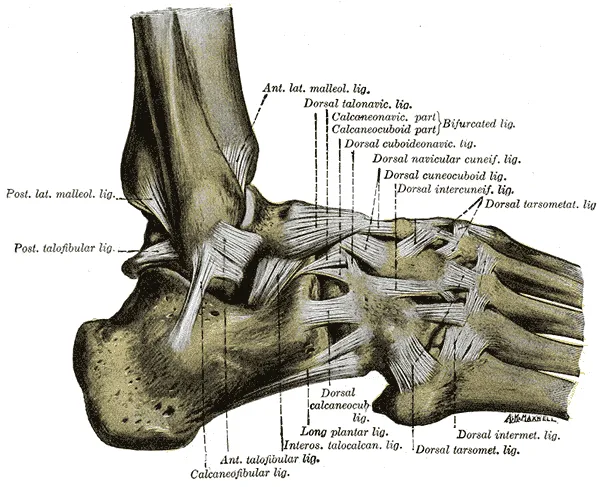
| Ligament | Where it runs | When it is tight |
|---|---|---|
| ATFL | Forward and inward from the front edge of the outer ankle bone to the talus (ankle bone)1 | Strain rises as the foot moves from pulled up to pointed down9 |
| CFL | Down and back from the front of the outer ankle bone to the outer side of the calcaneus (heel bone)1 | Tense through the whole up-and-down arc of the ankle1 |
| PTFL | Almost level, from a hollow on the inner face of the outer ankle bone to the back and outer side of the talus1 | Slack with the foot pointed or in neutral, tense when it is pulled up1 |
What each one holds back
Laboratory studies show the ATFL stops the talus sliding forward out of the ankle socket9. It also limits too much inversion and inward turning of the talus on the tibia (shinbone)9. The ATFL lies closely against the joint capsule (the sleeve of tough tissue that encloses a joint)1.
The CFL limits too much supination (rolling the foot outward onto its outer edge) at two joints9. One is the ankle joint itself, and the other is the subtalar joint below it, between the talus and the heel bone6,8,9. It is the only connective tissue that directly links those two joints6. Laboratory tests show it is tautest when the ankle is in dorsiflexion (foot pulled up toward the shin)9. It is slack when the ankle is tilted outward (valgus) and tense when it is tilted inward (varus)1.
The PTFL, broadly attached to the talus and fibula, holds back inversion and inward turning while the ankle bears load9.
Two bands that take turns
Published descriptions give the ATFL anywhere from one to three bands1. In one anatomy group’s dissections, two bands, an upper and a lower one, were the most common pattern1. Blood vessels run between the two bands1. The upper band is taut when the foot is pointed (plantarflexion), and the lower band when it is pulled up1.
In 12 ankles from donated bodies, fibres joined the ATFL’s lower band to the CFL in every one10. Pulling on that lower band lengthened the CFL by a median of 0.59 mm10. In a robotic study of 10 such ankles, cutting only the upper band let the talus turn inward and slide forward more11. The effect was greatest with the foot pointed11.
Breakdown
How the ankle rolls
Lateral ankle sprains typically happen when the back of the foot is forced to roll too far outward while the lower leg is turned outward9. One review puts most sprains down to how the foot is positioned as it lands12. A ground force passing to the inner side of the subtalar joint can create a sudden inward-rolling force at that joint in about 50 milliseconds12.
Anatomy work describes the ATFL as coming under strain only with the foot pointed, especially when it is also turned in1. A review reports the ATFL is often the one hurt with the foot pointed, and the CFL with it pulled up12. Video of real injuries gives a different picture in one sport13. In 17 sprains filmed in Australian professional netball, players tended to land on the front third of the foot13. Inversion with the foot swung inward was common, and pointing the foot was rarely involved13.
Which ligament gives way first
In a lateral ankle sprain, the ATFL is the first ligament damaged, or the only one1,9. The CFL is the next most often involved1,9. The PTFL is usually hurt only in severe injuries, typically along with a dislocation or a broken bone1,9.
A review of tests on fresh ankles from donated bodies gives these failure loads, in newtons (a unit of force)12:
| Ligament | Load at failure (N) |
|---|---|
| ATFL | 13912 |
| PTFL | 26112 |
| CFL | 34612 |
Once the ATFL is torn, studies on ankles from donated bodies show the back of the foot twists inward (rotates) much more9. That puts more stress on the ligaments that remain9.
How often each ligament tears
- One review reports that 73% of ankle sprains involved a tear of the ATFL alone12.
- An anatomy review reports that Broström found the ATFL and CFL torn together in 20% of cases, and the CFL alone very rarely1.
- One study reviewed 261 MRI scans (scans that show soft tissue in detail) of athletes after a fresh sprain14. Of these, 39.5% had a complete ATFL tear with no injury to the ligaments joining the tibia and fibula14.
In those same 261 scans, a complete tear of the outer ligaments was linked to more damage nearby14. The comparison was with no tear or a mild one14. The odds ratio (how many times higher the odds are in one group) for a bruise in the talus was 3.4314. For an injury to the deltoid ligament, on the inner side of the ankle, it was 4.046,14.
Who sprains them
Across 25 US college sports from 2009-10 to 2014-15, outer ankle ligament sprains were the injury recorded most often15. They made up 7.3% of all injuries, at 4.95 per 10,000 athlete-exposures (one athlete taking part in one practice or game)15. Men’s and women’s basketball had the highest rates15. Across all sports, the rate in games was 3.29 times that in practice15. Of these college sprains, 11.9% were repeat injuries15.
In US emergency departments from 2002 to 2006, ankle sprains peaked at ages 15 to 1916. Nearly half happened during sport, with basketball the largest share16. One meta-analysis (a study that pools the results of several earlier studies) included 3,636 athletes17. In the men, a past sprain was a risk factor17. Among the 735 women it included, only weaker strength in pulling the foot up was a risk factor, out of 18 factors examined17.
An International Ankle Consortium statement endorses defining an ankle sprain as a sudden injury to this ligament group18. The ankle sprain page covers that definition, who it affects and what trials found.
Recovery
How the ligaments heal
Ligaments were once thought to be inert, but they respond to many factors, both nearby and body-wide19. A review of two knee ligaments, the anterior cruciate and medial collateral ligaments, says an injured ligament regains function by forming scar tissue19. That scar is poorer, both biologically and mechanically, than the tissue it replaces19. That review covered knee ligaments and did not study the ankle19.
A systematic review of 7 randomised trials (studies that assign people to groups by chance) measured ankle looseness after a fresh sprain5. It concluded the outer ligaments needed 6 weeks to 3 months or more to heal, with looseness easing over 6 weeks to 1 year5. In a study of 16 people with a fresh sprain and 16 without, the injured ankles were still looser at 8 weeks20. This suggests that looseness takes longer than 8 weeks to recover on its own20.
What scans show
One study followed 32 people with ultrasound (a scan made with sound waves that shows soft tissue) for 12 weeks after a sprain21. The injured ATFL was 1.53 times as thick as the other side at injury, falling to 1.21 times by 12 weeks21. The authors read this as steady remodelling (the replacement of old tissue with new) during healing21. Clinical scores improved in the same group21. Yet ATFL thickness was not linked to function scores at any time point21.
Sprains that come back
Chronic ankle instability involves a loose, unstable ankle that gets in the way of activity22. It can follow a single sprain or repeated injuries to these ligaments22. An International Ankle Consortium review states that these sprains recur at high rates4. It adds that a large share of people who have one go on to develop chronic ankle instability4.
A meta-analysis of 23 studies looked at people with a past sprain23. Their peroneal muscles, on the outer side of the lower leg, reacted later to a sudden inversion23. The delay was largest in people with chronic ankle instability23.
When one tear or two
One systematic review compared tears of both the ATFL and CFL with tears of the ATFL alone24. It found fair evidence that combined tears had worse clinical scores and less return to full sport24. It also pooled five studies of sprains managed without surgery and followed for at least 12 months24. In these, the risk of chronic ankle instability did not differ significantly between the two24.
Connections
The joint they hold
These ligaments form the outer of the three ligament groups that steady the ankle joint6. The other two are the tibiofibular syndesmosis between the tibia and fibula, and the deltoid ligaments on the inner side6.
The tendons and muscles alongside
The peroneal (fibularis) tendons and their sheaths cross over the CFL, leaving only about 1 cm of it uncovered1. Some PTFL fibres can help form the tunnel for the tendon of the flexor hallucis longus (a deep calf muscle whose tendon runs under the foot and bends the big toe)1. The peroneus longus and brevis, on the outer side of the leg, point the foot down and turn the sole outward6. They are central to controlling how far the back of the foot rolls outward, and to guarding against these sprains9.
For that guard to work, the peroneal muscles need to be active before the foot lands9. One study found a reflex from them would take at least 126 milliseconds after a sudden inversion9. That figure assumed no muscle activity before the heel touched down9. The muscles at the front of the shin, such as the tibialis anterior, may also help steady the outer ankle9.
Exercises studied around them
Related exercise pages: drop landing, single-leg squat. A meta-analysis of 21 studies found less peroneus longus activity just before a single-leg landing in people with chronic ankle instability than in controls25.
In single-leg squats, two studies of people with chronic ankle instability reported different buttock muscle activity26,27. One, of 48 people, found more gluteus maximus activity in the single-leg squat test in those with chronic ankle instability26. They were compared with people who recovered well from a sprain and with healthy controls26. The other, of 18 people, found less in a single-leg rotational squat27.
Lateral ankle ligaments holds together
Lateral ankle ligaments works with
Lateral ankle ligaments works opposite at the ankle to
Lateral ankle ligaments is injured in
Lateral ankle ligaments is loaded by
Sources
- Golanó P, Vega J, de Leeuw PA, Malagelada F, Manzanares MC, Götzens V, van Dijk CN (2010). Anatomy of the ankle ligaments: a pictorial essay.. Knee Surgery, Sports Traumatology, Arthroscopy. doi:10.1007/s00167-010-1100-x PMID 20309522
- Le MQT, Harper DE, Dixon M, Tiu TK (2026). Calcaneofibular Ligament Injury.. StatPearls. PMID 32491310
- Attarian DE, McCrackin HJ, DeVito DP, McElhaney JH, Garrett WE Jr (1985). Biomechanical characteristics of human ankle ligaments.. Foot & Ankle. doi:10.1177/107110078500600202 PMID 4065775
- Gribble PA, Bleakley CM, Caulfield BM, Docherty CL, Fourchet F, Fong DT, Hertel J, Hiller CE, Kaminski TW, McKeon PO, Refshauge KM, Verhagen EA, Vicenzino BT, Wikstrom EA, Delahunt E (2016). Evidence review for the 2016 International Ankle Consortium consensus statement on the prevalence, impact and long-term consequences of lateral ankle sprains.. British Journal of Sports Medicine. doi:10.1136/bjsports-2016-096189 PMID 27259753
- Hubbard TJ, Hicks-Little CA (2008). Ankle ligament healing after an acute ankle sprain: an evidence-based approach.. Journal of Athletic Training. doi:10.4085/1062-6050-43.5.523 PMID 18833315
- Brockett CL, Chapman GJ (2016). Biomechanics of the ankle.. Orthopaedics and Trauma. doi:10.1016/j.mporth.2016.04.015 PMID 27594929
- Matsui K, Takao M, Tochigi Y, Ozeki S, Glazebrook M (2017). Anatomy of anterior talofibular ligament and calcaneofibular ligament for minimally invasive surgery: a systematic review.. Knee Surgery, Sports Traumatology, Arthroscopy. doi:10.1007/s00167-016-4194-y PMID 27295109
- Betts JG, Young KA, Wise JA, Johnson E, Poe B, Kruse DH, Korol O, Johnson JE, Womble M, DeSaix P (2022). Anatomy and Physiology 2e. OpenStax. Link
- Hertel J (2002). Functional Anatomy, Pathomechanics, and Pathophysiology of Lateral Ankle Instability.. Journal of Athletic Training. PMID 12937557
- Cordier G, Nunes GA, Vega J, Roure F, Dalmau-Pastor M (2021). Connecting fibers between ATFL's inferior fascicle and CFL transmit tension between both ligaments.. Knee Surgery, Sports Traumatology, Arthroscopy. doi:10.1007/s00167-021-06496-w PMID 33646371
- Dalmau-Pastor M, El-Daou H, Stephen JM, Vega J, Malagelada F, Calder J (2023). Clinical Relevance and Function of Anterior Talofibular Ligament Superior and Inferior Fascicles: A Robotic Study.. American Journal of Sports Medicine. doi:10.1177/03635465231172196 PMID 37232327
- Fong DT, Chan YY, Mok KM, Yung PS, Chan KM (2009). Understanding acute ankle ligamentous sprain injury in sports.. Sports Medicine, Arthroscopy, Rehabilitation, Therapy & Technology. doi:10.1186/1758-2555-1-14 PMID 19640309
- Stuelcken MC, Hiller CE, Toohey L (2024). Mechanisms of lateral ankle ligament sprains in professional netball: A systematic video analysis.. Physical Therapy in Sport. doi:10.1016/j.ptsp.2024.06.004 PMID 38971091
- Roemer FW, Jomaah N, Niu J, Almusa E, Roger B, D'Hooghe P, Geertsema C, Tol JL, Khan K, Guermazi A (2014). Ligamentous Injuries and the Risk of Associated Tissue Damage in Acute Ankle Sprains in Athletes. The American journal of sports medicine. doi:10.1177/0363546514529643 PMID 24753239
- Roos KG, Kerr ZY, Mauntel TC, Djoko A, Dompier TP, Wikstrom EA (2017). The Epidemiology of Lateral Ligament Complex Ankle Sprains in National Collegiate Athletic Association Sports.. American Journal of Sports Medicine. doi:10.1177/0363546516660980 PMID 27573356
- Waterman BR, Owens BD, Davey S, Zacchilli MA, Belmont PJ Jr (2010). The epidemiology of ankle sprains in the United States.. Journal of Bone and Joint Surgery (American). doi:10.2106/JBJS.I.01537 PMID 20926721
- Mason J, Kniewasser C, Hollander K, Zech A (2022). Intrinsic Risk Factors for Ankle Sprain Differ Between Male and Female Athletes: A Systematic Review and Meta-Analysis.. Sports Medicine - Open. doi:10.1186/s40798-022-00530-y PMID 36399159
- Gribble PA, Delahunt E, Bleakley CM, Caulfield B, Docherty CL, Fong DT, Fourchet F, Hertel J, Hiller CE, Kaminski TW, McKeon PO, Refshauge KM, van der Wees P, Vicenzino W, Wikstrom EA (2014). Selection criteria for patients with chronic ankle instability in controlled research: a position statement of the International Ankle Consortium.. Journal of athletic training. doi:10.4085/1062-6050-49.1.14 PMID 24377963
- Frank CB (2004). Ligament structure, physiology and function. Journal of musculoskeletal & neuronal interactions. PMID 15615126
- Hubbard TJ, Cordova M (2009). Mechanical instability after an acute lateral ankle sprain.. Archives of Physical Medicine and Rehabilitation. doi:10.1016/j.apmr.2009.01.020 PMID 19577027
- Wi SM, Kim DH, Kim SH, Shin SJ (2026). Ultrasonographic Anterior Talofibular Ligament Thickness Does Not Predict Functional Outcomes After Acute Lateral Ankle Sprain.. Journal of Foot and Ankle Research. doi:10.1002/jfa2.70187 PMID 42477509
- Herzog MM, Kerr ZY, Marshall SW, Wikstrom EA (2019). Epidemiology of Ankle Sprains and Chronic Ankle Instability.. Journal of Athletic Training. doi:10.4085/1062-6050-447-17 PMID 31135209
- Hoch MC, McKeon PO (2014). Peroneal reaction time after ankle sprain. Medicine & Science in Sports & Exercise. doi:10.1249/MSS.0b013e3182a6a93b PMID 23899892
- Pacheco J, Guerra-Pinto F, Araújo L, Flora M, Alçada R, Rocha T, Diniz P, Consciência JG (2021). Chronic ankle instability has no correlation with the number of ruptured ligaments in severe anterolateral sprain: a systematic review and meta-analysis.. Knee Surgery, Sports Traumatology, Arthroscopy. doi:10.1007/s00167-021-06610-y PMID 33993320
- Chan LYT, Sim YTN, Gan FK, Bin Abd Razak HR (2022). Effect of chronic ankle instability on lower extremity kinematics, dynamic postural stability, and muscle activity during unilateral jump-landing tasks: A systematic review and meta-analysis.. Physical therapy in sport : official journal of the Association of Chartered Physiotherapists in Sports Medicine. doi:10.1016/j.ptsp.2022.04.005 PMID 35462322
- Carroll LA, Kivlan BR, Martin RL, Phelps AL, Carcia C (2026). Hip Strength and Activation in Individuals With Ankle Instability During the Single-Leg Squat Test.. Journal of Sport Rehabilitation. doi:10.1123/jsr.2024-0360 PMID 40467057
- Webster KA, Gribble PA (2013). A comparison of electromyography of gluteus medius and maximus in subjects with and without chronic ankle instability during two functional exercises.. Physical Therapy in Sport. doi:10.1016/j.ptsp.2012.02.002 PMID 23312728
Changes
- A supporting claim was narrowed to match its source; the page text is unchanged.