Patellar dislocation
Also called kneecap dislocation, dislocated kneecap, lateral patellar dislocation
The kneecap coming fully out of its groove on the thigh bone. How a European consensus defines it, who it affects, how often it happens again, and what trials of surgery, braces and exercise found.
- Region
- Knee
- Updated
- October 22, 2026
- Reviewed
- October 22, 2026 · how entries are checked
What it is
How it is defined
A Cochrane review is a systematic review done to the Cochrane Collaboration’s published standards. One describes patellar dislocation as the kneecap coming fully out of the trochlear groove, the groove at the lower end of the femur (thigh bone)5. A European formal consensus, ESSKA, defines a first-time dislocation the same way1. The event must be confirmed by examination, imaging or both1. Of the panel’s 55 experts, 54 were orthopaedic surgeons1.
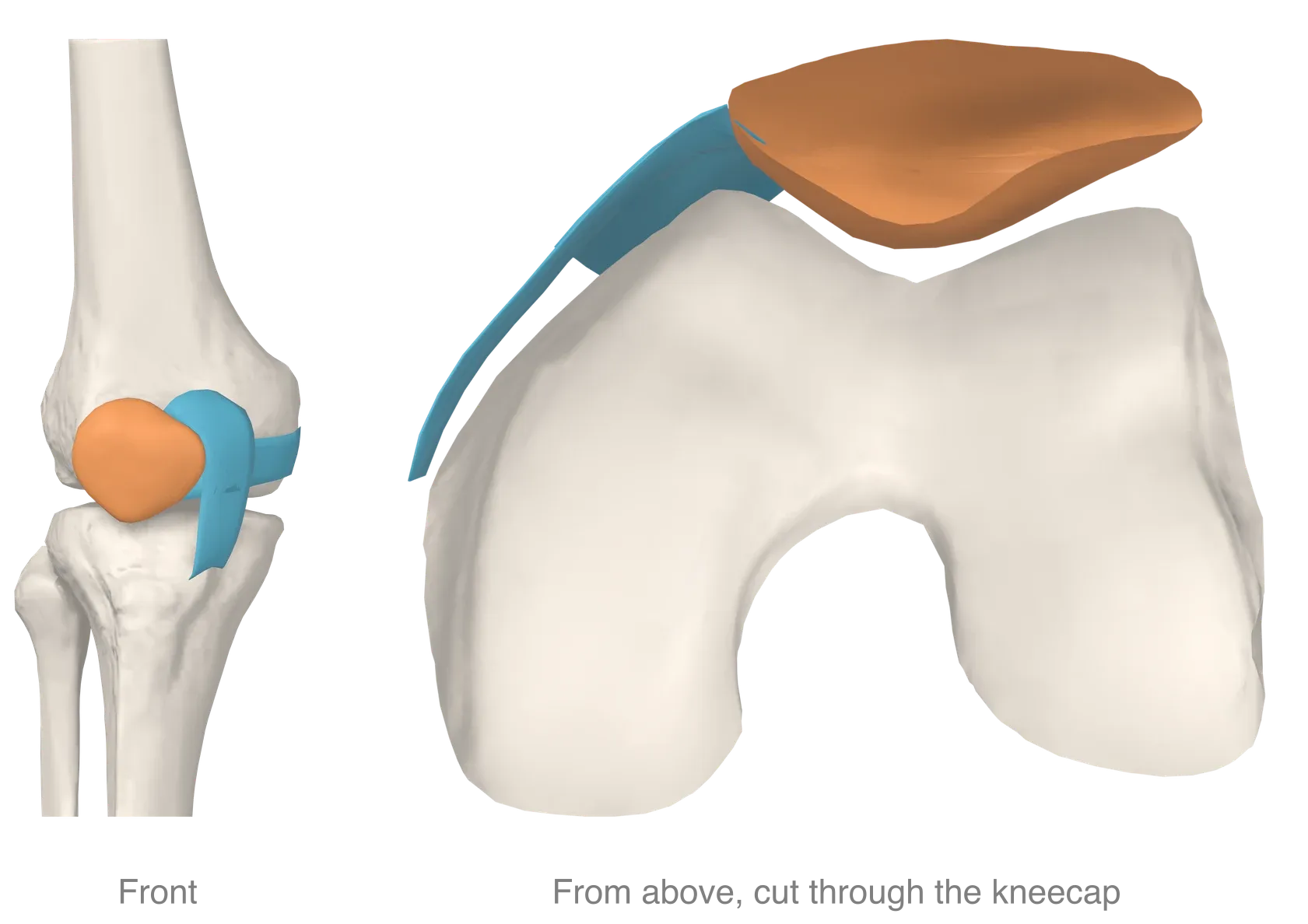
One population study describes most episodes as a twisting injury on a bent knee, without contact3. The kneecap moves outward over the thigh bone, often also damaging the soft tissues that hold it on the inner side and the joint cartilage3.
What is injured with it
Reviews of sudden outward dislocations report these injuries9,10:
- The MPFL: injured in 94.7%, in a meta-analysis of 35 articles (2,558 people)9. It most often tore at the kneecap end at age 16 or under, and at the thigh-bone end over 169.
- Bone bruises (injuries inside a bone, without a break): pooled at 89.6% in a review of 39 studies (3,354 people)10.
- Osteochondral injury (damage to joint cartilage and the bone just beneath it): pooled at 48.8% in the same review10. The inner side of the kneecap was the most common site10.
In the population cohort of 609 people, imaging found osteochondral injury in 16.7%3. ESSKA states that cartilage damage starts with the first episode and that its severity tracks how much instability persists1. It also states that, under age 15, a first dislocation is the most common cause of bleeding into the knee joint1.
Who it affects
How common it is
Studies give incidence, the number of new cases, per 100,000 person-years, a count of people multiplied by the years each was followed1,2,3.
| Group studied | What was found |
|---|---|
| Denmark nationwide, 1994 to 2013, 24,154 first dislocations | 42 per 100,000 person-years on average; highest in females aged 10 to 17, at 1082 |
| A population cohort, 609 first outward dislocations over 21 years | 23.2 per 100,000 person-years, adjusted for age and sex3; similar in males and females, highest at ages 14 to 18, at 147.73 |
| Studies summed up by the ESSKA consensus | Reported rates of 10 to 150 per 100,000 person-years, which may differ by region1 |
The ESSKA consensus states that first dislocations are most common in the growth spurt and usually happen before age 181. It describes a tendency toward females, and calls first dislocations after age 25 uncommon1.
Features linked with it
The ESSKA consensus lists risk factors in the knee’s shape, and others1:
- Trochlear dysplasia: a shallow or badly shaped groove at the lower end of the thigh bone1.
- Patella alta: a kneecap that sits higher on the knee than usual1.
- Alignment: malalignment of the leg, and an outward-placed tibial tubercle, a bump on the front of the shinbone1.
- Other factors: age, hyperlaxity (joints looser than usual), and the force of the injury1.
A systematic review of 18 studies judged its evidence low in quality11. In one study it included, general joint looseness was six times as common in 104 people with dislocation as in 110 without11. The figures were 64.4% against 10.9%11.
The other knee
In the Danish registry, the risk of a dislocation in the other knee was 5.8% overall and 11.1% at ages 10 to 172. In a trial of children under 16 after a first dislocation, instability of the other kneecap was noted in 48%12.
What studies found
How often it happens again
Studies of repeat dislocation after a first one report these rates2,4:
- A meta-analysis of 17 studies: 33.6% overall4.
- The population cohort of 609, followed for a mean of 12.3 years: 30.0%3. Most people in it had a single episode, and 10.8% had surgery for repeat instability3.
- The Danish registry, over 10 years: 22.7% overall and 36.8% in girls aged 10 to 172.
- A cohort of 189 people, over 2 to 5 years: 17% of first-time cases had more instability, against 49% of those with earlier instability13.
- The ESSKA consensus: at least 25% after non-surgical care, and up to 70% in children and teenagers14.
The meta-analysis linked younger age, open growth plates, trochlear dysplasia and patella alta with a higher chance of repeat dislocation4. A larger distance between the groove and the tibial tuberosity was linked too, while sex and earlier dislocation of the other knee were not4. In studies within that review, rates were 7.7% to 13.8% with no risk factors, and 70.4% to 78.5% with three4. In the trial of children under 16, by contrast, a family history of kneecap instability was the only significant predictor12.
What happens over the years
ESSKA states that about 25% of people have repeat instability, and about 50% other problems, such as pain, giving way and less sport1. It states these lasting problems are more common in people still growing than in those who have stopped14.
One retrospective cohort, which looked back at past cases, had 111 people managed without surgery after a first dislocation15. It excluded 7 who later had surgery15. Of the rest, 73.1% reported no further dislocation at about 3 years15. Of those, only 26.4% said they had returned to their chosen sport without limits15.
A 2017 study followed a cohort of 609 people after a first dislocation, with matched controls16. In it, 48.9% had arthritis behind the kneecap at 25 years, against 8.3% of controls16. Repeat dislocation, osteochondral injury and trochlear dysplasia were linked with that arthritis16.
Surgery or non-surgical care
The Cochrane review of 10 trials (519 people) was uncertain whether surgery improves outcome, on very low-certainty evidence5. In 8 of its studies, it took an assumed 348 per 1000 dislocating again without surgery5. Against that, it estimated 157 fewer per 1000 two to nine years after surgery5. That estimate also rested on very low-certainty evidence5.
A review of 7 trials (282 people) found all of them relatively low in quality17. It linked surgery with fewer repeat dislocations, but whether surgery gives better function remained unclear17.
Studies comparing surgery with non-surgical care give results that differ by age group18,19:
| Study | What it found |
|---|---|
| Review of 9 trials, 433 people | Fewer repeat dislocations after surgery overall; lower after surgery at a mean age over 20, with no significant difference at 20 or under18 |
| Meta-analysis of 4 studies of a recent dislocation, age 18 or under | No significant difference in outcomes, repeat dislocation included; better pain scores without surgery19 |
| Trial in children under 16, followed for a mean of 14 years | Repeat dislocation in 71% of knees without surgery and 67% with it12; early surgery did not improve long-term outcome12 |
| Trial in 74 children aged 9 to 14, over 2 years | 22% redislocated after MPFL repair, against 43% with a knee brace20; function no better than with the brace; most in both groups satisfied20 |
A 2026 meta-analysis pooled trials in 306 people with MPFL injuries, of mean age about 20, followed for about 22 months21. It found repeat instability in 10.69% after surgery and 29.93% without it21. It found no significant difference in knee function scores21. A further check in that review found the current data too few for firm conclusions on each comparison21. A network meta-analysis of 13 trials (789 people) found the lowest rate of repeat instability after MPFL reconstruction, then MPFL repair, then non-surgical care22.
Braces after a first dislocation
A trial took 79 people who had stopped growing, after a first dislocation, and 64 completed it24. Redislocation at 3 years was 34.4% with a brace that limited knee motion and 37.5% with a neoprene sleeve24. The limiting brace brought less knee motion and more thigh muscle wasting early on, and worse function at 6 months24. No clinically relevant difference remained at 3 years24. Its authors note it was sized to detect a large difference in redislocation, not modest ones24.
ESSKA states there is no evidence that any brace is better than no brace after a first dislocation14.
After repeat dislocations
One trial took 61 people aged 12 to 30 with repeat dislocations and no major risk factors in the bone25. Both groups had a knee arthroscopy (keyhole surgery inside the joint, using a small camera) and an active exercise programme; one group also had MPFL reconstruction25,26. Ongoing instability was reported by 41.9% of the group without reconstruction and 6.7% of the reconstruction group at 12 months25. At 3 years, the figures were 53.6% and 16.7%26. Both groups improved on self-reported scores, with no significant difference between them26.
Its oversight group stopped it early, after 61 of 100 planned people, because outcomes differed widely25. Its authors say blinding was not possible, and the results cannot be generalised to everyone with kneecap instability26. The 12-month and 3-year reports of this Norwegian trial list funding from foundations, a sports medicine association, a regional health authority and a hospital25,26.
Results after MPFL reconstruction
Three reviews of return to sport after MPFL reconstruction give these rates6,7,8:
| Review | Returned to sport |
|---|---|
| 23 articles, 930 people, for kneecap instability | 92.8%; 71.3% to the same level or higher6 |
| 27 studies, 1,278 people, for repeat instability | 85.1%; 68.3% to the same level, at an average of 7.0 months7 |
| 14 articles, MPFL alone, for repeat dislocation | 84.1%, with repeat instability in 1.2%, in short-term results8 |
A review of 53 studies of MPFL surgery looked at how each decided when people went back to activity27. Only 10 (18.9%) used objective or subjective criteria; most used time-based criteria27. The review found that safe guidelines for return to play were not established27.
A 2023 review of 28 studies (1,478 people) found complications in 0% to 32.3% of knees28. Most were lasting pain at the front of the knee28. Failure ranged from 0% to 10.7%, and kneecap fracture from 0% to 8.3%28.
In a Danish registry of 1,956 reconstructions, 20.9% had a new kneecap-related visit to the health service more than a year after surgery29. That was counted over eight years, and was 28.9% at ages 10 to 1729. The risk was higher after other stabilising surgery (33.8%) and after non-surgical care (29.4%)29.
Connections
The patella page covers the kneecap itself, which slides up and down in the thigh bone’s groove30. The kneecap and thigh bone form one of three joints inside the knee30.
The joint cartilage that ESSKA says is damaged from the first episode is covered on the articular cartilage page1. Arthritis behind the kneecap can occur alone or together with arthritis of the main knee joint31. That wider picture is on the knee osteoarthritis page16.
Patellar dislocation involves
Patellar dislocation can damage
Patellar dislocation is followed in some people by arthritis covered in
Sources
- Blønd L, Askenberger M, Stephen J, Akmeşe R, Balcarek P, El Attal R, Chouliaras V, Ferrua P, Monart JM, Pagenstert G, Sillanpää P, Da Silva MV, Walawski J, Beaufils P, Dirisamer F (2025). Management of first-time patellar dislocation: The ESSKA 2024 formal consensus-Part 1.. Knee surgery, sports traumatology, arthroscopy : official journal of the ESSKA. doi:10.1002/ksa.12620 PMID 39976176
- Gravesen KS, Kallemose T, Blønd L, Troelsen A, Barfod KW (2018). High incidence of acute and recurrent patellar dislocations: a retrospective nationwide epidemiological study involving 24.154 primary dislocations.. Knee surgery, sports traumatology, arthroscopy : official journal of the ESSKA. doi:10.1007/s00167-017-4594-7 PMID 28646382
- Sanders TL, Pareek A, Hewett TE, Stuart MJ, Dahm DL, Krych AJ (2018). Incidence of First-Time Lateral Patellar Dislocation: A 21-Year Population-Based Study.. Sports Health. doi:10.1177/1941738117725055 PMID 28795924
- Huntington LS, Webster KE, Devitt BM, Scanlon JP, Feller JA (2020). Factors Associated With an Increased Risk of Recurrence After a First-Time Patellar Dislocation: A Systematic Review and Meta-analysis.. American Journal of Sports Medicine. doi:10.1177/0363546519888467 PMID 31825650
- Smith TO, Gaukroger A, Metcalfe A, Hing CB (2023). Surgical versus non-surgical interventions for treating patellar dislocation.. Cochrane Database of Systematic Reviews. doi:10.1002/14651858.CD008106.pub4 PMID 36692346
- Platt BN, Bowers LC, Magnuson JA, Marx SM, Liu JN, Farr J, Stone AV (2022). Return to Sport After Medial Patellofemoral Ligament Reconstruction: A Systematic Review and Meta-analysis.. American Journal of Sports Medicine. doi:10.1177/0363546521990004 PMID 33720789
- Manjunath AK, Hurley ET, Jazrawi LM, Strauss EJ (2021). Return to Play After Medial Patellofemoral Ligament Reconstruction: A Systematic Review.. The American journal of sports medicine. doi:10.1177/0363546520947044 PMID 32866030
- Schneider DK, Grawe B, Magnussen RA, Ceasar A, Parikh SN, Wall EJ, Colosimo AJ, Kaeding CC, Myer GD (2016). Outcomes After Isolated Medial Patellofemoral Ligament Reconstruction for the Treatment of Recurrent Lateral Patellar Dislocations: A Systematic Review and Meta-analysis.. The American journal of sports medicine. doi:10.1177/0363546515624673 PMID 26872895
- Kluczynski MA, Miranda L, Marzo JM (2020). Prevalence and Site of Medial Patellofemoral Ligament Injuries in Patients With Acute Lateral Patellar Dislocations: A Systematic Review and Meta-analysis.. Orthopaedic journal of sports medicine. doi:10.1177/2325967120967338 PMID 33403210
- Yi Z, Jiang J, Liu J, Ma M, Chen Y, Teng F, Yang A, Liu Z, Geng B, Xia Y, Wu M (2024). Prevalence and Site of Concomitant Osteochondral Injuries in Patients With Acute Lateral Patellar Dislocation: A Systematic Review and Meta-analysis.. Orthopaedic journal of sports medicine. doi:10.1177/23259671231220904 PMID 38274015
- Heighes LA, Abelleyra Lastoria DA, Beni R, Iftikhar A, Hing CB (2024). The relationship between joint hypermobility and patellar instability: A systematic review.. Journal of orthopaedics. doi:10.1016/j.jor.2024.05.009 PMID 38784948
- Palmu S, Kallio PE, Donell ST, Helenius I, Nietosvaara Y (2008). Acute patellar dislocation in children and adolescents: a randomized clinical trial.. The Journal of bone and joint surgery. American volume. doi:10.2106/JBJS.G.00072 PMID 18310694
- Fithian DC, Paxton EW, Stone ML, Silva P, Davis DK, Elias DA, White LM (2004). Epidemiology and natural history of acute patellar dislocation.. The American journal of sports medicine. doi:10.1177/0363546503260788 PMID 15262631
- Balcarek P, Blønd L, Beaufils P, Askenberger M, Stephen JM, Akmeşe R, El Attal R, Chouliaras V, Ferrua P, Minguell Monart J, Pagenstert G, Sillanpää P, Vieira Da Silva M, Dirisamer F, Walawski J (2025). Management of first-time patellar dislocation: The ESSKA 2024 formal consensus-Part 2.. Knee surgery, sports traumatology, arthroscopy : official journal of the ESSKA. doi:10.1002/ksa.12637 PMID 40053919
- Magnussen RA, Verlage M, Stock E, Zurek L, Flanigan DC, Tompkins M, Agel J, Arendt EA (2015). Primary patellar dislocations without surgical stabilization or recurrence: how well are these patients really doing?. Knee surgery, sports traumatology, arthroscopy : official journal of the ESSKA. doi:10.1007/s00167-015-3716-3 PMID 26215775
- Sanders TL, Pareek A, Johnson NR, Stuart MJ, Dahm DL, Krych AJ (2017). Patellofemoral Arthritis After Lateral Patellar Dislocation: A Matched Population-Based Analysis.. The American journal of sports medicine. doi:10.1177/0363546516680604 PMID 28005405
- Flores GW, de Oliveira DF, Ramos APS, Sanada LS, Migliorini F, Maffulli N, Okubo R (2023). Conservative management following patellar dislocation: a level I systematic review.. Journal of orthopaedic surgery and research. doi:10.1186/s13018-023-03867-6 PMID 37254200
- Chen Y, Wang Y, Xiao H, Yang A, Teng F, Yi Z, Sheng X, Zhang S, Geng B, Xia Y (2024). Age Is a Key Factor Influencing the Choice of Treatment for Primary Patellar Dislocation: A Systematic Review and Meta-analysis.. Orthopaedic surgery. doi:10.1111/os.14259 PMID 39384187
- Lee DY, Kang DG, Jo HS, Heo SJ, Bae JH, Hwang SC (2023). A systematic review and meta-analysis comparing conservative and surgical treatments for acute patellar dislocation in children and adolescents.. Knee surgery & related research. doi:10.1186/s43019-023-00189-z PMID 37349852
- Askenberger M, Bengtsson Moström E, Ekström W, Arendt EA, Hellsten A, Mikkelsen C, Janarv PM (2018). Operative Repair of Medial Patellofemoral Ligament Injury Versus Knee Brace in Children With an Acute First-Time Traumatic Patellar Dislocation: A Randomized Controlled Trial.. The American journal of sports medicine. doi:10.1177/0363546518770616 PMID 29847145
- Patel S, Anaspure OS, Baumann AN, Manz TM, Justin Mistovich R (2026). Operative Versus Nonoperative Treatment of Medial Patellofemoral Ligament Injuries: A Systematic Review and Meta-analysis of Randomized Controlled Trials With Trial Sequential Analysis.. The American journal of sports medicine. doi:10.1177/03635465251380278 PMID 41496495
- Hurley ET, Colasanti CA, Anil U, McAllister D, Matache BA, Alaia MJ, Strauss EJ, Campbell KA (2022). Management of Patellar Instability: A Network Meta-analysis of Randomized Control Trials.. The American journal of sports medicine. doi:10.1177/03635465211020000 PMID 34339311
- Parikh SN, Schlechter JA, Veerkamp MW, Stacey JD, Gupta R, Pendleton AM, Shea KG, Friel NA, Molony JT Jr, Yaniv M, Rhodes J, Finlayson CJ, Williams BA, Ellington M, PRISM Patellofemoral Research Interest Group (PRISM PF RIG) (2024). Consensus-Based Guidelines for Management of First-Time Patellar Dislocation in Adolescents.. Journal of pediatric orthopedics. doi:10.1097/BPO.0000000000002616 PMID 38258884
- Honkonen EE, Sillanpää PJ, Reito A, Mäenpää H, Mattila VM (2022). A Randomized Controlled Trial Comparing a Patella-Stabilizing, Motion-Restricting Knee Brace Versus a Neoprene Nonhinged Knee Brace After a First-Time Traumatic Patellar Dislocation.. The American journal of sports medicine. doi:10.1177/03635465221090644 PMID 35438588
- Straume-Næsheim TM, Randsborg PH, Mikaelsen JR, Årøen A (2022). Medial patellofemoral ligament reconstruction is superior to active rehabilitation in protecting against further patella dislocations.. Knee surgery, sports traumatology, arthroscopy : official journal of the ESSKA. doi:10.1007/s00167-022-06934-3 PMID 35347375
- Straume-Næsheim TM, Randsborg PH, Nilsgård TL, Årøen A (2026). Medial Patellofemoral Ligament Reconstruction vs Nonoperative Treatment for Recurrent Lateral Patellar Dislocation: Three-Year Results From a Randomized Controlled Trial.. The American journal of sports medicine. doi:10.1177/03635465261416931 PMID 41655186
- Zaman S, White A, Shi WJ, Freedman KB, Dodson CC (2018). Return-to-Play Guidelines After Medial Patellofemoral Ligament Surgery for Recurrent Patellar Instability: A Systematic Review.. The American journal of sports medicine. doi:10.1177/0363546517713663 PMID 28678520
- Jackson GR, Tuthill T, Gopinatth V, Mameri ES, Jawanda H, Sugrañes J, Asif S, Wessels M, McCormick JR, Kaplan DJ, Yanke AB, Knapik DM, Verma NN, Chahla J (2023). Complication Rates After Medial Patellofemoral Ligament Reconstruction Range From 0% to 32% With 0% to 11% Recurrent Instability: A Systematic Review.. Arthroscopy : the journal of arthroscopic & related surgery : official publication of the Arthroscopy Association of North America and the International Arthroscopy Association. doi:10.1016/j.arthro.2023.01.098 PMID 36764559
- Gravesen KS, Kallemose T, Blønd L, Troelsen A, Barfod KW (2019). Persistent morbidity after Medial Patellofemoral Ligament Reconstruction - A registry study with an eight-year follow-up on a nationwide cohort from 1996 to 2014.. The Knee. doi:10.1016/j.knee.2018.10.013 PMID 30502935
- Betts JG, Young KA, Wise JA, Johnson E, Poe B, Kruse DH, Korol O, Johnson JE, Womble M, DeSaix P (2022). Anatomy and Physiology 2e. OpenStax. Link
- Crossley KM, Stefanik JJ, Selfe J, Collins NJ, Davis IS, Powers CM, McConnell J, Vicenzino B, Bazett-Jones DM, Esculier JF, Morrissey D, Callaghan MJ (2016). 2016 Patellofemoral pain consensus statement from the 4th International Patellofemoral Pain Research Retreat, Manchester. Part 1: Terminology, definitions, clinical examination, natural history, patellofemoral osteoarthritis and patient-reported outcome measures.. British Journal of Sports Medicine. doi:10.1136/bjsports-2016-096384 PMID 27343241
Changes
- First published.