Scapholunate ligament
Also called scapholunate interosseous ligament, SL ligament, SLIL
The short ligament that ties the scaphoid to the lunate, two neighbouring wrist bones. How its three parts are built, how falls tear it, and what small studies report about tears over time.
- Region
- Wrist & hand
- Updated
- October 14, 2026
- Reviewed
- October 14, 2026 · how entries are checked
Function
Where it sits
The scapholunate ligament connects the scaphoid and the lunate1. A ligament is a tough band of tissue that holds bones together at a joint. The scaphoid and lunate are carpal bones, the small bones of the wrist2. Counting from the thumb side, they are the first two bones in the row next to the forearm2. Both meet the end of the radius, the forearm bone on the thumb side, directly2.
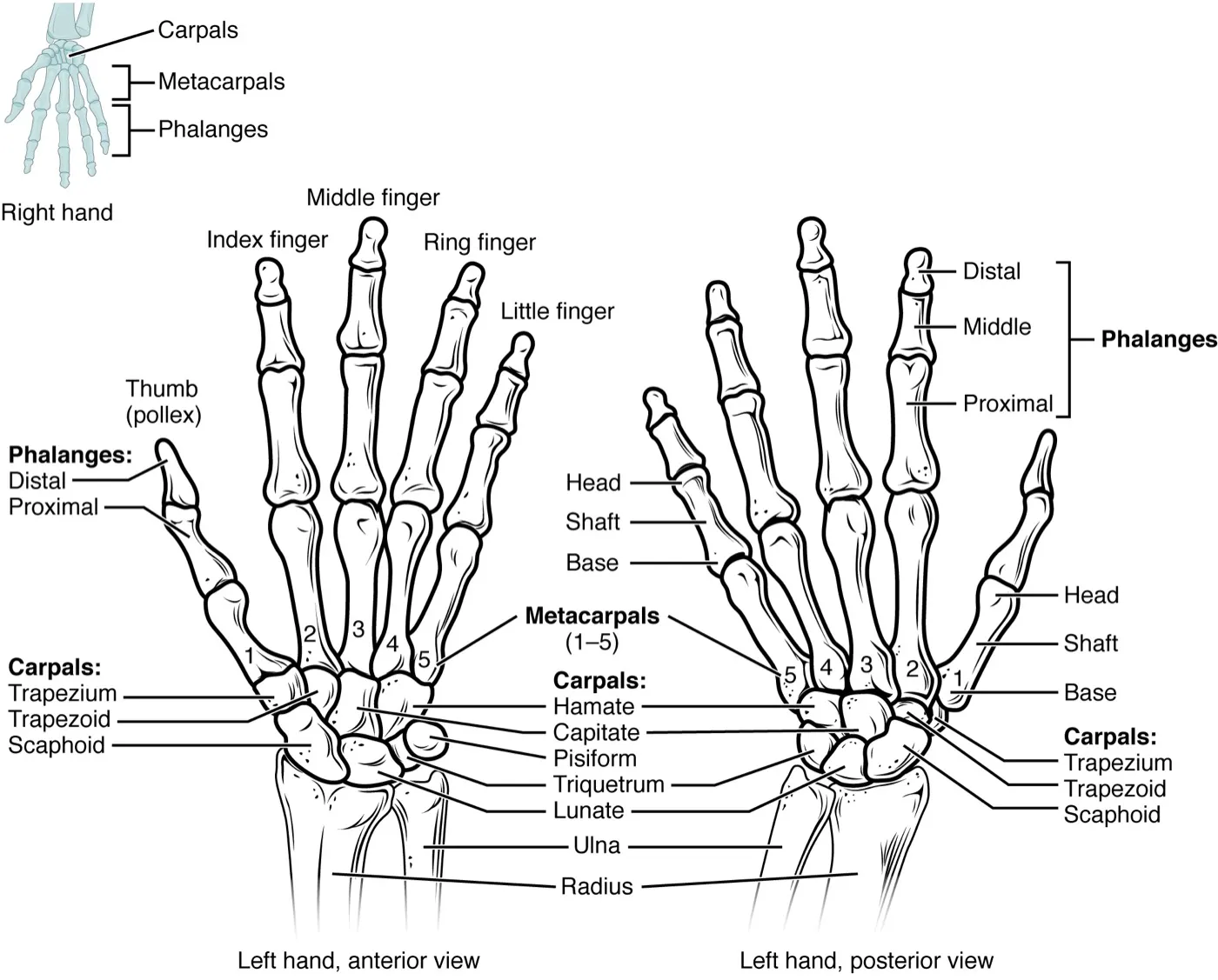
The drawing shows the bones without their ligaments; this ligament joins the two labelled scaphoid and lunate1. Intrinsic wrist ligaments are those that run from one carpal bone to another7. A review of wrist anatomy calls the scapholunate and lunotriquetral ligaments the most important of them7.
Three parts, built differently
A review describes the ligament as C-shaped, with three structurally distinct parts: volar (palm side), membranous (thin and sheet-like) and dorsal (back)4. A study of cadaver wrists from adults, 21 fresh and 16 fixed, could consistently divide it into dorsal, proximal and palmar regions1. The two sources name the parts differently1,4. Proximal means nearer the centre of the body, and palmar means on the palm side. That study found each region built differently:
- The dorsal region was thick, with short fibres of collagen (a strong, rope-like protein) running straight across from bone to bone1.
- The palmar region was thin, with collagen bundles running at a slant1.
- The proximal region was mainly fibrocartilage, a tough, fibrous kind of cartilage1.
What it holds steady
In eight cadaver arms moved in a wrist joint simulator, the ligament appeared to be the primary stabiliser between the scaphoid and lunate8. Cutting it changed how the two bones moved during wrist flexion and extension, the bending of the wrist forward and back8. It did not change their motion during side-to-side tilting8.
In 24 cadaver wrists, the dorsal region gave the greatest restraint to the two bones sliding against each other3. In sixteen fresh cadaver wrists, cutting the dorsal portion accounted for 37% to 72% of the extra scaphoid flexion seen after cutting the whole ligament9. Cutting the volar portion accounted for 6% to 14%, depending on the motion tested9.
Other ligaments back it up. In five fresh cadavers, completely cutting the scapholunate ligament did not by itself produce a static collapse of the lunate10. After the dorsal intercarpal ligament was also detached from the lunate, both bones moved and the gap widened10. That ligament crosses the back of the wrist and joins several wrist bones.
How strong it is: studies disagree
Three cadaver studies loaded parts of the ligament until they gave way, and their figures differ3,11,12. Forces are in newtons, a unit of force.
- In preparations from 24 adult cadaver wrists, the dorsal region had the greatest yield strength, about 260 newtons3. The palmar region followed at about 118 newtons and the proximal region at about 633.
- In ligaments from 10 fresh-frozen cadavers, the dorsal 10 mm pulled to failure had a peak load of 270 ± 91 newtons11.
- In one study of ligaments from fresh frozen cadaver wrists, the dorsal and palmar portions failed at mean loads of 83 and 86 newtons12. There was no statistical difference between them, and the intermediate portion failed at 36 newtons12.
Where its nerve endings lie: studies disagree
Mechanoreceptors are nerve endings that sense pressure, stretch or movement. Two small cadaver studies place them differently in this ligament13,14:
- The authors of a study of six fresh cadaver ligaments concluded that the palmar subregion holds the most nerve structures and mechanoreceptors13. They described the dorsal subregion as densely packed collagen with limited nerve supply13.
- In ligaments from 5 fresh-frozen cadaver specimens, nerve endings and mechanoreceptors were pronounced in the dorsal wrist ligaments, the dorsal scapholunate ligament among them14. They were limited or occasional in most volar wrist ligaments14.
In nine volunteers with a mean age of 26, the dorsal part was stimulated electrically through a fine-wire electrode15. Forearm wrist muscles were excited within 20 milliseconds15. Co-contraction, opposing muscles working at the same time, peaked around 150 milliseconds15.
Breakdown
How it tears
A review describes the injury as common in young people4. It is often the result of a fall forwards from a height, a sports injury or a motorcycle accident4. Another review says the injuries that separate the two bones are thought to follow one kind of fall most often16. The wrist lands bent back and tilted towards the little-finger side16.
An experiment loaded 32 cadaver wrists to failure17. Dislocations around the lunate came from wrist extension, ulnar deviation and intercarpal supination17. Ulnar deviation tilts the hand toward the little finger, and intercarpal supination is a twist between the wrist bones. A dislocation is when a bone is forced fully out of its normal place at a joint. The first and least unstable stage of that damage was a gap between the scaphoid and lunate17.
How often it is injured
One review calls this the most commonly injured ligament between the wrist bones4. It states that about 5% of wrist sprains come with a scapholunate tear4. A sprain is a stretched or torn ligament. Among 144 patients with wrist pain after an injury but normal standard X-rays, arthroscopy showed scapholunate ligament lesions in 1418. Arthroscopy is keyhole surgery inside a joint, using a small camera.
Tears alongside a broken wrist
Arthroscopy studies have counted tears of this ligament alongside a distal radius fracture19,20,21. The distal radius is the end of the radius farther from the centre of the body.
| Who was studied | Scapholunate ligament finding |
|---|---|
| 60 patients with a displaced fracture into the joint surface | 19 had a tear19 |
| 50 initially displaced fractures in young adults | 27 (54%) had a partial or total tear20 |
| A systematic review of 20 articles and 1,346 patients with an acute fracture | The overall rate of injury was 35.3%21 |
A systematic review is a study that searches for all the research on a question in a set, checkable way and sums it up. A systematic review of eleven studies looked at the ligament alongside an acute scaphoid fracture22. Reported rates of injury ran from 0% to 71%, and were higher with arthroscopy than with X-ray or MRI22. Complete tears were rare, and the overall quality of the studies was low to moderate22. The scaphoid fracture page covers that break.
Defects in wrists without symptoms, and in donated wrists
One study compared painful and painless wrists in the same people, using arthrograms (joint X-rays taken with dye)23. Its 30 patients had wrist trauma, pain in one wrist, normal X-rays and a scapholunate defect in at least one wrist23. The study took no other patients23. Defects were found in 28 painful and 20 painless wrists23. The defect reached the dorsal part in 64% of painful wrists and 25% of painless ones23.
In 393 dissected wrists, whose symptoms in life were not recorded, the ligament was torn in 28%24. In 62 cadaver wrists examined for changes in elderly wrists without symptoms, a scapholunate lesion was found in 185. Most of those defects were incomplete and lay in the central portion5. The authors concluded that such defects arise as a process of ageing5.
From a tear to a collapsed wrist
A review describes four groups of scapholunate injury, by what X-rays show, and attributes them to Watson and colleagues16:
- Predynamic instability. X-rays show no malalignment, which means bones sitting out of their usual line16.
- Dynamic instability. The gap between the two bones may widen on a clenched-fist X-ray, or on live imaging while the wrist is moved or loaded16.
- Static scapholunate dissociation. The ligament is completely torn and the bones are malaligned on plain X-rays16.
- Scapholunate advanced collapse (SLAC). Its own stages follow how far arthritis has spread through the wrist16.
Another review says static instability is often called dorsal intercalated segment instability, or DISI4. That review states that a long-standing injury with separation of the two bones always ends in DISI and a SLAC wrist4. It also says the average time from injury to a SLAC wrist is unknown and variable4. From experience, it says, the collapse most often turns up three to 15 years after the injury4.
Recovery
What reviews say about healing
Three reviews comment on how a torn ligament fares4,6,25:
- One describes it as a true intra-articular ligament, one inside the joint, bathed in joint fluid6. It says this contributes to its poor healing potential6.
- A second states that the intrinsic wrist ligaments tend to degenerate rapidly after injury, in as little as two to six weeks4. It adds that the ideal time for sewing the ligament back together has not been defined4.
- A systematic review states that once more than 6 weeks have passed the instability counts as chronic, because the ligament can no longer heal25.
Tears left alone
Two small series have followed tears that were left alone26,27. A 2013 review states that the natural history of these injuries is essentially unknown6.
- Eleven patients, isolated injury. Each had an injury seen at arthroscopy, no X-ray signs of DISI or gapping, and no further procedure26. At an average of 7 years, all 11 still had pain and functional limitation26. Not one had progressed rapidly to SLAC-type degenerative change26.
- Fifty-one patients under 60 with a displaced distal radius fracture. Thirty-two had a tear that was left alone: 10 complete and 22 partial27. Among the 38 patients who came back 13 to 15 years later, not one had developed a static dissociation or a SLAC wrist27. The study graded tears on Lindau’s scale, and no tear reached grade 427. The authors note that grade 4 tears may fare differently27.
After surgery, in outline
A systematic review covered return to sport or work after surgery for isolated injury, in adults without osteoarthritis28. Osteoarthritis is a long-term joint disease in which the cartilage lining the joint wears away. Across fourteen papers and six operations, return rates were above 80% for each technique28. The review concluded that the best operation remains undetermined, because the published studies are varied and small28. The wrist sprain page gives an outline of the reconstruction reviews.
Connections
The ligament joins the scaphoid to the lunate, inside the wrist joint1,6. Both bones meet the end of the radius, described on the distal radius page2. The scaphoid and lunate sit in the row of carpal bones next to the forearm2. A review of wrist biomechanics states that no muscle acting on the wrist attaches to that row7. The triangular fibrocartilage complex sits between the lunate, the triquetrum and the head of the ulna7.
Injury to the ligament is described on the wrist sprain page, and it can accompany a distal radius fracture or a scaphoid fracture4,21,22.
Related exercise pages: push-up. One study loaded eight fresh cadaver wrists in push-up positions29. Cutting the ligament moved the centre of pressure between radius and scaphoid an average of 1.4 mm towards the thumb side29.
Scapholunate ligament steadies
Scapholunate ligament joins
Scapholunate ligament can tear when a fall breaks
Scapholunate ligament is injured in
Scapholunate ligament can tear alongside
Scapholunate ligament was tested under the load of
Sources
- Berger RA (1996). The gross and histologic anatomy of the scapholunate interosseous ligament.. The Journal of hand surgery. doi:10.1016/S0363-5023(96)80096-7 PMID 8683042
- Betts JG, Young KA, Wise JA, Johnson E, Poe B, Kruse DH, Korol O, Johnson JE, Womble M, DeSaix P (2022). Anatomy and Physiology 2e. OpenStax. Link
- Berger RA, Imeada T, Berglund L, An KN (1999). Constraint and material properties of the subregions of the scapholunate interosseous ligament.. The Journal of hand surgery. doi:10.1053/jhsu.1999.0953 PMID 10509273
- Andersson JK (2017). Treatment of scapholunate ligament injury: Current concepts.. EFORT open reviews. doi:10.1302/2058-5241.2.170016 PMID 29071123
- Wright TW, Del Charco M, Wheeler D (1994). Incidence of ligament lesions and associated degenerative changes in the elderly wrist.. The Journal of hand surgery. doi:10.1016/0363-5023(94)90026-4 PMID 8201201
- Pappou IP, Basel J, Deal DN (2013). Scapholunate ligament injuries: a review of current concepts.. Hand (New York, N.Y.). doi:10.1007/s11552-013-9499-4 PMID 24426911
- Eschweiler J, Li J, Quack V, Rath B, Baroncini A, Hildebrand F, Migliorini F (2022). Anatomy, Biomechanics, and Loads of the Wrist Joint.. Life (Basel, Switzerland). doi:10.3390/life12020188 PMID 35207475
- Short WH, Werner FW, Green JK, Masaoka S (2002). Biomechanical evaluation of ligamentous stabilizers of the scaphoid and lunate.. The Journal of hand surgery. doi:10.1053/jhsu.2002.35878 PMID 12457349
- Waters MS, Werner FW, Haddad SF, McGrattan ML, Short WH (2016). Biomechanical Evaluation of Scaphoid and Lunate Kinematics Following Selective Sectioning of Portions of the Scapholunate Interosseous Ligament.. The Journal of hand surgery. doi:10.1016/j.jhsa.2015.11.009 PMID 26718075
- Mitsuyasu H, Patterson RM, Shah MA, Buford WL, Iwamoto Y, Viegas SF (2004). The role of the dorsal intercarpal ligament in dynamic and static scapholunate instability.. The Journal of hand surgery. doi:10.1016/j.jhsa.2003.11.004 PMID 15043902
- Pang EQ, Douglass N, Behn A, Winterton M, Rainbow MJ, Kamal RN (2018). Tensile and Torsional Structural Properties of the Native Scapholunate Ligament.. The Journal of hand surgery. doi:10.1016/j.jhsa.2018.01.004 PMID 29459171
- Nikolopoulos FV, Apergis EP, Poulilios AD, Papagelopoulos PJ, Zoubos AV, Kefalas VA (2011). Biomechanical properties of the scapholunate ligament and the importance of its portions in the capitate intrusion injury.. Clinical biomechanics (Bristol, Avon). doi:10.1016/j.clinbiomech.2011.04.009 PMID 21636190
- Mataliotakis G, Doukas M, Kostas I, Lykissas M, Batistatou A, Beris A (2009). Sensory innervation of the subregions of the scapholunate interosseous ligament in relation to their structural composition.. The Journal of hand surgery. doi:10.1016/j.jhsa.2009.05.007 PMID 19683877
- Hagert E, Garcia-Elias M, Forsgren S, Ljung BO (2007). Immunohistochemical analysis of wrist ligament innervation in relation to their structural composition.. The Journal of hand surgery. doi:10.1016/j.jhsa.2006.10.005 PMID 17218173
- Hagert E, Persson JK, Werner M, Ljung BO (2009). Evidence of wrist proprioceptive reflexes elicited after stimulation of the scapholunate interosseous ligament.. The Journal of hand surgery. doi:10.1016/j.jhsa.2008.12.001 PMID 19249163
- Konopka G, Chim H (2018). Optimal management of scapholunate ligament injuries.. Orthopedic research and reviews. doi:10.2147/ORR.S129620 PMID 30774459
- Mayfield JK, Johnson RP, Kilcoyne RK (1980). Carpal dislocations: pathomechanics and progressive perilunar instability.. The Journal of hand surgery. doi:10.1016/s0363-5023(80)80007-4 PMID 7400560
- Adolfsson L (1994). Arthroscopic diagnosis of ligament lesions of the wrist.. Journal of hand surgery (Edinburgh, Scotland). doi:10.1016/0266-7681(94)90217-8 PMID 7964104
- Geissler WB, Freeland AE, Savoie FH, McIntyre LW, Whipple TL (1996). Intracarpal soft-tissue lesions associated with an intra-articular fracture of the distal end of the radius.. The Journal of bone and joint surgery. American volume. doi:10.2106/00004623-199603000-00006 PMID 8613442
- Lindau T, Arner M, Hagberg L (1997). Intraarticular lesions in distal fractures of the radius in young adults. Journal of hand surgery (Edinburgh, Scotland). doi:10.1016/s0266-7681(97)80364-6 PMID 9752922
- Begum R, Hourston GJM, Bochmann T, Chojnowski AJ (2022). A Systematic 10-Year Review of the Use of Arthroscopy in the Assessment and Treatment of Intercarpal Ligament Injuries Associated with Acute Distal Radius Fracture.. The journal of hand surgery Asian-Pacific volume. doi:10.1142/S2424835522500862 PMID 36476085
- Glévarec L, Njessi P, Poumellec MA, Balaguer T, Camuzard O, Lupon E (2026). Scapholunate Injuries in the Context of Acute Scaphoid Fractures: A Systematic Literature Review.. Hand (New York, N.Y.). doi:10.1177/15589447261430936 PMID 41933503
- Linkous MD, Pierce SD, Gilula LA (2000). Scapholunate ligamentous communicating defects in symptomatic and asymptomatic wrists: characteristics.. Radiology. doi:10.1148/radiology.216.3.r00se15846 PMID 10966721
- Viegas SF, Patterson RM, Hokanson JA, Davis J (1993). Wrist anatomy: incidence, distribution, and correlation of anatomic variations, tears, and arthrosis.. The Journal of hand surgery. doi:10.1016/0363-5023(93)90094-J PMID 8515018
- Athlani L, Pauchard N, Detammaecker R, Huguet S, Lombard J, Dap F, Dautel G (2018). Treatment of chronic scapholunate dissociation with tenodesis: A systematic review.. Hand surgery & rehabilitation. doi:10.1016/j.hansur.2017.12.001 PMID 29292109
- O'Meeghan CJ, Stuart W, Mamo V, Stanley JK, Trail IA (2003). The natural history of an untreated isolated scapholunate interosseus ligament injury.. Journal of hand surgery (Edinburgh, Scotland). doi:10.1016/s0266-7681(03)00079-2 PMID 12849939
- Mrkonjic A, Lindau T, Geijer M, Tägil M (2015). Arthroscopically diagnosed scapholunate ligament injuries associated with distal radial fractures: a 13- to 15-year follow-up.. The Journal of hand surgery. doi:10.1016/j.jhsa.2015.03.017 PMID 25936737
- Liew MY, Dingle LA, Semple A, Rust PA (2023). Return to sport or work following surgical management of scapholunate ligament injury: a systematic review.. British medical bulletin. doi:10.1093/bmb/ldac026 PMID 36457032
- Daly BT, Werner FW, Cavallaro SM, Tucci ER, Harley BJ (2018). Effect of Push-Up Position on Wrist Joint Pressures in the Intact Wrist and Following Scapholunate Interosseous Ligament Sectioning.. The Journal of hand surgery. doi:10.1016/j.jhsa.2017.10.019 PMID 29157783
Changes
- First published.