Wrist sprain
Also called sprained wrist, acute wrist sprain, wrist ligament sprain
A label for a wrist injury whose X-rays show no break. How studies define it, what MRI finds behind it, who it affects, and what studies of casts, wrist guards and ligament surgery found.
- Region
- Wrist & hand
- Updated
- October 14, 2026
- Reviewed
- October 14, 2026 · how entries are checked
What it is
How studies define it
A sprain is a stretched or torn ligament. Two studies give definitions of a wrist sprain, and they differ1,2.
- A 2016 study of wrist injuries in children states the current definition: a partial injury to a wrist ligament with nothing found on plain X-rays1.
- The authors of a 2012 MRI study called wrist sprain an inaccurate label2. They proposed instead: an occult (hidden) injury, partial or complete, to bone or soft tissue (ligament, tendon, muscle) after trauma with a negative X-ray2.
The authors of the 2016 study concluded that the current definition fitted none of their 57 cases and appears inappropriate for children1.
A 2024 imaging review uses the word for one MRI grade of injury to the wrist’s outer (extrinsic) ligaments6. A sprain, grade 1, shows swelling and fluid in and around the ligament6. A partial tear is grade 2, and a full-thickness tear is grade 36. The review puts about 85% of these injuries at grade 1 and about 10% at grade 2, and calls grade 3 uncommon6.
A 2016 paper describes a further group: people with thumb-side wrist pain after an injury whose X-rays and MRI are both normal4. It says this leaves no specific label other than wrist sprain, and no consensus on the ideal care for the group4.
Which structures are involved
The wrist is built from eight small carpal bones (wrist bones) set in two rows of four7. One review of wrist anatomy counts 33 ligaments within the joint and its capsule8.
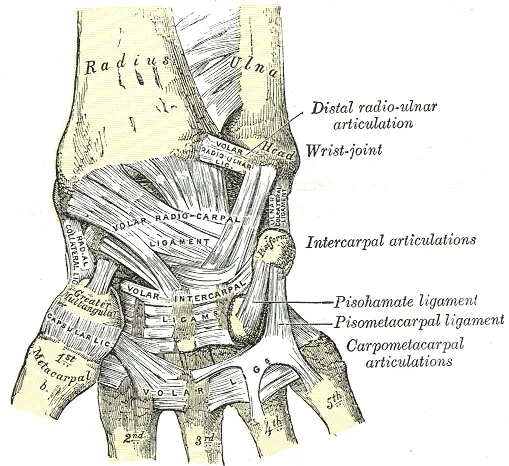
The scapholunate ligament connects two of those bones, the scaphoid and the lunate9. A review states that approximately 5% of wrist sprains have an associated scapholunate tear10. A 2017 article says scapholunate and other perilunate injuries (those around the lunate) are often written off as simple “sprains”, above all in athletes11. The triangular fibrocartilage complex, or TFCC, sits on the little-finger side of the wrist12.
What scans and keyhole surgery found behind normal X-rays
Studies have looked again at injured wrists, by MRI or by arthroscopy (keyhole surgery inside a joint, using a small camera)2,13. Across 155 MRI scans of acutely injured wrists with normal X-rays, 30 were completely normal2.
| Who was studied | What was found |
|---|---|
| People aged 18 to 49, acute wrist injury, normal X-rays; 155 MRI scans2 | 54 fractures and 56 bone bruises, together mostly in the radius, then the scaphoid2. Also 73 soft-tissue injuries, among them 15 to the TFCC and five scapholunate ligament lesions2 |
| 57 children with an acute wrist injury and no bony abnormality on X-rays | MRI showed occult fractures in 36.5% and bone contusions (bruises) in 35.0%; no child had a soft-tissue injury alone1 |
| 43 patients with normal X-rays and severe pain still present 4 to 12 weeks after injury | Arthroscopy showed recent pathology in 41 wrists; 17 had significant ligament lesions13 |
In the 155-scan study, the MRI findings changed how more than a third of the patients were cared for2. The breaks themselves are covered under scaphoid fracture and distal radius fracture, a break at the lower end of the radius2.
Who it affects
How common it is
One study weighted a national sample of US emergency department visits in 200916. Its estimated incidence of wrist strains or sprains was 64.1 per 100,000 persons16. Incidence is how many new cases appear in a group over a set time.
What sports records show
| Sport and setting | What was recorded |
|---|---|
| US college, 25 sports, 2004-05 to 2013-14 | Wrist sprains were 14.7% of 4,851 hand and wrist injuries17 |
| US high school, 11 school years | Ligament sprains were 9.0% of hand and wrist injuries18 |
| National Football League, 1996 to 2005 | Of 859 elbow, forearm and wrist injuries, 30% involved the wrist; wrist sprains were the most common injury recorded19 |
| Snowboarding, 47 medical facilities near Colorado resorts, 1988 to 1998 | The wrist was the most common site, with 21.6% of 7,430 injuries20; 26.78% of the 3,645 upper limb injuries were sprains20 |
How falls load the wrist
Falling was the predominant mechanism of upper limb injury in the Colorado snowboarding survey20. One study measured low forward falls, from 0 to 5 cm, onto the outstretched hand and fitted a mathematical model21. The wrist took a higher peak force than the shoulder21.
A 2021 imaging review states that a fall on an outstretched hand often injures the dorsal intercarpal ligament, on the back of the wrist22. It says the result is what is called a dorsal wrist sprain22. A 2018 review describes the fall thought to lie most often behind scapholunate injuries that separate the two bones23. The wrist is bent back and tilted toward the little finger23.
What studies found
How it goes over time
The authors of the 2012 MRI study write that the outlook is usually good2. They add that some patients have long-lasting pain and reduced wrist function, probably because an injury was missed2.
A 2013 cohort study (one that follows a group over time) covered 152 adults at an English emergency department24. Each had had a limited MRI for a suspected scaphoid injury24. Of the scans, 80% showed no fracture and 47% showed no injury at all; bone bruising was the main finding in 22%24. A worst-case analysis covered those whose MRI was normal24. A year or more after the injury, at least 12.5% had symptoms remaining and 14% had function that was not normal24.
A 2021 study notes that a US society of hand surgeons tells patients that symptoms resolve in six weeks3. The study says there is scant evidence behind this reassurance3. It followed 49 US Military Academy cadets coded with a wrist sprain3:
- In the first weeks: 96% were placed on restricted upper-limb duty, for a median (middle value) of 14 days3. Each of those cadets eventually returned to full military duty3.
- A mean of 10.4 years later, by telephone survey: 78% had had no further wrist injury3. Two (4%) had gone on to surgical repair3. The average QuickDASH score was 7.5, on a scale where 0 means no disability and 100 the greatest3,25. The QuickDASH is an 11-item short form of the DASH questionnaire, described below26.
For the scapholunate ligament, a review calls the natural history of injury essentially unknown27.
A cast against moving at once
One randomised trial enrolled 43 patients aged 18 to 64 with thumb-side wrist pain after an injury4. Their MRI showed no fracture and no scapholunate ligament injury4. Twenty-one wore a cast on the back of the wrist for 2 weeks, and 22 moved the wrist at once4.
- At 2 weeks, the cast group had less wrist range of motion and a higher score on the DASH4. The DASH is a 30-item questionnaire on disability and symptoms of the arm, shoulder and hand25. Its score also runs from 0, no disability, to 100, the greatest, so a higher score means more disability25.
- At 4 weeks, the DASH score was still higher in the cast group, with no difference in range of motion4.
- At 6 weeks, the groups did not differ on any outcome, and the difference in sick leave was not statistically significant4.
Wrist guards in snowboarding
Two randomised studies gave some snowboarders a wrist brace or protector and others none28,29.
- In 5,029 snowboarders, fewer wrist injuries occurred in the brace group than in the controls, a significant difference28. As a wrist injury, the trial counted a break, or a sprain with lost movement and pain for at least 3 days28. No injury could be related to wearing the brace28.
- In 721 snowboarders, fewer severe wrist injuries occurred in the protector group, with confidence limits that included no difference29. Twelve people secretly threw their protectors away, and a per-protocol analysis gave a significant result29. That analysis counts only the people who kept to the plan for their group. A 2016 systematic review rated this trial adequately randomised; it was not among the trials the review listed as having blinded assessment30.
Reviews and observational studies add figures and some doubts31,32.
- A 2007 systematic review of six studies found a lower risk with guards, in its randomised trials and cohort studies31. The relative risk (how many times as often it happened) was 0.23 for wrist injury and 0.17 for wrist sprain31. It reported that non-experimental data suggested guards may raise the risk of finger and elbow-shoulder injuries31.
- A case-control study at 19 ski areas in Quebec linked guards with 85% lower odds of hand, wrist or forearm injury32. For elbow, upper arm or shoulder injury its odds ratio was 2.35, with a confidence interval that includes no effect32. The authors wrote that guards may increase these injuries32.
Surgery for torn wrist ligaments
A systematic review of 30 years of research on wrist ligament surgery found no randomised controlled trial among its studies5. It covered 362 studies, from 1985 to 2016, of surgery on the scapholunate ligament, the TFCC and one other wrist ligament5. Of the 362 studies, 97% had a low level of evidence, and the review judged the evidence too thin to favour one technique5.
The structure pages report the outcome studies in full; three reviews give the outline33,34,35.
- TFCC debridement (trimming away damaged tissue), 18 studies: mean grip strength went from 65% of the other side to 91%, across 10 studies33. A 2024 trial protocol states that no randomised controlled trial has studied operating on TFCC tears36. It notes that debridement results come from studies without a comparison group, and that the tears’ natural course could explain them36.
- TFCC tears managed without surgery, eight studies of 425 patients: a systematic review called the data mixed and scarce34.
- Scapholunate reconstruction for long-standing injuries, 805 procedures: compared with before the operation, pain scores fell, grip strength improved modestly and wrist flexion (bending forward) decreased35.
Connections
The structures are covered on the pages for the wrist joint, the scapholunate ligament and the triangular fibrocartilage complex. A review of wrist cartilage injuries states what osteoarthritis after a wrist injury most often follows37. It is an earlier ligament injury, or a fracture of the lower radius that enters the joint37.
One MRI study of wrists with normal X-rays found 54 hidden breaks and 56 bone bruises2. Taken together, these were mostly in the radius and then the scaphoid2. With MRI as the reference in 300 injured wrists with thumb-side tenderness, X-rays showed 70% of scaphoid fractures38. The pages on scaphoid fracture and distal radius fracture report the trials for those injuries.
One lab study relates to the push-up: researchers cut the scapholunate ligament in eight cadaver wrists (from bodies donated for study) loaded in push-up positions39. The centre of pressure where the radius meets the scaphoid then moved an average of 1.4 mm toward the thumb side39.
Wrist sprain involves
Wrist sprain has MRI studies that found hidden breaks of
Wrist sprain is compared with
Wrist sprain has a lab study of the wrist during
Sources
- Elvey M, Patel S, Avisar E, White WJ, Sorene E (2016). Defining occult injuries of the distal forearm and wrist in children.. Journal of children's orthopaedics. doi:10.1007/s11832-016-0735-7 PMID 27121641
- Bergh TH, Lindau T, Bernardshaw SV, Behzadi M, Soldal LA, Steen K, Brudvik C (2012). A new definition of wrist sprain necessary after findings in a prospective MRI study.. Injury. doi:10.1016/j.injury.2012.06.028 PMID 22819266
- Sandler AB, Hoyt BW, Klahs KJ, Scanaliato JP, Nesti LJ, Dunn JC (2021). Epidemiology and Long-Term Outcomes of Wrist Sprains in Military Academy Cadets.. The American journal of sports medicine. doi:10.1177/03635465211013551 PMID 34038194
- Clementson M, Thomsen N, Jørgsholm P, Besjakov J, Björkman A (2016). Is early mobilisation better than immobilisation in the treatment of wrist sprains?. Journal of plastic surgery and hand surgery. doi:10.3109/2000656X.2015.1137925 PMID 26852887
- Andersson JK, Rööser B, Karlsson J (2018). Level of evidence in wrist ligament repair and reconstruction research: a systematic review.. Journal of experimental orthopaedics. doi:10.1186/s40634-018-0135-7 PMID 29881999
- Ng AWH, Chan JYS, Griffith JF, Ng ISH, Tse WL, Ng SSH (2024). Imaging of dorsal wrist pain.. Quantitative imaging in medicine and surgery. doi:10.21037/qims-24-420 PMID 39281114
- Betts JG, Young KA, Wise JA, Johnson E, Poe B, Kruse DH, Korol O, Johnson JE, Womble M, DeSaix P (2022). Anatomy and Physiology 2e. OpenStax. Link
- Eschweiler J, Li J, Quack V, Rath B, Baroncini A, Hildebrand F, Migliorini F (2022). Anatomy, Biomechanics, and Loads of the Wrist Joint.. Life (Basel, Switzerland). doi:10.3390/life12020188 PMID 35207475
- Berger RA (1996). The gross and histologic anatomy of the scapholunate interosseous ligament.. The Journal of hand surgery. doi:10.1016/S0363-5023(96)80096-7 PMID 8683042
- Andersson JK (2017). Treatment of scapholunate ligament injury: Current concepts.. EFORT open reviews. doi:10.1302/2058-5241.2.170016 PMID 29071123
- Morrell NT, Moyer A, Quinlan N, Shafritz AB (2017). Scapholunate and perilunate injuries in the athlete.. Current reviews in musculoskeletal medicine. doi:10.1007/s12178-017-9383-x PMID 28101827
- Martins T, Marappa-Ganeshan R (2023). Anatomy, Shoulder and Upper Limb, Forearm Triangular Fibrocartilage Complex.. StatPearls. PMID 32119451
- Adolfsson L, Povlsen B (2004). Arthroscopic findings in wrists with severe post-traumatic pain despite normal standard radiographs.. Journal of hand surgery (Edinburgh, Scotland). doi:10.1016/j.jhsb.2003.12.003 PMID 15142688
- Andersson JK, Andernord D, Karlsson J, Fridén J (2015). Efficacy of Magnetic Resonance Imaging and Clinical Tests in Diagnostics of Wrist Ligament Injuries: A Systematic Review.. Arthroscopy : the journal of arthroscopic & related surgery : official publication of the Arthroscopy Association of North America and the International Arthroscopy Association. doi:10.1016/j.arthro.2015.04.090 PMID 26095820
- De Santis S, Cozzolino R, Luchetti R, Cazzoletti L (2022). Comparison between MRI and Arthroscopy of the Wrist for the Assessment of Posttraumatic Lesions of Intrinsic Ligaments and the Triangular Fibrocartilage Complex.. Journal of wrist surgery. doi:10.1055/s-0041-1729757 PMID 35127261
- Ootes D, Lambers KT, Ring DC (2012). The epidemiology of upper extremity injuries presenting to the emergency department in the United States.. Hand (New York, N.Y.). doi:10.1007/s11552-011-9383-z PMID 23449400
- Chan JJ, Xiao RC, Hasija R, Huang HH, Kim JM (2023). Epidemiology of Hand and Wrist Injuries in Collegiate-Level Athletes in the United States.. The Journal of hand surgery. doi:10.1016/j.jhsa.2021.10.011 PMID 34895779
- Johnson BK, Brou L, Fields SK, Erkenbeck AN, Comstock RD (2017). Hand and Wrist Injuries Among US High School Athletes: 2005/06-2015/16.. Pediatrics. doi:10.1542/peds.2017-1255 PMID 29162658
- Carlisle JC, Goldfarb CA, Mall N, Powell JW, Matava MJ (2008). Upper extremity injuries in the National Football League. The American journal of sports medicine. doi:10.1177/0363546508318198 PMID 18583521
- Idzikowski JR, Janes PC, Abbott PJ (2000). Upper extremity snowboarding injuries. The American journal of sports medicine. doi:10.1177/03635465000280061001 PMID 11101105
- Chiu J, Robinovitch SN (1998). Prediction of upper extremity impact forces during falls on the outstretched hand.. Journal of biomechanics. doi:10.1016/s0021-9290(98)00137-7 PMID 9882050
- Shahabpour M, Abid W, Van Overstraeten L, De Maeseneer M (2021). Wrist Trauma: More Than Bones.. Journal of the Belgian Society of Radiology. doi:10.5334/jbsr.2709 PMID 35071978
- Konopka G, Chim H (2018). Optimal management of scapholunate ligament injuries.. Orthopedic research and reviews. doi:10.2147/ORR.S129620 PMID 30774459
- Bowles F, Keeton H, Adlington H, Cumberbatch GL, Markham D (2013). Morbidity in adults with a normal limited scaphoid MRI: a retrospective cohort study and follow-up questionnaire.. Emergency medicine journal. doi:10.1136/emermed-2012-201177 PMID 22492123
- Gummesson C, Ward MM, Atroshi I (2006). The shortened disabilities of the arm, shoulder and hand questionnaire (QuickDASH): validity and reliability based on responses within the full-length DASH.. BMC musculoskeletal disorders. doi:10.1186/1471-2474-7-44 PMID 16709254
- Beaton DE, Wright JG, Katz JN, Upper Extremity Collaborative Group (2005). Development of the QuickDASH: comparison of three item-reduction approaches.. The Journal of bone and joint surgery. American volume. doi:10.2106/JBJS.D.02060 PMID 15866967
- Pappou IP, Basel J, Deal DN (2013). Scapholunate ligament injuries: a review of current concepts.. Hand (New York, N.Y.). doi:10.1007/s11552-013-9499-4 PMID 24426911
- Rønning R, Rønning I, Gerner T, Engebretsen L (2001). The efficacy of wrist protectors in preventing snowboarding injuries.. The American journal of sports medicine. doi:10.1177/03635465010290051001 PMID 11573916
- Machold W, Kwasny O, Eisenhardt P, Kolonja A, Bauer E, Lehr S, Mayr W, Fuchs M (2002). Reduction of severe wrist injuries in snowboarding by an optimized wrist protection device: a prospective randomized trial.. The Journal of trauma. doi:10.1097/00005373-200203000-00016 PMID 11901328
- Salam RA, Arshad A, Das JK, Khan MN, Mahmood W, Freedman SB, Bhutta ZA (2016). Interventions to Prevent Unintentional Injuries Among Adolescents: A Systematic Review and Meta-Analysis.. The Journal of adolescent health. doi:10.1016/j.jadohealth.2016.07.024 PMID 27664598
- Russell K, Hagel B, Francescutti LH (2007). The effect of wrist guards on wrist and arm injuries among snowboarders: a systematic review.. Clinical journal of sport medicine : official journal of the Canadian Academy of Sport Medicine. doi:10.1097/JSM.0b013e31803f901b PMID 17414485
- Hagel B, Pless IB, Goulet C (2005). The effect of wrist guard use on upper-extremity injuries in snowboarders.. American journal of epidemiology. doi:10.1093/aje/kwi181 PMID 15972933
- Saito T, Malay S, Chung KC (2017). A Systematic Review of Outcomes after Arthroscopic Débridement for Triangular Fibrocartilage Complex Tear.. Plastic and reconstructive surgery. doi:10.1097/PRS.0000000000003750 PMID 29068932
- Choi SI, Malik S, MacLean S (2024). The Natural History of Non-operatively Treated Traumatic Triangular Fibrocartilage Complex Tears: A Systematic Review.. Journal of wrist surgery. doi:10.1055/s-0044-1786164 PMID 39619455
- Montgomery SJ, Rollick NJ, Kubik JF, Meldrum AR, White NJ (2019). Surgical outcomes of chronic isolated scapholunate interosseous ligament injuries: a systematic review of 805 wrists.. Canadian journal of surgery. Journal canadien de chirurgie. doi:10.1503/cjs.006918 PMID 30900438
- Kaivorinne A, Räisänen MP, Karjalainen T, Jokihaara J, Gvozdenovic R, Wilcke M, et al. (2024). tREatment of trIaNgular FibrOcaRtilage ComplEx Ruptures (REINFORCER): protocol for randomised, controlled, blinded, efficacy trial of triangular fibrocartilage complex tears.. BMJ open. doi:10.1136/bmjopen-2024-086102 PMID 39663172
- Andersson JK, Hagert E, Brittberg M (2021). Cartilage Injuries and Posttraumatic Osteoarthritis in the Wrist: A Review.. Cartilage. doi:10.1177/19476035211021909 PMID 34128415
- Jørgsholm P, Thomsen NO, Besjakov J, Abrahamsson SO, Björkman A (2013). The benefit of magnetic resonance imaging for patients with posttraumatic radial wrist tenderness.. The Journal of hand surgery. doi:10.1016/j.jhsa.2012.09.034 PMID 23200950
- Daly BT, Werner FW, Cavallaro SM, Tucci ER, Harley BJ (2018). Effect of Push-Up Position on Wrist Joint Pressures in the Intact Wrist and Following Scapholunate Interosseous Ligament Sectioning.. The Journal of hand surgery. doi:10.1016/j.jhsa.2017.10.019 PMID 29157783
Changes
- First published.