Sternocleidomastoid
Also called SCM
The strap-like muscle that runs up each side of the neck from the breastbone and collarbone to behind the ear. How it turns and bends the head, what studies of whiplash, heading and concussion measured, and how it changes with training.
- Region
- Neck
- Starts on (sternal head)
- the front of the manubrium, the top part of the breastbone, by a rounded tendon1,2,3
- Starts on (clavicular head)
- the upper part of the front of the collarbone's inner third, by a band-like tendon1,2,3,9,10
- Ends on
- the mastoid process behind the ear, and the outer part of the superior nuchal line on the skull's back1,2,3
- Updated
- October 28, 2026
- Reviewed
- October 28, 2026 · how entries are checked
Function
Where it starts and ends
The sternocleidomastoid is a prominent muscle near the surface of the neck1,2. Seen from the side, it splits the neck into a front triangle and a back triangle1,2. It forms a muscular ridge that runs upward and across the neck, thick in the middle and thinner at each end3.
It starts on the manubrium (the upper part of the breastbone) and the inner part of the clavicle (collarbone)1,2. These are usually two separate heads3:
| Head | Where it starts | How it starts |
|---|---|---|
| Sternal | The front surface of the manubrium3 | A distinct, rounded tendon3 |
| Clavicular | The inner third of the collarbone, on an upper area of its front surface3,9,10 | A band-like tendon mixed with muscle fibres, varying in width3 |
The two heads rise up the neck, with the clavicular head passing under the sternal head3. About halfway up, they join into one thick belly3.
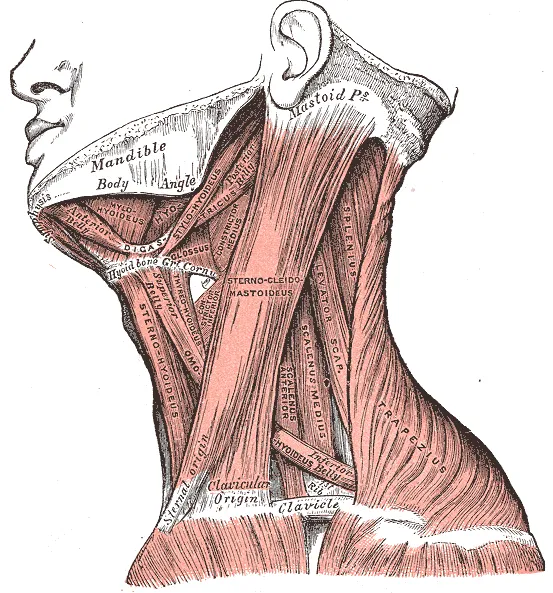
At the top, the muscle usually ends in two places on the skull1,3. One is the outer surface of the mastoid process, behind the ear1,3. The other is the outer part of the superior nuchal line, on the back of the skull1,3. These lie on the temporal bone and the occipital bone (the bone at the back and base of the skull)2.
What it moves
An anatomy textbook calls it the major muscle that bends the head to the side and turns it2. Acting on one side, it turns the head toward the opposite side2. When both sides work together, they can bend or straighten the neck, depending on how stiffly the neck spine is held1. In a computer model of the upright neck, it had the largest moment arm (leverage) for bending forward and sideways12.
It also works during chewing13. One reference adds roles in posture, in jaw function and in coordinating the muscles of the neck and face1.
Its nerve, blood supply and fibres
The accessory nerve (cranial nerve XI) is its main nerve supply1. Fibres for proprioception, the body’s sense of where its joints are, come from the cervical plexus, a network of nerves in the neck1. Its blood comes from branches of the external carotid artery1.
In autopsy samples from young men presumed healthy, about 31.5% of fibres were the slow type13. About 26.8% were hybrids, carrying two fast forms of myosin, the protein used to sort fibres into types13. Such a high share of hybrid fibres differs from adult limb muscles, where hybrids are rare13. The authors suggest this may be linked to its two nerve supplies and its many jobs13. In an MRI study of 13 men and 14 women, the women’s muscle was smaller for their body mass14.
A helper for hard breathing
The muscle helps with breathing in, especially when breathing takes more effort1,13. Three studies of healthy adults breathing in against loads measured it4,15,16:
- In 62 young adults, its activity rose with load up to the top load, while diaphragm thickening peaked midway and then fell4. Focusing on breathing with the diaphragm went with less sternocleidomastoid activity4.
- In 13 adults, its activity rose in a straight line with load and was higher in lower-oxygen air15. It showed no electrical signs of fatigue15.
- In 12 adults, it switched on earlier in each breath as they reached the point of stopping16. Earlier onset went with feeling more out of breath16.
In heading and tackling
In 15 college women soccer players, the sternocleidomastoid switched on before the trapezius when heading a ball17. It was more active before the ball arrived, and the trapezius more active after17. Jumping headers gave higher right-side activity than standing ones, though impact forces did not differ17. In 28 high-school rugby players, its activity was significantly higher when tackling with the head up than head down18.
Breakdown
In rear-end impacts
A 2018 narrative review says whiplash symptoms likely come from sprained ligaments or strained muscles in the neck19. The whiplash page covers the condition itself. In 42 volunteers in low-speed rear-end collisions, this muscle switched on before the back-of-neck muscles5. The head’s first backward movement then stretched the already active muscle5. The authors describe this as consistent with an injury caused by a muscle contracting while it lengthens5.
In that study, neck muscles switched on earlier in women and in the faster collisions5. A computer model drawn from human rear-impact data put the sternocleidomastoid’s peak fibre strain (stretch) at 4% to 7%20. The model put it higher, 21%, in the splenius capitis at the back of the neck20. In 20 volunteers on a test sled, a loud warning tone cut this muscle’s activity by 16%21. The authors propose that the startle reaction is an overreaction that may raise forces in neck tissues21.
After whiplash and in neck pain
Two MRI studies of chronic (long-lasting) whiplash-associated disorders, the range of symptoms that can follow a whiplash injury, found different results22,23:
- In 109 women, the whiplash group had significantly more fat in this muscle and a larger cross-sectional area22.
- In 31 people and matched controls, only those with severe, mainly right-sided symptoms had more fat in the right muscle23. No other differences were found23.
In 75 volunteers, people with neck pain, whether or not it followed whiplash, showed more sternocleidomastoid activity than controls in a craniocervical flexion test24. The neck pain page covers that condition.
Neck strength, head motion and concussion
Greater neck strength and bracing are thought to lower concussion risk by limiting head motion, but earlier research was mixed25. In 46 contact sport athletes aged 8 to 30, greater isometric neck strength went with smaller head speed changes under a test force25. So did bracing the neck in advance25. In 40 active volunteers, women had 50% greater head acceleration under a test force, despite switching this muscle on earlier26. They also had 49% less neck strength and 43% less head mass26.
In 100 soccer players heading a ball, neck strength explained about 13% to 17% of the spread in head acceleration27. Head and neck size explained about 22% to 23%, and muscle activity did not significantly predict it27. A systematic review of 60 heading studies found some evidence that a stronger neck lowered head acceleration, but not in all cases28. Head acceleration is often used to stand in for concussion risk28.
The studies of concussion itself measured neck strength, and they disagree6,7,8:
| Who was studied | What was found |
|---|---|
| 6,704 high school soccer, basketball and lacrosse athletes | Weaker overall neck strength was associated with concussion6 |
| 43 high-school rugby players aged 15 to 18 | The 11 concussed during the season had weaker preseason neck extension strength; other neck measures did not differ29 |
| 136 male professional rugby players | Concussed players had neck strength similar to the others7. Flexion strength and neck endurance were not associated with concussion7 |
| 8 studies, 7,625 team-sport athletes (meta-analysis) | Very low-certainty evidence of a small, non-significant link between stronger necks and lower concussion risk30 |
| 5 studies of athletes (2026 meta-analysis) | No significant differences in neck strength in five directions; evidence judged inconclusive8 |
Among 136 male professional rugby players, a past concussion was the strongest predictor of another7. In that group, 40 players had 51 concussions in one season, and 65% reported a past concussion7. Stronger neck extension went with slightly higher odds of concussion, an effect the authors judged likely too small to matter in practice7. In 27 club rugby players making simulated tackles, those concussed in the past year had the highest head acceleration31. The concussion page covers the condition.
Recovery
How it changes with training
In a cross-sectional study, which looks at a group once, 129 sub-elite male rugby players had thicker sternocleidomastoid muscles than non-players of the same age32. They also had larger necks and less neck movement32. In a randomised trial of 60 people with chronic neck pain, ten weeks of neck flexion exercise made this muscle thicker33. Craniocervical flexion exercise (a small nod of the head) increased the size of the longus colli more33.
Training has also changed how much the muscle is used in people with neck pain34,35. In 46 people with chronic neck pain, six weeks of nodding practice lowered its activity during the nodding test34. A review of trials in people with chronic neck pain found lower activity after neck exercise than after control programmes35.
Does neck training change head motion?
A meta-analysis of 26 articles found a large effect of resistance training on isometric neck strength36. Studies of head motion after neck training found mixed results36,37,38:
- In 36 college soccer players, eight weeks of training raised neck flexor strength by 15%37. It did not change head motion or sternocleidomastoid activity under a test force37.
- In a pilot study of 17 young athletes, neck training raised neck girth and strength more than a control programme did38. Changes in head speed were mixed38.
- One meta-analysis found no significant effect of neck training on head acceleration, from low to very low quality evidence36.
- A review of 60 heading studies concluded that standard neck strengthening did not lower head acceleration, but adding neuromuscular exercises appeared to28.
Neuromuscular training is exercise aimed at how nerves and muscles work together to control movement. A review of 10 studies found two in which neck strengthening in male rugby players went with fewer concussions39. No study in that review showed this in soccer or women’s rugby39.
Connections
Muscles it works with
The spinal accessory nerve is the main motor nerve for both this muscle and the trapezius40. In a study of three men, the sternocleidomastoid and the sternohyoid, another front neck muscle, worked in similar directions41. In 10 healthy volunteers, a standard neck flexion hold worked it and the anterior scalene harder than a gentle nod42. The anterior scalene is one of the scalenes, at the side of the neck. In the 46-person trial, nodding practice raised deep neck flexor activity as this muscle’s activity fell34.
In a model of rear-end impacts, this muscle lengthened as the head moved back, and the neck extensors lengthened on the rebound20.
Exercises that load it
Related exercise pages: neck isometric hold. The study of 10 volunteers compared the two holds at full, half and one-fifth effort, and the flexion hold gave more activity each time42.
Sternocleidomastoid is loaded by
Sternocleidomastoid starts on
Sternocleidomastoid shares a nerve with
Sternocleidomastoid works with
Sternocleidomastoid is compared with
Sternocleidomastoid has been measured in studies of
Sources
- Bordoni B, Jozsa F, Varacallo MA (2026). Anatomy, Head and Neck: Sternocleidomastoid Muscle.. StatPearls. PMID 30422476
- Betts JG, Young KA, Wise JA, Johnson E, Poe B, Kruse DH, Korol O, Johnson JE, Womble M, DeSaix P (2022). Anatomy and Physiology 2e. OpenStax. Link
- Dupont G, Iwanaga J, Altafulla JJ, Lachkar S, Oskouian RJ, Tubbs RS (2018). Bilateral sternocleidomastoid variant with six distinct insertions along the superior nuchal line.. Anatomy & cell biology. doi:10.5115/acb.2018.51.4.305 PMID 30637167
- Liu F, Jones AYM, Tsang RCC, Yam TTT, Tsang WWN (2025). Recruitment of the diaphragm and sternocleidomastoid muscle during increasing inspiratory pressure loads in healthy young adults.. Respiratory physiology & neurobiology. doi:10.1016/j.resp.2024.104365 PMID 39489202
- Brault JR, Siegmund GP, Wheeler JB (2000). Cervical muscle response during whiplash: evidence of a lengthening muscle contraction.. Clinical biomechanics (Bristol, Avon). doi:10.1016/s0268-0033(99)00097-2 PMID 10771121
- Collins CL, Fletcher EN, Fields SK, Kluchurosky L, Rohrkemper MK, Comstock RD, Cantu RC (2014). Neck strength: a protective factor reducing risk for concussion in high school sports.. The journal of primary prevention. doi:10.1007/s10935-014-0355-2 PMID 24930131
- Liston M, Leckey C, Whale A, van Dyk N (2023). Neck Strength Assessment Offers No Clinical Value in Predicting Concussion in Male Professional Rugby Players: A Prospective Cohort Study.. The Journal of orthopaedic and sports physical therapy. doi:10.2519/jospt.2023.11723 PMID 37017931
- Postula B, Hicks A, Toldi JP (2026). Evaluation of Neck Strength and Concussion Risk: A Systematic Review.. Current sports medicine reports. doi:10.1249/JSR.0000000000001313 PMID 41524441
- Gray H; Lewis WH (editor) (1918). Anatomy of the Human Body. Lea & Febiger, Philadelphia (20th edition). Link
- La Rose J, Charlick M, Varacallo MA (2026). Anatomy, Shoulder and Upper Limb, Clavicle.. StatPearls. PMID 30252246
- Silawal S, Schulze-Tanzil G (2023). The sternocleidomastoid muscle variations: a mini literature review.. Folia morphologica. doi:10.5603/FM.a2022.0045 PMID 35607877
- Vasavada AN, Li S, Delp SL (1998). Influence of muscle morphometry and moment arms on the moment-generating capacity of human neck muscles.. Spine. doi:10.1097/00007632-199802150-00002 PMID 9516695
- Cvetko E, Karen P, Eržen I (2012). Myosin heavy chain composition of the human sternocleidomastoid muscle.. Annals of anatomy. doi:10.1016/j.aanat.2012.05.001 PMID 22658700
- Migotto BDJ, Gill S, Sem M, Macpherson AK, Hynes LM (2022). Sex-related differences in sternocleidomastoid muscle morphology in healthy young adults: A cross-sectional magnetic resonance imaging measurement study.. Musculoskeletal science & practice. doi:10.1016/j.msksp.2022.102590 PMID 35667320
- Basoudan N, Rodrigues A, Gallina A, Garland J, Guenette JA, Shadgan B, Road J, Reid WD (2020). Scalene and sternocleidomastoid activation during normoxic and hypoxic incremental inspiratory loading. Physiological reports. doi:10.14814/phy2.14522 PMID 32726513
- Matsumura U, Rodrigues A, Mori T, Rassam P, Van Hollebeke M, Rozenberg D, Brochard L, Goligher EC, Roblyer D, Reid WD (2025). Timing of activation of different inspiratory muscles during incremental inspiratory loading in healthy adults: A cross-sectional study.. Canadian journal of respiratory therapy. doi:10.29390/001c.143022 PMID 40822663
- Bauer JA, Thomas TS, Cauraugh JH, Kaminski TW, Hass CJ (2001). Impact forces and neck muscle activity in heading by collegiate female soccer players.. Journal of sports sciences. doi:10.1080/026404101750095312 PMID 11256822
- Morimoto K, Sakamoto M, Fukuhara T, Kato K (2013). Electromyographic study of neck muscle activity according to head position in rugby tackles.. Journal of physical therapy science. doi:10.1589/jpts.25.563 PMID 24259802
- Anderson C, Yeung E, Toong T, Tong T, Reed N (2018). A narrative review on cervical interventions in adults with chronic whiplash-associated disorder.. BMJ open sport & exercise medicine. doi:10.1136/bmjsem-2017-000299 PMID 29719724
- Vasavada AN, Brault JR, Siegmund GP (2007). Musculotendon and fascicle strains in anterior and posterior neck muscles during whiplash injury.. Spine. doi:10.1097/01.brs.0000259058.00460.69 PMID 17414909
- Mang DW, Siegmund GP, Inglis JT, Blouin JS (2012). The startle response during whiplash: a protective or harmful response?. Journal of applied physiology. doi:10.1152/japplphysiol.00100.2012 PMID 22700800
- Elliott JM, O'Leary S, Sterling M, Hendrikz J, Pedler A, Jull G (2010). Magnetic resonance imaging findings of fatty infiltrate in the cervical flexors in chronic whiplash.. Spine. doi:10.1097/BRS.0b013e3181bb0e55 PMID 20118837
- Peolsson A, Karlsson A, Peterson G, Borén H, Zsigmond P, Elliott JM, Leinhard OD (2022). Morphology and composition of the ventral neck muscles in individuals with chronic whiplash related disorders compared to matched healthy controls: a cross-sectional case-control study.. BMC musculoskeletal disorders. doi:10.1186/s12891-022-05811-x PMID 36114530
- Jull G, Kristjansson E, Dall'Alba P (2004). Impairment in the cervical flexors: a comparison of whiplash and insidious onset neck pain patients.. Manual therapy. doi:10.1016/S1356-689X(03)00086-9 PMID 15040968
- Eckner JT, Oh YK, Joshi MS, Richardson JK, Ashton-Miller JA (2014). Effect of neck muscle strength and anticipatory cervical muscle activation on the kinematic response of the head to impulsive loads.. The American journal of sports medicine. doi:10.1177/0363546513517869 PMID 24488820
- Tierney RT, Sitler MR, Swanik CB, Swanik KA, Higgins M, Torg J (2005). Gender differences in head-neck segment dynamic stabilization during head acceleration.. Medicine and science in sports and exercise. doi:10.1249/01.mss.0000152734.47516.aa PMID 15692324
- Caccese JB, Buckley TA, Tierney RT, Arbogast KB, Rose WC, Glutting JJ, Kaminski TW (2018). Head and neck size and neck strength predict linear and rotational acceleration during purposeful soccer heading.. Sports biomechanics. doi:10.1080/14763141.2017.1360385 PMID 29037111
- Blyth R, Farrell G, Zoellner A, Ahmed OH, Bussey M, Galea O, Sole G (2025). What Factors Influence Head Acceleration During a Purposeful Header in Soccer Players? A Systematic Review.. Sports medicine (Auckland, N.Z.). doi:10.1007/s40279-025-02209-2 PMID 40272776
- Leung FT, Brown DA, Warner E, Shamim S, Harris S, Hides JA (2025). Neck strength deficit is a risk factor for concussion in high school rugby union and rugby league players.. Journal of science and medicine in sport. doi:10.1016/j.jsams.2024.11.016 PMID 39672717
- Garrett JM, Mastrorocco M, Peek K, van den Hoek DJ, McGuckian TB (2023). The Relationship Between Neck Strength and Sports-Related Concussion in Team Sports: A Systematic Review With Meta-analysis.. The Journal of orthopaedic and sports physical therapy. doi:10.2519/jospt.2023.11727 PMID 37428807
- Bussey MD, McLean M, Pinfold J, Anderson N, Kiely R, Romanchuk J, Salmon D (2019). History of concussion is associated with higher head acceleration and reduced cervical muscle activity during simulated rugby tackle: An exploratory study.. Physical therapy in sport. doi:10.1016/j.ptsp.2019.03.012 PMID 30928840
- Hemelryck W, Calistri J, Papadopoulou V, Theunissen S, Dugardeyn C, Balestra C (2018). Ultrasonographic assessment of neck muscular size and range of motion in rugby players.. International journal of sports physical therapy. PMID 29484239
- Javanshir K, Amiri M, Mohseni Bandpei MA, De las Penas CF, Rezasoltani A (2015). The effect of different exercise programs on cervical flexor muscles dimensions in patients with chronic neck pain.. Journal of back and musculoskeletal rehabilitation. doi:10.3233/BMR-150593 PMID 25812548
- Jull GA, Falla D, Vicenzino B, Hodges PW (2009). The effect of therapeutic exercise on activation of the deep cervical flexor muscles in people with chronic neck pain.. Manual therapy. doi:10.1016/j.math.2009.05.004 PMID 19632880
- Dirito AM, Abichandani D, Jadhakhan F, Falla D (2024). The effects of exercise on neuromuscular function in people with chronic neck pain: A systematic review and meta-analysis.. PloS one. doi:10.1371/journal.pone.0315817 PMID 39700104
- Ivanic B, Cronström A, Johansson K, Ageberg E (2024). Efficacy of exercise interventions on prevention of sport-related concussion and related outcomes: a systematic review and meta-analysis.. British journal of sports medicine. doi:10.1136/bjsports-2024-108260 PMID 39242177
- Mansell J, Tierney RT, Sitler MR, Swanik KA, Stearne D (2005). Resistance training and head-neck segment dynamic stabilization in male and female collegiate soccer players.. Journal of athletic training. PMID 16404453
- Eckner JT, Goshtasbi A, Curtis K, Kapshai A, Myyra E, Franco LM, Favre M, Jacobson JA, Ashton-Miller JA (2018). Feasibility and Effect of Cervical Resistance Training on Head Kinematics in Youth Athletes: A Pilot Study.. American journal of physical medicine & rehabilitation. doi:10.1097/PHM.0000000000000843 PMID 29557889
- Alvacite Cardenas D, Preston N (2025). Does strengthening the cervical spine musculature enhance neck strength and reduce sports-related concussions in rugby and football players? A systematic literature review.. Journal of bodywork and movement therapies. doi:10.1016/j.jbmt.2025.08.023 PMID 41316595
- Gun K, Uludag M, Delil S, Ozbayrak S, Sucuoglu H, Battal H, Adatepe NU, Karamehmetoglu SS (2014). Spinal accessory nerve injury: eight cases and review of the literature.. La Clinica Terapeutica. PMID 25203336
- Siegmund GP, Blouin JS, Brault JR, Hedenstierna S, Inglis JT (2007). Electromyography of superficial and deep neck muscles during isometric, voluntary, and reflex contractions.. Journal of biomechanical engineering. doi:10.1115/1.2401185 PMID 17227100
- O'Leary S, Falla D, Jull G, Vicenzino B (2007). Muscle specificity in tests of cervical flexor muscle performance.. Journal of Electromyography and Kinesiology. doi:10.1016/j.jelekin.2005.10.006 PMID 16423538
Changes
- First published.