Plantar heel pain
Also called plantar fasciitis, plantar fasciopathy
Pain under the heel, often called plantar fasciitis. How a guideline and reviews describe it, who it affects, how it changes over years, and what trials of stretching, exercise, orthoses, shockwave, injections and surgery found.
- Region
- Foot & ankle
- Updated
- October 8, 2026
- Reviewed
- October 8, 2026 · how entries are checked
What it is
How a guideline and reviews describe it
A 2023 clinical practice guideline restates a case description for plantar fasciitis1. It centres on pain under the inner side of the heel, most noticeable with the first steps after inactivity1. The pain is also worse after long spells of weight-bearing1. The guideline describes pain that comes on gradually, usually tied to a change in how much weight-bearing activity a person does1.
A 2022 systematic review (a study that searches for all the research on a question in a set way) covered 214 articles5. It found that the criteria studies use to decide who takes part vary widely5. This page keeps the name each study used: plantar heel pain, plantar fasciitis or plantar fasciopathy1,6,7.
The tissue behind the name
The plantar fascia is a band of tough tissue along the sole of the foot, from the heel toward the toes. In dissections of 12 feet, its thick central part arose on the calcaneus (heel bone) and split into five slips8.
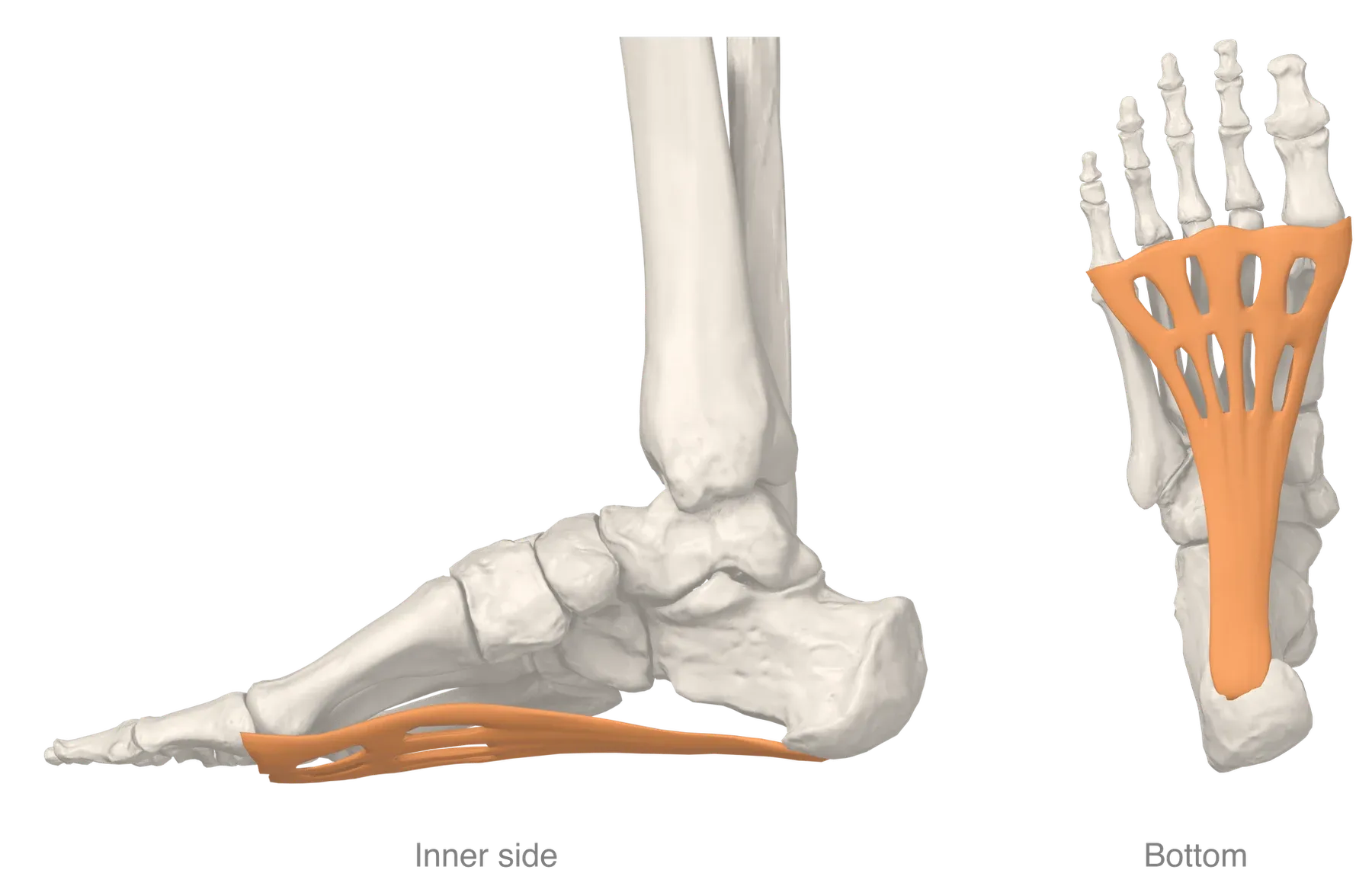
The 2023 guideline notes that the name plantar fasciitis implies a mainly inflammatory condition1. It adds that the tissue changes may sit along a spectrum with both inflammatory and degenerative features1. A meta-analysis (a study pooling earlier studies) of 21 ultrasound studies found the fascia 2.00 mm thicker in people with plantar heel pain9.
Who it affects
How common it is
Prevalence is the share of people in a group who have a condition at a given time. Incidence is how many new cases appear in a group over a set time. Studies report both for this pain2,11.
| Group studied | What was found |
|---|---|
| About 1.9 million patients in Dutch general-practice records | 3.83 new cases per 1,000 patient-years: 4.64 in females and 2.98 in males2 |
| About 75,000 people in a 2013 internet panel survey built to match US adults | An estimated 0.85% reported plantar fasciitis identified by a clinician, with pain in the past month12 |
| 5,109 adults aged 50 and over, from four general practices, answering a survey | Estimated prevalence in the last month of 9.6%, and 7.9% for disabling plantar heel pain11 |
| Runners, in a 2012 systematic review of running-related injuries | Incidence from 4.5% to 10.0% and prevalence from 5.2% to 17.5%13 |
In the US survey, it was more prevalent in women (1.19%) than men (0.47%)12. The 2023 guideline states that it is most common between ages 40 and 60, without a sex bias1.
A 2021 best practice guide says the pain mostly affects sedentary middle-aged and older adults6. It puts the pain at an estimated 8% of injuries related to running6.
Factors studied
Several findings come from one case-control study, which compares people who have a condition with similar people who do not. It had 50 patients with plantar fasciitis in one foot14.
- Body weight: in that study, a body mass index (weight for height) above 30 had 5.6 times the odds of 25 or less14. A 2016 systematic review of 51 studies found an index above 27 was the one clinical factor significantly associated15. The effect was strongest in non-athletic people15.
- Body weight in active people: a 2021 review of reviews reports one review of 12 studies that found no link in athletic populations16. A 2021 meta-analysis of 16 studies in physically active people did report higher body mass index as a risk factor17.
- Ankle range: dorsiflexion is pulling the foot up toward the shin. In the case-control study, 0 degrees or less carried 23.3 times the odds of more than 10 degrees14. The confidence interval, a range showing how precise a result is, was wide: 4.3 to 124.414. The 2023 guideline restates limited dorsiflexion as a risk factor1. A 2024 case-control study of 108 patients with plantar fasciitis found it was not a risk factor: patients had more dorsiflexion than matched controls18.
- Time on the feet: in the 50-patient study, spending most of the workday standing carried 3.6 times the odds14. A 2015 systematic review of four studies in workers found low-quality evidence of a link with weight-bearing tasks19.
- Heel spurs: a heel spur is a bony outgrowth from the heel bone20. A 2006 systematic review of 16 articles found a spur associated with chronic plantar heel pain21.
What studies found
How it changes over time
A 2023 systematic review describes plantar heel pain as not self-limiting, meaning not tending to settle on its own22. It notes that some studies report many people recovering on their own within a year22. It also cites evidence that up to 50% still have the pain at 10 years22.
One follow-up study covered 174 patients seen for plantar fasciitis between 2001 and 20113. It estimated the risk of still having it at set times after symptoms began:
| Time since symptoms began | Estimated risk of still having it |
|---|---|
| 1 year | 80.5%3 |
| 5 years | 50.0%3 |
| 10 years | 45.6%3 |
| 15 years | 44.0%3 |
In that study, 54% were symptom-free after a mean of 725 days of symptoms3. Of that group, 31.9% had at least one relapse first3. The risk of still having it was significantly greater for women and for patients with pain in both heels3. Fascia thickness and a heel spur at the start had no impact3.
The authors note that 75 of 269 invited patients did not respond, and probably had few or no symptoms3. They say the outlook would most likely have looked better had those patients taken part3.
Two 1994 follow-ups of patients managed without surgery reported23,24:
- 100 patients, telephone follow-up at an average of 47 months: 82 had no symptoms, and 3 had symptoms that limited activity or changed their work23.
- 105 patients on a standard non-surgical protocol: 89.5% had no heel pain within 10.9 months, and 4.8% chose surgery24.
What a guideline and broad reviews concluded
The 2023 guideline gives1:
- Grade A to plantar fascia-specific and calf stretching, for short- and long-term pain and function1.
- Grade A to foot taping alongside other approaches, for short-term pain and function1.
- Grade A, kept from 2014, to 1 to 3 months of night splints (splints worn during sleep) for morning first-step pain1. It notes that no new studies had tested them1.
- Grade B to exercise with resistance training for the muscles of the foot and ankle1. It found too little evidence to identify a superior type1.
A 2021 best practice guide drew on a systematic review, the views of experts and feedback from patients6. It concluded that the core approach should include taping, stretching and individualised education6.
The 2019 analysis of 31 trials was a network meta-analysis, which compares many options at once4. It found that the evidence does not suggest any commonly used option is better than any other4.
Stretching and exercise
A meta-analysis of eight randomised trials found moderate-quality evidence that plantar fascia-specific stretching reduced pain more than calf stretching25. A 2026 meta-analysis of 12 randomised trials found no statistically significant difference in pain or foot function between stretching and comparators26. Certainty was very low across its pooled outcomes, as the plantar fascia stretch page sets out26.
A randomised trial of 48 patients compared high-load heel raises with daily plantar fascia-specific stretching27. At 3 months the heel-raise group scored 29 points lower, a better result, on the Foot Function Index27. The groups did not differ at 1, 6 or 12 months27.
Foot orthoses and shockwave
Two 2018 meta-analyses of foot orthoses (shoe inserts) reached different conclusions28,29:
- 19 trials, 1,660 participants: moderate-quality evidence that orthoses reduced pain more than sham (dummy) orthoses at 7 to 12 weeks28. It was uncertain whether the change is clinically important28.
- 20 randomised trials: no short-term difference in pain between prefabricated, custom and sham orthoses29. It concluded that orthoses are not superior to sham or other conservative approaches29.
The 2023 guideline says orthoses should not be used alone for short-term pain relief (grade B), but may be combined with other approaches (grade C)1.
Shockwave therapy sends pulses of sound energy through the skin to a painful area. A 2023 meta-analysis of 236 randomised trials found it was the one approach that reduced pain against control in the medium and long term30. A sham-controlled trial of 200 patients gave everyone advice and customised orthoses31. Adding radial shockwave gave no extra drop in heel pain during activity at 6 months31.
Injections and surgery
A 2017 Cochrane review, a systematic review done to the Cochrane Collaboration’s standards, covered 39 trials of corticosteroid injection32. A corticosteroid is a drug that copies a type of hormone the body makes. Against placebo (a dummy version) or nothing, it found low-quality evidence that an injection may slightly reduce pain for up to one month32. Among 699 injected participants in 21 trials, it counted two plantar fascia ruptures and three injection-site infections32. It said serious adverse events were rare but under-reported32.
A 2020 review covered 15 studies of endoscopic (keyhole) plantar fascia release for chronic plantar fasciitis33. Scores improved after surgery in each study and the complication rate was 11.0%, on evidence the review judged weak33.
In a 1986 report of 15 athletes who had surgical release of the plantar fascia, 14 returned to full athletic activity34. In the 2017 Cochrane review, no trial of injection against placebo or nothing reported on return to previous activity32.
Connections
The central part of the plantar fascia arises on the calcaneus8. The tibial nerve page covers Baxter’s neuropathy.
A systematic review of seven studies found foot muscles generally smaller in volume in people with plantar heel pain, on very low-strength evidence35.
Among injured runners seen at one sports medicine centre, plantar fasciitis was the third most common running injury36. Heel raises, covered on the calf raise page, were added to advice and a heel cup in a randomised trial of 180 adults7. No between-group difference in pain reached the minimal important difference at any follow-up up to 52 weeks7.
A randomised study of 101 people with chronic plantar fasciitis compared a plantar fascia stretch programme with an Achilles tendon calf stretch programme37. The first gave better scores for worst pain and first-step morning pain at eight weeks37.
Plantar heel pain involves
Plantar heel pain has studies of muscle size in
Plantar heel pain can resemble a nerve entrapment covered in
Plantar heel pain has studies of runners in
Plantar heel pain has trials of
Sources
- Koc TA, Bise CG, Neville C, Carreira D, Martin RL, McDonough CM (2023). Heel Pain - Plantar Fasciitis: Revision 2023.. The Journal of orthopaedic and sports physical therapy. doi:10.2519/jospt.2023.0303 PMID 38037331
- Rasenberg N, Bierma-Zeinstra SM, Bindels PJ, van der Lei J, van Middelkoop M (2019). Incidence, prevalence, and management of plantar heel pain: a retrospective cohort study in Dutch primary care.. The British journal of general practice : the journal of the Royal College of General Practitioners. doi:10.3399/bjgp19x706061 PMID 31636128
- Hansen L, Krogh TP, Ellingsen T, Bolvig L, Fredberg U (2018). Long-Term Prognosis of Plantar Fasciitis: A 5- to 15-Year Follow-up Study of 174 Patients With Ultrasound Examination.. Orthopaedic journal of sports medicine. doi:10.1177/2325967118757983 PMID 29536022
- Babatunde OO, Legha A, Littlewood C, Chesterton LS, Thomas MJ, Menz HB, van der Windt D, Roddy E (2019). Comparative effectiveness of treatment options for plantar heel pain: a systematic review with network meta-analysis.. British journal of sports medicine. doi:10.1136/bjsports-2017-098998 PMID 29954828
- Riel H, Plinsinga ML, Delahunt E, Jensen MB, Landorf KB, van Middelkoop M, Roddy E, Rathleff MS, Vicenzino B, Olesen JL (2022). Large variation in participant eligibility criteria used in plantar heel pain research studies - a systematic review.. Journal of foot and ankle research. doi:10.1186/s13047-022-00573-0 PMID 36076244
- Morrissey D, Cotchett M, Said J'Bari A, Prior T, Griffiths IB, Rathleff MS, Gulle H, Vicenzino B, Barton CJ (2021). Management of plantar heel pain: a best practice guide informed by a systematic review, expert clinical reasoning and patient values.. British journal of sports medicine. doi:10.1136/bjsports-2019-101970 PMID 33785535
- Riel H, Vicenzino B, Olesen JL, Bach Jensen M, Ehlers LH, Rathleff MS (2023). Does a corticosteroid injection plus exercise or exercise alone add to the effect of patient advice and a heel cup for patients with plantar fasciopathy? A randomised clinical trial.. British journal of sports medicine. doi:10.1136/bjsports-2023-106948 PMID 37414460
- Stecco C, Corradin M, Macchi V, Morra A, Porzionato A, Biz C, De Caro R (2013). Plantar fascia anatomy and its relationship with Achilles tendon and paratenon.. Journal of anatomy. doi:10.1111/joa.12111 PMID 24028383
- Drake C, Whittaker GA, Kaminski MR, Chen J, Keenan AM, Rathleff MS, Robinson P, Landorf KB (2022). Medical imaging for plantar heel pain: a systematic review and meta-analysis.. Journal of foot and ankle research. doi:10.1186/s13047-021-00507-2 PMID 35065676
- Chundru U, Liebeskind A, Seidelmann F, Fogel J, Franklin P, Beltran J (2008). Plantar fasciitis and calcaneal spur formation are associated with abductor digiti minimi atrophy on MRI of the foot.. Skeletal radiology. doi:10.1007/s00256-008-0455-2 PMID 18286281
- Thomas MJ, Whittle R, Menz HB, Rathod-Mistry T, Marshall M, Roddy E (2019). Plantar heel pain in middle-aged and older adults: population prevalence, associations with health status and lifestyle factors, and frequency of healthcare use.. BMC musculoskeletal disorders. doi:10.1186/s12891-019-2718-6 PMID 31325954
- Nahin RL (2018). Prevalence and Pharmaceutical Treatment of Plantar Fasciitis in United States Adults.. The journal of pain. doi:10.1016/j.jpain.2018.03.003 PMID 29597082
- Lopes AD, Hespanhol Júnior LC, Yeung SS, Costa LO (2012). What are the Main Running-Related Musculoskeletal Injuries?. Sports Medicine. doi:10.1007/BF03262301 PMID 22827721
- Riddle DL, Pulisic M, Pidcoe P, Johnson RE (2003). Risk factors for Plantar fasciitis. The Journal of bone and joint surgery. American volume. doi:10.2106/00004623-200305000-00015 PMID 12728038
- van Leeuwen KD, Rogers J, Winzenberg T, van Middelkoop M (2016). Higher body mass index is associated with plantar fasciopathy/'plantar fasciitis': systematic review and meta-analysis of various clinical and imaging risk factors.. British journal of sports medicine. doi:10.1136/bjsports-2015-094695 PMID 26644427
- Rhim HC, Kwon J, Park J, Borg-Stein J, Tenforde AS (2021). A Systematic Review of Systematic Reviews on the Epidemiology, Evaluation, and Treatment of Plantar Fasciitis.. Life (Basel). doi:10.3390/life11121287 PMID 34947818
- Hamstra-Wright KL, Huxel Bliven KC, Bay RC, Aydemir B (2021). Risk Factors for Plantar Fasciitis in Physically Active Individuals: A Systematic Review and Meta-analysis.. Sports health. doi:10.1177/1941738120970976 PMID 33530860
- Johannsen FE, Rydahl JP, Jacobsen AS, Brahe CCH, Magnusson PS (2024). Foot Posture and Ankle Dorsiflexion as Risk Factors for Developing Achilles Tendinopathy and Plantar Fasciitis: A Case-Control Study.. Foot & ankle international. doi:10.1177/10711007241281289 PMID 39422991
- Waclawski ER, Beach J, Milne A, Yacyshyn E, Dryden DM (2015). Systematic review: plantar fasciitis and prolonged weight bearing.. Occupational medicine (Oxford, England). doi:10.1093/occmed/kqu177 PMID 25694489
- Kirkpatrick J, Yassaie O, Mirjalili SA (2017). The plantar calcaneal spur: a review of anatomy, histology, etiology and key associations. Journal of anatomy. doi:10.1111/joa.12607 PMID 28369929
- Irving DB, Cook JL, Menz HB (2006). Factors associated with chronic plantar heel pain: a systematic review.. Journal of science and medicine in sport. doi:10.1016/j.jsams.2006.02.004 PMID 16584917
- Gulle H, Morrissey D, Tan XL, Cotchett M, Miller SC, Jeffrey AB, Prior T (2023). Predicting the outcome of plantar heel pain in adults: a systematic review of prognostic factors.. Journal of foot and ankle research. doi:10.1186/s13047-023-00626-y PMID 37173686
- Wolgin M, Cook C, Graham C, Mauldin D (1994). Conservative treatment of plantar heel pain: long-term follow-up.. Foot & ankle international. doi:10.1177/107110079401500303 PMID 7951946
- Davis PF, Severud E, Baxter DE (1994). Painful heel syndrome: results of nonoperative treatment.. Foot & ankle international. doi:10.1177/107110079401501002 PMID 7834059
- Siriphorn A, Eksakulkla S (2020). Calf stretching and plantar fascia-specific stretching for plantar fasciitis: A systematic review and meta-analysis.. Journal of bodywork and movement therapies. doi:10.1016/j.jbmt.2020.06.013 PMID 33218515
- Jawade SS, Jawade SA (2026). Therapeutic efficacy of stretching exercises as a conservative treatment for plantar fasciitis: a systematic review with meta-analysis.. The Journal of manual & manipulative therapy. doi:10.1080/10669817.2026.2733480 PMID 42732047
- Rathleff MS, Mølgaard CM, Fredberg U, Kaalund S, Andersen KB, Jensen TT, Aaskov S, Olesen JL (2015). High-load strength training improves outcome in patients with plantar fasciitis: A randomized controlled trial with 12-month follow-up.. Scandinavian journal of medicine & science in sports. doi:10.1111/sms.12313 PMID 25145882
- Whittaker GA, Munteanu SE, Menz HB, Tan JM, Rabusin CL, Landorf KB (2018). Foot orthoses for plantar heel pain: a systematic review and meta-analysis.. British journal of sports medicine. doi:10.1136/bjsports-2016-097355 PMID 28935689
- Rasenberg N, Riel H, Rathleff MS, Bierma-Zeinstra SMA, van Middelkoop M (2018). Efficacy of foot orthoses for the treatment of plantar heel pain: a systematic review and meta-analysis.. British journal of sports medicine. doi:10.1136/bjsports-2017-097892 PMID 29555795
- Guimarães JS, Arcanjo FL, Leporace G, Metsavaht LF, Conceição CS, Moreno MVMG, Vieira TEM, Moraes CC, Gomes Neto M (2023). Effects of therapeutic interventions on pain due to plantar fasciitis: A systematic review and meta-analysis.. Clinical rehabilitation. doi:10.1177/02692155221143865 PMID 36571559
- Heide M, Røe C, Mørk M, Myhre K, Brunborg C, Brox JI, Hoksrud AF (2024). Is radial extracorporeal shock wave therapy (rESWT), sham-rESWT or a standardised exercise programme in combination with advice plus customised foot orthoses more effective than advice plus customised foot orthoses alone in the treatment of plantar fasciopathy? A double-blind, randomised, sham-controlled trial.. British journal of sports medicine. doi:10.1136/bjsports-2024-108139 PMID 38904119
- David JA, Sankarapandian V, Christopher PR, Chatterjee A, Macaden AS (2017). Injected corticosteroids for treating plantar heel pain in adults.. The Cochrane database of systematic reviews. doi:10.1002/14651858.cd009348.pub2 PMID 28602048
- Malahias MA, Cantiller EB, Kadu VV, Müller S (2020). The clinical outcome of endoscopic plantar fascia release: A current concept review.. Foot and ankle surgery : official journal of the European Society of Foot and Ankle Surgeons. doi:10.1016/j.fas.2018.12.006 PMID 30665823
- Leach RE, Seavey MS, Salter DK (1986). Results of surgery in athletes with plantar fasciitis.. Foot & ankle. doi:10.1177/107110078600700305 PMID 3804138
- Osborne JWA, Menz HB, Whittaker GA, Landorf KB (2019). Muscle Function and Muscle Size Differences in People With and Without Plantar Heel Pain: A Systematic Review.. Journal of Orthopaedic and Sports Physical Therapy. doi:10.2519/jospt.2019.8588 PMID 31597545
- Taunton JE, Ryan MB, Clement DB, McKenzie DC, Lloyd-Smith DR, Zumbo BD (2002). A retrospective case-control analysis of 2002 running injuries.. British journal of sports medicine. doi:10.1136/bjsm.36.2.95 PMID 11916889
- DiGiovanni BF, Nawoczenski DA, Lintal ME, Moore EA, Murray JC, Wilding GE, Baumhauer JF (2003). Tissue-specific plantar fascia-stretching exercise enhances outcomes in patients with chronic heel pain.. The Journal of bone and joint surgery. American volume. doi:10.2106/00004623-200307000-00013 PMID 12851352
Changes
- Figure replaced with a render from the AnatomyTOOL 3D model
- First published.