SLAP tear
Also called SLAP lesion, superior labrum anterior posterior lesion, superior labral tear
Damage to the top of the shoulder labrum, where the long head of biceps attaches. How studies define it, what arthroscopy and insurance records count, and what a sham-surgery trial and reviews of surgery and of care without surgery found.
- Region
- Shoulder
- Updated
- October 15, 2026
- Reviewed
- October 15, 2026 · how entries are checked
What it is
Where the name comes from
The authors of a 2017 randomised trial trace the term to Snyder and colleagues1. They used SLAP, short for superior labrum anterior posterior, for one injury1. In it, the top of the labrum and the long head of biceps tendon come away together from the rim of the socket1.
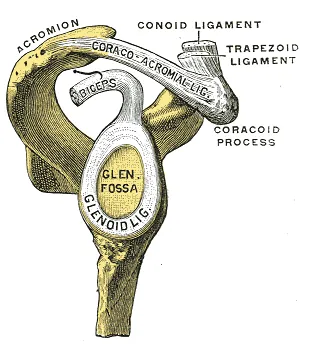
In this engraving the labrum is labelled “Glenoid lig.”, and the cut biceps tendon is drawn at the top of the socket. Snyder and colleagues first sorted these lesions into four types in 19902. Type I is fraying with the biceps and labral attachment intact, and type II is detachment of the top together with the biceps tendon2. Types III and IV are “bucket handle” tears displaced into the joint, type IV with part of the biceps tendon2. The shoulder labrum page covers the rim itself.
Why it is hard to pin down
The authors of the 2017 trial call identifying SLAP lesions controversial1. They note that clinical tests, and even arthroscopy and MR arthrography (an MRI scan taken after dye is put into the joint), have been questioned1. A 2025 meta-analysis, which pools several studies, used arthroscopy as the reference15. For tears at the top, MR arthrography had a sensitivity of 0.77 and a specificity of 0.8315. Sensitivity is the share of real tears found; specificity is the share of tear-free shoulders correctly cleared.
In one series of 544 arthroscopies, most SLAP lesions came with other damage inside the joint4. Its authors conclude that SLAP lesions with no other findings are uncommon4. They urge care before blaming symptoms on a SLAP lesion if other damage is also found4. One MRI study scanned 53 adults aged 45 to 60 without shoulder symptoms16. Two radiologists read 55% and 72% of scans as showing a tear at the top16.
In a 2025 NEER Circle survey of 92 shoulder experts, consensus was reached in 26 of 78 clinical scenarios17. The experts disagreed about examination, history, imaging, care without surgery and the surgical approach17.
Who it affects
How it happens
A retrospective review (one that looks back at past records) of 530 arthroscopies found 32 SLAP lesions3. The injury was traction in 22%, compression in 28% and overhead sport in 25%3.
In a review of 178 arthroscopies at one hospital serving military and civilian patients, a SLAP lesion was found in 38.6% of military patients18. It was found in 11.1% of civilian patients, and was more likely after trauma or with instability symptoms18.
What insurance records count
The figures below count recorded cases or operations in insurance and surgical records19,20,21.
| Records | What they showed |
|---|---|
| US private insurance claims, about 55 million people, 2003 to 2013 | Recorded SLAP tears rose from 28.0 to 142.4 per 100,000, while the share of those patients having shoulder surgery fell19 |
| A US insurance-records database, 2004 to 2009 | 25,574 arthroscopic SLAP repairs; the rate rose from 17.0 to 28.1 per 10,000 patients with an orthopaedic code20 |
| The same database | Repair rates highest at ages 20 to 29 and 40 to 49; men had about three times the rate of women20 |
| A US private insurance database, 2007 to 2016 | 3,347 patients had surgery for an isolated SLAP tear; isolated repair fell by 69.3% and biceps tenodesis rose by 370.0%22 |
| National US estimates, 2016 to 2018 | SLAP repairs fell from 29,931 to 23,451, while biceps tenodeses rose from 19,221 to 22,86723 |
| A Korean national database, 2008 to 2017 | 27,850 isolated repairs. The rate rose from 1.07 to 8.48 per 100,000 by 2012, then fell to 5.28 by 2017. It was 2.3 times higher in men21 |
What studies found
A trial with a sham operation
A double-blind, sham-controlled randomised trial in Oslo assigned 118 surgical candidates by chance to three groups1. Each had an isolated type II lesion, and their mean age was 401. The groups had labral repair (40), biceps tenodesis (39) or sham surgery (39), with main outcomes at 6 and 24 months1. The sham was a standard look inside the shoulder plus a 5 mm skin cut1.
The trial enrolled people aged 18 to 60 whose shoulder pain had lasted over 3 months despite non-surgical care1. Of 445 eligible patients, 118 were randomised, and the authors note this risks selection bias1. An independent statistician generated the allocation, and sealed envelopes were opened in theatre once arthroscopy had confirmed the lesion1. The patients, the therapists who saw them afterwards and those collecting and analysing data did not know the groups1. Each group had the same individually adjusted programme afterwards, with a sling for 3 weeks1.
The trial’s results were as follows1:
- Each of the three groups improved significantly from baseline to 6 and 24 months1.
- The groups did not differ significantly in any outcome at any follow-up1. At 2 years, Rowe score (shoulder stability, movement and function) differences were 0.6 to 1.6 points1.
- At 1 year, 84% of the sham group reported excellent or good results, against 83% after repair and 89% after tenodesis1.
- There were no serious adverse events1. Prolonged stiffness followed in five after repair, four after tenodesis and one after sham surgery, after trauma at 3 weeks1.
The authors note the trial cannot show how well supervised exercise works without arthroscopy1. They add that placebo, regression to the mean and the natural course should not be played down1. The 2017 report declares no competing interests1. A secondary analysis of the trial states that Lovisenberg Deakonal Hospital, as the paper spells it, funded the study5.
Repair against biceps surgery
Reviews have compared SLAP repair with biceps tenodesis, and one also with tenotomy, surgery that cuts a tendon10,11. Their findings differ7,8,10:
| Review | What it found |
|---|---|
| 2019 meta-analysis, 2 randomised trials and 6 observational studies of type II lesions | Higher ASES (American Shoulder and Elbow Surgeons) scores and satisfaction after tenotomy or tenodesis; no significant difference in other scores or complications10 |
| 2019 review, 23 studies of isolated type II tears | Similar scores; return to sport 20% to 95% after repair and 73% to 100% after tenodesis11 |
| The same 2019 review | Reoperation 2.9% to 40% after repair and 0% to 15.3% after tenodesis11 |
| 2021 review, 6 studies, 287 patients | Similar functional scores; reoperation in 12% after repair and 6% after tenodesis6 |
| 2022 review, 4 studies, 274 patients under 40 | Similar pain, function and satisfaction; higher return to sport and fewer reoperations after tenodesis7 |
| 2024 review, 5 cohort studies, patients under 40 | No significant difference in return to play, function scores or revision surgery8 |
| 2022 meta-analysis, 13 studies of overhead athletes | Tenodesis no worse than repair in ASES score, return to sport, return to pre-injury level or complications; called for randomised trials9 |
Of the two reviews of people under 40, the 2022 review reported higher return after tenodesis, and the 2024 review found no significant difference7,8. In the NEER Circle consensus, age was the main factor in surgical choices17.
Without surgery
The authors of a 2016 retrospective study state that uncertainty remains about the natural course of SLAP tears managed with exercise and activity changes24. In their 63 young, active patients with type II tears, 71.4% improved in pain and function at an average of 21 months24.
A systematic review of five studies covered 244 athletes managed without surgery25. Overall, 53.7% returned to play, and 78% of those who completed their exercise programme did25. The same review found 42.6% returned to their prior level of performance25. Its authors call for higher-level prospective studies to find which athletes do well without surgery25.
Return to sport after surgery
Reviews of return to sport after SLAP surgery report these rates12,14,26:
| Review | Returned to sport | Returned to previous level |
|---|---|---|
| 2025, 42 studies, 1,759 cases of repair | 77.5%12 | 68.2%12 |
| 2019, 22 studies, 944 patients of repair | 69.6%14 | 69.0%14 |
| 2024 meta-analysis of SLAP surgery | 90.6%26 | 71.7%26 |
The mean time to return was 8.2 months in the 2025 review and 8.9 months in the 2019 review12,14. The 2024 meta-analysis notes that it lacked subgroup analysis by demand or lesion type, which may introduce a high risk of bias26. In a retrospective study of 43 patients, CT arthrography (a CT scan with dye in the joint) showed 32.6% unhealed at a year27. Clinical outcomes did not differ significantly between healed and unhealed repairs27.
A 2010 review called repair results in throwing or overhead athletes much less predictable28. It found return to the previous level of 22% to 64% for baseball players28. Newer reviews compare pitchers with others and find that pitchers return less often13,14. In a 2019 review, 57.5% of 146 pitchers returned, against 87.1% of non-pitchers returning to sport or work14. A 2025 review of 547 throwers found lower return in pitchers than position players after both repair and tenodesis13.
In a 2025 review of 45 studies, no study gave criteria for return to sport29. The same review found reasons for not returning included pain, instability, weakness or stiffness, fear of reinjury and life changes29.
Connections
A SLAP lesion involves the shoulder labrum, the rim around the socket of the shoulder joint1,2. A scoping review lists SLAP lesions among the common problems of the long head of biceps tendon30. Of 140 injuries of the top of the labrum, 29% came with a partial-thickness rotator cuff tear and 28% were isolated31.
In the series of 544 arthroscopies, type II lesions in patients aged 40 or younger were linked with a Bankart lesion alone4. That is a detachment of the front of the labrum, covered on the shoulder dislocation page2. Among 77 people operated on for acute AC joint dislocation, SLAP lesions were seen in 11 (14.3%)32.
SLAP tear involves
SLAP tear often comes with injury to
SLAP tear is related to
SLAP tear can come with
Sources
- Schrøder CP, Skare Ø, Reikerås O, Mowinckel P, Brox JI (2017). Sham surgery versus labral repair or biceps tenodesis for type II SLAP lesions of the shoulder: a three-armed randomised clinical trial.. Br J Sports Med. doi:10.1136/bjsports-2016-097098 PMID 28495804
- Almajed YA, Hall AC, Gillingwater TH, Alashkham A (2022). Anatomical, functional and biomechanical review of the glenoid labrum.. J Anat. doi:10.1111/joa.13582 PMID 34725812
- Handelberg F, Willems S, Shahabpour M, Huskin JP, Kuta J (1998). SLAP lesions: a retrospective multicenter study.. Arthroscopy. doi:10.1016/s0749-8063(98)70028-3 PMID 9848599
- Kim TK, Queale WS, Cosgarea AJ, McFarland EG (2003). Clinical features of the different types of SLAP lesions: an analysis of one hundred and thirty-nine cases.. J Bone Joint Surg Am. PMID 12533574
- Brox JI, Skare Ø, Mowinckel P, Brox JS, Reikerås O, Schrøder CP (2020). Sick leave and return to work after surgery for type II SLAP lesions of the shoulder: a secondary analysis of a randomised sham-controlled study.. BMJ Open. doi:10.1136/bmjopen-2019-035259 PMID 32241790
- Civan O, Bilsel K, Kapicioglu M, Ozenci AM (2021). Repair versus biceps tenodesis for the slap tears: A systematic review.. J Orthop Surg (Hong Kong). doi:10.1177/23094990211004794 PMID 33882738
- Sandler AB, Scanaliato JP, Baird MD, Dunn JC, Parnes N (2022). Lower Reoperation and Higher Return-to-Sport Rates After Biceps Tenodesis Versus SLAP Repair in Young Patients: A Systematic Review.. Arthrosc Sports Med Rehabil. doi:10.1016/j.asmr.2022.07.004 PMID 36312714
- Hurley ET, Baker R, Danilkowicz RM, Levin JM, Klifto CS, Dickens JF, Taylor DC, Lau BC (2024). Similar outcomes between biceps tenodesis and SLAP repair for SLAP tears in younger patients - A meta-analysis.. J ISAKOS. doi:10.1016/j.jisako.2023.09.007 PMID 37797939
- Shin MH, Baek S, Kim TM, Kim H, Oh KS, Chung SW (2022). Biceps Tenodesis Versus Superior Labral Anterior and Posterior (SLAP) Lesion Repair for the Treatment of SLAP Lesion in Overhead Athletes: A Systematic Review and Meta-analysis.. Am J Sports Med. doi:10.1177/03635465211039822 PMID 34591715
- Ren YM, Duan YH, Sun YB, Yang T, Hou WY, Tian MQ (2019). Is arthroscopic repair superior to biceps tenotomy and tenodesis for type II SLAP lesions? A meta-analysis of RCTs and observational studies.. J Orthop Surg Res. doi:10.1186/s13018-019-1096-y PMID 30760293
- de Sa D, Arakgi ME, Lian J, Crum RJ, Lin A, Lesniak BP (2019). Labral Repair Versus Biceps Tenodesis for Primary Surgical Management of Type II Superior Labrum Anterior to Posterior Tears: A Systematic Review.. Arthroscopy. doi:10.1016/j.arthro.2018.12.015 PMID 31053457
- Rowe DG, Hurley ET, Bethell MA, Lorentz SG, Meyer AM, Klifto CS, Lau BC, Taylor DC, Dickens JF (2025). Return to Play After Arthroscopic Superior Labral Repair: A Systematic Review.. Am J Sports Med. doi:10.1177/03635465241246122 PMID 39751378
- Lack BT, Childers JT, Mowers CC, Berreta RS, Jackson GR, DeFroda SF, Knapik DM, Verma NN (2025). Biceps Tenodesis and SLAP Repair Show Similar Outcomes in Overhead Throwing Athletes With Baseball Pitchers Exhibiting Worse Rates of Return to Sport: A Systematic Review.. Arthroscopy. doi:10.1016/j.arthro.2025.01.061 PMID 39938668
- Thayaparan A, Yu J, Horner NS, Leroux T, Alolabi B, Khan M (2019). Return to Sport After Arthroscopic Superior Labral Anterior-Posterior Repair: A Systematic Review.. Sports Health. doi:10.1177/1941738119873892 PMID 31584340
- Elbadry M, Abdelgalil MS, Qafesha RM, Ghalwash AA, Elkhawaga H, Abdelrehim AM, Mashaly D, Eldeeb H, Naguib MM, Yousef Selim YA (2025). High Sensitivity and Specificity of Magnetic Resonance Arthrography for Labral Tears, Rotator Cuff Tears, Hill-Sachs Lesions, and Bankart Lesions: A Systematic Review and Meta-analysis.. Arthroscopy. doi:10.1016/j.arthro.2025.01.048 PMID 39914604
- Schwartzberg R, Reuss BL, Burkhart BG, Butterfield M, Wu JY, McLean KW (2016). High Prevalence of Superior Labral Tears Diagnosed by MRI in Middle-Aged Patients With Asymptomatic Shoulders.. Orthop J Sports Med. doi:10.1177/2325967115623212 PMID 26779556
- Verma NN, Hoenecke H, MacDonald P, Dornan GJ, Saad Berreta R, Scanaliato JP, Khan ZA, NEER Circle Group (2025). Principles of the superior labrum and biceps complex: an expert consensus from the NEER Circle.. J Shoulder Elbow Surg. doi:10.1016/j.jse.2024.09.040 PMID 39622358
- Kampa RJ, Clasper J (2005). Incidence of SLAP lesions in a military population.. J R Army Med Corps. doi:10.1136/jramc-151-03-07 PMID 16440960
- Dougherty MC, Kulenkamp JE, Boyajian H, Koh JL, Lee MJ, Shi LL (2020). National trends in the diagnosis and repair of SLAP lesions in the United States.. J Orthop Surg (Hong Kong). doi:10.1177/2309499019888552 PMID 31876225
- Zhang AL, Kreulen C, Ngo SS, Hame SL, Wang JC, Gamradt SC (2012). Demographic trends in arthroscopic SLAP repair in the United States.. Am J Sports Med. doi:10.1177/0363546512436944 PMID 22328710
- Jo YH, Oh HK, Jeong SY, Lee BG (2020). National Trends in the Repair of Isolated Superior Labral Tear from Anterior to Posterior in Korea.. J Korean Med Sci. doi:10.3346/jkms.2020.35.e285 PMID 32864905
- Cvetanovich GL, Gowd AK, Agarwalla A, Forsythe B, Romeo AA, Verma NN (2019). Trends in the Management of Isolated SLAP Tears in the United States.. Orthop J Sports Med. doi:10.1177/2325967119833997 PMID 30923727
- Hong IS, Meade JD, Young BL, Yu Z, Trofa DP, Fleischli JE, Hamid N, Piasecki D, Saltzman BM (2022). Trends in Repair vs. Biceps Tenodesis for Superior Labrum From Anterior to Posterior (SLAP) Tear: An Epidemiological Study.. Cureus. doi:10.7759/cureus.27096 PMID 36017300
- Jang SH, Seo JG, Jang HS, Jung JE, Kim JG (2016). Predictive factors associated with failure of nonoperative treatment of superior labrum anterior-posterior tears.. J Shoulder Elbow Surg. doi:10.1016/j.jse.2015.09.008 PMID 26671775
- Steinmetz RG, Guth JJ, Matava MJ, Brophy RH, Smith MV (2022). Return to play following nonsurgical management of superior labrum anterior-posterior tears: a systematic review.. J Shoulder Elbow Surg. doi:10.1016/j.jse.2021.12.022 PMID 35063641
- Gregori P, Maffulli N, Abboud J, Za P, Giurazza G, Papalia GF, Ferrini A, Franceschetti E (2024). Return to Sport at Preinjury Level is Common After Surgical Treatment of SLAP Lesions: A Systematic Review and a Meta-analysis.. Sports Med Arthrosc Rev. doi:10.1097/jsa.0000000000000383 PMID 38695497
- Nashikkar PS, Rhee SM, Desai CV, Oh JH (2018). Is Anatomical Healing Essential for Better Clinical Outcome in Type II SLAP Repair? Clinico-Radiological Outcome after Type II SLAP Repair.. Clin Orthop Surg. doi:10.4055/cios.2018.10.3.358 PMID 30174813
- Gorantla K, Gill C, Wright RW (2010). The outcome of type II SLAP repair: a systematic review.. Arthroscopy. doi:10.1016/j.arthro.2009.08.017 PMID 20362836
- Shirinskiy IJ, Rutgers C, Sierevelt IN, Priester-Vink S, Ring D, van den Bekerom MPJ, Verweij LPE (2025). Ill-defined Return-to-Sport Criteria and Inconsistent Unsuccessful Return Rates Caused by Various Reasons Not Necessarily Related to Treatment After Superior Labral Treatments: A Systematic Review.. Arthroscopy. doi:10.1016/j.arthro.2024.09.053 PMID 39393428
- Diplock B, Hing W, Marks D (2023). The long head of biceps at the shoulder: a scoping review.. BMC Musculoskeletal Disorders. doi:10.1186/s12891-023-06346-5 PMID 36978047
- Snyder SJ, Banas MP, Karzel RP (1995). An analysis of 140 injuries to the superior glenoid labrum.. J Shoulder Elbow Surg. doi:10.1016/s1058-2746(05)80015-1 PMID 8542365
- Tischer T, Salzmann GM, El-Azab H, Vogt S, Imhoff AB (2009). Incidence of associated injuries with acute acromioclavicular joint dislocations types III through V.. The American journal of sports medicine. doi:10.1177/0363546508322891 PMID 18725652
Changes
- First published.