Quadriceps tendon
The tendon just above the kneecap that joins the four thigh muscles to it. How it is built in layers, how it carries load as the knee bends, how it gets painful or tears, and what it works with.
- Region
- Knee
- Muscles
- quadriceps
- Updated
- September 29, 2026
- Reviewed
- September 29, 2026 · how entries are checked
Function
Where it sits and what joins it
The quadriceps is a group of four muscles at the front of the thigh2:
- the rectus femoris, at the front2;
- the vastus lateralis, on the outer side2;
- the vastus medialis, on the inner side2;
- the vastus intermedius, between the other two vasti and beneath the rectus femoris2.
The four converge into a single tendon that fixes into the base of the patella1. Below the kneecap, it carries on as the patellar ligament, also called the patellar tendon2. That ligament attaches to the tibial tuberosity, a bump on the front of the tibia (shinbone)2.
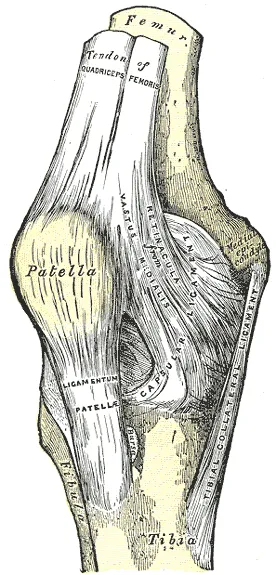
The patella is the body’s largest sesamoid bone, a bone that sits inside a tendon2. It sits within the quadriceps tendon2. It holds the tendon out from the knee joint, which gives the quadriceps more leverage across the knee2. A viewpoint article states this tendon joins muscle to bone, tissues of very different stiffness (the force it takes to stretch them)5. The patellar tendon, by contrast, joins bone to bone5.
How it is built in layers
In 18 knees from donors aged 18 to 38, the tendon had three distinct layers in every knee9. Each layer came from different muscles9:
| Layer | Comes from |
|---|---|
| Surface | The rectus femoris9 |
| Middle | The vastus medialis and vastus lateralis, with slanting fibres9 |
| Deep | The vastus intermedius9 |
Other studies found more variety1,10. A meta-analysis, which pools earlier studies, of 18 cadaver studies, covering 1,066 legs, found three layers most often, in 47.7%1. Four layers were found in 42.5%1. In another dissection of 20 limbs, only 3 showed the usual three-layer pattern10.
How big and strong it is
One lab study tested 10-mm-wide central strips from young male donors against strips of the patellar ligament11:
| Measure | Quadriceps tendon | Patellar ligament |
|---|---|---|
| Cross-sectional area, the size of a slice cut across it | 64.6 mm²11 | 36.8 mm²11 |
| Load at failure, in newtons (a unit of force) | About 2,173 newtons11 | 1,953 newtons11 |
The failure loads did not differ significantly11. On thin slices, the quadriceps tendons were also significantly longer and thicker, with a larger attachment to bone11.
How load passes through the kneecap
One study loaded six cadaver knees at one-sixth of a maximal quadriceps effort3. Force in the quadriceps tendon peaked at 60 degrees of knee bend, at 532 newtons3. Scaled up to a full effort, the authors estimated about 3,200 newtons3.
The split of force above and below the kneecap changed with knee angle3. At 30 degrees, the tendon below the kneecap carried 1.27 times the force of the quadriceps tendon3. At 90 and 120 degrees, that fell to 0.73.
In six donated knees, the quadriceps tendon carried more force than the tendon below the kneecap in deep bending3. The authors concluded the patella is not a simple pulley passing on equal force3.
The direction of pull also matters12. In ten cadaver knees, pulling each vastus muscle along its own fibre direction shifted the split12. From 0 to 60 degrees of bend, less force passed below the kneecap, relative to above it, than with a straight pull12.
A viewpoint article states that each quadriceps muscle pulls along its own line, so load across this tendon is uneven5. It includes shear force, a force that pushes two surfaces to slide across each other5. The same article states the patellar tendon is the stiffer of the two5. It also describes the quadriceps tendon as a shock absorber in landing, lengthening with the muscle as it controls knee bend5.
How blood reaches it
One cadaver study found the tendon’s blood supply split into three networks: inner side, outer side and around the patella13. Another found vessels spread unevenly14. The surface part had a complete network from where muscle meets tendon down to the patella14. The deep part held an oval area with no blood vessels, about 30 mm long and 15 mm wide14. The authors suggest pressure against the thigh bone’s groove, as the knee bends, may explain it14.
Breakdown
What little is written about tendinopathy
The narrative review describes quadriceps tendinopathy as pain at the front of the knee with activity, and tenderness at the top edge of the kneecap4. It says the condition is seen most often in athletes, and often occurs alongside tendinosis (changes inside a tendon) of the patellar tendon4.
The viewpoint article places the pain at the top of the kneecap, strongest in deep knee bends5. Patellar tendinopathy, in contrast, shows at the bottom of the kneecap5. It calls both overuse injuries: too much load on the tendon, with too little recovery5. The article says first symptoms are usually tied to one moment of heavy eccentric load, such as landing from a basketball rebound5. Eccentric means muscle work done while the muscle lengthens.
The same article says a period of too much load usually comes first5. It notes few studies of how common the condition is, with estimates in athletes of 0.2% to 2%5. Among athletes with pain in the parts that straighten the knee, up to one in four have pain at the top of the kneecap5.
Sources disagree about the name “jumper’s knee”5,15,16. The viewpoint article says the term covers both patellar and quadriceps tendinopathy5. Other sources use it as another name for patellar tendinopathy15,16.
What scans show in athletes
Two studies of athletes compared scan findings with symptoms4,17:
- In 61 professional beach volleyball players, an ultrasound scan, made with sound waves, found tendinosis in 21% of dominant and 34% of non-dominant legs17. That was about as often as in the patellar tendon17.
- In those players, only quadriceps tendon findings, including its thickness, were significantly linked with pain17.
- The narrative review cites 24 college basketball players without symptoms, scanned by MRI (magnetic resonance imaging) before and after a season4. Changes fitting quadriceps tendinopathy showed in 75% of preseason and 90% of postseason scans, without matching symptoms4. The review calls these changes not significant, and says they did not line up with symptoms4.
Who tears it
A Finnish national register counted 1,343 operations for quadriceps tendon rupture from 1997 to 20146. About 90% were in men, with a mean age of 55 for men and 59 for women6. In 1997 the rate was 0.55 per 100,000 person-years, and by 2014 it was 2.82, a rise of 411%6. In men, the rise was steepest at age 40 and over, with little change under 406.
| Group in the Finnish register | Rate of operations, per 100,000 person-years |
|---|---|
| Everyone, 1997 | 0.556 |
| Everyone, 2014 | 2.826 |
| Men, 1997 | 0.896 |
| Men, 2014 | 5.236 |
One study looked at 74 tears of either tendon in NFL (National Football League) players18. Quadriceps tendon tears were significantly linked with higher body mass index (weight for height) and longer careers before injury18. They were also significantly linked with lineman positions (players who line up at the front line of play)18.
A five-year hospital study grouped this rupture with Achilles and patellar tendon rupture as injuries of middle age19. A narrative review states these tears usually happen at older ages than patellar tendon tears20. It cites one study with a median (middle value) age of 61, against 39.5 for patellar tendon ruptures20.
How and where it tears
A systematic review, which sums up research using a set, checkable search, looked at 12 studies of 319 patients with a mean age of 5721. A simple fall was the most common cause, in 61.5%21. Ruptures with no clear cause made up 3.2%21. The register study’s authors describe the usual pattern as a fall and a sudden, uncontrolled muscle contraction that tears a degenerated (worn) tendon6. A narrative review adds that otherwise healthy people can also tear it through a forceful eccentric contraction20.
The same systematic review found tears most often 1 to 2 cm above the top of the patella21. In older people, the tendon-bone junction was also a common site21. In 33 tendons from 20 cadavers, a zone with few blood vessels was consistently found 1 to 2 cm above the top of the patella13. The authors noted it matches where ruptures without a clear cause are reported13.
A narrative review lists these reported risk factors for tears20:
- obesity and diabetes20;
- rheumatoid arthritis, a long-term disease in which the immune system attacks the joints, and amyloidosis, a build-up of abnormal protein in body tissues20;
- long-term tendinopathy with bone spurs20;
- corticosteroids, drugs that copy a hormone the body makes, used body-wide or locally20.
The review also states that using statins, cholesterol-lowering drugs, is linked with a higher risk of rupture20. The review reports that about a third of tears happen in people with body-wide conditions linked to tendinopathy20. For tears in both legs, that share rises to almost two-thirds20.
Recovery
How healthy tendon changes with sport
Elite junior volleyball athletes were followed with ultrasound for an average of 1.7 years8. Among the healthy athletes, the quadriceps tendon grew 7 to 11% thicker8. Patellar tendon thickness did not increase in the same athletes8. So in this study, the two tendons on either side of the kneecap did not respond the same way8.
How the tendon looks after a strip is taken
In one study, 35 people had a strip of this tendon taken to rebuild the ACL (anterior cruciate ligament), a ligament inside the knee22. A mean 3.4 years later, the tendon’s width and cross-sectional area did not differ significantly from the other knee22.
Its echogenicity, how bright it shows on ultrasound, was lower22. A gap remained at the site in 20%22.
What follows a repaired tear
A systematic review pooled 12 studies of 319 people, followed for a mean of 47.5 months, after surgical repair of this tendon21. Most studies reported good or excellent range of motion, how far a joint moves21. Most also reported a return to the activities people did before the injury21. Even so, most people had shrinking of the quadriceps and a loss of strength21. Results were worst when the repair was delayed, and overall 2% tore the tendon again21.
A narrative review states that muscle volume loss may remain 10 years after surgery for tendon tears at the front of the knee20.
Return to sport and work after repair
A systematic review pooled 18 studies of 378 quadriceps tendon repairs7. It reported these rates7:
| Group and outcome after repair | Share |
|---|---|
| Returned to play, overall | 89.8%7 |
| Returned to the same level of play, overall | 70.0%7 |
| Returned to work, overall | 95.9%7 |
| Professional athletes, returned to play | 70.9%7 |
A study of NFL players reported a lower figure18. Of 29 quadriceps tendon tears from 1982 to 2023, 55.2% of players went on to play at least one regular-season game18. They took a median of 11.2 months18. That rate was similar to players with patellar tendon tears18.
Tears repaired long after the injury
A systematic review of 10 studies looked at chronic repair, surgery done a longer time after the tear23. It left out tears in knees that had a knee replacement23. Across the studies, the share of repairs that failed was between 0 and 33%23. Five of the 10 studies reported extensor lag, where the thigh muscles do not fully straighten the knee23. It remained a common complication23.
Connections
The muscles it serves
The tendon carries the pull of the four quadriceps muscles to the kneecap2. Working through the patella and patellar ligament, the quadriceps straightens the knee powerfully2.
What it hands load to
The patella anchors both the quadriceps tendon above it and the patellar tendon below it24. The split of load between the two shifts as the knee bends3. A viewpoint article states that the quadriceps tendon takes greater load than the patellar tendon as the knee bends further5. The authors put this down to the patellar tendon’s growing leverage and to passive tension in the quadriceps near the end of the bend5. Passive tension is the pull of a stretched muscle that is not contracting.
Exercises that bend the knee deeply
Related exercise pages: decline squat. In one study of five people doing one-leg squats on sloped boards, the largest knee angle measured rose as the board got steeper25. The claims on the quadriceps tendon’s load come from cadaver knees and a viewpoint article, not from the decline squat itself3,5.
Quadriceps tendon carries force from
Quadriceps tendon continues below the kneecap as
Quadriceps tendon is loaded by
Sources
- Piagkou M, Triantafyllou G, Georgiev GP, Tsakotos G, Olewnik Ł, Landfald IC, Gonera B (2025). Systematic Review and Prevalence Meta-Analysis of Quadriceps Femoris Morphology: Significance of the Quadriceps Tendon in Anterior Cruciate Ligament Reconstruction.. Journal of Functional Morphology and Kinesiology. doi:10.3390/jfmk10030250 PMID 40700186
- Betts JG, Young KA, Wise JA, Johnson E, Poe B, Kruse DH, Korol O, Johnson JE, Womble M, DeSaix P (2022). Anatomy and Physiology 2e. OpenStax. Link
- Huberti HH, Hayes WC, Stone JL, Shybut GT (1984). Force ratios in the quadriceps tendon and ligamentum patellae.. Journal of Orthopaedic Research. doi:10.1002/jor.1100020108 PMID 6491798
- King D, Yakubek G, Chughtai M, Khlopas A, Saluan P, Mont MA, Genin J (2019). Quadriceps tendinopathy: a review-part 1: epidemiology and diagnosis.. Annals of Translational Medicine. doi:10.21037/atm.2019.01.58 PMID 30963066
- Sprague A, Epsley S, Silbernagel KG (2019). Distinguishing Quadriceps Tendinopathy and Patellar Tendinopathy: Semantics or Significant?. Journal of Orthopaedic and Sports Physical Therapy. doi:10.2519/jospt.2019.0611 PMID 31475629
- Reito A, Paloneva J, Mattila VM, Launonen AP (2019). The increasing incidence of surgically treated quadriceps tendon ruptures.. Knee Surgery, Sports Traumatology, Arthroscopy. doi:10.1007/s00167-019-05453-y PMID 30919003
- Haskel JD, Fried JW, Hurley ET, Mojica ES, Alaia MJ, Strauss EJ, Campbell KA (2021). High rates of return to play and work follow knee extensor tendon ruptures but low rate of return to pre-injury level of play.. Knee Surgery, Sports Traumatology, Arthroscopy. doi:10.1007/s00167-021-06537-4 PMID 33760963
- Visnes H, Tegnander A, Bahr R (2015). Ultrasound characteristics of the patellar and quadriceps tendons among young elite athletes.. Scandinavian Journal of Medicine and Science in Sports. doi:10.1111/sms.12191 PMID 24612006
- Strauss M, Kennedy ML, Brady A, Moatshe G, Chahla J, LaPrade RF, Lind M, Engebretsen L (2021). Qualitative and Quantitative Anatomy of the Human Quadriceps Tendon in Young Cadaveric Specimens.. Orthopaedic Journal of Sports Medicine. doi:10.1177/23259671211037305 PMID 34541017
- Waligora AC, Johanson NA, Hirsch BE (2009). Clinical anatomy of the quadriceps femoris and extensor apparatus of the knee.. Clinical Orthopaedics and Related Research. doi:10.1007/s11999-009-1052-y PMID 19690926
- Stäubli HU, Schatzmann L, Brunner P, Rincón L, Nolte LP (1996). Quadriceps tendon and patellar ligament: cryosectional anatomy and structural properties in young adults.. Knee Surgery, Sports Traumatology, Arthroscopy. doi:10.1007/BF01477262 PMID 8884731
- Powers CM, Chen YJ, Scher IS, Lee TQ (2010). Multiplane loading of the extensor mechanism alters the patellar ligament force/quadriceps force ratio.. Journal of Biomechanical Engineering. doi:10.1115/1.4000852 PMID 20370249
- Yepes H, Tang M, Morris SF, Stanish WD (2008). Relationship between hypovascular zones and patterns of ruptures of the quadriceps tendon.. The Journal of Bone and Joint Surgery. American Volume. doi:10.2106/JBJS.G.01200 PMID 18829911
- Petersen W, Stein V, Tillmann B (1999). [Blood supply of the quadriceps tendon].. Der Unfallchirurg. doi:10.1007/s001130050448 PMID 10459301
- Mabrouk A, Lee CYM, Sherman AL (2026). Patellar Tendinopathy (Jumper's Knee).. StatPearls. PMID 30422564
- Dan M, Phillips A, Johnston RV, Harris IA (2019). Surgery for patellar tendinopathy (jumper's knee).. Cochrane Database of Systematic Reviews. doi:10.1002/14651858.CD013034.pub2 PMID 31546279
- Pfirrmann CW, Jost B, Pirkl C, Aitzetmüller G, Lajtai G (2008). Quadriceps tendinosis and patellar tendinosis in professional beach volleyball players: sonographic findings in correlation with clinical symptoms.. European Radiology. doi:10.1007/s00330-008-0926-9 PMID 18386014
- Choudhry H, Eaddy SG, Padua FG, Pacewicz A, Skrobot G, Falbo R, Levine JW (2025). Return to Play and Performance Outcomes After Extensor Mechanism Ruptures in National Football League Athletes.. Orthopaedic Journal of Sports Medicine. doi:10.1177/23259671251329295 PMID 40416996
- Clayton RA, Court-Brown CM (2008). The epidemiology of musculoskeletal tendinous and ligamentous injuries.. Injury. doi:10.1016/j.injury.2008.06.021 PMID 19036362
- Tandogan RN, Terzi E, Gomez-Barrena E, Violante B, Kayaalp A (2022). Extensor mechanism ruptures.. EFORT Open Reviews. doi:10.1530/EOR-22-0021 PMID 35638613
- Ciriello V, Gudipati S, Tosounidis T, Soucacos PN, Giannoudis PV (2012). Clinical outcomes after repair of quadriceps tendon rupture: a systematic review.. Injury. doi:10.1016/j.injury.2012.08.044 PMID 22959496
- Inoue J, Kamada K, Takaba K, Kayaalp ME, Giusto JD, Lesniak BP, Sprague AL, Musahl V (2025). Near-normal ultrasound morphology in quadriceps tendon after anterior cruciate ligament graft harvest.. Journal of Experimental Orthopaedics. doi:10.1002/jeo2.70463 PMID 41164325
- Bryan MR, Mazzucco M, Omurzakov A, White AE, Kumar P, Uppstrom T, Pascual-Leone N, O'Brien S, Taylor SA (2026). Lower Satisfaction and Inferior Outcomes Associated With Delayed Surgery for Chronic Quadriceps Tendon Ruptures: A Systematic Review.. Arthroscopy, Sports Medicine, and Rehabilitation. doi:10.1002/ars2.70004 PMID 42500148
- Cox CF, Sinkler MA, Black AC, Launico MV, Hubbard JB (2023). Anatomy, Bony Pelvis and Lower Limb, Knee Patella. StatPearls. PMID 30137819
- Zwerver J, Bredeweg SW, Hof AL (2007). Biomechanical analysis of the single-leg decline squat.. British journal of sports medicine. doi:10.1136/bjsm.2006.032482 PMID 17224441
Changes
- Tidy pass: minor review findings fixed, glosses aligned with the reviewed glossary.
- First published.