Achilles tendon rupture
Also called Achilles rupture, ruptured Achilles tendon, torn Achilles tendon, Achilles tendon tear, calcaneal tendon rupture
A sudden tear of the tendon that joins the calf muscles to the heel bone. How reviews define it, who it affects, how recovery runs over time, and what trials comparing surgery with no surgery found.
- Region
- Foot & ankle
- Muscles
- gastrocnemius, soleus
- Updated
- October 22, 2026
- Reviewed
- October 22, 2026 · how entries are checked
What it is
How reviews define it
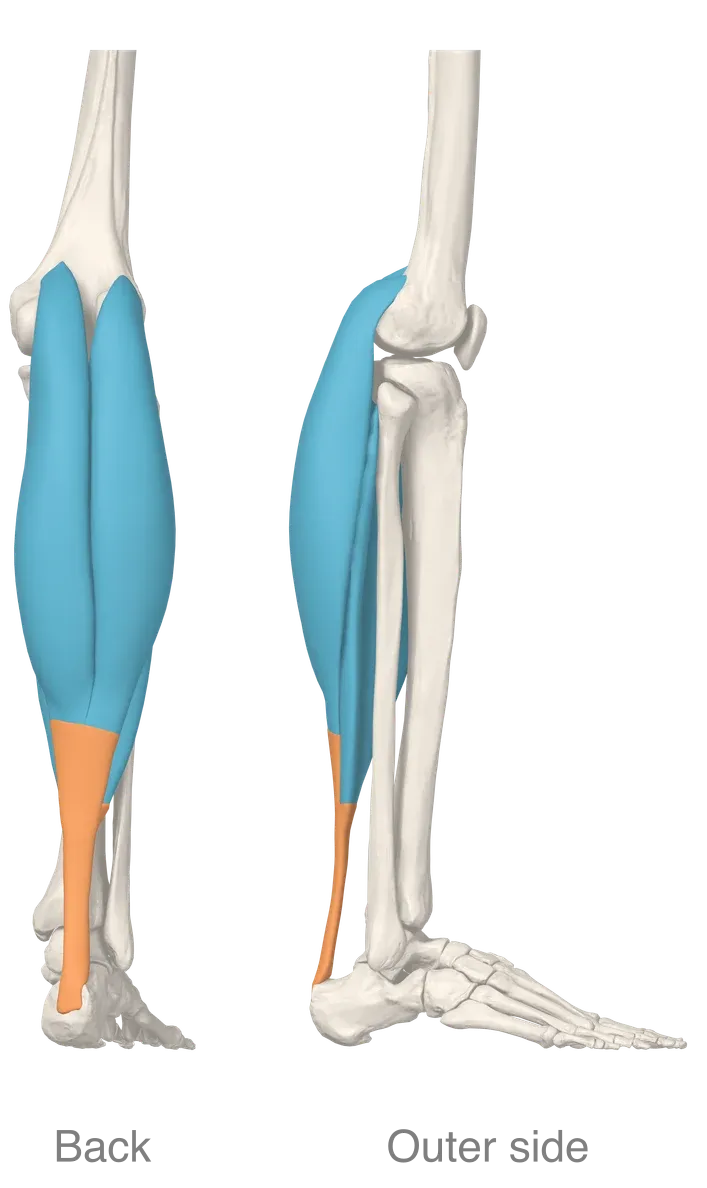
One narrative review, a summary written without a set, checkable search method, describes an acute rupture as a sudden tearing of the Achilles tendon1,2. Another groups sudden tears as a range: microtears, partial tears, interstitial tears inside the tendon, and complete ruptures1,2. The tendon joins the calf muscles to the calcaneus (heel bone), as the Achilles tendon page sets out3.
How it happens
A 2026 review says rupture most often affects active people in sports with sudden speeding up, slowing down or jumping4. It adds that rupture also occurs in inactive and ageing people4. A 2022 narrative review links running, jumping and agility work with a higher risk9. It names work with eccentric loading (muscle work while the muscle lengthens) and explosive plyometric efforts (stretch, then quick shortening, as in jumping)9.
A video study of ruptures in professional male football (soccer) players found they happened as players sped up10:
In those videos, the ankle was at the end of its dorsiflexion (foot pulled up toward the shin), at about 40 degrees10. Biopsies from 891 people with spontaneously ruptured tendons, mostly of the Achilles and biceps tendons, showed no healthy structure11. Of the changes found, 97% were degenerative (worn-down tissue), against degenerative changes in 34% of matched control tendons11.
How guidelines rate the evidence
A 2010 American Academy of Orthopaedic Surgeons guideline drew on systematic reviews (set, checkable searches of all the research)12. It graded none of its 16 recommendations as strong12. Most were graded inconclusive12. A 2026 guideline from a committee of 40 orthopaedic surgeons listed when to operate, timing, open or minimally invasive technique, and post-operative plans as disputed13.
Who it affects
How common it is
The Achilles tendon page sets out the rates4. In brief, a meta-analysis (a study pooling earlier results) of 28 population studies found 15.7 per 100,000 person-years (people times years followed)4. Rates peaked at ages 30 to 49 in males and 40 to 49 in females, and males had about three times the rate of females4. The yearly rise was about the same in males (4.5%) and females (4.6%)4. Men aged 30 to 49 more often tore it in basketball or soccer, while women over 50 more often tore it outside sport4.
A review of 532 studies found their participants averaged 81% male and 19% female, with the female share rising slowly over time14. Only 10.7% of those studies reported results by sex, which limited what could be said about females14.
Sport and everyday activity
| Group studied | What was found |
|---|---|
| 28 population studies, in a 2026 review4 | About 68% of ruptures linked to sport, especially ball and racquet sports4 |
| Competitive athletes, in the same review4 | The literature suggests only 4% to 18% of ruptures4 |
| US emergency departments, 2012 to 201615 | 81.9% during sport or recreation; basketball made up 42.6% of the sport-related ones15 |
The 2026 review found no standard definition of a sport-related rupture4.
Factors linked with it
A 2023 systematic review of 19 studies rated the evidence on risk factors as low to very low certainty16. The factors included steroids, quinolone antibiotics, Achilles tendinopathy, diabetes, earlier injury and regular athletic activity16. It could not extract data on movement or psychological factors16.
A meta-analysis of 15 observational studies, which watch without assigning groups, linked fluoroquinolone antibiotics with higher odds of rupture17. The odds ratio, how many times higher the odds were, was 2.5217. In public records of NBA players from 1958 to 2024, an earlier calf strain went with higher odds of rupture (odds ratio 2.49)18.
What studies found
How recovery runs over time
A 2022 narrative review concludes that healing probably lasts up to a year, perhaps more9. In the data it reviewed, the Achilles tendon Total Rupture Score reached only 82 of 100 at one year9. This is a score that people report themselves9. It did not noticeably improve after that9.
The same review reports the tendon can lengthen by 10 to 20 mm9. Different regimes after injury have not shown a significant cut in this lengthening9. It also reports side-to-side differences in calf muscle cross-sectional area (the size of a slice across the muscle) of 9% to 25% at 12 months9. Three to 13 years after, the differences were 11% to 15%, suggesting the loss may be permanent in some cases9. Single studies on the Achilles tendon page found calf deficits at seven years and a longer tendon 14 years after repair19,20.
A trial of management without surgery followed 37 people 4.5 years after the injury21. Their injured side reached 82.4% of the other side’s heel-raise height21. Heel-raise work reached 60%, and the mean rupture score was 80.521. A 2022 narrative review states that evidence on how best to restore function after a rupture is largely missing from the literature9.
Trials of surgery against no surgery
Trials compared repair by surgery, open or minimally invasive, with management without surgery5,22:
| Trial | Who | What was found |
|---|---|---|
| ACHILLES, Norway; funded by a regional health authority and a university hospital5 | 554 adults; no surgery, open or minimally invasive repair5 | Rupture score change at 12 months did not differ (−17.0, −16.0, −14.7)5. Re-rupture 6.2% without surgery, 0.6% in each surgery group; nerve injuries 0.6%, 2.8% and 5.2%5 |
| Canada22 | 144 people, mean age 40.4; both groups bore weight and moved the ankle early22 | Re-rupture in 2 after surgery and 3 without; no clinically important strength or motion difference; 13 against 6 complications22 |
| Finland: one trial, two reports23,24 | 60 people; surgery or no surgery23,24. Both arms had the same programme afterwards: a cast for 1 week, then a brace for 6, with full weight-bearing after week 123 | First report: at 18 months, 10% to 18% more calf strength after surgery, with similar performance scores23. Second report, on muscle size: injured soleus 24.8% smaller without surgery and 17.7% after it; tendons 19 mm longer without surgery24 |
| Long-term follow-up25 | 64 of 80 people, at a mean of 15.7 years25 | Scores on the SMFA, a function measure people report themselves, did not differ significantly25. Re-rupture rates did not differ significantly25 |
| CARTA, Denmark; funding included 100,000 euros from DJO Global26 | 300 adults; one arm chose surgery by ultrasound (a sound-wave scan) findings26 | No gain in heel-rise work at 12 months; re-rupture 3% in that arm against 11% without surgery26 |
What pooled studies found
Four pooled analyses compared surgery with no surgery6,7,8,27:
- A 2010 Cochrane review: in 6 trials, open surgery went with fewer re-ruptures (risk ratio, how many times as often: 0.41)6. It went with more other complications, including infection6. The review, done to Cochrane’s published standards, found results on function inconclusive and many trials poor in method6.
- A 2019 meta-analysis of 29 studies: re-rupture was 2.3% after surgery and 3.9% without, and complications 4.9% against 1.6%, mainly infection7. In studies with early motion, re-rupture did not differ significantly7.
- A 2025 meta-analysis of 14 randomised trials (1,628 people): both kinds of surgery had fewer re-ruptures, and only open surgery had more complications27. Function did not differ significantly27.
- A 2025 meta-analysis of 33 studies (35,896 people): surgery went with fewer re-ruptures and more return to sport, but more infections and nerve injuries8. The rupture score did not differ8.
The authors of the 33-study analysis rated re-rupture, return to sport and nerve injury as high certainty, and the rupture score as low8. They also noted that return to sport rested on few studies and people8. Over time, the 28-study incidence review found surgical repair rates peaked in 2003 and fell after, pointing to more care without surgery4. Comparing the two kinds of surgery, a 2018 meta-analysis of 8 trials found fewer complications and wound infections with minimally invasive repair28. It found no difference in re-rupture or return to activity, on mostly low-quality evidence28.
Casts, braces, movement and injections
Trials in people managed without surgery compared several approaches29,30,31,32:
- Cast or brace: in UKSTAR, 540 people at 39 UK hospitals wore a plaster cast or a brace for 8 weeks29. Its main measure, the rupture score at 9 months, did not differ (74.4 against 72.8)29. Re-rupture was 6% with the cast against 5% with the brace29.
- Early ankle movement: in one trial of 130 people, some moved the ankle five times daily in weeks 3 to 830. Others had 8 weeks of immobilisation (keeping a limb still)30. The movements showed no benefit30.
- Earlier weight-bearing: a meta-analysis of 9 trials (1,046 adults) found no significant difference from weight-bearing within 4 weeks or later31.
- Blood injection: in PATH-2, 230 adults had a platelet-rich plasma injection, part of their own blood prepared for injection, or a placebo (a dummy version)32. It did not improve muscle-tendon function or any other outcome32.
The UK’s National Institute for Health Research paid for UKSTAR, and a UK research programme paid for PATH-229,32. Neither funder had a role in design or analysis29,32. A 2025 network meta-analysis, comparing many options at once across 29 trials, found no one mix of approach and weight-bearing timing best on all outcomes33. Of newer options, such as nutraceuticals, biomaterials, cell therapies and anti-inflammatory drugs, the 2026 guideline states that no single approach has yet been shown to be the best way to speed or improve recovery13.
Return to sport
A 2016 meta-analysis of 108 studies (6,506 people) found 80% returned to play34. Its authors concluded the rate depends on how return is measured34. A 2025 review of 748 people after surgery found 77.4% returned to sport, at a mean of 8.1 months35.
In a review of 15 studies of professional NFL, NBA, MLB and soccer athletes, 76% returned to professional play, at a mean of 11 months36. Their performance fell compared with uninjured players36. In 62 NBA, NFL and MLB players after surgery, 30.6% did not return37. Those who did played less and worse at one year, but not at two, than matched players37.
Connections
The rupture is a tear of the Achilles tendon, made of fibres from the gastrocnemius and soleus1,2,38. The general case of this tissue is on the tendon page, which covers degeneration before rupture11.
One review describes the calf raise test as a way to assess the calf muscles and the Achilles tendon39. In 34 people about six years after a rupture, the injured leg showed large losses of ankle power in walking, jogging and one-legged hopping40. In jogging and one-legged hopping only, its knee took more load than the other leg’s40. A hopping exercise has its own page, pogo hops.
Achilles tendon rupture involves
Achilles tendon rupture has been measured in studies of
Achilles tendon rupture has been linked in one study with an earlier
Achilles tendon rupture has been studied alongside
Achilles tendon rupture is one kind of injury to
Achilles tendon rupture has been measured with the movement of
Achilles tendon rupture has lab studies of hopping after
Sources
- Wang CC, Chen PY, Yang KC, Wang CL, Chen IH (2024). Current treatment concepts for Achilles tendon rupture.. Tzu Chi Medical Journal. doi:10.4103/tcmj.tcmj_113_23 PMID 38406567
- Fenech M, Ajjikuttira A, Edwards H (2024). Ultrasound assessment of acute Achilles tendon rupture and measurement of the tendon gap.. Australasian Journal of Ultrasound in Medicine. doi:10.1002/ajum.12384 PMID 38784700
- Betts JG, Young KA, Wise JA, Johnson E, Poe B, Kruse DH, Korol O, Johnson JE, Womble M, DeSaix P (2022). Anatomy and Physiology 2e. OpenStax. Link
- Kotsifaki R, Malliaras P, Byron C, Marques J, Korakakis V (2026). Incidence, Temporal Trends, and Surgical Shift of Achilles Tendon Rupture: A Systematic Review and Meta-analysis.. Sports Medicine. doi:10.1007/s40279-026-02397-5 PMID 41933260
- Myhrvold SB, Brouwer EF, Andresen TKM, Rydevik K, Amundsen M, Grün W, Butt F, Valberg M, Ulstein S, Hoelsbrekken SE (2022). Nonoperative or Surgical Treatment of Acute Achilles' Tendon Rupture.. The New England Journal of Medicine. doi:10.1056/NEJMoa2108447 PMID 35417636
- Khan RJ, Carey Smith RL (2010). Surgical interventions for treating acute Achilles tendon ruptures.. The Cochrane Database of Systematic Reviews. doi:10.1002/14651858.CD003674.pub4 PMID 20824836
- Ochen Y, Beks RB, van Heijl M, Hietbrink F, Leenen LPH, van der Velde D, Heng M, van der Meijden O, Groenwold RHH, Houwert RM (2019). Operative treatment versus nonoperative treatment of Achilles tendon ruptures: systematic review and meta-analysis.. BMJ (Clinical research ed.). doi:10.1136/bmj.k5120 PMID 30617123
- Yang Z, Ge Z, Zheng J, Zhang L, Yang Z (2025). Surgical treatment versus conservative management for acute Achilles tendon rupture: a systematic review and meta-analysis.. Journal of Orthopaedic Surgery and Research. doi:10.1186/s13018-025-05990-y PMID 40629410
- Hoeffner R, Svensson RB, Bjerregaard N, Kjær M, Magnusson SP (2022). Persistent Deficits after an Achilles Tendon Rupture: A Narrative Review.. Translational Sports Medicine. doi:10.1155/2022/7445398 PMID 38655161
- Della Villa F, Buckthorpe M, Tosarelli F, Zago M, Zaffagnini S, Grassi A (2022). Video analysis of Achilles tendon rupture in male professional football (soccer) players: injury mechanisms, patterns and biomechanics.. BMJ Open Sport & Exercise Medicine. doi:10.1136/bmjsem-2022-001419 PMID 36172398
- Kannus P, Józsa L (1991). Histopathological changes preceding spontaneous rupture of a tendon. A controlled study of 891 patients.. The Journal of Bone and Joint Surgery. American Volume. doi:10.2106/00004623-199173100-00009 PMID 1748700
- Chiodo CP, Glazebrook M, Bluman EM, Cohen BE, Femino JE, Giza E, Watters WC 3rd, Goldberg MJ, Keith M, Haralson RH 3rd, Turkelson CM, Wies JL, Raymond L, Anderson S, Boyer K, Sluka P (2010). Diagnosis and treatment of acute Achilles tendon rupture.. The Journal of the American Academy of Orthopaedic Surgeons. doi:10.5435/00124635-201008000-00007 PMID 20675643
- Feng SM, Maffulli N, Oliva F, Paul C, Fehske K, Plaass C, Karius T, Saxena A, et al. (2026). Evidence-based clinical practice guidelines on the surgical management of acute Achilles tendon rupture.. British Medical Bulletin. doi:10.1093/bmb/ldaf026 PMID 41528729
- Potter MN, Mlecko J, Christensen M, Aufwerber S, Katz SE, Pohlig RT, Silbernagel KG (2026). Changes in sex distribution in Achilles tendon rupture literature over 74 years: A systematic review.. Knee Surgery, Sports Traumatology, Arthroscopy. doi:10.1002/ksa.70520 PMID 42405884
- Lemme NJ, Li NY, DeFroda SF, Kleiner J, Owens BD (2018). Epidemiology of Achilles Tendon Ruptures in the United States: Athletic and Nonathletic Injuries From 2012 to 2016.. Orthopaedic Journal of Sports Medicine. doi:10.1177/2325967118808238 PMID 30505872
- Xergia SA, Tsarbou C, Liveris NI, Hadjithoma M, Tzanetakou IP (2023). Risk factors for Achilles tendon rupture: an updated systematic review.. The Physician and Sportsmedicine. doi:10.1080/00913847.2022.2085505 PMID 35670156
- Alves C, Mendes D, Marques FB (2019). Fluoroquinolones and the risk of tendon injury: a systematic review and meta-analysis.. European Journal of Clinical Pharmacology. doi:10.1007/s00228-019-02713-1 PMID 31270563
- Elsabbagh Z, Le Y, Bcharah G, Ryu D, Badin D, Hsu NN, Thompson JM, Aiyer A (2026). Prior Calf Strain as a Risk Factor for Achilles Tendon Rupture in National Basketball Association Players: A Retrospective Analysis.. Orthopaedic journal of sports medicine. doi:10.1177/23259671261449170 PMID 42293040
- Brorsson A, Grävare Silbernagel K, Olsson N, Nilsson Helander K (2018). Calf Muscle Performance Deficits Remain 7 Years After an Achilles Tendon Rupture.. The American Journal of Sports Medicine. doi:10.1177/0363546517737055 PMID 29068725
- Heikkinen J, Lantto I, Piilonen J, Flinkkilä T, Ohtonen P, Siira P, Laine V, Niinimäki J, Pajala A, Leppilahti J (2017). Tendon Length, Calf Muscle Atrophy, and Strength Deficit After Acute Achilles Tendon Rupture. The Journal of Bone and Joint Surgery. American Volume. doi:10.2106/JBJS.16.01491 PMID 28926379
- Kastoft R, Bencke J, Speedtsberg MB, Penny JO, Barfod K (2019). Early weight-bearing in nonoperative treatment of acute Achilles tendon rupture did not influence mid-term outcome: a blinded, randomised controlled trial.. Knee Surgery, Sports Traumatology, Arthroscopy. doi:10.1007/s00167-018-5058-4 PMID 30030579
- Willits K, Amendola A, Bryant D, Mohtadi NG, Giffin JR, Fowler P, Kean CO, Kirkley A (2010). Operative versus nonoperative treatment of acute Achilles tendon ruptures: a multicenter randomized trial using accelerated functional rehabilitation.. The Journal of Bone and Joint Surgery. American volume. doi:10.2106/JBJS.I.01401 PMID 21037028
- Lantto I, Heikkinen J, Flinkkila T, Ohtonen P, Siira P, Laine V, Leppilahti J (2016). A Prospective Randomized Trial Comparing Surgical and Nonsurgical Treatments of Acute Achilles Tendon Ruptures.. The American Journal of Sports Medicine. doi:10.1177/0363546516651060 PMID 27307495
- Heikkinen J, Lantto I, Flinkkila T, Ohtonen P, Niinimaki J, Siira P, Laine V, Leppilahti J (2017). Soleus Atrophy Is Common After the Nonsurgical Treatment of Acute Achilles Tendon Ruptures: A Randomized Clinical Trial Comparing Surgical and Nonsurgical Functional Treatments.. The American Journal of Sports Medicine. doi:10.1177/0363546517694610 PMID 28282504
- Maempel JF, Clement ND, Wickramasinghe NR, Duckworth AD, Keating JF (2020). Operative repair of acute Achilles tendon rupture does not give superior patient-reported outcomes to nonoperative management.. The Bone & Joint Journal. doi:10.1302/0301-620X.102B7.BJJ-2019-0783.R3 PMID 32600149
- Toft M, Hansen MS, Vestergaard JD, Jenlar J, Pramming AK, Moller S, Nedergaard BSK, Kristensen MT, Simonsen LL, Viberg B, Holmich P, Barfod KW (2026). Randomised three-armed trial investigation of the Copenhagen Achilles tendon Rupture Treatment Algorithm (CARTA) for individualised treatment of acute Achilles tendon rupture.. British Journal of Sports Medicine. doi:10.1136/bjsports-2025-110210 PMID 42082321
- Xu S, Xiao J, Li Y, Liu E, Qin Y, Shen X (2025). Operative versus nonoperative management of acute Achilles tendon rupture: a systematic review and meta-analysis of clinical outcomes from randomized controlled trials.. Annals of Medicine. doi:10.1080/07853890.2025.2537349 PMID 41243574
- Grassi A, Amendola A, Samuelsson K, Svantesson E, Romagnoli M, Bondi A, Mosca M, Zaffagnini S (2018). Minimally Invasive Versus Open Repair for Acute Achilles Tendon Rupture: Meta-Analysis Showing Reduced Complications, with Similar Outcomes, After Minimally Invasive Surgery.. The Journal of Bone and Joint Surgery. American volume. doi:10.2106/JBJS.17.01364 PMID 30480601
- Costa ML, Achten J, Marian IR, Dutton SJ, Lamb SE, Ollivere B, Maredza M, Petrou S, Kearney RS (2020). Plaster cast versus functional brace for non-surgical treatment of Achilles tendon rupture (UKSTAR): a multicentre randomised controlled trial and economic evaluation.. Lancet (London, England). doi:10.1016/S0140-6736(19)32942-3 PMID 32035553
- Barfod KW, Hansen MS, Holmich P, Kristensen MT, Troelsen A (2020). Efficacy of early controlled motion of the ankle compared with immobilisation in non-operative treatment of patients with an acute Achilles tendon rupture: an assessor-blinded, randomised controlled trial.. British Journal of Sports Medicine. doi:10.1136/bjsports-2019-100709 PMID 31597624
- Ghaddaf AA, Alomari MS, Alsharef JF, Alakkas E, Alshehri MS (2022). Early versus late weightbearing in conservative management of acute achilles tendon rupture: A systematic review and meta-analysis of randomized controlled trials.. Injury. doi:10.1016/j.injury.2022.01.028 PMID 35115168
- Keene DJ, Alsousou J, Harrison P, Hulley P, Wagland S, Parsons SR, Thompson JY, O'Connor HM, Schlussel MM, Dutton SJ, Lamb SE, Willett K (2019). Platelet rich plasma injection for acute Achilles tendon rupture: PATH-2 randomised, placebo controlled, superiority trial.. BMJ (Clinical research ed.). doi:10.1136/bmj.l6132 PMID 31748208
- Irfan SA, Ahmed S, Ashkar A, Heyes G, Khan MW, Ahsan Nawaz SM, Siddiqui AA, Mustafa H (2025). Comparative effectiveness of weight-bearing strategies on functional recovery in acute Achilles tendon rupture: A network meta-analysis.. Foot and Ankle Surgery. doi:10.1016/j.fas.2025.02.013 PMID 40057392
- Zellers JA, Carmont MR, Grävare Silbernagel K (2016). Return to play post-Achilles tendon rupture: a systematic review and meta-analysis of rate and measures of return to play.. British Journal of Sports Medicine. doi:10.1136/bjsports-2016-096106 PMID 27259751
- Cofano E, Colace S, Piro F, Longo UG, D'Hooghe P, Kennedy JG, Marangon A, Gasparini G, Mercurio M (2025). Successful functional outcomes and return to sport rate can be achieved after surgery for acute Achilles tendon rupture: A systematic review.. Journal of Experimental Orthopaedics. doi:10.1002/jeo2.70469 PMID 41164319
- Johns W, Walley KC, Seedat R, Thordarson DB, Jackson B, Gonzalez T (2021). Career Outlook and Performance of Professional Athletes After Achilles Tendon Rupture: A Systematic Review.. Foot & Ankle International. doi:10.1177/1071100720969633 PMID 33218267
- Trofa DP, Miller JC, Jang ES, Woode DR, Greisberg JK, Vosseller JT (2017). Professional Athletes' Return to Play and Performance After Operative Repair of an Achilles Tendon Rupture.. The American Journal of Sports Medicine. doi:10.1177/0363546517713001 PMID 28644678
- Pękala PA, Henry BM, Ochała A, Kopacz P, Tatoń G, Młyniec A, Walocha JA, Tomaszewski KA (2017). The twisted structure of the Achilles tendon unraveled: A detailed quantitative and qualitative anatomical investigation.. Scandinavian Journal of Medicine & Science in Sports. doi:10.1111/sms.12835 PMID 28139009
- Hébert-Losier K, Schneiders AG, Newsham-West RJ, Sullivan SJ (2009). Scientific bases and clinical utilisation of the calf-raise test.. Physical Therapy in Sport. doi:10.1016/j.ptsp.2009.07.001 PMID 19897168
- Willy RW, Brorsson A, Powell HC, Willson JD, Tranberg R, Grävare Silbernagel K (2017). Elevated Knee Joint Kinetics and Reduced Ankle Kinetics Are Present During Jogging and Hopping After Achilles Tendon Ruptures.. The American journal of sports medicine. doi:10.1177/0363546516685055 PMID 28186834
Changes
- First published.