Chronic exertional compartment syndrome
Also called CECS, exertional compartment syndrome, chronic compartment syndrome
Exercise pain and tightness in a muscle compartment of the leg or forearm that eases after stopping. How reviews define it, the debate over pressure tests, who studies include, and what studies of surgery and running-style programmes found.
- Region
- Lower leg
- Muscles
- tibialis anterior, peroneus longus, peroneus brevis, soleus, gastrocnemius, tibialis posterior
- Updated
- October 22, 2026
- Reviewed
- October 22, 2026 · how entries are checked
What it is
How reviews and a consensus define it
A 2022 expert consensus calls it a disabling overuse injury of the muscle compartments of the arms or legs1. It describes muscle pain with a feeling of pressure or tightness during repeated movement, easing once the activity stops1. A 2020 review defines it as a short-lived rise in compartment pressure during activity8. In that account the fascia, a sheet of tough connective tissue, fails to make room for the rise, and pain follows8.
The 2022 panel of 27 civilian and military clinicians agreed on five features that make it likely1. Two are pain and tightness, each during exercise1.
Why the cause is still argued over
The symptoms are thought to come from a reversible rise in pressure, as swelling muscle expands inside fascia that gives little1. The 2022 consensus paper notes growing evidence that the condition has several causes and is more than a passing pressure rise1. A 2026 review by two authors of that consensus says it has long been seen as a problem of blood flow1,9. The review adds that this remains unproven9.
The four compartments of the leg
The lower leg has four compartments10.
- Anterior (front): the tibialis anterior, peroneus tertius, extensor digitorum longus and extensor hallucis longus11.
- Lateral (outer side): the fibularis longus and fibularis brevis muscles, with nerves and branches of two arteries10.
- Superficial posterior (back, outer layer): the soleus, gastrocnemius and plantaris12.
- Deep posterior (back, deep layer): the tibialis posterior, popliteus and two toe-bending muscles, the flexor hallucis longus and flexor digitorum longus12.
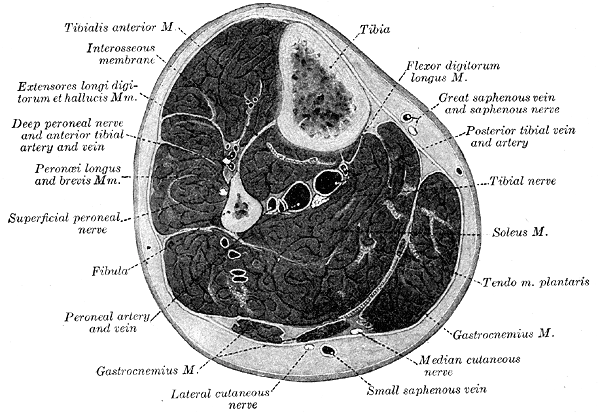
The 2022 consensus paper says the condition is found mostly in the anterior compartment1. A 2016 systematic review of 1,596 people who had surgery counted which compartments were involved13.
| Compartment | Share of involvement, 2016 review |
|---|---|
| Anterior | 51%13 |
| Lateral | 33%13 |
| Deep posterior | 13%13 |
| Superficial posterior | 3%13 |
A 2020 review lists conditions considered alongside this one when exercise brings on leg pain8. Among them are muscle strain, medial tibial stress syndrome and stress fracture, a small crack in a bone from repeated loading8. “Shin splints” is one of the two most common names for medial tibial stress syndrome14.
What pressure tests show, and why they are debated
In a 2024 review of 29 studies, 24 identified it with static monitors of compartment pressure15. Pressure is given in mmHg (millimetres of mercury). A 1990 study of 131 people with exercise leg pain proposed three cutoffs, any one of which, with fitting clinical findings, points to it16. They were at least 15 mmHg before exercise, 30 mmHg one minute after, or 20 mmHg five minutes after16.
Later reviews questioned the commonly used cutoffs4,9:
- A 2012 review of 32 studies found the evidence for them weak and judged them unreliable4. One minute after exercise was the only time point where average pressures in patients and controls (a comparison group without the condition) did not overlap4. Patients ranged from 34 to 55.4 mmHg and controls from 9 to 19 mmHg4. The authors suggested that values above 27.5 mmHg, with a good history, be regarded as highly suggestive4.
- A second 2012 review, of 38 studies, found that the common cutoffs overlap the pressures seen in healthy people5. Relaxation pressure was the exception5.
- A 2026 review by two authors of the 2022 consensus says the value of pressure testing remains highly debated, with cutoffs lacking robust checks1,9.
A 2015 study measured pressure during exercise in 40 men exercising on a treadmill with a 15-kg load17. Twenty had symptoms in the anterior compartment and 20 had no symptoms17.
Test sensitivity is the share of people with a condition whom a test picks out. Test specificity is the share without it whom the test rules out. Measured during exercise, pressure gave 63% sensitivity and 95% specificity, higher than existing criteria17. The authors found a cutoff of 105 mmHg during exercise more accurate than the 1990 cutoffs17.
A 2023 review covered 28 studies of tests other than pressure, including MRI (a scan that shows soft tissue in detail)18. It reported promising results but no high-quality checks18.
Who it affects
How common it is
The 2022 consensus paper states that no reliable rates of new or existing cases are available1. A 2023 review says incidence, the number of new cases over a set time, is still unknown in the general population19. A 2024 review links the uncertain prevalence to people managing it alone or changing activity, errors in recognising it, and not seeking care2. A 2023 scoping review of nine causes of exercise leg pain says how common they are is not clear, and calls for better studies20.
Two reviews instead give its share of exercise leg pain2,19:
- A 2023 review, citing earlier work, puts it second after medial tibial stress syndrome, at 27% to 33%19.
- A 2024 review estimates that 14% to 34% of exertion leg pain referred to orthopaedic care fits the condition2.
The counts of new cases found here come from US military records3,21. Among US active service members from 2006 to 2011, there were 0.49 cases per 1,000 person-years3. Person-years are people multiplied by the years each was followed. Higher risk went with being older, female or white, holding a junior enlisted rank, and serving in the Army3. A 2024 study of 1,103,417 US military entrants counted 1,947 people with the condition in the lower limb21.
Who appears in the studies
| Group studied | What was found |
|---|---|
| 1,596 people who had surgery, in a 2016 review of 24 studies | Mean age 26.6, 70% men; 54% military members and 29% athletes, most of them recreational13 |
| Patients in a 2024 review of 41 studies | 51% female22 |
| 1,411 people assessed for exercise leg pain at a referral centre, 2018 study | 698 had the condition; it peaked around age 20 to 25; running and skating were among its predictors23 |
| 698 patients at Máxima Medical Center, Veldhoven, in a 2018 study | About 1 in 7 were aged 50 or older, mostly with anterior involvement24 |
| 155 patients aged 18 or under who had surgery, at one hospital | 88% female; running, soccer and field hockey were the commonest main sports25 |
The forearm form
The forearm form is described as rare in the general population but seen in motorcycle racers, climbers and rowers26. A 2025 review of 590 patients with it found 505 were men27.
What studies found
How the evidence stands
A 2020 review of outcomes in any lower-leg compartment found no randomised controlled trials, which assign people to groups by chance6. Another 2020 review found no agreed best approach and no established international guidelines28. That review, of 14 mostly retrospective studies, found too little evidence to favour surgery or non-surgical care over the other28. The 2022 consensus panel reached no agreement on what pressure values add, or on the preferred approach when symptoms persist or return1.
Without surgery
In 12 military men who did not have surgery, each still had typical complaints after a mean of 50 months29. In 16 of their 21 legs, pressure was still at or above the 35 mmHg cutoff29.
A 2016 review of non-surgical options for the leg found seven articles, each a case series or a case report30. A case series reports on patients with no comparison group. Several studies have tested changes to running style, a form of gait retraining (changing how a person walks or runs)31,32:
- In a case series of 10 candidates for surgery, 6 weeks of forefoot-landing training was followed by lower post-run pressure and longer running distance31. No patient needed surgery over one year of follow-up31.
- In 19 people, a 6-week forefoot running programme was followed by 36% lower post-run pressure, with no significant difference between centre and home settings33.
- Of 75 Dutch military patients eligible for surgery, 65% initially returned to duty without it after a gait retraining programme32. About two years later, 57% of those who answered a survey were still on duty without surgery32.
- A study took 108 Dutch military members with chronic exercise leg pain who completed gait retraining and met its criteria34. Of these, 69% returned to duty, and anterior pressure was not linked with outcome34.
Botulinum toxin is a drug that weakens or relaxes a muscle it is injected into. In a case series of 16 people with front or front-outer leg symptoms, exertional pain went away after injection in 1535. The injected muscles lost some strength in 11, without loss of function, the authors report, over up to 9 months35. In a retrospective study of another 16, with the arm or leg affected, 11 reported early benefit, but symptoms often returned36.
Surgery compared with non-surgical care
Fasciotomy is surgery that cuts through fascia. The studies comparing it with non-surgical care are not randomised trials. They are summarised below6,37:
- A 2020 review of 68 reports found 85% satisfaction and 80% return to activity after fasciotomy, against 47% and 50% without it6. Its studies were few and low-level6.
- The same review found return to activity more often after surgery, except in one study of army personnel that favoured gait retraining6.
- A 2024 meta-analysis of four cohort studies found more pain relief and higher satisfaction after fasciotomy37. Return to activity did not differ significantly, and results for it varied widely between studies37.
- In one cohort followed for at least two years, 81% of 73 people rated fasciotomy a success38. Of 27 who continued non-surgical care, 41% rated it a success38. Pressure values did not correlate with outcome38.
Results after surgery
A 2016 review found first surgery on the leg succeeded in about two-thirds of patients, and 84% were satisfied, at short- to mid-term follow-up13. A 2020 review lists the harms reported28:
- haematoma (a pocket of blood in tissue), 2.7% to 22.5%28;
- nerve injury, 2.0% to 18.6%28;
- deep vein thrombosis (a blood clot in a deep vein), 2.7%28;
- symptoms returning, 0.65% to 8.4%, with up to 10.4% needing a repeat operation28.
For the deep posterior compartment, a 2014 review of 131 patients found success rates of 30% to 65%39. A 2020 review found more complications and recurrences in military than in civilian patients6.
How much fascia to open is also unsettled. A 2022 review of 7 studies of athletes and military personnel found two- and four-compartment fasciotomy about equally successful40. Yet each study had a high risk of bias40. A 2016 review states that open surgery is the main technique, and that how it compares with endoscopic (keyhole) methods is not known13.
A randomised trial of two cutting tools
A 2021 trial gave 50 people with anterior symptoms in both legs a different fasciotome, the cutting tool, on each leg7. Patients did not know which leg had which device, but the surgeons did7. The devices did not differ in complications or symptom relief7. The authors had developed one of them, FascioMax (van Straten Medical), and declared no conflicts of interest7. They note that small differences may have been missed7.
Connections
In the leg, the condition is most often found in the compartment of the tibialis anterior1,41. The lateral compartment holds the peroneals10. The back compartments hold the soleus, the gastrocnemius and the tibialis posterior12. The 2022 consensus account places swelling muscle inside fascia that gives little1.
Medial tibial stress syndrome, commonly called “shin splints”, is one condition considered alongside this one8,14. In a 1982 study of 12 patients with it, pressures in the back compartments were not raised42. Those authors concluded it is not a compartment syndrome42.
Running was among the predictors at the referral centre, and among the commonest sports in the under-18 surgical series23,25. The forearm form involves compartments usually described as superficial volar, deep volar, lateral and dorsal26. Volar means on the palm side. The forearm flexors and forearm extensors pages cover it more fully26.
Chronic exertional compartment syndrome involves the compartment of
Chronic exertional compartment syndrome involves
Chronic exertional compartment syndrome also occurs in the compartments of
Chronic exertional compartment syndrome is compared with
Chronic exertional compartment syndrome is common in
Sources
- Vogels S, Ritchie ED, van der Burg BLSB, Scheltinga MRM, Zimmermann WO, Hoencamp R (2022). Clinical Consensus on Diagnosis and Treatment of Patients with Chronic Exertional Compartment Syndrome of the Leg: A Delphi Analysis. Sports medicine (Auckland, N.Z.). doi:10.1007/s40279-022-01729-5 PMID 35904751
- Jorge PB, Toledo MB, Mari FC, Toledo RRF, Lima MV, Sprey JWC (2024). Chronic Compartment Syndrome in Athletes. Revista brasileira de ortopedia. PMID 39649060
- Waterman BR, Liu J, Newcomb R, Schoenfeld AJ, Orr JD, Belmont PJ Jr (2013). Risk factors for chronic exertional compartment syndrome in a physically active military population. The American journal of sports medicine. doi:10.1177/0363546513497922 PMID 23911700
- Aweid O, Del Buono A, Malliaras P, Iqbal H, Morrissey D, Maffulli N, Padhiar N (2012). Systematic review and recommendations for intracompartmental pressure monitoring in diagnosing chronic exertional compartment syndrome of the leg. Clinical journal of sport medicine : official journal of the Canadian Academy of Sport Medicine. doi:10.1097/JSM.0b013e3182580e1d PMID 22627653
- Roberts A, Franklyn-Miller A (2012). The validity of the diagnostic criteria used in chronic exertional compartment syndrome: a systematic review. Scandinavian journal of medicine & science in sports. doi:10.1111/j.1600-0838.2011.01386.x PMID 22092446
- Vogels S, Ritchie ED, van Dongen TTCF, Scheltinga MRM, Zimmermann WO, Hoencamp R (2020). Systematic review of outcome parameters following treatment of chronic exertional compartment syndrome in the lower leg. Scandinavian journal of medicine & science in sports. doi:10.1111/sms.13747 PMID 32526086
- de Bruijn JA, van Zantvoort APM, Hundscheid HPH, Hoogeveen AR, van Eerten P, Teijink JAW, Scheltinga MR (2021). Comparison of 2 Fasciotomes for Treatment of Patients With Chronic Exertional Compartment Syndrome of the Anterior Leg. Orthopaedic journal of sports medicine. doi:10.1177/23259671211051358 PMID 34888390
- Nwakibu U, Schwarzman G, Zimmermann WO, Hutchinson MR (2020). Chronic Exertional Compartment Syndrome of the Leg Management Is Changing: Where Are We and Where Are We Going?. Current sports medicine reports. doi:10.1249/JSR.0000000000000762 PMID 33031210
- Vogels S, Zimmermann WO (2026). Diagnostic and therapeutic dilemmas in chronic exertional compartment syndrome. British medical bulletin. doi:10.1093/bmb/ldag020 PMID 42478572
- Khan IA, Mahabadi N, D'Abarno A, Varacallo MA (2023). Anatomy, Bony Pelvis and Lower Limb: Leg Lateral Compartment.. StatPearls. PMID 30137811
- Van den Bergh FR, Vanhoenacker FM, De Smet E, Huysse W, Verstraete KL (2013). Peroneal nerve: Normal anatomy and pathologic findings on routine MRI of the knee. Insights into imaging. doi:10.1007/s13244-013-0255-7 PMID 23709403
- Abuqubo R, Graefe SB, La Rose J (2026). Anatomy, Bony Pelvis and Lower Limb: Leg Posterior Compartment.. StatPearls. PMID 30726025
- Campano D, Robaina JA, Kusnezov N, Dunn JC, Waterman BR (2016). Surgical Management for Chronic Exertional Compartment Syndrome of the Leg: A Systematic Review of the Literature. Arthroscopy : the journal of arthroscopic & related surgery : official publication of the Arthroscopy Association of North America and the International Arthroscopy Association. doi:10.1016/j.arthro.2016.01.069 PMID 27020462
- Anderson LM, Warden SJ, Willy RW, Bonanno DR, Menz HB (2025). Medial Tibial Stress Syndrome Needs a New Name-Make No Bones About It. The Journal of orthopaedic and sports physical therapy. doi:10.2519/jospt.2025.13411 PMID 40985462
- Dean RS, Farley KX, Waterman BR, Guettler J, Bicos J (2024). Chronic exertional compartment syndrome is frequently diagnosed through static compartment pressure measurements and managed with fasciotomy: A systematic review. Journal of ISAKOS : joint disorders & orthopaedic sports medicine. doi:10.1016/j.jisako.2023.09.005 PMID 37778507
- Pedowitz RA, Hargens AR, Mubarak SJ, Gershuni DH (1990). Modified criteria for the objective diagnosis of chronic compartment syndrome of the leg. The American journal of sports medicine. doi:10.1177/036354659001800106 PMID 2301689
- Roscoe D, Roberts AJ, Hulse D (2015). Intramuscular compartment pressure measurement in chronic exertional compartment syndrome: new and improved diagnostic criteria. The American journal of sports medicine. doi:10.1177/0363546514555970 PMID 25406302
- Ritchie ED, Vogels S, van Dongen TTCF, van der Burg BLSB, Scheltinga MRM, Zimmermann WO, Hoencamp R (2023). Systematic Review of Innovative Diagnostic Tests for Chronic Exertional Compartment Syndrome. International journal of sports medicine. doi:10.1055/a-1866-5957 PMID 35649437
- Tarabishi MM, Almigdad A, Almonaie S, Farr S, Mansfield C (2023). Chronic Exertional Compartment Syndrome in Athletes: An Overview of the Current Literature. Cureus. doi:10.7759/cureus.47797 PMID 38022185
- Bosnina F, Padhiar N, Miller S, Girotra K, Massoura C, Morrissey D (2023). Developing a diagnostic framework for patients presenting with Exercise Induced Leg Pain (EILP): a scoping review. Journal of foot and ankle research. doi:10.1186/s13047-023-00680-6 PMID 37990284
- Nelson DA, Kazman JB, Nelson K, Edgeworth DB, Lindow MF, Emanuele P, Clifton DR, Choi YS, Shell D, Deuster PA (2024). Fasciotomy and Occupational Separation among US Service Members with Lower Extremity Chronic Exertional Compartment Syndrome. Medicine and science in sports and exercise. doi:10.1249/MSS.0000000000003471 PMID 39143675
- Rothman R, Berke C, Jivanelli B, Casey E, Cheng J (2024). Sex and gender differences in lower limb chronic exertional compartment syndrome: a systematic review. The Physician and sportsmedicine. doi:10.1080/00913847.2023.2173489 PMID 36698053
- de Bruijn JA, van Zantvoort APM, van Klaveren D, Winkes MB, van der Cruijsen-Raaijmakers M, Hoogeveen AR, Teijink JAW, Scheltinga MR (2018). Factors Predicting Lower Leg Chronic Exertional Compartment Syndrome in a Large Population. International journal of sports medicine. doi:10.1055/s-0043-119225 PMID 29126337
- de Bruijn JA, van Zantvoort APM, Winkes MB, van der Cruijsen-Raaijmakers M, Hoogeveen AR, Teijink JAW, Scheltinga MRM (2018). Lower Leg Chronic Exertional Compartment Syndrome in Patients 50 Years of Age and Older. Orthopaedic journal of sports medicine. doi:10.1177/2325967118757179 PMID 29531960
- Beck JJ, Tepolt FA, Miller PE, Micheli LJ, Kocher MS (2016). Surgical Treatment of Chronic Exertional Compartment Syndrome in Pediatric Patients. The American journal of sports medicine. doi:10.1177/0363546516651830 PMID 27365374
- Smeraglia F, Tamborini F, Garutti L, Minini A, Basso MA, Cherubino M (2021). Chronic exertional compartment syndrome of the forearm: a systematic review. EFORT Open Reviews. doi:10.1302/2058-5241.6.200107 PMID 33828852
- Hirardot T, Pomares G, Menu P, Grondin J, Dauty M, Fouasson-Chailloux A (2025). Diagnostic criteria of forearm Chronic Exertional Compartment Syndrome: A systematic review. Orthopaedics & Traumatology: Surgery & Research. doi:10.1016/j.otsr.2024.104001 PMID 39313023
- Ding A, Machin M, Onida S, Davies AH (2020). A systematic review of fasciotomy in chronic exertional compartment syndrome. Journal of vascular surgery. doi:10.1016/j.jvs.2020.05.030 PMID 32473344
- Van der Wal WA, Heesterbeek PJ, Van den Brand JG, Verleisdonk EJ (2015). The natural course of chronic exertional compartment syndrome of the lower leg. Knee surgery, sports traumatology, arthroscopy : official journal of the ESSKA. doi:10.1007/s00167-014-2847-2 PMID 24474581
- Rajasekaran S, Hall MM (2016). Nonoperative Management of Chronic Exertional Compartment Syndrome: A Systematic Review. Current sports medicine reports. doi:10.1249/JSR.0000000000000261 PMID 27172084
- Diebal AR, Gregory R, Alitz C, Gerber JP (2012). Forefoot running improves pain and disability associated with chronic exertional compartment syndrome. The American journal of sports medicine. doi:10.1177/0363546512439182 PMID 22427621
- Zimmermann WO, Hutchinson MR, Van den Berg R, Hoencamp R, Backx FJG, Bakker EWP (2019). Conservative treatment of anterior chronic exertional compartment syndrome in the military, with a mid-term follow-up. BMJ open sport & exercise medicine. doi:10.1136/bmjsem-2019-000532 PMID 31191976
- Helmhout PH, Diebal AR, van der Kaaden L, Harts CC, Beutler A, Zimmermann WO (2015). The Effectiveness of a 6-Week Intervention Program Aimed at Modifying Running Style in Patients With Chronic Exertional Compartment Syndrome: Results From a Series of Case Studies. Orthopaedic journal of sports medicine. doi:10.1177/2325967115575691 PMID 26665032
- Vogels S, Bakker EWP, O'Connor FG, Hoencamp R, Zimmermann WO (2022). Association Between Intracompartmental Pressures in the Anterior Compartment of the Leg and Conservative Treatment Outcome for Exercise-Related Leg Pain in Military Service Members. Archives of rehabilitation research and clinical translation. doi:10.1016/j.arrct.2021.100171 PMID 35282146
- Isner-Horobeti ME, Dufour SP, Blaes C, Lecocq J (2013). Intramuscular pressure before and after botulinum toxin in chronic exertional compartment syndrome of the leg: a preliminary study. The American journal of sports medicine. doi:10.1177/0363546513499183 PMID 23969633
- Charvin M, Orta C, Davy L, Raumel MA, Petit J, Casillas JM, Gremeaux V, Gouteron A (2022). Botulinum Toxin A for Chronic Exertional Compartment Syndrome: A Retrospective Study of 16 Upper- and Lower-Limb Cases. Clinical journal of sport medicine : official journal of the Canadian Academy of Sport Medicine. doi:10.1097/JSM.0000000000000958 PMID 34282061
- Elsenosy AM, Elnewishy A, Hassan E, Delewar RA (2024). Outcomes of Fasciotomy Versus Conservative Management for Chronic Exertional Compartment Syndrome: A Systematic Review and Meta-Analysis. Cureus. doi:10.7759/cureus.75803 PMID 39759644
- Packer JD, Day MS, Nguyen JT, Hobart SJ, Hannafin JA, Metzl JD (2013). Functional outcomes and patient satisfaction after fasciotomy for chronic exertional compartment syndrome. The American journal of sports medicine. doi:10.1177/0363546512471330 PMID 23371941
- Winkes MB, Hoogeveen AR, Scheltinga MR (2014). Is surgery effective for deep posterior compartment syndrome of the leg? A systematic review. British journal of sports medicine. doi:10.1136/bjsports-2013-092518 PMID 24065078
- Weiss C, Vogels S, Wee L, Janssen L, de Bie RA, Scheltinga MR (2022). Two-Compartment or 4-Compartment Fasciotomy for Lower Leg Chronic Exertional Compartment Syndrome: A Systematic Review. The Journal of foot and ankle surgery : official publication of the American College of Foot and Ankle Surgeons. doi:10.1053/j.jfas.2022.02.011 PMID 35337738
- Juneja P, Hubbard JB (2023). Anatomy, Bony Pelvis and Lower Limb: Tibialis Anterior Muscles.. StatPearls. PMID 30020676
- Mubarak SJ, Gould RN, Lee YF, Schmidt DA, Hargens AR (1982). The medial tibial stress syndrome. The American journal of sports medicine. doi:10.1177/036354658201000402 PMID 7125040
Changes
- First published.