Growth-plate injuries
Also called growth plate injuries, growth plate fracture, growth plate fractures, physeal fracture, physeal fractures, physeal injury, physeal injuries, Salter-Harris fracture, growth plate stress injury
Sudden fractures and stress injuries of the growth plates in children's bones. How reviews describe them, how often studies found them, how often growth was disturbed, and what reviews say about youth weight training.
- Region
- Across the body
- Updated
- October 15, 2026
- Reviewed
- October 15, 2026 · how entries are checked
What it is
Where the growth plate sits
Long bones grow in length at the growth plate, a layer of cartilage that is replaced by bone at about 18 to 21 years8. A 2006 systematic review of growth-plate injuries in young athletes calls the plate the physis1. It places it between the epiphysis (the bone’s end) and the metaphysis (the flared part of the shaft)1.
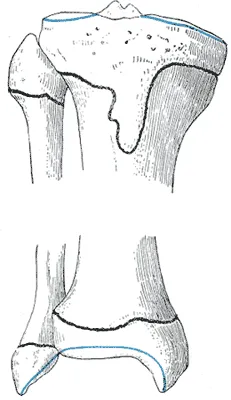
A 2016 review explains that Salter and Harris described two kinds of growth plate9. Pressure plates sit at the ends of long bones, inside joints, bear weight and give growth in length9. Traction plates, or apophyses, sit where muscles attach, outside joints, and give growth in width9. Overuse problems of apophyses, such as Osgood-Schlatter disease and Sever’s disease, are common in young athletes and have their own pages1.
Why the plate is a weak point
The 2006 review notes that growth-plate cartilage resists stress less than adult joint cartilage1. It also resists shear and tension less than the bone beside it1. Forces that might tear a ligament in an adult can therefore injure the growth plate instead1.
The 2016 review explains that Salter and Harris found fractures typically run through one weak layer of the plate9. Later tissue studies found that injuries commonly cross several layers, depending on the forces involved9. That is why, the review says, type II fractures can stop growth, though in theory they spare the growing cells9.
Two ways the plate is hurt in sport
The 2006 review found both sudden (acute) injuries and stress injuries1. The same review describes the stress injury as seeming to come from repeated loading1. The loading changes blood flow on the shaft side and gets in the way of cartilage hardening, so the plate widens1. The widening is usually temporary, but in some cases growth becomes uneven, slows, stops, or the plate closes early1.
The Salter-Harris types
A 2016 review states that the 1963 Salter-Harris classification of growth-plate fractures remains the most widely used9. It sorts fractures into five types9:
| Type | Path of the break | What reviews note |
|---|---|---|
| I | Straight through the growth plate, separating the bone end9 | A 2024 review describes Little League shoulder as a type I stress fracture10 |
| II | Along the plate, then out through the shaft side9 | The most common type, 74% of growth-plate fractures9 |
| III | Along the plate, then out through the bone end9 | Runs into the joint; arthritis after injury is possible besides growth arrest9 |
| IV | Across the plate, from shaft side to bone end9 | A bony bar, a bridge of bone across the plate, can form if it heals out of line, with uneven growth9 |
| V | A crush injury of the plate9 | Rare, and some authors question whether it exists9 |
The same review adds that crush damage can also arise as a stress injury, as in gymnasts who repeatedly load an extended wrist9. It notes that the classification describes a generic plate, which limits how well it indicates the outlook for any one fracture9. In one population study, 16% of growth-plate fractures did not fit the classification11.
Who it affects
How common growth-plate fractures are
Studies of children’s fractures gave quite different figures for how common growth-plate fractures are3,11. Some gave incidence, how many new cases appear in a group over a set time. Person-years are a count of people multiplied by the years each was followed.
| Study | What it found |
|---|---|
| All children in Olmsted County, Minnesota, 1979 to 1988 | 951 fractures in 850 children, 279.2 per 100,000 person-years; boys outnumbered girls two to one11 |
| 1990 study, 2,650 long-bone fractures in children aged 0 to 16 | 30% involved the growth plate2 |
| 2016 US National Trauma Data Bank, ages 18 or under | 5.7% of long-bone fractures; 71% in males; the tibia was the most common site3 |
| Danish children with tibia, lower femur or lower fibula fractures | 35 per 100,000 person-years, highest for the lower tibia and lower fibula12 |
The trauma database authors note their share is lower than earlier studies, which reported 18% to 30%3. The 2006 review gives about 15% of all children’s fractures1.
In Olmsted County, the finger bones were the most common site (37%), and type II the most common type (54%)11.
Sudden injuries in sport
The 2006 review found acute growth-plate injuries made up as much as 30% of sports injuries in one study1. It concluded the share is probably much lower, 1% to 12% depending on the sport1. In one large population study it reviewed, falls were the largest single cause1. Competitive sports accounted for 33.5% and recreation such as biking and skiing for 21.7%1.
Stress injuries from repeated loading
A 2022 review covered 128 articles on growth-plate stress injuries, 101 of them case reports or series4. It reports that youth in many high-impact, repetitive sports may have these injuries4. The sports included baseball, climbing, dance, gymnastics, swimming and tennis, at the shoulder, elbow, wrist, hand, knee, ankle and foot4. Cross-sectional studies, which look at a group once, gave these rates4:
- At the shoulder in 0% to 36.6% of baseball players4.
- At the wrist in 10% to 83% of gymnasts4 and 52.6% of platform divers4.
- In the fingers of 5% to 58% of rock climbers4.
The review notes that some imaging changes caused no symptoms4. It adds that no prospective cohort studies had yet given incidence figures4.
Growth spurts and training load
The 2006 review states the plate appears especially open to injury during rapid growth, when it becomes thicker and more fragile1. A 2024 scoping review of 30 studies of elite youth athletes found that injuries linked to growth were most common in the teenage growth spurt13. It reports that faster height gains went with more bone and growth-plate injuries in male track and field athletes13. The 2006 review calls the idea that growth spurts tighten muscles and tendons controversial1.
A 2017 systematic review of 24 studies looked at overuse growth-plate injuries in youth athletes14. It found five risk factors: periods of fast growth, age, size, how much athletes trained, and past injury14. A 2024 American Academy of Pediatrics clinical report states that overuse injuries can come from repeated stress without enough recovery15.
What studies found
How often growth was disturbed after a fracture
Studies of growth-plate fractures in children counted growth disturbance, growth arrest (growth stopping) or early closure of the plate6,12,16. Their rates differed widely:
| Study | Growth found disturbed |
|---|---|
| 16 pooled studies, 564 lower-femur fractures | 52%, from 36% of type I to 64% of type IV6 |
| Prospective cohort, 332 children, arm and leg long bones | 30.1% growth arrest, highest after lower-femur fractures (86%)16 |
| 124 children with lower-tibia fractures, mean 57 weeks | 12.1% early closure, with no case after type I17 |
| 236 Danish children, tibia, lower femur or lower fibula | 9.7% early closure with a leg length difference or deformity12 |
| 157 lower-radius injuries in 157 patients, mean 25.5 years | 4.4% of radial injuries shortened by 1 cm or more5 |
| Case series gathered in the 2006 review | 0% to 75%; the authors judged a poor outlook probably 0% to 37%1 |
The authors of the 332-child cohort note their rate is higher than earlier reports of up to 5.5%16. They add that definitions of arrest vary and the true rate may be lower16. A number of children were near the end of growth, where arrest likely matters less16. In the lower-radius study, only 2 patients had severe problems with function5.
What went with growth problems
Displacement, where the broken ends have moved out of line, went with growth problems in four studies6,12,16,17:
- In the pooled lower-femur studies, displaced fractures had four times the odds of growth arrest6.
- In the lower-tibia study, each millimetre of first displacement raised the relative risk (how many times more likely closure was) by 1.1517.
- In the Danish cohort, fractures displaced by 3 mm or more had a hazard ratio of 12 for early closure12.
- In the 332-child cohort, children with arrest were older on average and more often displaced16.
The 2006 review concluded that type I and especially type II injuries are not as harmless as first described1. In published sport cases, mostly in male athletes, it found growth disturbance in 8 of 501. Follow-up was short or unreported in some, and most athletes were 13 to 17, with less growth left to disturb1.
How stress injuries turned out
The 2006 review found most stress injuries resolved without affecting growth over short follow-up1. Several reports, though, describe early closure of part or all of the plate1. The 2022 review of 128 articles found most patients, across sites and sports, returned to their sport after a period of rest4. In the same review, 57 of 448 reported cases (12.7%) had a growth disturbance4. Late presentation and not keeping to rest were common in those cases4.
Two reviews of return to sport looked at single sites18,19:
- Climbers’ fingers: in a 2026 scoping review of adolescent sport climbers, 91% returned to climbing, after 2 weeks to 6 months18.
- Upper ulna: a review of 40 studies covered 174 athletes with upper-ulna stress injuries19. Of these, 74 had growth-plate injuries, aged 11 to 26; the rest had stress fractures19. Across the whole group, return rates were 67% to 100% with or without surgery19. Almost half of those who had surgery had first not improved without it19.
The 2022 review of 128 articles concluded that prospective studies are still needed on incidence and long-term skeletal health4.
Weight training before the plates close
A 2013 review noted growth plates are weaker than the bone around them7. It said the literature does not definitively answer whether strength training is safe for adolescents7. In its authors’ earlier survey of 500 sports medicine experts, respondents judged it very likely false that lifting should wait until the plates close7. Reviews from 2006 to 2022 report:
- 2006: an evidence-based review found that of 22 training studies in pre- and early-pubertal youth, 10 monitored injuries, and 3 injuries were reported20. The programmes did not change growth in height or weight20.
- 2010: a literature review states that no prospective youth study with professional instruction reported growth-cartilage injury21.
- 2013: the review above found properly supervised programmes were not linked to more acute injury in adolescents, but long-term effects on growth plates are unknown7.
- 2022: a review of weightlifting in children and adolescents reports that injury rates appear relatively low and severe injury is uncommon22.
The 2022 finding is about injury in general, not growth plates22. On injury, it points the same way as the 2006 and 2013 reviews7,20.
Limits on load in published statements
The 2017 review of 24 studies also found that prevention strategies stressed limits on participation and sport-specific training programmes14. It also found little consensus on risk factors, prevention and management14.
A 2024 baseball review reproduces the Pitch Smart pitch-count recommendations of USA Baseball and Major League Baseball10. The daily maximum runs from 50 pitches at ages 7 to 8 to 105 at 17 to 18, with more rest days after more pitches10. It notes that young players can get around pitch counts by playing on several teams10.
Connections
The growth plate is the layer of cartilage where long bones grow in length8. In the US trauma database, the tibia (shinbone) was the most common site3. The Danish cohort also counted the lower femur (thigh bone) and lower fibula12. The humerus (upper arm bone) page covers its upper growth plate and Little League shoulder23,24. The distal radius and wrist pages cover gymnasts’ wrists25,26.
Apophyses have their own pages: Osgood-Schlatter disease and Sever’s disease1. A 2022 review defines bone stress injury in general as overuse of generally normal bone, as the stress fracture page describes27. In 476 pitchers aged 9 to 14, pitch counts went with elbow pain, as the elbow ulnar collateral ligament page describes28.
Youth lifting is covered on the resistance training and free weights and machines pages21,29. The power clean page covers weightlifting injury in youth22.
Growth-plate injuries is an injury of the growing part of
Growth-plate injuries involves
Growth-plate injuries has studies of gymnasts' wrists in
Growth-plate injuries is compared with
Growth-plate injuries has youth pitching studies with
Growth-plate injuries has youth safety reviews of
Growth-plate injuries has youth injury studies of
Sources
- Caine D, DiFiori J, Maffulli N (2006). Physeal injuries in children's and youth sports: reasons for concern?. British journal of sports medicine. doi:10.1136/bjsm.2005.017822 PMID 16807307
- Mann DC, Rajmaira S (1990). Distribution of physeal and nonphyseal fractures in 2,650 long-bone fractures in children aged 0-16 years.. Journal of pediatric orthopedics. doi:10.1097/01241398-199011000-00002 PMID 2250054
- Fuchs JR, Gibly RF, Erickson CB, Thomas SM, Hadley Miller N, Payne KA (2022). Analysis of Physeal Fractures from the United States National Trauma Data Bank.. Children (Basel, Switzerland). doi:10.3390/children9060914 PMID 35740851
- Caine D, Meyers R, Nguyen J, Schöffl V, Maffulli N (2022). Primary Periphyseal Stress Injuries in Young Athletes: A Systematic Review.. Sports medicine (Auckland, N.Z.). doi:10.1007/s40279-021-01511-z PMID 34370212
- Cannata G, De Maio F, Mancini F, Ippolito E (2003). Physeal fractures of the distal radius and ulna: long-term prognosis.. Journal of orthopaedic trauma. doi:10.1097/00005131-200303000-00002 PMID 12621255
- Basener CJ, Mehlman CT, DiPasquale TG (2009). Growth disturbance after distal femoral growth plate fractures in children: a meta-analysis.. Journal of orthopaedic trauma. doi:10.1097/BOT.0b013e3181a4f25b PMID 19897989
- Milone MT, Bernstein J, Freedman KB, Tjoumakaris F (2013). There is no need to avoid resistance training (weight lifting) until physeal closure.. The Physician and sportsmedicine. doi:10.3810/psm.2013.11.2041 PMID 24393806
- Betts JG, Young KA, Wise JA, Johnson E, Poe B, Kruse DH, Korol O, Johnson JE, Womble M, DeSaix P (2022). Anatomy and Physiology 2e. OpenStax. Link
- Cepela DJ, Tartaglione JP, Dooley TP, Patel PN (2016). Classifications In Brief: Salter-Harris Classification of Pediatric Physeal Fractures.. Clinical orthopaedics and related research. doi:10.1007/s11999-016-4891-3 PMID 27206505
- Sgroi T, Jones D, Andrews R, Giral J (2024). Throwing Injuries and Prevention Strategies in Youth Baseball.. HSS journal : the musculoskeletal journal of Hospital for Special Surgery. doi:10.1177/15563316241249139 PMID 39108454
- Peterson HA, Madhok R, Benson JT, Ilstrup DM, Melton LJ 3rd (1994). Physeal fractures: Part 1. Epidemiology in Olmsted County, Minnesota, 1979-1988.. Journal of pediatric orthopedics. doi:10.1097/01241398-199407000-00002 PMID 8077422
- Cant DALW, Faergemann C (2023). The incidence of physeal fractures in the lower limb and the frequency of premature physeal closure: a cohort study of 236 patients.. Acta orthopaedica. doi:10.2340/17453674.2023.13429 PMID 37345369
- Parry GN, Williams S, McKay CD, Johnson DJ, Bergeron MF, Cumming SP (2024). Associations between growth, maturation and injury in youth athletes engaged in elite pathways: a scoping review.. British journal of sports medicine. doi:10.1136/bjsports-2024-108233 PMID 39209526
- Arnold A, Thigpen CA, Beattie PF, Kissenberth MJ, Shanley E (2017). Overuse Physeal Injuries in Youth Athletes.. Sports health. doi:10.1177/1941738117690847 PMID 28165873
- Brenner JS, Watson A (2024). Overuse Injuries, Overtraining, and Burnout in Young Athletes.. Pediatrics. doi:10.1542/peds.2023-065129 PMID 38247370
- Hooper N, Johnson L, Banting N, Pathy R, Schaeffer EK, Bone JN, et al (2024). Risk Factor Analysis for Growth Arrest in Paediatric Physeal Fractures-A Prospective Study.. Journal of clinical medicine. doi:10.3390/jcm13102946 PMID 38792486
- Leary JT, Handling M, Talerico M, Yong L, Bowe JA (2009). Physeal fractures of the distal tibia: predictive factors of premature physeal closure and growth arrest.. Journal of pediatric orthopedics. doi:10.1097/BPO.0b013e3181a6bfe8 PMID 19461377
- Jaini A, Lu J, Smuek A, Chou R (2026). Finger growth plate injuries in adolescent sport climbers: A scoping review.. PM & R : the journal of injury, function, and rehabilitation. doi:10.1002/pmrj.70068 PMID 41424400
- Borgida JS, Molenaars RJ, de Klerk HH, Berenschot B, Doornberg JN, Eygendaal D, et al (2025). Similar Rates of Return to Play After Operative and Nonoperative Management of Physeal Nonunions and Stress Fractures of the Proximal Ulna in Athletes: A Systematic Review of 174 Patients.. Arthroscopy, sports medicine, and rehabilitation. doi:10.1016/j.asmr.2024.101019 PMID 40041833
- Malina RM (2006). Weight training in youth-growth, maturation, and safety: an evidence-based review.. Clinical journal of sport medicine : official journal of the Canadian Academy of Sport Medicine. doi:10.1097/01.jsm.0000248843.31874.be PMID 17119361
- Faigenbaum AD, Myer GD (2010). Resistance training among young athletes: safety, efficacy and injury prevention effects.. British journal of sports medicine. doi:10.1136/bjsm.2009.068098 PMID 19945973
- Pierce KC, Hornsby WG, Stone MH (2022). Weightlifting for Children and Adolescents: A Narrative Review.. Sports Health. doi:10.1177/19417381211056094 PMID 34781771
- Collins AC, May T (2026). Proximal Humeral Epiphysiolysis.. StatPearls. PMID 30485006
- Koslosky EJ, Heath DM, Atkison CL, Dutta A, Brady CI (2024). Upper Extremity Stress Fractures.. Sports Medicine - Open. doi:10.1186/s40798-024-00769-7 PMID 39327396
- DiFiori JP, Puffer JC, Aish B, Dorey F (2002). Wrist pain, distal radial physeal injury, and ulnar variance in young gymnasts: does a relationship exist?. The American journal of sports medicine. doi:10.1177/03635465020300062001 PMID 12435656
- DiLeo SDF, Noori A, Day E, Burkhart TA, Paul RA, Chan AHW (2026). Epidemiology and Risk Factors of Wrist Pain and Injury in Adolescent Artistic Gymnasts: A Systematic Review and Meta-analysis.. Orthopaedic journal of sports medicine. doi:10.1177/23259671251395329 PMID 41552624
- Hoenig T, Ackerman KE, Beck BR, Bouxsein ML, Burr DB, Hollander K, Popp KL, Rolvien T, Tenforde AS, Warden SJ (2022). Bone stress injuries. Nature reviews. Disease primers. doi:10.1038/s41572-022-00352-y PMID 35484131
- Lyman S, Fleisig GS, Andrews JR, Osinski ED (2002). Effect of pitch type, pitch count, and pitching mechanics on risk of elbow and shoulder pain in youth baseball pitchers.. The American journal of sports medicine. doi:10.1177/03635465020300040201 PMID 12130397
- Myer GD, Quatman CE, Khoury J, Wall EJ, Hewett TE (2009). Youth versus adult "weightlifting" injuries presenting to United States emergency rooms: accidental versus nonaccidental injury mechanisms.. Journal of strength and conditioning research. doi:10.1519/jsc.0b013e3181b86712 PMID 19855330
Changes
- First published.